




Saab AB, listed on Nasdaq Stockholm as SAAB B, has signed a SEK 24.6 billion contract with Sweden’s Defence Materiel Administration for 16 Gripen E fighter aircraft destined for Ukraine. The aircraft are scheduled for delivery from 2029 to 2030 and the order will be booked in Saab’s third quarter of 2026. The contract includes the aircraft, spare parts, associated equipment and technical support, giving Ukraine a long-term path toward a Western combat-air fleet built around a dispersed and lower-maintenance fighter platform. The award follows Saab’s strong second-quarter 2026 results, where order bookings reached SEK 68.39 billion and sales rose nearly 30% organically, reinforcing the company’s transition from a high-demand defence stock into a capacity-expansion story. With Saab B shares trading at SEK 595.90 on July 31, about 20% below their 52-week high but still up over the past month, investors are now watching whether Saab can convert geopolitical demand into deliveries without stretching its production system.
The Ukraine Gripen E contract is strategically important because it turns earlier political intent into a funded industrial programme. Sweden had already indicated support for Ukraine’s future fighter modernisation, but a signed aircraft contract gives Saab a clearer revenue pathway and gives Kyiv a defined capability target beyond donated aircraft and interim air-defence support.
The deal also matters because fighter procurement is rarely just about aircraft numbers. A new combat-air fleet requires pilots, maintenance crews, spare engines, weapons integration, mission planning, training, software support, secure communications and hardened operating concepts. For Ukraine, the Gripen E is not simply another Western aircraft type. It is a potential foundation for rebuilding fighter capability around survivability, dispersed operations and alliance-compatible support.
Why does Saab’s SEK 24.6 billion Gripen E contract with Ukraine matter beyond aircraft numbers?
The 16-aircraft order is modest compared with the largest fighter programmes, but it is strategically meaningful because it gives Ukraine a defined long-term fighter modernisation path. Ukraine has already received or prepared to receive different Western aircraft and air-defence systems, but the Gripen E order signals that Kyiv is planning for a post-emergency combat-air structure rather than relying only on donated legacy platforms.
For Saab, the contract provides a major export reference in wartime Europe. The value of SEK 24.6 billion is material relative to Saab’s 2026 revenue trajectory and will add to the order book in the third quarter. It also validates the Gripen E as a combat-aircraft option for customers that want capability without the infrastructure intensity of heavier fighter platforms.
The timing is commercially important. European governments are increasing defence spending, but fighter markets remain difficult because aircraft procurement is slow, expensive and politically sensitive. A signed contract with Ukraine gives Saab a high-visibility customer case in a market dominated by Lockheed Martin Corporation’s F-35 and by national European combat-air programmes.
Ukraine’s requirements also highlight Gripen’s core design logic. The aircraft has long been marketed around operational flexibility, short turnaround, lower maintenance demand and the ability to operate from dispersed bases. Those attributes are directly relevant for a country facing missile strikes on airfields, infrastructure pressure and the need to keep aircraft survivable.
The order therefore has signalling value beyond its revenue. It says that Ukraine is willing to commit to a fighter architecture that prioritises resilience and distributed operations, while Saab is being asked to prove that the Gripen E can move from export narrative to wartime industrial reality.
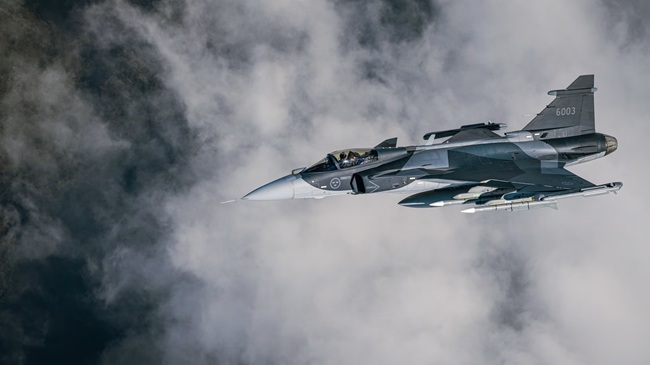
How does the Ukraine Gripen E order reshape Saab’s fighter-aircraft franchise?
Saab’s Gripen franchise has often been seen as a capable but commercially constrained alternative to larger Western fighter programmes. The Ukraine order changes that perception because it places Gripen E inside one of Europe’s most visible defence modernisation stories.
The aircraft’s appeal rests partly on its operating model. Gripen was designed for countries that need credible fighter capability without the same basing, maintenance and manpower burden associated with heavier platforms. Ukraine’s battlefield environment makes those features more than marketing points. Aircraft that can operate from dispersed locations and return to service quickly have obvious value when fixed bases are under threat.
The contract also gives Saab a stronger argument in other export campaigns. Potential customers in Europe, Latin America and Asia can now point to Ukraine as a demanding buyer whose operational circumstances place a premium on survivability, availability and ease of support.
However, the deal also raises the performance bar. Ukraine will not be a gentle reference customer. Its air force operates under extreme threat conditions, with Russian air defence, missile strikes, drones and electronic warfare all shaping mission planning. If Gripen E performs well, Saab’s export credibility could improve substantially. If integration, training or sustainment becomes difficult, the same visibility could create reputational pressure.
The franchise implication is therefore double-edged. Saab has gained a major opportunity, but also a customer environment that will test whether the aircraft’s design strengths translate into operational advantage under stress.
Why is production capacity now the central issue for Saab after the Ukraine contract?
Demand is no longer Saab’s biggest problem. Capacity is becoming the harder question. The company reported SEK 68.39 billion of order bookings in the second quarter, helped by a large submarine order for Poland, while the Ukraine Gripen E award will be booked in the third quarter. This means Saab is entering the second half of 2026 with a heavier order pipeline across multiple business areas.
The Gripen E order is scheduled for delivery from 2029 to 2030, giving Saab time to plan. However, fighter aircraft production is not something that can be scaled casually. It requires certified suppliers, engine availability, avionics integration, radar systems, software baselines, flight testing, skilled labour and customer-specific configuration.
This is why Saab’s July 21 agreement with Embraer S.A. matters. The companies signed a framework for the potential production of 20 additional Gripen aircraft at Embraer’s Gavião Peixoto industrial complex in Brazil. Embraer would serve as a complementary assembly source to Saab’s Linköping final assembly line if future demand requires more capacity.
That arrangement does not automatically solve the Ukraine delivery challenge, but it shows that Saab is preparing for a broader production problem. Gripen demand could come from Ukraine, Brazil, existing operators, potential European buyers and other export campaigns. Concentrating all future volume in one Swedish production system would create delivery and risk-management limitations.
Production capacity is also an investor issue. Defence stocks can rally on orders, but their long-term performance depends on converting orders into revenue, margin and cash flow. A growing backlog that cannot be delivered on time becomes a liability rather than a trophy.
Saab’s next challenge is to show that its industrial system can absorb fighter, naval, surveillance and missile demand together. The Ukraine contract adds strategic excitement, but investors will look for delivery credibility.
What makes Gripen E relevant to Ukraine’s operating environment and air-defence needs?
Gripen E is designed as a multi-role fighter with emphasis on availability, survivability and upgradeability. For Ukraine, those characteristics matter because the country’s air force must operate under constant pressure from missiles, drones, air defence systems and electronic warfare.
Dispersed operations are central to the aircraft’s relevance. An air force that depends heavily on large, fixed bases becomes vulnerable when those bases can be targeted repeatedly. A fighter designed to operate from shorter and less conventional surfaces can complicate an adversary’s targeting problem.
Maintenance simplicity also matters. Ukraine will need to train technicians, create spares pipelines and integrate the aircraft into a force that already has multiple wartime priorities. An aircraft that demands fewer maintenance hours and faster turnaround can produce higher effective availability from a smaller fleet.
The software architecture is another important feature. Modern fighters need continuous updates as threats evolve. Radar modes, electronic warfare libraries, weapons integration and mission planning all change over time. An upgradeable software base can help Ukraine adapt the aircraft to evolving Russian tactics.
Gripen E’s role should not be exaggerated. Sixteen aircraft will not transform the air war by themselves. They will arrive from 2029 to 2030, and Ukraine’s immediate air-defence needs remain dominated by interceptors, ground-based systems, drones, electronic warfare and existing aircraft support.
The strategic significance lies in future force design. The contract gives Ukraine a pathway toward a fighter fleet aligned with European supply chains, Swedish support and Western training structures. It is a long-cycle capability investment, not an immediate battlefield fix.
How does the Gripen E deal interact with Sweden’s wider support for Ukraine?
The Gripen E contract sits within a broader Swedish policy shift toward deeper defence-industrial support for Ukraine. Sweden has already moved from donations and aid packages toward structured capability cooperation that includes future fighter acquisition.
That distinction matters. Donations can fill urgent gaps, but they do not always create a sustainable force structure. A contracted fighter programme creates a longer horizon involving training, procurement financing, industrial planning and sustainment.
Sweden’s role is especially important because Saab is not selling directly to Ukraine in the ordinary commercial sense. The contract is with Sweden’s Defence Materiel Administration, and the aircraft are intended for Ukraine. This structure links national policy, defence procurement and industrial execution.
The arrangement also gives Stockholm more control over delivery management, technology release, training coordination and support architecture. That can reduce some complexity compared with a direct manufacturer-to-customer export, although it does not remove the operational challenges of introducing a new fighter into Ukraine’s air force.
For Saab, the Swedish government relationship is central. Fighter aircraft exports depend heavily on sovereign approvals, diplomatic alignment and defence-policy credibility. Saab benefits when Sweden treats Gripen as part of national strategic policy rather than merely as a product in an export catalogue.
The deal also signals to other European governments that defence aid and industrial procurement can overlap. Support for Ukraine is increasingly being structured not only as donations from existing stocks, but as financed production that sustains European industry while building Ukrainian capability.
What does Saab’s second-quarter performance reveal about the financial backdrop for the Ukraine contract?
Saab’s Q2 2026 performance gives the Ukraine contract a stronger financial context. The company reported order bookings of SEK 68.39 billion, compared with SEK 28.40 billion in the prior-year quarter. Sales reached SEK 25.45 billion, with organic sales growth of 29.8%.
EBITDA rose to SEK 3.77 billion, and the EBITDA margin improved to 14.8% from 14.3%. EBIT increased 41% to SEK 2.79 billion, while the EBIT margin rose to 11.0% from 10.0%. Net income increased to SEK 2.17 billion, and earnings per share reached SEK 3.96.
These numbers show that Saab is not only accumulating orders. It is also converting demand into higher sales and improved profitability. That matters because Europe’s defence-spending cycle has created many optimistic backlogs, but investors are increasingly asking which companies can actually deliver.
The company’s operational cash flow improved sharply, although it remained slightly negative at SEK 62 million outflow. That improvement suggests better working-capital management, but also reminds investors that capacity expansion and high delivery volumes can absorb cash before revenue conversion fully catches up.
The Ukraine contract will be booked in Q3, so it is not part of the Q2 order-booking figure. This gives Saab another large order layer after an already strong quarter, potentially reinforcing investor confidence in medium-term demand.
The financial question is whether Saab can sustain margin improvement while investing in production capacity. Defence manufacturers often face a trade-off between growth and execution. Factories, suppliers and labour all need money before they produce full returns.
How should investors read Saab B shares after the Ukraine contract and Q2 update?
Saab B shares traded at SEK 595.90 on July 31, up 0.78% on the session, with a market capitalisation of approximately SEK 318.9 billion. The stock’s 52-week range stood at SEK 445.10 to SEK 748.80, placing the shares about 20.4% below the annual high and about 33.9% above the low.
The stock was up 1.45% over five days and 5.88% over one month. That suggests the market remained constructive after the Q2 update and subsequent order flow, but not euphoric enough to return the stock to its 52-week peak.
The valuation remains demanding. Saab’s price-to-earnings ratio was above 45 on recent market data, meaning investors are pricing in sustained defence demand, strong execution and continued margin discipline. That leaves limited room for disappointment.
The Ukraine Gripen E contract supports the long-term growth case, but investors should avoid treating the full SEK 24.6 billion as immediate revenue. Deliveries are scheduled for 2029 to 2030, and the revenue profile will depend on production milestones, equipment delivery, support scope and accounting treatment.
The near-term share-price response is also influenced by broader European defence sentiment. Saab trades within a sector that has rallied on higher NATO spending, Ukraine support, missile defence demand and renewed European concern about industrial readiness.
The investor takeaway is balanced. Saab has strong demand visibility and a valuable fighter export win. But the stock already reflects a premium defence-growth story, so the next phase depends on production execution rather than announcement flow alone.
Why does the Embraer Gripen production framework matter for Saab’s global fighter ambitions?
Saab’s agreement with Embraer provides a framework for possible production of 20 additional Gripen aircraft in Brazil. The arrangement would use Embraer’s Gavião Peixoto industrial complex as a complement to Saab’s Linköping final assembly line.
This matters because fighter production capacity is becoming a strategic asset. If Saab wants to compete seriously for more Gripen customers, it needs credible delivery capacity outside Sweden. Customers considering large aircraft orders will ask whether Saab can deliver aircraft on schedule while also supporting existing commitments.
Brazil is a logical partner because Embraer already participates deeply in the Gripen programme for the Brazilian Air Force. The partnership includes technology transfer, training and local industrial development. That gives Brazil a more mature role than a basic offset partner.
The arrangement also gives Saab flexibility. If demand increases from Ukraine, Brazil, future Latin American customers or European buyers, a second production node can reduce pressure on Swedish final assembly. It can also strengthen Saab’s position in export campaigns where local industrial participation matters.
However, distributed production introduces complexity. Aircraft assembled in different countries must meet the same standards, use aligned supply chains, maintain configuration control and satisfy customer certification. This requires strong industrial governance and technical discipline.
The Embraer framework is therefore a capacity option, not a guaranteed solution. Its value will depend on whether Saab and Embraer convert the agreement into binding production arrangements and whether future orders justify the added industrial footprint.
How could the Ukraine contract influence future Gripen export campaigns?
The Ukraine order gives Gripen E a new strategic reference at a time when fighter competitions are increasingly shaped by affordability, sovereignty and delivery timing. Not every country wants, can afford or can politically absorb the F-35. Some customers want a capable Western fighter with lower operating demands and greater national control.
Gripen E fits that segment. It offers a modern radar, electronic warfare suite, weapons flexibility and dispersed operating model. It also gives customers a fighter option from a smaller country that may be more flexible on industrial cooperation than larger suppliers.
The Ukraine case may be particularly influential for countries worried about air-base survivability. If Gripen’s dispersed operating concept becomes more visible through Ukrainian planning and eventual service, Saab can use that narrative in other markets.
The contract may also strengthen Saab’s discussions with countries considering mixed fleets. Some air forces may not replace all fighters with one platform. They may combine higher-end stealth aircraft with lower-cost, high-availability fighters for air policing, dispersed defence and regional missions.
However, export campaigns will still be difficult. The F-35 remains dominant among NATO buyers, South Korea, Turkey, France and the United States all promote competing platforms, and new sixth-generation programmes will shape future decisions.
Saab’s advantage is not that Gripen E beats every competitor on every metric. Its advantage is that it may offer a compelling balance of capability, cost, autonomy and operational resilience for buyers that do not want to copy the largest air forces.
What risks could affect Saab’s Gripen E delivery schedule and profitability?
The first risk is supply-chain pressure. Fighter aircraft depend on engines, avionics, sensors, mission computers, electronic warfare systems, landing gear, composite structures, weapons interfaces and software. Delays in any subsystem can affect final delivery.
The second risk is customer-specific integration. Ukraine will need aircraft configured for its weapons, communications, training and operational environment. The more customer-specific the configuration, the greater the engineering and validation burden.
The third risk is wartime uncertainty. Ukraine’s needs, infrastructure and operational priorities could change before deliveries begin in 2029. A long delivery timeline in a live conflict environment creates planning uncertainty.
The fourth risk is production competition across Saab’s portfolio. The company is seeing strong demand in submarines, surveillance, air defence, command systems and weapons. Management must allocate capital, labour and supplier attention across multiple growth areas.
The fifth risk is margin pressure. Capacity expansion can be expensive. If suppliers raise prices or if Saab must invest aggressively to meet delivery commitments, near-term margins could face pressure even while revenue grows.
The sixth risk is political risk. Fighter deliveries to Ukraine involve Sweden, Ukraine, European financing structures and potential security considerations. Any change in political alignment, funding or export-control conditions could affect execution.
The seventh risk is support readiness. Aircraft delivery is not enough. Ukraine will need pilots, ground crews, training pipelines, simulators, maintenance facilities, spare parts and operational doctrine. A fighter fleet without support depth becomes a fragile asset.
What should executives and investors watch after Saab’s Ukraine Gripen E award?
The first signal will be Q3 order booking and backlog detail. Saab has said the SEK 24.6 billion Ukraine order will be booked in the third quarter, and investors will watch how it affects backlog composition.
The second signal will be production-capacity disclosures. Updates on Linköping, supplier expansion and Embraer-related manufacturing plans will show whether Saab is preparing for a larger Gripen production cycle.
The third signal will be delivery milestone confidence. The 2029 to 2030 schedule gives Saab time, but fighter production requires long-lead components and disciplined programme management.
The fourth signal will be Ukraine support architecture. Training, spares, weapons integration and maintenance arrangements will determine whether the aircraft become a sustainable capability rather than a procurement headline.
The fifth signal will be export momentum. If the Ukraine order helps Saab in additional Gripen campaigns, the strategic value of the contract will exceed the SEK 24.6 billion award.
The sixth signal will be margin resilience. Saab’s Q2 margin expansion was encouraging, but investors will want proof that rapid growth and capacity investment do not erode profitability.
The seventh signal will be cash flow. Operational cash flow improved materially in Q2 but remained slightly negative. A growing order book will require working capital, and the market will watch whether Saab can improve cash conversion as deliveries rise.
Saab’s Ukraine contract gives the Gripen E programme its most geopolitically visible export win. The opportunity is large, but so is the test. Saab must now prove that it can build aircraft, scale capacity, support Ukraine and protect margins while European defence demand continues to rise across nearly every part of its portfolio.
Key takeaways on Saab’s SEK 24.6 billion Gripen E contract for Ukraine
- Saab has signed a SEK 24.6 billion contract with Sweden’s Defence Materiel Administration for 16 Gripen E fighter aircraft for Ukraine.
- Deliveries are scheduled for 2029 to 2030, making the order a long-term capability investment rather than an immediate battlefield fix.
- The contract includes aircraft, spare parts, associated equipment and technical support.
- The order will be booked in Saab’s third quarter of 2026, adding to an already strong order environment.
- Saab reported Q2 order bookings of SEK 68.39 billion and organic sales growth of 29.8%, before the Ukraine fighter order is booked.
- The Gripen E’s dispersed-operation model is especially relevant for Ukraine because survivable basing and fast turnaround are central to wartime air operations.
- Saab’s production-capacity challenge is becoming more important as Ukraine, Brazil and other potential customers increase fighter demand.
- The Embraer production framework in Brazil could give Saab a second Gripen assembly route if future demand requires added capacity.
- Saab B shares traded at SEK 595.90 on July 31, below their 52-week high but supported by strong defence demand and order momentum.
- The main risks are production scaling, subsystem supply, customer-specific integration, political timing, margin pressure and the need to build a complete Ukrainian support ecosystem.
Discover more from Business-News-Today.com
Subscribe to get the latest posts sent to your email.