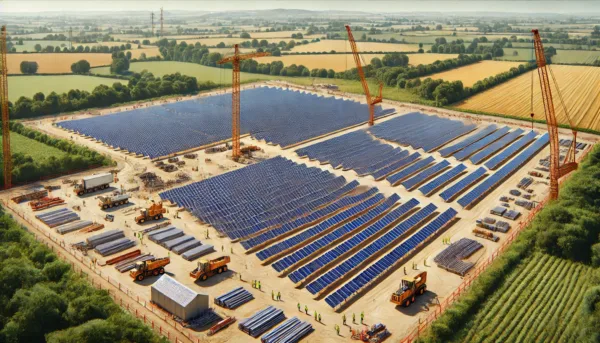
Scatec ASA (OSE: SCATC) has reached commercial operations for the second and final phase of the Obelisk project in Egypt, bringing the development to 1.125GW of solar capacity alongside a 100MW/200MWh battery energy storage system. The August 12 milestone adds 564MW of solar to the 561MW first phase that entered commercial operation in February, completing a project expected to produce more than 3,000GWh of electricity annually under a 25-year US dollar-denominated power purchase agreement with the Egyptian Electricity Transmission Company. Obelisk was developed against estimated capital expenditure of approximately $590 million and financed largely through non-recourse project funding from international development institutions, while Scatec subsequently reduced its economic ownership to 40% through partnerships with National Bank of Egypt, Norfund and EDF Power Solutions. The result is more significant than another gigawatt of operating renewables because it illustrates how Scatec intends to combine construction margins, minority equity ownership, long-term contracted cash flow and development-finance capital to scale in markets where committing the entire project cost from its own balance sheet would constrain growth. The next test is whether that model can be repeated across an Egyptian near-term portfolio exceeding 4.3GW of generation and 4.1GWh of battery storage without weakening returns or rebuilding corporate leverage.
How quickly did Scatec turn the Obelisk project from a power agreement into a 1.1GW operating asset?
Obelisk’s execution timetable is one of the more important elements of the project. Scatec signed the project’s long-term power agreement in late 2024, reached financial close in June 2025, commissioned the first 561MW solar phase and entire 100MW/200MWh battery system on February 23, 2026, and completed the remaining 564MW solar phase on August 12. The company therefore moved from contracted development into full commercial operation across more than 1GW of solar capacity within roughly two years of securing the PPA.
That matters because emerging-market renewable projects are often judged less by the size announced at signing than by the probability that financing, grid connection, construction and offtake arrangements survive long enough to produce cash. Obelisk has now crossed all of those major thresholds. Development risk has not disappeared entirely because operating performance, counterparty collections and long-term asset availability still matter, but construction execution is no longer the central uncertainty.
The output expectation also provides useful scale. Scatec expects Obelisk to generate more than 3,000GWh annually. Measured against 1.125GW of solar nameplate capacity, 3,000GWh would imply an annual utilisation equivalent to roughly 30% before considering the battery’s role in shifting production rather than creating additional energy. That is consistent with the attraction of Egypt’s strong solar resource and helps explain why large photovoltaic projects can remain economically competitive even when battery storage is included.
Why is the $479 million financing package as important as the project’s 1.125GW capacity?
At financial close, Scatec said Obelisk had estimated capital expenditure of approximately $590 million and had secured $479.1 million of non-recourse project financing. That funding represented about 80% of estimated project cost, with the European Bank for Reconstruction and Development, African Development Bank and British International Investment forming the original financing group. The final commercial-operations announcement also identifies the European Investment Bank among the senior lenders supporting the project.
The financing structure limits the amount of corporate capital required for each dollar of generating capacity. Project debt is secured primarily against the project itself rather than the parent company, which allows Scatec to pursue developments considerably larger than the equity contribution it would otherwise be able to fund directly.
The approximately $479.1 million financing package equals about 81% of the original $590 million capex estimate. The remaining funding requirement therefore represented only a fraction of total construction cost before taking account of the exact mix of shareholder equity, bridge financing, grants, transaction expenses and final project cost. That leverage is central to the economics of Scatec’s growth model.
The development-finance component also matters beyond the headline debt percentage. Portions of the funding include concessional capital, guarantees and other risk-mitigation structures intended to improve project bankability. Those mechanisms can lower financing costs or absorb risks that conventional commercial lenders might otherwise price more aggressively in a market such as Egypt.
How did Scatec reduce its Obelisk economic exposure to 40% while keeping control of the project?
Scatec initially developed Obelisk with a much larger economic position but progressively introduced equity partners. In May 2026, National Bank of Egypt agreed to take a 20% economic interest. Following that transaction, Scatec said its own economic interest would fall to 40%, while EDF Power Solutions and Norfund would each hold 20%.
The important detail is that Scatec said it would retain majority control through a layered ownership structure despite holding only 40% of the project’s economic interest. That allows the company to preserve strategic control and continue providing services while sharing the capital requirement and long-term project economics with institutional partners.
This is not simply dilution. For an integrated developer, retaining 100% of every asset can become a constraint if each new project requires substantial corporate equity. Selling minority interests releases capital that can be recycled into new developments while Scatec continues earning through engineering, procurement and construction, asset management, operations and maintenance, and its retained ownership share.
Obelisk therefore illustrates the difference between maximizing ownership percentage and maximizing the amount of infrastructure a fixed corporate balance sheet can support. Scatec has deliberately chosen the second approach.
How much value can Scatec capture from Obelisk beyond its 40% ownership stake?
Scatec’s economic exposure to Obelisk is not limited to its share of future power-production cash flow. The company developed the project and acts as engineering, procurement and construction contractor, asset manager and operations and maintenance provider. At financial close, Scatec said its EPC scope represented approximately 70% of total project capex.
Applying that percentage to the original $590 million capex estimate implies an EPC scope of roughly $413 million. That figure is not profit, because most EPC revenue is consumed by equipment, procurement, labour and construction expenses, but it demonstrates how Scatec monetises projects before long-term electricity revenues begin.
The strategy is important because construction earnings can partially finance the equity required to retain ownership. Scatec describes its broader model as capital-light, normally funding renewable assets with roughly 70% to 80% non-recourse project debt and 20% to 30% equity while using EPC margins and co-investors to reduce the corporate equity requirement further.
After construction, recurring economics shift toward power production, asset management and operations and maintenance. The same asset can therefore generate development value, construction margin, recurring service income and long-duration electricity cash flow at different points in its lifecycle. Obelisk is a useful demonstration of why Scatec considers vertical integration an economic model rather than simply an operating capability.
Why does the 25-year dollar-denominated PPA materially change Obelisk’s risk profile?
All electricity from Obelisk is expected to be sold to the Egyptian Electricity Transmission Company under a 25-year PPA denominated in US dollars and backed by a sovereign guarantee. The arrangement reduces exposure to short-term merchant electricity prices and limits direct mismatch between local-currency power revenues and hard-currency project financing.
For a renewable developer operating in emerging markets, currency structure can be as important as electricity prices. A project can perform operationally while still producing weak equity returns if revenues are earned in a depreciating local currency while debt or imported equipment costs remain denominated in dollars or euros.
A dollar-denominated PPA does not eliminate sovereign or counterparty risk. Payment delays, fiscal stress, convertibility restrictions and broader political or regulatory changes can still affect project cash flows. The sovereign guarantee is intended to mitigate some of those risks, but it ultimately links part of the project’s credit exposure to the Egyptian state.
The structure is nevertheless materially stronger than a merchant project funded with hard-currency debt and local-currency revenues. It gives lenders greater visibility, supports the project’s high debt share and creates longer-term predictability for Scatec and its equity partners.
What does the 200MWh battery actually contribute to a solar project of this scale?
Obelisk combines 1.125GW of photovoltaic capacity with a 100MW/200MWh battery, meaning the storage system can nominally discharge at full rated power for about two hours. Relative to the enormous solar component, the battery is therefore not designed to make the entire project continuously dispatchable throughout the night.
Its more practical role is to shift part of daytime generation into periods when electricity is more valuable to the grid, smooth short-duration fluctuations and improve the project’s ability to support evening demand or grid balancing. This can increase the usefulness of solar electricity without requiring storage capacity comparable with the plant’s full daily output.
The African Development Bank, EBRD and BII financing documents described Obelisk as Egypt’s first integrated solar and battery installation of this scale and linked the battery to grid stability and peak-demand management. The lenders also expect the complete project to avoid roughly 1.4 million tonnes of emissions annually, while Scatec’s final completion release uses an estimate of more than 1.2 million tonnes. The difference reflects differing published estimates rather than a change in the project’s physical capacity.
The bigger implication is replication. If Egypt can integrate gigawatt-scale solar alongside progressively larger batteries, renewable additions can become easier to absorb without requiring an equivalent increase in conventional generation for short-duration balancing. That makes storage capacity, rather than solar module deployment alone, increasingly relevant to Scatec’s future Egyptian pipeline.
Why has Egypt become one of Scatec’s most important growth markets?
With the second Obelisk phase operational, Scatec says it now has approximately 1.5GW of operating capacity in Egypt when Obelisk is combined with the 380MW BenBan solar plant. More importantly, the company describes Egypt as one of its most important long-term markets and has assembled a near-term portfolio exceeding 4.3GW of renewable generation and 4.1GWh of battery storage.
The pipeline extends well beyond Obelisk. Scatec has signed a 25-year dollar-denominated PPA with Egypt Aluminium for another 1.1GW solar project coupled with 100MW/200MWh of battery storage. That project is particularly interesting because electricity would be supplied to a large industrial consumer rather than solely through a traditional utility PPA, creating a model linked directly to industrial decarbonisation and European carbon-border requirements.
Scatec’s June investor presentation also listed Energy Valley, Egypt Aluminium and Shadwan among the company’s large Egyptian backlog projects. Energy Valley alone was shown with approximately 1.95GW of generation and 3.935GWh of storage, making it several times larger than Obelisk’s battery component.
If those projects progress, Egypt would evolve from one important country in Scatec’s portfolio into a concentration of multi-gigawatt solar and storage assets. That creates scale economies and repeatable relationships but also increases country exposure. Execution, financing conditions and Egyptian counterparty performance will therefore matter increasingly to group results.
Can Scatec continue expanding while reducing corporate debt at the same time?
Scatec’s strategic challenge is that its development ambitions are growing while management is also trying to reduce corporate leverage. The company’s 2030 roadmap targets average annual equity investments of approximately NOK 1 billion, gross corporate debt of NOK 4 billion and at least NOK 3.4 billion of additional proceeds from asset divestments and farm-downs between 2026 and 2030.
That is why the Obelisk structure deserves more attention than the project’s solar capacity alone. A 100% owned $590 million project would absorb far more corporate capital than a project financed predominantly with non-recourse debt and shared with three equity partners.
Scatec’s June investor presentation showed corporate gross interest-bearing debt of about NOK 6.5 billion at the end of the first quarter, down roughly 30% from NOK 9.2 billion when its deleveraging strategy was introduced. Management’s objective is therefore not simply to grow asset capacity but to expand while continuing to move corporate debt toward NOK 4 billion by 2030.
Obelisk supports that strategy because its capital burden is distributed across project lenders and equity partners while Scatec retains construction and service economics. The model will only remain capital-light, however, if future projects attract similar financing and partner appetite. A deterioration in sovereign risk, project returns or lender confidence could require Scatec to contribute more equity than planned.
What does Scatec’s latest share price suggest investors think about the Obelisk completion?
Scatec shares ended the August 13 Oslo session at NOK 98.70, according to Euronext, up from NOK 97.20 on August 12 and NOK 95.55 on August 11. The stock therefore gained about 3.3% across the two sessions surrounding the Obelisk commercial-operations announcement. That timing is notable, although it would be inappropriate to attribute the entire move specifically to one project milestone because broader market and company factors can also influence daily trading.
The one-month comparison is modestly positive. Scatec closed at NOK 95.15 on July 13, leaving the August 13 price approximately 3.7% higher. The longer-term picture remains less favourable, with the shares still well below their 52-week high of NOK 137.60 and only modestly above a recent 52-week low around NOK 90.50.
That positioning suggests investors are not valuing Scatec simply on the size of its development pipeline. Execution, financing, leverage and the timing of cash distributions from individual projects remain central to the equity story.
A more significant valuation test arrives quickly. Scatec is scheduled to release its second-quarter and first-half 2026 results on August 21, when investors should receive updated group financials, construction contribution and guidance surrounding the enlarged operating portfolio.
What are the key takeaways from Scatec completing the Obelisk solar and battery project?
- Scatec reached commercial operations for the final 564MW phase of Obelisk on August 12, completing the entire 1.125GW solar project and 100MW/200MWh battery system.
- The first 561MW phase and the complete battery system had already entered commercial operation in February 2026.
- Obelisk is expected to generate more than 3,000GWh of electricity annually under a 25-year US dollar-denominated PPA with the Egyptian Electricity Transmission Company.
- The project was developed against estimated capital expenditure of approximately $590 million and secured $479.1 million of project financing, equivalent to about 80% of estimated capex.
- Scatec now holds a 40% economic interest, while National Bank of Egypt, Norfund and EDF Power Solutions each hold 20%; Scatec says it retains majority control through the ownership structure.
- Scatec’s original EPC scope was approximately 70% of capex, implying roughly $413 million of construction scope based on the original $590 million project estimate.
- Scatec now has approximately 1.5GW operating in Egypt and a near-term Egyptian portfolio exceeding 4.3GW of renewable capacity and 4.1GWh of battery storage.
- Egypt Aluminium and Energy Valley illustrate how Scatec is attempting to replicate Obelisk with substantially more solar and storage capacity.
- Scatec shares ended August 13 at NOK 98.70, about 3.3% above the August 11 close but still materially below the stock’s 52-week high.
- The next major proof point is whether Scatec can convert its Egyptian backlog into financed projects while maintaining its capital-light model and continuing to reduce corporate debt.
Can Obelisk become Scatec’s template for scaling renewables without rebuilding balance-sheet risk?
Obelisk gives Scatec something more valuable than another completed solar project. It provides evidence that the company can take a gigawatt-scale emerging-market development through PPA signing, international project financing, construction, battery integration, equity syndication and full commercial operation while retaining only 40% of the long-term economics. That combination is close to the capital-light model management has been describing to investors.
The structure also creates several layers of value. Scatec captures development and construction economics, retains a share of 25 years of contracted electricity revenue and continues earning asset-management and operating fees. At the same time, lenders and minority partners provide most of the capital required to build the physical infrastructure.
What remains unresolved is replication. Egypt’s next projects are larger, particularly when multi-gigawatt-hour storage systems are included, and they will require new financing packages, grid connections, sovereign support and additional equity partners. A model that works at $590 million must now prove that it remains economically attractive when several projects are progressing at once.
The August 21 results will provide the first near-term opportunity to measure that transition at group level. If Obelisk begins contributing predictable power-production cash flow while Scatec continues progressing Egypt Aluminium, Energy Valley and other backlog projects without reversing corporate deleveraging, the project will look increasingly like a repeatable financing template. If new projects require significantly higher corporate equity or become difficult to finance, the same pipeline could turn from a source of growth into a capital-allocation constraint.
Discover more from Business-News-Today.com
Subscribe to get the latest posts sent to your email.