
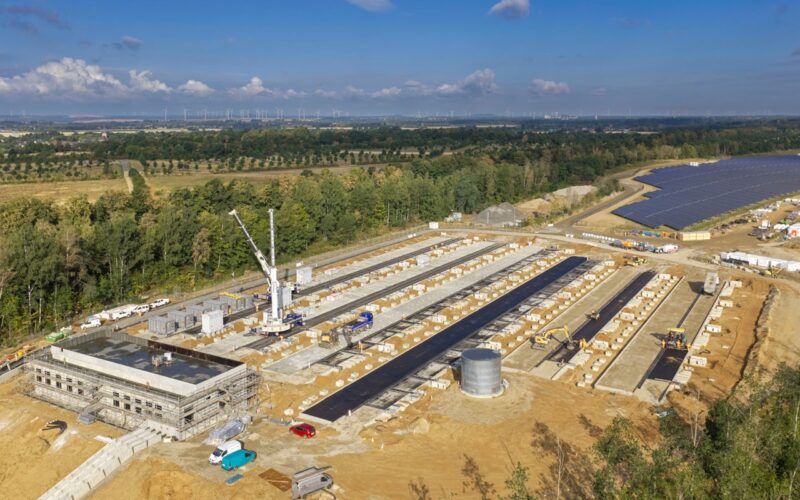
RWE Aktiengesellschaft (ETR: RWE) is constructing a 236-megawatt battery energy storage system at the Hambach opencast mine near Niederzier in North Rhine-Westphalia, Germany. The facility will contain 128 lithium-ion battery containers, provide 470 megawatt-hours of storage and is scheduled to begin operating in 2027. The development is strategically significant because it combines large-scale grid flexibility with the repurposing of infrastructure inside a region preparing for the end of lignite-based power generation. RWE also announced stronger earnings guidance for 2026 and 2027 on the same day, giving the project a supportive financial backdrop. The central question is whether Hambach can produce attractive, repeatable storage revenues as Germany’s battery market becomes larger, more competitive and increasingly dependent on efficient grid access.
How will RWE’s 236MW Hambach battery project support Germany’s increasingly volatile power grid?
The Hambach battery will be capable of delivering its full 236MW output for approximately two hours, based on its 470MWh energy capacity. That configuration positions the facility for short-duration applications such as balancing electricity supply and demand, responding to sudden system fluctuations and shifting stored electricity into periods of stronger market demand. RWE said the system would respond within fractions of a second and provide balancing energy, while also being designed for future grid-support functions such as synthetic inertia. These capabilities are becoming more valuable as Germany adds wind and solar generation whose output can change rapidly with weather conditions.
The project should not be understood as a conventional power plant that generates electricity continuously. Its value will instead come from flexibility, meaning the ability to absorb electricity when supply exceeds immediate demand and return it when the system requires additional power. Depending on market conditions and technical qualification, battery operators can combine several revenue streams, including wholesale price arbitrage, frequency services and capacity made available to grid operators. The commercial challenge is that these markets can become less profitable when too many storage systems compete for the same short-duration opportunities.
Hambach’s nearly two-hour duration gives RWE enough flexibility to address short-term imbalances, but it does not make the project a solution for prolonged periods of weak wind and solar output. RWE itself has distinguished between the role of batteries in bridging short-term gaps and the role of dispatchable generation in covering shortages lasting many hours or days. The project therefore fits into a broader portfolio rather than replacing every form of flexible generation. Its economics will depend on how effectively RWE coordinates battery storage, renewable generation, trading operations and other dispatchable assets across the German power market.

Why does repurposing the Hambach lignite mine matter for RWE’s regional transition strategy?
The location is as important as the battery technology. Preparatory work began at the end of 2025 on a three-hectare section of the Hambach mine site, with the first containers already delivered by the time RWE announced the project on July 28, 2026. Building on an established industrial site may offer advantages involving land availability, technical infrastructure, workforce familiarity and proximity to parts of the existing power network. However, RWE has not disclosed the investment value, expected project return or contracted revenue structure for the Hambach battery.
RWE plans to end lignite-fired electricity generation by 2030 under its accelerated coal phase-out agreement with Germany’s federal government and the state of North Rhine-Westphalia. Hambach is consequently moving from being identified primarily with coal extraction toward a mixed energy landscape that includes solar generation, battery storage and long-term land rehabilitation. The battery project provides tangible evidence that at least part of the site can remain economically connected to the electricity system after mining activity declines. That matters for a region where energy transition policy is also an employment, infrastructure and industrial-development issue.
RWE already operates three solar plants at Hambach with approximately 50MW of alternating-current capacity, together with an integrated 4.1MW and 8.1MWh battery system. A few kilometres away, the company is developing the Manheimer Bucht solar park with 14.8MW of alternating-current capacity and a separate battery designed to store 80MWh. The new 236MW facility is therefore not an isolated demonstration project. It represents a substantial increase in the scale at which RWE is using the former mining landscape for renewable generation and grid flexibility.
The strategic benefit is that RWE can develop several energy assets within one geographic cluster instead of treating every battery, solar park and grid connection as a standalone project. This could support shared operational capabilities, improve local knowledge and create opportunities for coordinated dispatch. It may also strengthen the political case for keeping the Rhenish mining region relevant to Germany’s future energy system. The financial benefit, however, will still depend on each project meeting RWE’s return requirements rather than merely carrying symbolic transition value.
Can a two-hour battery generate durable returns as Germany’s storage competition accelerates?
Large battery systems can benefit from volatile electricity prices because they can charge during periods of lower prices and discharge when prices rise. They can also earn revenue by supplying grid-balancing services that require extremely fast response times. Yet storage development can gradually reduce the price volatility and balancing-market scarcity that originally supported attractive returns. The same technology that monetises market inefficiency can therefore weaken that inefficiency as more capacity enters operation.
Germany’s large-scale storage market is expanding quickly, with development activity considerably greater than the amount currently operating. Industry analysis has pointed to hundreds of grid-connection applications representing a pipeline far beyond near-term system requirements, while German authorities and market participants continue examining how connection requests should be prioritised. Not every announced battery will reach construction, but the volume of interest shows that Hambach will enter a competitive market rather than an undersupplied niche.
RWE has several advantages in this environment. It has an established electricity-trading business, experience operating flexible generation, a growing renewable portfolio and multiple battery projects across Europe, the United States and Australia. These capabilities can help RWE optimise charging and discharging decisions across several markets instead of depending on a single balancing service. Scale also creates opportunities to standardise procurement, control systems, maintenance and market participation.
Those advantages do not remove execution risk. Battery degradation, equipment availability, changing grid charges, market saturation and the timing of new connections can all affect realised returns. The disclosed 236MW and 470MWh specifications explain what the facility can technically deliver, but they do not reveal the project’s capital cost, expected annual revenue or target internal rate of return. Investors will therefore have to assess Hambach as one component of RWE’s wider investment programme rather than as a project with independently visible economics.
How does Hambach fit into RWE’s rapidly expanding 1.7GW German battery construction pipeline?
RWE reported that it operated approximately 1.7GW of battery capacity worldwide and had another 2.5GW under construction when the Hambach announcement was released. Around 1.7GW of the construction pipeline was located in Germany, meaning Hambach represents almost 14% of the company’s German battery capacity currently being built. That is large enough to matter operationally, although it remains only one part of a multi-site programme.
The portfolio includes a 400MW and 700MWh battery system at the former Gundremmingen nuclear power site in Bavaria, where RWE has disclosed an investment of approximately €230 million and plans to start commercial operations in early 2027. RWE is also developing a 400MW facility with at least 800MWh of storage on a former industrial site in Lingen, Lower Saxony, with operation targeted for 2028. Together with Hambach and other projects, these developments show that RWE is systematically targeting locations where existing energy or industrial infrastructure can support new storage capacity.
Hambach differs from Gundremmingen in scale, duration and disclosed financial information. Gundremmingen will have higher power capacity but a slightly shorter duration of around 1.75 hours, while Hambach is designed for almost two hours. The €230 million figure disclosed for Gundremmingen should not be directly applied to Hambach because equipment configuration, site work, grid infrastructure and procurement timing can materially alter project costs. RWE’s decision not to publish a Hambach investment figure limits external analysis of expected capital efficiency.
The wider programme nevertheless suggests that RWE is moving battery storage from an experimental technology into a mainstream infrastructure business. The company is not merely adding batteries beside renewable projects, but also building standalone systems capable of participating independently in electricity and ancillary-service markets. The strategic test will be whether the portfolio produces reliable earnings as installed capacity rises. Gigawatts under construction demonstrate deployment capability, but sustainable returns will ultimately depend on utilisation, market spreads and operational optimisation.
What does RWE’s stronger 2026 earnings outlook reveal about its capacity to fund storage growth?
RWE’s preliminary first-half results provide a stronger financial backdrop for the Hambach development. The company expects to report adjusted EBITDA of €3 billion, adjusted net income of €1.3 billion and adjusted earnings per share of €1.77 for the first six months of 2026. RWE raised its full-year adjusted EBITDA guidance to between €5.75 billion and €6.35 billion, compared with its previous range of €5.2 billion to €5.8 billion. The company also increased its adjusted net income forecast to between €1.95 billion and €2.45 billion.
The guidance increase was not driven by Hambach or battery storage alone. RWE attributed the improvement to stronger operating performance, compensation received in its Flexible Generation segment, higher earnings from international power generation and an increased contribution from its expanded stake in Amprion. The distinction matters because it would be misleading to present the storage project as a major contributor to current earnings. Hambach is a future operational asset, while the immediate guidance upgrade reflects existing businesses and several positive effects, including items that may not recur.
RWE entered 2026 with a large capital programme, planning €35 billion of net investment between 2026 and 2031 across renewable energy, battery storage, flexible generation and grid infrastructure. At March 31, 2026, net debt had risen to €15.6 billion from €10.9 billion at the end of 2025, largely because of investment spending and seasonal cash-flow effects. The subsequent €3.6 billion acquisition of additional Amprion interests was financed through an equity capital raise, preserving some balance-sheet capacity while increasing the number of shares outstanding.
This financing context places greater emphasis on capital discipline. RWE has the earnings scale and funding access to build Hambach, but investors will expect the company to prioritise projects capable of earning returns above their financing and operating costs. Battery storage can complement RWE’s renewable and flexible-generation portfolio, yet it also competes internally with offshore wind, solar, gas-fired generation and regulated grid investments for capital. Hambach’s strategic logic is credible, but stronger evidence of portfolio-level storage profitability would make the financial case more visible.
How is the market pricing RWE’s storage ambitions after the latest earnings upgrade?
RWE shares were quoted at approximately €56.16 late in the Xetra session on July 30, 2026, up around 0.9% during the day. The company’s market capitalisation was approximately €44 billion, while the stock’s 52-week range stood between €33.72 and €62. The share price was therefore about 9.4% below the 52-week high but more than 66% above the 52-week low, reflecting a substantial longer-term recovery without a return to its recent peak.
Based on available historical prices, the stock was down approximately 4.7% from its July 23 closing level of €58.92 and around 0.8% below its June 30 close of €56.62. That pattern indicates that the market had not treated the Hambach project or the earnings upgrade as an uncomplicated rerating catalyst. RWE’s shares were also absorbing the effect of its Amprion acquisition, equity issuance, changing commodity expectations and the broader capital demands of its investment programme.
The market reaction should not be attributed solely to the battery announcement because RWE published its preliminary half-year performance and higher earnings guidance on the same date. Hambach is unlikely to be financially material enough on its own to determine the valuation of a company with a market capitalisation approaching €44 billion. Its importance is cumulative. Each completed storage project can strengthen RWE’s ability to monetise renewable volatility, but investors will require evidence that the expanding portfolio contributes dependable earnings rather than simply increasing installed capacity.
What milestones will prove whether the Hambach battery creates strategic and financial value?
The first measurable test will be construction progress toward the planned 2027 commissioning date. Delivery and installation of all 128 containers, completion of grid infrastructure, testing of control systems and qualification for relevant balancing services will determine whether RWE can bring the asset online without material delay. The company has already moved beyond an early proposal because site work began in 2025 and equipment deliveries have started. However, commercial operation remains the point at which the project can begin validating its investment case.
The second test will be how RWE operates Hambach within its wider storage fleet. A battery’s value depends not only on technical availability but also on the software, trading decisions and market access used to optimise it. Evidence of growing battery earnings, high availability and successful participation across several revenue pools would strengthen the thesis that RWE can translate its scale into operating advantage. Weak utilisation, declining ancillary-service prices or repeated construction delays would reduce that advantage.
The final figures for RWE’s first half of 2026, scheduled for August 13, will provide a nearer-term assessment of the company’s earnings, cash flow and financing position. Those results will not reveal Hambach’s eventual economics, but they will clarify the strength of the group funding the project and the extent to which preliminary gains included one-off effects. Over the longer term, the decisive evidence will come from commissioning Hambach and RWE’s other German batteries on schedule, followed by disclosure showing that storage is making a measurable contribution to portfolio returns.
RWE has improved the strategic case for Hambach by moving construction forward, securing equipment deliveries and integrating the project into a much larger German storage programme. What remains unresolved is the project’s capital cost and the durability of the revenue pools it will enter. The next proof point is not another capacity announcement, but successful commissioning followed by operating evidence. Hambach will strengthen RWE’s transition narrative only if the battery becomes both a reliable grid asset and a disciplined use of shareholder capital.
What are the key takeaways from RWE’s 236MW Hambach battery storage project?
- RWE is constructing a 236MW and 470MWh lithium-ion battery storage facility at the Hambach opencast mine in Germany.
- The project will use 128 battery containers and is scheduled to begin operating in 2027.
- Its nearly two-hour duration is designed for balancing energy, short-term electricity shifting and future grid-support services.
- Hambach strengthens RWE’s strategy of repurposing former coal, nuclear and industrial sites for new energy infrastructure.
- The project joins existing and planned solar and battery assets across the Hambach mining area.
- RWE has around 1.7GW of battery capacity operating worldwide and another 2.5GW under construction.
- Hambach represents nearly 14% of the approximately 1.7GW of battery capacity RWE is building in Germany.
- RWE has not disclosed Hambach’s investment cost, projected revenue or expected return.
- Rising competition in Germany’s storage market could pressure balancing and electricity-arbitrage revenues.
- Construction progress, commissioning in 2027 and subsequent operating performance will determine whether Hambach creates durable value.
Discover more from Business-News-Today.com
Subscribe to get the latest posts sent to your email.