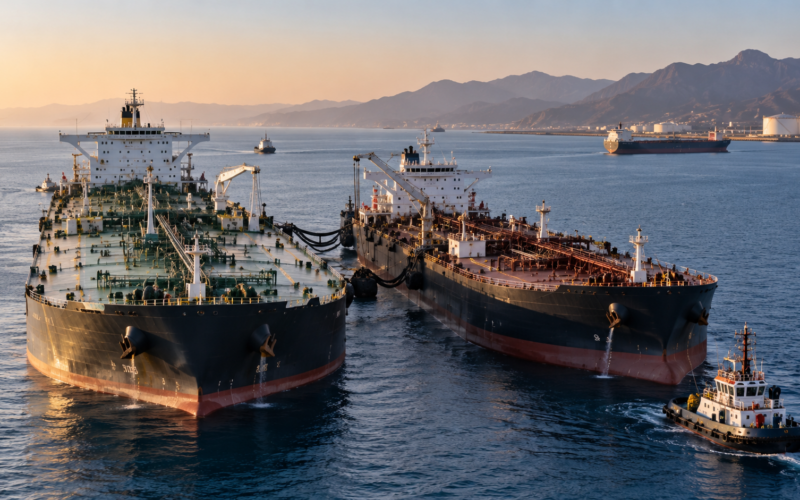
Saudi Arabia is using ship-to-ship transfers off Oman’s Sohar port to move additional crude toward Asian customers after drone attacks damaged the kingdom’s strategically important East-West pipeline to the Red Sea, according to Reuters, which cited people familiar with the cargo arrangements. Saudi Aramco has reportedly offered Arab Light, Arab Medium and Arab Heavy crude to term customers for loading off Sohar, a location outside the Strait of Hormuz. Aramco declined to comment on the Reuters report.
The workaround had an immediate psychological effect on an oil market that had been increasingly concerned about Saudi export capacity. Brent crude fell 3.3% to about $105.12 per barrel during Wednesday’s trading, while West Texas Intermediate declined 3.9% to approximately $101.72 as the Oman arrangements eased some fears that the pipeline disruption would remove even more barrels from international supply.
Why did Saudi Arabia need another route for its crude oil?
Saudi Arabia’s East-West pipeline connects producing regions in the east with Yanbu on the Red Sea, allowing crude to bypass the Strait of Hormuz. That function has become particularly valuable because shipping through Hormuz has been severely disrupted by the continuing regional conflict.
Saudi Aramco said earlier in 2026 that the approximately 1,200-kilometre East-West system had reached around seven million barrels per day of crude capacity, including roughly two million barrels per day feeding domestic refineries. The company specifically described the pipeline as part of its long-term supply resilience and contingency infrastructure.
Drone attacks damaged the pipeline and forced its shutdown, while crude loadings at Yanbu were suspended. Reuters reported separately that the interruption threatened as much as 4% of global oil supply if it persisted because approximately four million barrels per day had been moving toward the Red Sea through the system during the crisis.
The resulting logistical problem is unusually difficult. Hormuz itself has suffered severe disruption, while the alternative Saudi pipeline designed to bypass Hormuz has now also been damaged.
How does the Oman workaround operate?
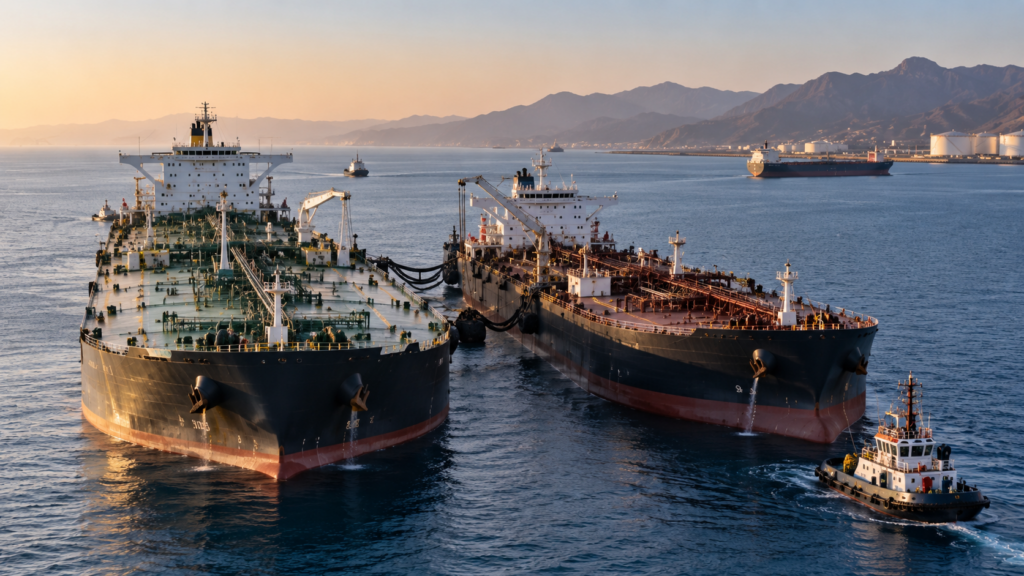
Reuters reported that Saudi Aramco is offering crude for transfer off Sohar, Oman, where cargoes can be moved between tankers outside the Strait of Hormuz. This allows Saudi Arabia to move oil through the Gulf using available shipping and then reposition cargoes outside the chokepoint for onward delivery to Asian customers.
Satellite and ship-tracking data cited by Reuters showed Saudi Arabia increasing crude loadings from Ras Tanura and Juaymah inside the Gulf. Energy Aspects estimated daily loading activity there at the equivalent of about four million barrels, while separate Kpler data showed several very large crude carriers capable of carrying millions of barrels loading at Ras Tanura.
Such logistics are considerably more complicated and potentially more expensive than normal direct export routes. They require vessel availability, additional handling and safe passage through areas where commercial shipping has already been disrupted.
Saudi Arabia has reportedly informed at least some Asian customers that Yanbu shipments will be delayed and rescheduled, while European buyers were told that certain September cargoes would be cancelled. Those details originated from trading and shipping sources cited by Reuters rather than a public Aramco announcement.
Why is the Strait of Hormuz still so important to global oil prices?
The U.S. Energy Information Administration says an average 20.9 million barrels per day of petroleum liquids passed through the Strait of Hormuz during the first half of 2025, equivalent to about 20% of global petroleum-liquids consumption. More than 20% of global liquefied-natural-gas trade also passed through the waterway.
Asian markets are particularly exposed. The Energy Information Administration estimates that 89% of crude oil and condensate moving through Hormuz in the first half of 2025 went to Asia, with China, India, Japan and South Korea accounting for almost three-quarters of those flows.
That explains why Saudi cargoes offered outside the strait matter far beyond the kingdom itself. Every barrel that can be reliably delivered without depending entirely on Hormuz helps reduce the probability of extreme physical shortages.
Yet the Oman workaround cannot make the underlying security problem disappear. Ship crossings through Hormuz remained in the single digits on Tuesday, with Reuters reporting only four detected vessel transits compared with a 10-day average of 18.
Why did oil prices fall even though the supply crisis is not over?
Oil markets trade on changes in expected availability rather than simply whether geopolitical conditions are good or bad. The Saudi pipeline shutdown had raised fears that additional supply could disappear just as Hormuz traffic was already constrained.
Evidence that Saudi Arabia had found another way to deliver crude reduced the most extreme shortage scenarios. That was enough to push benchmark oil prices down sharply on September 16 even though Brent remained above $100 per barrel and the broader energy system remained disrupted.
U.S. petroleum inventory data also contributed to the decline. Reuters reported that crude stocks fell less than analysts had expected while gasoline and distillate inventories increased, giving traders another reason to take some risk premium out of crude prices.
Refined fuels remain more problematic. Diesel prices have been under exceptional pressure because Middle East supply disruption has coincided with interruptions elsewhere, leaving the market with less spare capacity than the fall in crude prices alone might suggest.
What does the rerouting mean for Saudi Aramco and Asian refiners?
For Saudi Aramco, the development demonstrates the value of logistics flexibility but also exposes the vulnerability created when multiple alternative routes are disrupted simultaneously. The company reported adjusted net income of $33.4 billion for the second quarter and specifically highlighted continued use of the East-West pipeline as part of its supply strategy before the latest damage occurred.
Asian refiners face a different problem. Even when Saudi barrels remain technically available, longer routes, ship-to-ship operations, higher insurance costs and uncertain loading schedules can raise the effective cost of obtaining them.
That is why the repair timetable for the East-West pipeline remains crucial. Sohar can function as a pressure valve, but a sustained restoration of normal Saudi export logistics would provide much greater reassurance than a series of emergency cargo arrangements.
The latest oil-price decline therefore should not be confused with resolution of the Middle East energy crisis. Saudi Arabia has found another way to move some crude, and markets rewarded that flexibility. The system is still operating with far fewer shock absorbers than it had before the regional conflict disrupted both maritime and pipeline routes.
Discover more from Business-News-Today.com
Subscribe to get the latest posts sent to your email.