

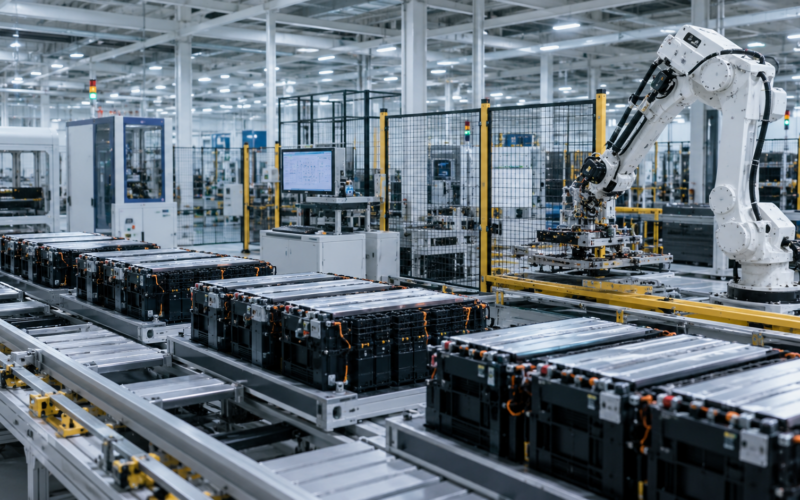
GP Eco Solutions India Limited (NSE: GPECO), through its iNVERGY energy-storage business, has commissioned a 3 GWh annual battery energy storage system manufacturing facility at Dasna in Uttar Pradesh, creating a sizeable domestic platform for assembling utility, commercial and residential storage equipment. The approximately 217,000-square-foot automated factory has been developed with investment exceeding ₹200 crore and will manufacture complete BESS units, lithium iron phosphate battery packs, integrated storage solutions and solar inverters.
The facility matters because GP Eco Solutions is attempting to move beyond distribution and project supply into higher-value manufacturing at a time when India’s grid-scale storage market is beginning to move from tenders into physical deployment. The company’s own investor material had previously targeted a progression from more than 500 MWh of BESS capacity toward the 3 GWh Dasna platform, meaning commissioning represents execution of an earlier manufacturing roadmap rather than a fresh memorandum of understanding.
How much manufacturing scale does iNVERGY gain from the 3 GWh Dasna factory?
Three gigawatt-hours correspond to 3,000 MWh of theoretical annual manufacturing capacity. If the facility were used entirely for 5 MWh utility-scale containers, that would mathematically equate to around 600 such systems a year at full utilisation, although actual production will span multiple product sizes and utilisation will depend on orders, supply chains and operating ramp-up.
The production portfolio extends from residential energy-storage systems through commercial and industrial products to utility-scale containers. GP Eco Solutions has described iNVERGY Home systems ranging from approximately 5 kWh to 30 kWh, commercial and industrial products extending toward 2 MWh and utility-scale iNVERGY Grid offerings in the 3 MWh to 5 MWh range.
That breadth gives the factory flexibility but also increases manufacturing complexity. Residential products require very different sales channels and service requirements from 5 MWh utility containers supplied to renewable-energy developers or distribution companies.
The Dasna facility also manufactures inverters, allowing GP Eco Solutions to combine storage and power-conversion equipment under one product platform. Management has highlighted a portfolio extending to 350 kW string inverters, seeking to address a segment where imported equipment remains significant.

Is the ₹200 crore investment large enough to support a 3 GWh battery manufacturing business?
The reported investment exceeds ₹200 crore, equivalent to roughly ₹66.7 crore of manufacturing investment per GWh of stated annual capacity if the amount is divided mechanically across the 3 GWh platform. That is not a valid measure of cell-manufacturing economics because the factory focuses substantially on battery packs, systems integration and related equipment rather than a fully integrated upstream cell-material supply chain.
This distinction is central to understanding Indian battery announcements. A BESS assembly facility can produce gigawatt-hours of finished storage systems with substantially less capital than a plant manufacturing battery cells from raw materials because cells account for a major portion of system value and production complexity.
GP Eco Solutions’ opportunity is therefore centred on systems integration, battery management, power conversion, enclosure engineering and project-specific configuration. The company has highlighted AI-driven battery-management systems, IoT-enabled monitoring and automated quality-control processes as part of the Dasna manufacturing setup.
Longer term, localising a greater portion of the battery value chain could improve control over costs and supply, but it would also require materially greater capital and technology capability. Investors should consequently distinguish the 3 GWh BESS manufacturing capacity from 3 GWh of domestically manufactured battery-cell capacity.
Why could India’s utility-scale storage buildout determine utilisation at Dasna?
Utility storage is moving rapidly up India’s electricity-investment agenda as solar and wind capacity increases. Renewable generation can vary by hour, while peak demand often occurs after solar production falls, creating demand for batteries capable of moving electricity across the day and providing grid-support services.
Recent projects demonstrate the size of individual opportunities. IndiGrid commissioned a 180 MW/360 MWh standalone BESS in Sanand for Gujarat Urja Vikas Nigam Limited, while projects of several hundred megawatt-hours are increasingly appearing in state and central tenders. A single large storage project can therefore consume a meaningful percentage of a 3 GWh factory’s annual production.
For illustration, ten projects of 300 MWh each would absorb 3 GWh of storage systems. That does not establish iNVERGY’s order book or expected sales because projects may source equipment from multiple manufacturers, but it shows why utility-scale contract wins can rapidly change utilisation for relatively young BESS factories.
The competitive field will also become more demanding. Indian conglomerates and specialised energy companies are investing heavily in battery manufacturing and systems integration, while global suppliers continue competing on cell pricing and technology. iNVERGY will need more than nameplate capacity; bankable warranties, operating track record, financing comfort and lifecycle support will become increasingly important in winning large projects.
Can GP Eco Solutions convert manufacturing capacity into another earnings growth cycle?
The company enters the manufacturing phase after a sharp improvement in financial scale. GP Eco Solutions reported FY26 consolidated revenue of approximately ₹418 crore, representing growth of about 69%, while annual net profit rose to roughly ₹40.1 crore from about ₹10 crore a year earlier.
A ₹200 crore-plus factory is therefore very substantial relative to the existing company. The investment represents close to half of FY26 revenue and highlights the degree to which management is committing capital to storage manufacturing rather than remaining primarily an asset-light distributor.
If utilisation rises, manufacturing could give the company greater control over gross margins and product differentiation. On the other hand, low utilisation would leave GP Eco Solutions carrying depreciation, staffing and manufacturing overhead against a relatively modest revenue base.
The company’s existing solar and storage distribution network may provide a route to market, but utility-scale projects require a different commercial capability from selling smaller solar equipment. Winning large tenders can involve performance guarantees, working capital and multi-year maintenance obligations, potentially increasing both project size and balance-sheet exposure.
What does GP Eco Solutions’ share price say about investor expectations for iNVERGY?
GP Eco Solutions shares closed at ₹379 on August 21, down 0.47% for the session. The stock has fallen roughly 9% over one month and remains around 39% below its 52-week high of ₹616.50, although it is still more than 43% above the 52-week low of ₹264.05. Market capitalisation stands at roughly ₹470 crore.
The comparison between the company’s approximately ₹470 crore market capitalisation and the more than ₹200 crore Dasna investment demonstrates how important the plant is to the equity story. It is not a peripheral capex programme inside a giant industrial group; the factory represents a sizeable strategic commitment relative to the company’s valuation and operating history.
That magnifies both upside and risk. Strong order intake and high utilisation could materially expand GP Eco Solutions’ revenue base, while weak demand or aggressive industry pricing could make the fixed manufacturing investment harder to earn back.
The important milestones from here are therefore commercial rather than ceremonial. The Dasna factory has already been commissioned. Investors now need evidence of utility-scale orders, production utilisation, customer diversification and sustainable manufacturing margins to determine whether 3 GWh of nameplate capacity becomes a genuine earnings engine.
Discover more from Business-News-Today.com
Subscribe to get the latest posts sent to your email.