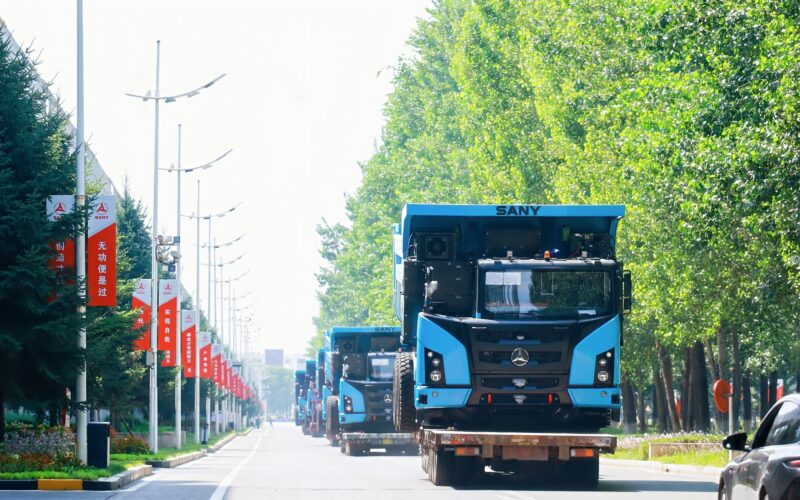
Sany Heavy Equipment International Holdings Company Limited (HKEX: 0631) is the listed company most directly exposed to SANY Group’s latest autonomous-mining expansion, as the Chinese equipment manufacturer sends its first batch of SKT110Ei pure-electric autonomous mining trucks to South America. The trucks left SANY Heavy Equipment’s Shenyang industrial park on August 12, with the group announcing the development internationally on August 19 as its first autonomous mining truck project in the region. More importantly, SANY is not supplying vehicles alone: the project combines an autonomous fleet with intelligent dispatching, roadside infrastructure and lifecycle operations and maintenance support. That shifts the commercial proposition from selling heavy equipment toward supplying a more integrated mine-haulage system, although SANY has not disclosed the customer, destination country, contract value or number of trucks involved.
The strategic significance therefore lies less in the physical shipment than in whether SANY can reproduce outside China an autonomous-mining model that it says already encompasses more than 300 deployed trucks. South America is a demanding place to test that proposition because the region combines some of the world’s most important copper operations with established autonomous-haulage competitors, difficult mine environments and mining groups that generally require long operating records before committing large production fleets to new technology. SANY’s opportunity is substantial, but so is the proof threshold.
What exactly is SANY delivering with the SKT110Ei autonomous mining project in South America?
The SKT110Ei vehicles are described by SANY as pure-electric autonomous mining trucks equipped with an autonomous driving system developed internally. The South American package also connects the vehicles with roadside infrastructure and cloud-based dispatching, while localized operations and maintenance services are intended to support the fleet after commissioning. SANY says the system is designed around drive-by-wire chassis technology, multi-sensor perception, artificial-intelligence-based decision making and centralized cloud dispatching.
That integrated architecture matters commercially because autonomous haulage is not simply a question of replacing a driver with software. A mine has to coordinate vehicle movements with loading equipment, haul roads, traffic controls, charging infrastructure, maintenance requirements and changing production schedules. Reliability becomes a system-level issue. A truck that can drive autonomously but cannot integrate consistently with mine planning or fleet dispatch creates limited value for a large operator.
SANY is consequently competing for a larger share of the mine’s operating system rather than only the equipment budget. If the South American project performs successfully, the company could have opportunities to expand vehicle numbers, software usage, maintenance services and potentially other intelligent mining equipment around the initial installation. Conversely, weak fleet availability, difficult integration or inadequate local technical support would make expansion much harder even if the trucks themselves perform as designed.
The company has not disclosed several details that would allow investors and mining customers to assess the immediate scale of the project. There is no named mine, customer or South American country in the international announcement, while the size and value of the first batch also remain undisclosed. The shipment is therefore strategically noteworthy without yet demonstrating how material the contract is financially.
Why does SANY’s existing fleet of more than 300 autonomous mining trucks matter for overseas adoption?
SANY says its autonomous mining operation had deployed more than 300 trucks by July 2026, with cumulative safe operating distance exceeding 13 million kilometres and more than 41 million cubic metres of earth and rock transported. The company points to commercial deployments in major Chinese open-pit mining regions as evidence that its autonomous system has moved beyond laboratory testing and isolated pilot projects.
Those figures are important because mining companies tend to judge autonomy using operating evidence rather than demonstrations alone. Availability, intervention frequency, maintenance requirements, safe interaction with other equipment and performance under changing weather and road conditions all become more meaningful as accumulated operating hours increase.
However, SANY is entering an international competitive landscape in which major rivals possess considerably larger autonomous-haulage reference bases. Komatsu said in April that it had commissioned its 1,000th autonomous ultra-class haul truck using the FrontRunner Autonomous Haulage System, with customers having moved more than 11.5 billion metric tons of material since commercialization began. Caterpillar said early this year that nearly 700 autonomous mining trucks using its technology were operating globally and had collectively hauled more than 11 billion tonnes.
Those numbers should not be compared mechanically with SANY’s 300-truck fleet because equipment size, mine type and reported operating metrics differ substantially. Komatsu’s milestone specifically concerns ultra-class autonomous haul trucks, for example. What the comparison does show is that SANY is challenging companies with long-established autonomous-haulage operating histories and extensive customer references.
South America is particularly relevant. Komatsu’s first commercial autonomous haulage deployment began at Codelco’s Gabriela Mistral copper operation in Chile in 2008, while the company has subsequently expanded autonomous systems at mines including Glencore’s Lomas Bayas and Anglo American’s Los Bronces. SANY is therefore entering a region where autonomous mining is already commercially understood rather than attempting to introduce an entirely unfamiliar operating concept.
Could combining battery-electric trucks with autonomous haulage give SANY a different competitive opening?
SANY’s South American deployment brings together two mining transitions that are increasingly overlapping: vehicle automation and haulage electrification. The SKT110Ei is not simply an autonomous version of a conventional diesel mining truck. It is being marketed as an electric autonomous platform, allowing SANY to compete around operating labour, energy consumption and digital fleet management simultaneously.
The company is pursuing the same convergence elsewhere in its mining portfolio. At the SANY Group Mining Summit 2026, it unveiled a cabless pure-electric mining truck using liquid-cooled dual-gun charging and offering on-site takeover, remote takeover and fully autonomous operating modes. Removing the cab illustrates where purpose-built autonomous mining equipment could eventually diverge from conventional trucks that are merely adapted for driverless operation.
SANY has also been building relevant operating exposure in South America outside autonomy. In April, Chilean state copper producer Codelco reported that a fully electric SANY road truck carrying 27 tonnes of copper completed a 680-kilometre round trip between the Radomiro Tomic division and Puerto Angamos during a real-world electromobility pilot. The autonomous SKT110Ei shipment is a different application, but the earlier test shows that SANY is already working with mining customers in the region around electrified transport.
Electric autonomous haulage could ultimately offer a compelling operating model, but combining the technologies does not automatically guarantee superior mine economics. Charging time, battery degradation, electricity infrastructure, haul gradients, temperature, payload cycles and fleet utilization can materially change the economics from one mine to another. Autonomous software must also operate reliably enough that labour savings are not offset by lower equipment availability or excessive intervention.
That makes the South American deployment valuable as a reference site. If the system demonstrates strong availability and predictable energy consumption under commercial conditions, SANY would gain evidence that can be used in future international tenders. A successful reference customer may therefore have greater strategic value than the initial number of trucks suggests.

What does the South America shipment mean for Sany Heavy Equipment International Holdings investors?
Sany Heavy Equipment International Holdings Company Limited has already been reporting strong top-line growth alongside weaker profitability. For the three months ended March 31, 2026, unaudited consolidated revenue increased 13.2% year on year to approximately RMB6.65 billion, while consolidated net profit declined 17.6% to RMB523.8 million. Profit attributable to owners of the parent fell 19.8% to RMB509.4 million. The company attributed the profit decline primarily to a greater contribution from lower-margin logistics equipment and higher raw-material costs affecting emerging businesses, including battery-related activities.
At the same time, management specifically said mining equipment and logistics equipment revenue maintained rapid growth and that overseas sales were expanding quickly. That makes the South American autonomous project strategically consistent with an existing growth priority rather than an isolated technology demonstration. The more important financial question is whether international mining expansion can eventually improve revenue quality and margins through a combination of equipment, software, aftermarket service and lifecycle support.
The market is approaching another important test. Sany Heavy Equipment International Holdings has scheduled a board meeting for August 26 to consider and approve its results for the six months ended June 30, meaning investors will soon receive a broader view of whether first-quarter margin pressure persisted as overseas sales expanded.
Shares were quoted at HK$7.78 at 10:20 a.m. Hong Kong time on August 20, with a market capitalization of roughly HK$25.6 billion. That was about 7.8% above the August 14 closing level of HK$7.22, although the shares remained approximately 52% below their HK$16.24 52-week high and around 22% above their HK$6.40 52-week low. The positioning suggests the stock has recovered from its recent trough but remains far below the valuation levels reached earlier in the past year.
The autonomous-truck shipment can strengthen sentiment around the company’s overseas mining opportunity, but the immediate investment case still rests on financial delivery. Investors will need evidence that fast overseas growth contributes profit rather than simply additional volume, particularly after the first quarter showed revenue expansion occurring alongside declining earnings.
Can SANY turn one South American autonomous fleet into a repeatable international mining business?
That is the central test behind the announcement. SANY has demonstrated enough scale in China to argue that its autonomous system has progressed beyond experimentation, and the South American shipment gives it an opportunity to establish a reference operation in one of the world’s most important mining regions. The combination of electric trucks, proprietary autonomy, dispatch software and lifecycle support also gives the company several potential revenue layers rather than relying solely on equipment sales.
What remains unclear is equally important. SANY has not disclosed the customer, fleet size, contract value or commissioning timetable, so the immediate financial contribution cannot yet be assessed. The company must also compete against established autonomous-haulage ecosystems from Komatsu and Caterpillar, whose installed fleets and operating histories give mine operators substantial comparative data.
A successful commissioning would therefore be more valuable than the shipment ceremony itself. The clearest evidence of progress would be disclosure of sustained fleet availability, operating kilometres, material moved, energy performance and subsequent truck orders from either the initial customer or other Latin American mines.
The South American entry has expanded SANY’s addressable autonomous-mining market. The next challenge is converting that geographical milestone into a repeatable commercial model whose operating economics are strong enough to persuade large mining companies to scale beyond the first fleet.
Key takeaways from SANY’s first autonomous mining truck deployment in South America
- SANY Group shipped its first batch of SKT110Ei pure-electric autonomous mining trucks to South America on August 12.
- The project is SANY’s first autonomous mining truck deployment in Latin America and includes vehicles, dispatching technology, roadside infrastructure and lifecycle support.
- The customer, country, truck quantity and contract value have not been disclosed, limiting assessment of the project’s near-term financial importance.
- SANY says more than 300 of its autonomous mining trucks had been deployed by July 2026, logging over 13 million kilometres and moving more than 41 million cubic metres of material.
- Komatsu and Caterpillar already operate much larger global autonomous-haulage installed bases, creating a high competitive benchmark for international adoption.
- Combining electrification with autonomy could differentiate SANY if the SKT110Ei demonstrates strong fleet availability, energy performance and operating economics.
- Sany Heavy Equipment International Holdings reported first-quarter 2026 revenue growth of 13.2%, but attributable profit declined 19.8%, keeping profitability central to the investment case.
- Sany Heavy Equipment International Holdings shares traded around HK$7.78 on August 20, well above the recent 52-week low but still roughly 52% below the 52-week high.
- The company’s interim results scheduled for consideration on August 26 will provide the next major financial test of overseas growth and margin performance.
- The most important proof point is no longer whether SANY can ship autonomous mining trucks abroad, but whether the first South American operation leads to reliable production performance and repeat orders.
Discover more from Business-News-Today.com
Subscribe to get the latest posts sent to your email.