
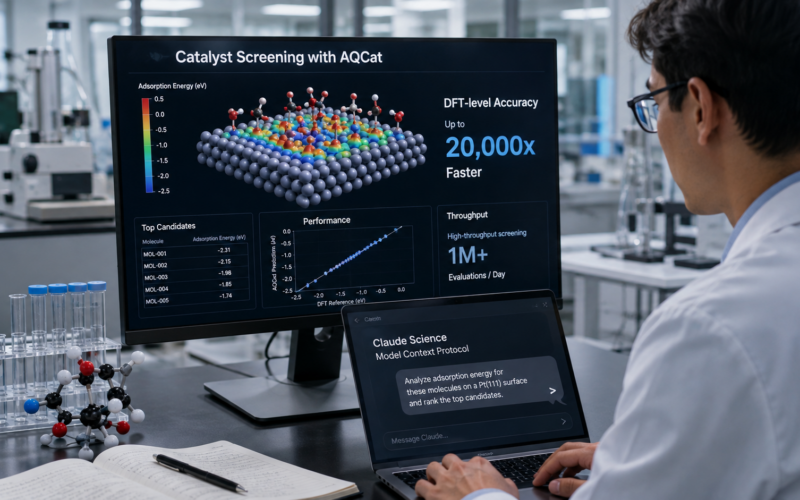
SandboxAQ has made AQCat generally available through Anthropic’s Claude Science using Model Context Protocol, turning a specialized catalyst-screening model into a scientific tool researchers can invoke with ordinary language instead of writing simulation code or provisioning dedicated computing infrastructure. AQCat evaluates adsorption energy, a critical early measurement of how strongly a molecule binds to a catalyst surface, and SandboxAQ says its model can approach Density Functional Theory accuracy while running as much as 20,000 times faster. The August 19 release also makes AQCat available through SandboxAQ directly and AWS Marketplace, moving the technology beyond the waitlist-based Claude integration announced in May. The strategic question is whether simplifying access to advanced computational chemistry can expand the number of researchers using high-throughput catalyst screening sufficiently to change industrial R&D economics, rather than simply making an existing specialist workflow easier to operate.
The opportunity is potentially broad because catalysts sit behind much of the physical economy. SandboxAQ says catalysts are used in more than 90% of commercially produced chemicals and are relevant to more than 80% of manufactured products, including fertilizers, fuels, plastics and other industrial materials. Conventional experimental screening can evaluate fewer than 100 candidate materials per week, according to the company, while AQCat is intended to computationally rank thousands before scientists commit more expensive simulation and laboratory resources. That distinction matters because the commercial proposition is not that artificial intelligence eliminates experimentation. It is that substantially more of the search space can be rejected before expensive experimentation begins.
Why does putting SandboxAQ’s AQCat inside Claude matter more than simply launching another catalyst AI model?
The important change is distribution.
Advanced computational chemistry has historically required a combination of domain expertise, specialist simulation software, computing infrastructure and the ability to configure jobs correctly. Those requirements restrict who can run sophisticated calculations even when an organization already possesses the underlying scientific expertise to interpret the results.
SandboxAQ is attempting to separate those two skills. A researcher can describe an adsorption problem in natural language, Claude can send the appropriate structured request through SandboxAQ’s Model Context Protocol server, and AQCat performs the actual scientific calculation on SandboxAQ-managed infrastructure. The structured result is then returned to the large language model for explanation or use in a broader workflow. SandboxAQ’s documentation says its MCP server supports Claude Desktop, claude.ai, Claude Science and Claude Code, as well as other compatible clients.
That architecture is significant because Claude is not being asked to infer the adsorption energy from language patterns. The large language model acts primarily as the conversational and orchestration layer, while AQCat performs the domain-specific quantitative calculation.
This distinction addresses one of the central weaknesses of using general-purpose generative AI for scientific work. Large language models can be highly effective at interpreting requests, connecting information and coordinating tools, but they are not substitutes for validated physics models when numerical accuracy matters.
SandboxAQ’s broader thesis is therefore that large language models and what it calls Large Quantitative Models should complement each other. Claude provides the interface and reasoning environment, while AQCat supplies a physics-grounded computation that the language model itself would not be expected to reproduce reliably. SandboxAQ first disclosed the Claude integration in May, when AQCat access remained waitlist-based. General availability turns that architecture from a demonstration into a commercial product.

How does AQCat attempt to make catalyst screening faster without abandoning the physics behind DFT?
Density Functional Theory has become a core computational method for estimating material properties and molecular interactions, but sufficiently detailed calculations can be computationally expensive. That creates an uncomfortable trade-off for catalyst development: researchers want accurate physics, yet the computational cost limits how many candidate surfaces and compositions they can realistically investigate.
AQCat attempts to change that trade-off with a machine-learning interatomic potential trained on quantum-chemistry calculations. SandboxAQ says the AQCat25 training dataset contains 13.5 million high-fidelity Density Functional Theory calculations spanning approximately 47,000 intermediate-catalyst systems and industrially relevant elements.
The model is also designed to account explicitly for spin polarization. That becomes important for catalytically relevant metals such as iron, cobalt and nickel, where magnetic behavior can affect adsorption calculations. SandboxAQ argues that some faster machine-learning approaches sacrifice this physics, potentially weakening predictions for magnetic materials, whereas AQCat was trained specifically to handle those systems.
SandboxAQ says the result is near-DFT adsorption-energy accuracy with calculations running as much as 20,000 times faster than traditional approaches. Its product documentation separately describes AQCat as delivering results at approximately 90% lower cost than DFT. These are SandboxAQ performance claims and the realized advantage will depend on the system, calculation and comparison methodology, but they illustrate the economic objective behind the model: preserve enough physical fidelity for meaningful pre-screening while reducing the cost of examining large candidate populations.
The distinction between pre-screening and full catalyst development is important. Adsorption energy is an essential early signal, but industrial catalyst performance can depend on many other variables, including kinetics, selectivity, durability, poisoning, operating temperature, pressure and manufacturability. AQCat can narrow the design space, but physical validation and more detailed modeling remain necessary before an industrial catalyst is ready for deployment.
That means the technology is best understood as a filter capable of moving expensive downstream resources toward better candidates rather than a machine that independently discovers a finished catalyst.
Could AQCat’s self-service pricing change who can afford high-throughput computational catalyst research?
SandboxAQ is also making an unusually direct commercial move by publishing self-service pricing.
Its current MCP documentation prices AQCat at $1 per Relaxation Unit, defined as one bulk material, one crystal facet and one adsorbate with up to 500 optimization steps. SandboxAQ says there is no additional platform fee for its individual tier, while newly registered accounts currently receive $2,000 of free credits for their first 30 days, equivalent to roughly 2,000 AQCat relaxation units under the published rate card. Enterprise pricing and custom deployment terms are negotiated separately.
That pricing model is strategically interesting because it makes a sophisticated scientific model behave more like metered cloud infrastructure than traditional computational-chemistry software.
A university researcher, startup or corporate scientist does not necessarily have to negotiate a large enterprise contract before establishing whether the system is useful for a particular chemistry. Usage can begin at comparatively small scale and expand if results justify the spending.
For SandboxAQ, that could widen the top of the commercial funnel. Enterprise scientific software frequently faces lengthy evaluations because prospective customers must determine whether the underlying model works on their own problems before committing budget. Metered access allows usage itself to become part of customer acquisition.
The longer-term economics will depend on how much computational screening organizations conduct after initial experimentation. A dollar-level inference is economically attractive only if SandboxAQ can generate sufficient volume and if the resulting calculation saves meaningfully more expensive scientist, compute or laboratory time downstream.
That is why high throughput matters commercially as much as scientifically. The business becomes more interesting if teams move from occasional single calculations toward systematically examining thousands or millions of material combinations.
Why could iron, cobalt and nickel make SandboxAQ’s spin-aware approach strategically important for industry?
The magnetic-material angle could prove more consequential than the conversational interface.
Iron, cobalt and nickel are familiar industrial metals with extensive catalytic relevance, but their magnetic properties make accurate electronic-structure modeling more challenging. If high-speed screening systems simplify the physics too aggressively, they can perform well on benchmark chemistries while becoming less dependable when researchers move toward the earth-abundant materials they actually hope to commercialize.
SandboxAQ designed AQCat specifically to incorporate spin polarization for these systems. The company argues that this allows researchers to investigate abundant, relatively low-cost magnetic metals without accepting the accuracy compromises associated with spin-unpolarized models.
The commercial implications extend across several large industrial problems. SandboxAQ identifies green hydrogen, sustainable aviation fuel, fertilizer production and plastics recycling as potential application areas because each depends on catalytic efficiency somewhere in its process chain.
Improved screening does not guarantee that a cheaper catalyst exists, but it increases the number of possibilities that researchers can afford to examine. That becomes valuable whenever the existing catalyst depends on an expensive material, delivers poor selectivity or requires energy-intensive operating conditions.
For chemical manufacturers, the potential return could therefore come from more than accelerating R&D schedules. Better catalysts can influence raw-material costs, energy intensity, conversion yield, process emissions and dependence on constrained metals.
Those downstream economics explain why catalyst screening is a commercially meaningful place to apply scientific AI even though the software itself operates far upstream from a factory.
How does AQCat connect with SandboxAQ’s $500 million U.S. semiconductor materials program?
AQCat also now sits inside a considerably larger industrial materials strategy.
In June 2026, SandboxAQ signed a definitive agreement with the U.S. Department of Commerce for a $500 million CHIPS Research and Development award focused on materials and formulations important to domestic semiconductor manufacturing. The program covers PFAS-free process chemicals, catalysts, rare earth-free magnets and battery systems, with SandboxAQ expected to use its ReAQT simulation platform and Large Quantitative Models to virtually screen candidate materials before laboratory validation and eventual commercialization with manufacturing partners.
Catalysts are specifically one of the four program areas. SandboxAQ said its AQCat workflows will be used to examine candidates involved in semiconductor processes including ultra-pure gas production and treatment of fluorinated exhaust streams. The company cited the same 13.5 million high-fidelity calculation base and up to 20,000-fold screening-speed claim in explaining the technology behind the CHIPS program.
That program gives the Claude launch a different strategic context. AQCat is not being commercialized only as an academic or horizontal scientific tool. SandboxAQ is simultaneously trying to demonstrate that the same modeling architecture can support high-value industrial materials programs tied to semiconductor supply chains and U.S. manufacturing policy.
The $500 million award should not be treated as product revenue or cash already earned. Funding is tied to the government program and development activities, and the U.S. Department of Commerce will receive a minority, non-voting equity stake in SandboxAQ in connection with the agreement.
Nevertheless, the award provides an unusually large real-world proving ground for the company’s materials-discovery thesis.
Why is Anthropic’s Claude Science becoming an important distribution channel for specialist scientific AI?
SandboxAQ’s timing also coincides with Anthropic’s effort to make Claude a scientific computing environment rather than simply a conversational assistant.
Anthropic launched Claude Science in beta on June 30 for Claude Pro, Max, Team and Enterprise users. The platform combines conversational agents with scientific tools, databases and computing resources, including more than 60 preconfigured skills and connectors spanning fields such as genomics, proteomics, structural biology and cheminformatics. Anthropic says Claude Science can operate against local systems or research computing clusters while preserving an auditable history of outputs and the code used to generate them.
That creates a distribution opportunity for specialist companies such as SandboxAQ.
Instead of requiring researchers to move into an entirely separate interface for every scientific model, Claude Science can become an orchestration layer through which external models are invoked. SandboxAQ receives access to researchers already working inside Claude, while Anthropic expands the scientific capabilities of Claude without having to build every physics model itself.
The competitive dynamic could ultimately resemble other enterprise software ecosystems where the platform controlling the workflow becomes the distribution surface for increasingly specialized third-party capabilities.
For SandboxAQ, this could be particularly useful because its technology is computationally sophisticated but its commercial ambitions extend well beyond computational specialists. Lowering the interface barrier increases the number of researchers who can attempt a calculation, while keeping execution on SandboxAQ infrastructure protects the proprietary model and avoids distributing model weights to customers.
What does AQCat general availability mean for SandboxAQ’s broader quantitative AI business model?
SandboxAQ remains privately held, so there is no publicly traded share price through which investors can measure the market response to AQCat.
The company has nevertheless attracted substantial private capital. SandboxAQ said its Series E financing had expanded to more than $450 million by April 2025 and that total funding since its 2022 spinout from Alphabet had exceeded $950 million. Investors named by the company include Google, NVIDIA, BNP Paribas, Ray Dalio, Eric Schmidt and funds advised by T. Rowe Price Associates.
That capital base creates substantial expectations around commercialization.
SandboxAQ operates across several ambitious areas including materials simulation, drug discovery, cybersecurity, navigation and financial modeling. The strategic attraction is obvious because successful quantitative AI models could address extremely large industrial markets. The execution challenge is proving that technically impressive models can become repeatable enterprise products rather than remaining bespoke scientific engagements.
AQCat general availability is therefore an important business-model test.
The combination of Claude distribution, AWS Marketplace availability, transparent self-service pricing and an MCP interface moves SandboxAQ closer to a product that can be purchased and consumed repeatedly without a large services engagement accompanying every calculation. That is a much more scalable commercial architecture if customer adoption follows.
SandboxAQ is simultaneously making AQPotency generally available for drug discovery, suggesting that the company intends to repeat the same model-distribution strategy across scientific domains.
If successful, the company could develop a catalog of specialized quantitative models invoked by AI agents through standardized interfaces. The large language model would own the conversation, while SandboxAQ monetizes the high-value scientific calculation behind it.
What evidence will show whether AQCat actually changes catalyst discovery rather than just simplifying the interface?
The first test will be usage beyond demonstrations and academic evaluations. General availability removes an access barrier, but it does not prove that industrial chemistry organizations will change established R&D workflows.
The strongest evidence would be customers using AQCat to evaluate materially larger catalyst design spaces and then showing that computational prioritization reduces the number of expensive Density Functional Theory calculations or physical experiments needed to reach viable candidates.
The second test will be predictive reliability outside familiar benchmark systems. High-throughput screening creates value only if the ranking remains accurate enough to prevent promising candidates from being discarded and weak candidates from consuming downstream resources.
The third test will be industrial conversion. SandboxAQ’s $500 million CHIPS agreement gives the company an opportunity to move from virtual screening into laboratory validation and eventually commercial manufacturing partnerships. Successful materials emerging from those programs would provide considerably stronger evidence than speed benchmarks alone.
Finally, the commercial test will be repeat usage. A $1 AQCat unit gives researchers a low-friction way to experiment, but SandboxAQ ultimately needs organizations to scale from individual calculations into recurring, high-volume scientific workflows.
The most interesting part of the August 19 announcement is therefore not that scientists can discuss catalysts with Claude. General-purpose AI can already discuss chemistry. What changes is that Claude can now hand a precisely defined scientific problem to a physics-grounded model, receive a quantitative result and continue the research workflow around it. If that architecture proves reliable at industrial scale, the larger opportunity may be less about conversational AI replacing scientists and more about making previously scarce scientific computation routinely accessible to them.
What are the key takeaways from SandboxAQ making AQCat generally available through Claude?
- SandboxAQ made AQCat generally available through Claude Science using Model Context Protocol on August 19, 2026.
- AQCat calculates adsorption energy to help researchers prioritize catalyst candidates before more expensive modeling and laboratory work.
- SandboxAQ says AQCat can approach Density Functional Theory accuracy while running up to 20,000 times faster.
- The AQCat25 training dataset contains 13.5 million high-fidelity Density Functional Theory calculations across approximately 47,000 intermediate-catalyst systems.
- AQCat explicitly models spin behavior relevant to magnetic catalyst materials including iron, cobalt and nickel.
- Researchers can access AQCat through natural-language prompts rather than building their own simulation infrastructure or writing specialist workflow code.
- SandboxAQ currently prices its self-service AQCat service at $1 per Relaxation Unit, with enterprise terms negotiated separately.
- AQCat is available through Claude Science, SandboxAQ and AWS Marketplace after initially entering Claude through a waitlist-based integration in May.
- SandboxAQ’s $500 million U.S. Department of Commerce CHIPS Research and Development agreement includes catalyst discovery as one of four advanced-materials workstreams.
- The decisive test will be whether high-throughput computational screening leads to validated catalysts and measurable reductions in industrial R&D time and cost.
Discover more from Business-News-Today.com
Subscribe to get the latest posts sent to your email.