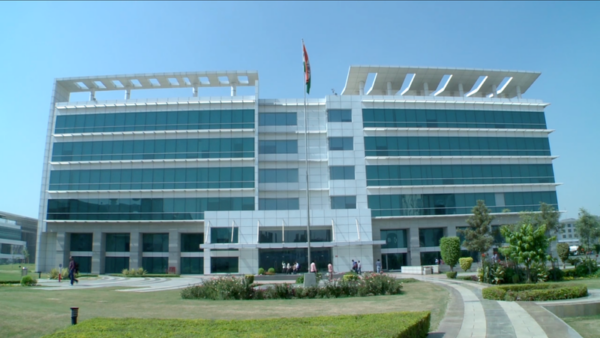
Samsung Electronics Co., Ltd. (KRX: 005930) expects preliminary third-quarter 2026 consolidated sales of approximately KRW195tn and operating profit of around KRW107.4tn, extending an extraordinary earnings expansion driven by tight memory supply and surging demand from artificial-intelligence infrastructure. The company provided estimate ranges of KRW194tn to KRW196tn for sales and KRW107.3tn to KRW107.5tn for operating profit, with the disclosed headline figures representing the midpoints required under Korean disclosure rules.
The numbers are preliminary rather than completed quarterly accounts. Samsung has not yet disclosed the third-quarter revenue, profit or margin of its individual businesses, which means the contribution from memory, foundry, smartphones, displays and other units cannot yet be stated precisely. Detailed third-quarter results are scheduled for October 29.
The scale of the preliminary change is nevertheless remarkable. Compared with Samsung’s second-quarter revenue of KRW171.5tn and operating profit of KRW89.5tn, the guidance implies sequential increases of approximately 13.7% and 20% respectively. Against the third quarter of 2025, the company calculates sales growth of about 126.6% and operating-profit growth of approximately 782.5%.
How did Samsung move from a memory downturn to KRW107.4tn of quarterly operating profit?
Memory semiconductor economics can reverse extremely quickly because manufacturers operate capital-intensive factories whose output cannot be adjusted instantaneously. When demand falls and inventories accumulate, prices can collapse; when demand accelerates faster than capacity, the same fixed-cost manufacturing system can produce enormous incremental profit.
Artificial intelligence has pushed the market toward the second condition. High-performance servers require growing quantities of DRAM, enterprise solid-state storage and high-bandwidth memory, while building new advanced capacity takes time. Samsung said after its second quarter that industry supply remained constrained despite some moderation in mobile and PC demand, with server DRAM, enterprise SSD and HBM demand expected to accelerate.
The impact was already evident before the latest preliminary figures. Samsung’s Device Solutions division produced second-quarter revenue of KRW127.5tn and operating profit of KRW89.2tn, while the Memory Business recorded all-time highs for both quarterly revenue and operating profit. That means semiconductors had already become the dominant earnings engine entering Q3.
Investors should still avoid simply assigning the entire increase to memory before Samsung reports the divisional numbers. Other businesses can influence consolidated earnings, and preliminary guidance deliberately provides only the group total.
Why is high-bandwidth memory strategically different from an ordinary DRAM upcycle?
HBM is designed to feed enormous quantities of data rapidly into AI accelerators by stacking memory dies vertically and placing them close to compute processors. The product requires sophisticated manufacturing, packaging and thermal management, creating a higher technological barrier than conventional commodity memory.
That barrier matters because the economics of a memory boom become more durable when customers care about qualification and performance rather than simply buying whichever supplier offers the lowest price. AI accelerator manufacturers spend considerable time validating HBM products, which can make supplier relationships more difficult to change rapidly.
Samsung has been working to strengthen its position after SK hynix established an early lead in HBM for major AI customers. In the second quarter, Samsung said it had expanded HBM4 sales and shipped HBM4E samples to major customers, evidence that competition is moving rapidly toward subsequent product generations rather than remaining centred on today’s memory specifications.
Success in HBM therefore affects more than one product category. It can determine whether Samsung captures a disproportionate share of the most profitable part of the DRAM market while also strengthening relationships with companies designing advanced accelerators.
The challenge is that rivals are investing aggressively as well. Exceptional profitability eventually attracts capacity and engineering resources, making product qualification, yields and the pace of technology transitions central to the durability of current returns.
Why can Samsung post extraordinary profit growth while investors remain cautious?
A semiconductor company can report spectacular current earnings and still face questions about what constitutes normal profitability. Memory has historically been one of technology’s most cyclical businesses, so investors often discount peak earnings if they believe additional supply will eventually reduce pricing.
Samsung also operates a much broader portfolio than a pure AI semiconductor company. Smartphones, displays, appliances and other businesses can dilute the valuation impact of record memory earnings even when they provide diversification during weaker chip cycles.
The market is also assessing whether Samsung can translate its manufacturing scale into a stronger position in the most advanced AI products. HBM qualification and foundry competitiveness matter because NVIDIA-style valuations are awarded not merely for producing large volumes of silicon, but for controlling scarce technology with durable pricing power.
That distinction helps explain why preliminary profit growth alone cannot settle Samsung’s valuation debate. An earnings boom created mainly by tight industry supply can eventually normalise; an earnings boom accompanied by greater technology leadership could support a more structural reassessment.
October 29 should provide the information required to separate those two narratives more clearly.
Could the current memory shortage persist into 2027?
Samsung’s own second-quarter outlook indicated that server-focused demand remained robust and that growth in server DRAM, enterprise SSDs and HBM could keep the market undersupplied. Continued capital expenditure by hyperscalers supports that argument because every new accelerator rack requires large quantities of memory alongside compute chips.
Supply still responds with a lag. Memory manufacturers can convert production between products, improve yields and add capacity, but advanced HBM requires specialised processes and packaging that cannot be expanded overnight. That constraint can preserve strong pricing longer than a simple commodity cycle would suggest.
The risk lies in extrapolation. Customers could moderate AI infrastructure spending, accelerator architectures could become more memory efficient, or producers could eventually add enough capacity to restore competitive pricing. Mobile and PC weakness could also release conventional DRAM capacity into other applications, depending on product compatibility and manufacturing economics.
Samsung’s preliminary Q3 result therefore confirms an exceptional present environment rather than proving a permanently higher profit base. The distinction will become increasingly important if quarterly operating profit remains above levels that historically would have been considered impossible for the group.
What must Samsung confirm when it reports detailed Q3 results on October 29?
The first requirement is a divisional bridge explaining where the KRW107.4tn operating profit came from. Investors need to know whether Device Solutions again produced the overwhelming majority or whether mobile, displays and other businesses contributed meaningfully to the sequential increase.
Memory product mix will be equally important. HBM, server DRAM and enterprise SSD exposure can provide a more attractive earnings profile than a recovery driven primarily by conventional PC or smartphone memory prices.
Management’s supply commentary will then determine whether the current profitability should be treated as an extraordinary peak or the beginning of a longer period of constrained capacity. Capital-spending plans will provide another clue because aggressive industry investment today can become tomorrow’s oversupply.
Samsung has already disclosed numbers dramatic enough to reset the earnings base. What remains unknown is the quality and durability of those earnings, which is why the October 29 divisional detail may matter more for valuation than the spectacular preliminary headline itself.
Discover more from Business-News-Today.com
Subscribe to get the latest posts sent to your email.