
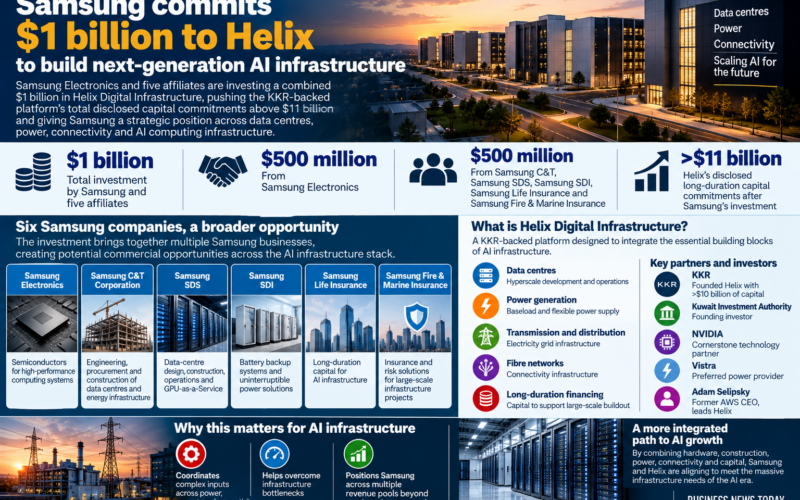
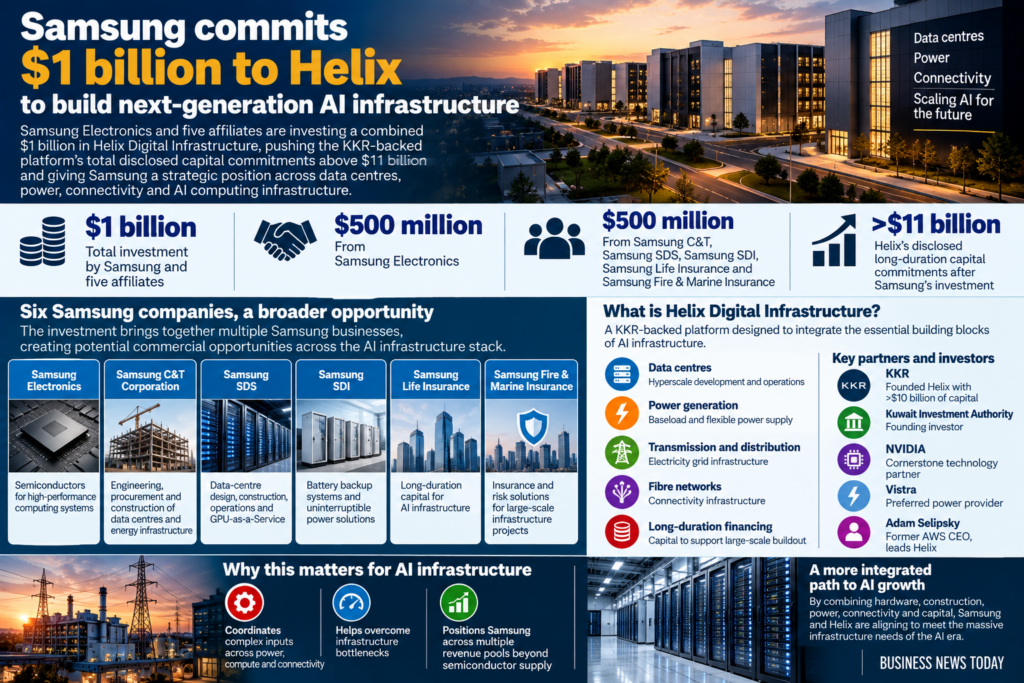
Samsung Electronics Co., Ltd. (KRX: 005930) and five Samsung affiliates are committing a combined $1 billion to Helix Digital Infrastructure, pushing the KKR-backed artificial intelligence infrastructure platform’s disclosed long-duration capital commitments above $11 billion and giving Samsung a potentially valuable commercial position across far more than semiconductor supply. Samsung Electronics will provide $500 million, while Samsung C&T Corporation, Samsung SDS Co., Ltd., Samsung SDI Co., Ltd., Samsung Life Insurance Co., Ltd. and Samsung Fire & Marine Insurance Co., Ltd. will collectively contribute the remaining $500 million.
The investment looks superficially like another large corporate bet on AI data centres. Its structure suggests something considerably broader. Samsung now brings semiconductor components, data-centre cooling, engineering and construction, GPU infrastructure, battery backup systems and financial capital into a platform that was already designed by KKR & Co. Inc. (NYSE: KKR) to combine data centres with electricity generation, transmission, fibre connectivity and long-duration financing.
That combination matters because the competitive bottleneck in AI infrastructure is increasingly shifting away from simply obtaining graphics processors. Building a modern AI facility means coordinating land, power, grid connections, cooling systems, servers, networking, construction, financing and increasingly complex energy arrangements on schedules that do not naturally align. Helix Digital Infrastructure is effectively betting that integrating those layers can become a competitive advantage, while Samsung is positioning itself to participate in several of the revenue pools created along the way.
Why is Samsung Electronics investing through six companies instead of making a conventional technology investment?
The clearest signal in the transaction is the number and diversity of Samsung companies involved. Samsung Electronics accounts for half of the $1 billion commitment, but five other affiliates are participating because AI infrastructure increasingly touches businesses that historically would have operated in separate industrial markets. That creates the possibility of turning what begins as a financial investment into a broader commercial relationship spanning equipment, construction, computing infrastructure and long-duration capital.
Samsung Electronics’ Device Solutions business already supplies semiconductor technologies required by high-performance computing systems. Its Device eXperience division now has a much stronger position in data-centre thermal management after Samsung Electronics completed its acquisition of FläktGroup in November 2025, following an agreement that valued the global heating, ventilation and air-conditioning specialist at €1.5 billion. FläktGroup supplies both conventional air-cooling systems and coolant distribution units for liquid-cooled computing environments, giving Samsung exposure to one of the increasingly difficult engineering problems created by high-density AI hardware.
Samsung C&T Corporation adds another layer. Its Engineering & Construction business can participate in the engineering, procurement and construction of data centres and associated energy infrastructure, potentially placing Samsung inside the physical buildout rather than limiting its role to supplying equipment after facilities are completed. Samsung SDS can design, construct and operate data centres while also participating in GPU-as-a-Service, connecting infrastructure ownership with computing services.
Samsung SDI, meanwhile, supplies technologies used in uninterruptible power systems and battery backup units. Samsung Life Insurance and Samsung Fire & Marine Insurance bring a different kind of strategic relevance because AI infrastructure requires enormous amounts of patient capital with investment horizons extending well beyond normal technology-product cycles. The six-company structure therefore resembles an attempt to assemble an industrial ecosystem around AI infrastructure rather than a simple minority investment by Samsung Electronics.
What exactly is KKR building with Helix Digital Infrastructure?
KKR launched Helix Digital Infrastructure in June 2026 with more than $10 billion of committed long-duration capital and an unusually broad group of strategic investors. The Kuwait Investment Authority joined KKR as a founding investor, while NVIDIA Corporation (NASDAQ: NVDA) became a cornerstone technology partner and Vistra Corp. (NYSE: VST) became Helix’s preferred power provider. Former Amazon Web Services chief executive Adam Selipsky leads the company.
Helix is intended to invest across hyperscale data-centre development and operations, baseload and flexible power generation, electricity transmission and distribution, fibre networks and related connectivity infrastructure. That mandate differs from the traditional model in which a data-centre developer secures a site and grid connection before separately sourcing computing equipment, energy contracts and network capacity. Helix is attempting to coordinate several of those inputs through a single investment platform.
The model is backed by substantial financial capacity. KKR has said its global infrastructure platform manages more than $100 billion of infrastructure assets and has invested more than $70 billion across digital and power infrastructure. Vistra brings a generation fleet expected to approach 50 GW by the end of 2026 and has already executed more than 5 GW of power purchase agreements with hyperscale customers.
Samsung’s $1 billion commitment now adds another industrial dimension. The disclosed investment is equivalent to almost one-tenth of the minimum capital pool implied after adding Samsung’s commitment to Helix’s original more-than-$10-billion base, although that comparison should not be interpreted as Samsung owning a similar percentage of Helix because neither the valuation nor the ownership structure has been publicly disclosed.
Why has power become as important as GPUs in the AI data-centre race?
The power problem is increasingly central to the economics of AI infrastructure. The International Energy Agency projects that worldwide data-centre electricity use could roughly double to about 945 terawatt-hours by 2030 under its base case, representing just under 3% of global electricity consumption. Electricity consumed by accelerated servers, which are heavily associated with AI workloads, is projected to increase much faster than consumption by conventional servers.
The challenge is that data-centre development and electricity infrastructure operate on different clocks. A data centre can sometimes be developed within a few years, while new transmission networks, large generating facilities and grid upgrades can require much longer planning, permitting and construction periods. A hyperscaler can therefore secure servers and customer demand yet remain unable to operate new capacity because sufficient reliable electricity cannot be delivered to the site.
Helix’s structure appears designed specifically around that mismatch. Vistra can provide access to existing generation while also contributing power-development and grid expertise, potentially allowing some projects to move faster than developments dependent entirely on new utility infrastructure. NVIDIA provides another piece through its AI-factory architecture and computing expertise, while Samsung can contribute cooling, power backup, semiconductors and construction capabilities.
None of those relationships eliminates execution risk. Electricity still has to be contracted at competitive prices, grid infrastructure must be available, permits must be secured and customers must be willing to commit to capacity over time. What changes is that Helix is attempting to coordinate these variables under one commercial umbrella rather than leaving a hyperscaler or data-centre developer to negotiate each component independently.
How does Samsung’s FläktGroup acquisition fit into the Helix investment?
Cooling is one of the clearest examples of how Samsung Electronics has been moving beyond its traditional consumer-electronics and semiconductor identity. The company agreed in 2025 to acquire FläktGroup for €1.5 billion and completed the transaction later that year, explicitly identifying data-centre cooling as an important growth market. The acquisition gave Samsung a specialised industrial HVAC platform with manufacturing and service operations across numerous international markets.
That footprint has already begun expanding. FläktGroup completed a new manufacturing operation in Pune, India, in August 2026 that is designed to manufacture advanced cooling equipment including air-handling units, fan-wall systems and computer-room air handlers. Samsung said the Pune facility could eventually produce as many as 6,500 HVAC units annually and support demand across India and the wider Asia-Pacific market.
Samsung Electronics has separately announced an investment of approximately KRW240 billion in a new FläktGroup HVAC production line in Gwangju, South Korea, targeted for completion by 2028. These investments indicate that Samsung’s interest in data-centre cooling predates the Helix transaction and has already progressed into physical manufacturing capacity.
The strategic connection is significant because cooling requirements rise as processors become more powerful and rack densities increase. Liquid cooling in particular pushes thermal management closer to the computing architecture itself, making coordination among chip designers, server manufacturers, data-centre operators and cooling suppliers more important. Samsung therefore enters the Helix relationship with an existing industrial asset that could potentially sell into the infrastructure expansion rather than needing to build that capability from scratch.
Could Samsung turn its Helix investment into a commercial sales channel?
That possibility may be more important than the financial return on Samsung’s investment, but it remains a possibility rather than a guaranteed outcome. Samsung has explicitly said its affiliates intend to seek cooperation opportunities with Helix across their respective capabilities. Helix has also disclosed that strategic investors may have arrangements such as priority or first-look rights to provide goods or services to investments, depending on the individual relationship.
If Samsung companies ultimately participate in Helix projects, the addressable opportunity could extend across several layers of the same facility. Samsung Electronics could supply semiconductor and cooling technologies, Samsung C&T Corporation could compete for construction work, Samsung SDS could participate in data-centre operations or computing services, and Samsung SDI could supply power-protection systems. Insurance affiliates could provide long-duration investment capital while the wider group benefits from commercial activity generated by the infrastructure assets.
There is nevertheless an important counterargument. A platform serving multiple hyperscalers must remain commercially attractive to customers that may prefer technology neutrality and competitive procurement rather than dependence on a tightly connected supplier ecosystem. Strategic relationships can reduce execution complexity, but they can also create questions about supplier concentration, pricing discipline and whether individual projects receive the best available technology from the wider market.
The investment terms disclosed so far do not establish that Samsung affiliates have exclusive supply rights, guaranteed procurement volumes or minimum commercial commitments from Helix. Investors should therefore distinguish between the strategic logic of the relationship and actual future revenue until individual project awards, supply agreements or customer contracts are announced.
What is still missing from the Helix Digital Infrastructure investment story?
The most important missing information is project-level detail. Helix has disclosed its capital base, partners, management strategy and target infrastructure categories, but it has not yet publicly identified a portfolio of individual data-centre campuses comparable with the specific project pipelines disclosed by established hyperscale developers. More than $11 billion of committed capital creates substantial financial capacity, but capital commitments alone do not establish construction schedules, customer contracts or investment returns.
The absence of disclosed sites also makes it difficult to calculate how much computing capacity Helix intends to build from its initial capital pool. AI infrastructure economics vary dramatically according to land costs, power prices, grid availability, GPU ownership structures, cooling architecture and whether infrastructure is owned directly or developed through joint ventures. A dollar committed to generation capacity does not translate into the same revenue profile as a dollar invested in GPU-equipped data-centre infrastructure.
That uncertainty is particularly important because the AI infrastructure market has moved rapidly from scarcity narratives toward increasingly large capital commitments. KKR, Blackstone, Brookfield, private credit providers, utilities and technology companies are all deploying capital into combinations of data centres, power generation and digital infrastructure. The competition may eventually shift from who can assemble the largest financing package to who can actually deliver energised capacity at attractive returns.
For Samsung Electronics, the investment still carries strategic value even if Helix itself represents only one infrastructure platform. The transaction places several Samsung businesses alongside KKR, NVIDIA, Vistra and the Kuwait Investment Authority inside a network designed around AI infrastructure deployment, potentially giving Samsung earlier visibility into customer requirements and future procurement opportunities.
What does Samsung Electronics’ recent share performance say about investor sentiment?
Samsung Electronics shares closed at KRW276,000 on October 2, compared with KRW272,500 on September 29 and KRW270,000 immediately before the Helix investment was announced. That represents only a modest net increase around the transaction and does not provide evidence that investors materially repriced Samsung Electronics because of the $500 million direct commitment.
The broader trading backdrop has been considerably more influential. Samsung Electronics rose 2.79% on October 1 as South Korean semiconductor stocks benefited from exceptionally strong September export data and renewed enthusiasm around global AI-related chip demand. South Korea reported record exports, with semiconductor shipments expanding particularly strongly, making it difficult to isolate any Helix-related effect on Samsung Electronics’ share price.
The market signal is therefore constructive toward AI exposure in general but inconclusive regarding Helix specifically. A $500 million investment by Samsung Electronics is strategically notable, yet small relative to the scale of the company and its semiconductor investment programme. The larger valuation consequence would emerge if Helix begins generating meaningful equipment, construction, cooling, battery or computing-service orders for Samsung affiliates.
KKR shares have meanwhile remained under broader pressure despite the expansion of Helix, reinforcing the point that public markets are not currently valuing the transaction as a stand-alone catalyst. For both Samsung Electronics and KKR, the financial significance will ultimately depend less on the headline size of the commitment than on how quickly Helix converts capital into operating infrastructure and recurring commercial relationships.
Why could the Samsung-Helix model reshape the next phase of AI infrastructure competition?
The first phase of the AI investment boom was dominated by access to advanced processors. The next phase increasingly requires coordination of processors with power generation, transmission, cooling, buildings, batteries, network infrastructure and financing. That changes the competitive landscape because very few individual companies control all of those capabilities.
Helix Digital Infrastructure is attempting to solve the problem through partnerships rather than ownership of every link in the chain. KKR supplies infrastructure investment expertise and long-duration capital, NVIDIA supplies the computing architecture, Vistra supplies power capabilities, and Samsung can potentially contribute technology and industrial systems across several layers. The Kuwait Investment Authority adds another source of patient institutional capital.
The model still has to prove itself at the asset level. Until Helix announces major campuses, customers, power arrangements and construction timelines, its more than $11 billion of committed capital represents capacity to invest rather than evidence of completed infrastructure. Execution speed, project economics and the ability to preserve supplier competition will determine whether integration genuinely removes bottlenecks or merely moves complexity inside the partnership.
Samsung’s participation nevertheless points to a broader shift in where technology companies see future value. Samsung Electronics is no longer positioning itself only to sell components into somebody else’s AI data centre. Through semiconductors, FläktGroup cooling, Samsung C&T construction, Samsung SDS computing infrastructure, Samsung SDI batteries and its financial affiliates, the wider Samsung ecosystem is increasingly positioned to earn revenue from the physical system surrounding AI computing itself.
That may prove to be the more consequential element of the $1 billion investment. The AI infrastructure race is beginning to resemble an industrial-development cycle in which electricity, construction capacity, thermal management and financing can be as strategically valuable as computing hardware. Samsung’s Helix commitment is one of the clearest signs yet that major technology groups are preparing for that transition.
Discover more from Business-News-Today.com
Subscribe to get the latest posts sent to your email.