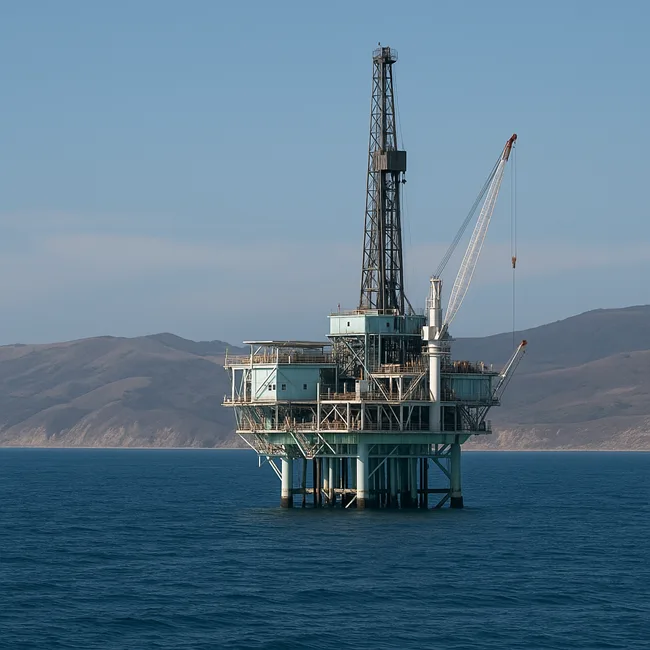


Sable Offshore Corp. (NYSE: SOC) closed Friday, May 15, 2026, at USD 15.13, up 1.38 dollars or 10.04 percent on volume of 4.146 million shares. The Houston-based offshore oil developer has become the most legally contested mid-cap energy name on the US exchanges, with its 52-week range stretching from a low of USD 3.72 to a high of USD 35.00 amid a year-long battle between the Trump administration’s Defense Production Act order authorising the restart of California’s Santa Ynez Unit and California Attorney General Rob Bonta’s lawsuit seeking to block it. The Friday rally arrived against a macro backdrop of elevated crude prices driven by the ongoing US-Israeli conflict with Iran, with the national average gasoline price recently at USD 3.98, and with the next confirmed legal catalyst the June 1 preliminary injunction hearing in the US District Court for the Central District of California.
What does Sable Offshore actually do and why is the Santa Ynez Unit the most strategically contested oil asset on the US West Coast?
Sable Offshore Corp. is an independent upstream oil and gas operator focused on developing the Santa Ynez Unit, a prolific oil field in federal waters off the coast of Santa Barbara County, California. The company was founded by industry veteran Jim Flores on October 16, 2020 and is headquartered in Houston, Texas. Sable acquired the Santa Ynez Unit assets from Exxon Mobil Corporation and Mobil Pacific Pipeline Company under a purchase and sale agreement originally signed on November 1, 2022, and the company’s common stock and public warrants began trading on the NYSE under the symbols SOC and SOC.WS on February 15, 2024.
The Santa Ynez Unit consists of three offshore platforms with Platform Harmony and Platform Heritage currently operating, supported by the Santa Ynez Pipeline System known as SYPS, an integrated interstate pipeline that transports crude oil from the offshore platforms to the Las Flores Canyon onshore processing facility and inland to California refineries. The 40 wells currently online at Harmony and Heritage are producing an average of 750 gross barrels of oil per day per well, generating approximately 30,000 gross barrels per day, with a stated target of 50,000 gross barrels per day at full ramp.
The strategic significance of the asset rests on its position as the largest federal offshore oil resource in the Pacific Outer Continental Shelf currently capable of resumed production. The Santa Ynez Unit had been shut in since the 2015 Refugio Beach pipeline spill operated by predecessor pipeline owner Plains All American, leaving California’s refining complex structurally dependent on foreign crude imports despite domestic federal reserves sitting in their own waters. That structural import dependence is the policy logic the Trump administration used to invoke the Defense Production Act.
How did the March 13 Defense Production Act order rewrite the legal framework around the Santa Ynez restart?
The single most important policy intervention in Sable’s history occurred on March 13, 2026, when President Donald J. Trump signed an Executive Order delegating Defense Production Act authority to the United States Secretary of Energy. On the same day, Energy Secretary Chris Wright issued the Pipeline Capacity Prioritization and Allocation Order, an emergency directive invoking the DPA to immediately prioritise and allocate pipeline transportation services for hydrocarbons from the Santa Ynez Unit through the SYPS, citing energy scarcity and supply disruption risks caused by California policies leaving the region and US military forces dependent on foreign oil.
The order’s legal architecture is unusually robust. According to a Department of Justice slip opinion released in support of the action, Sable Offshore is not liable for compliance with federal directives under the DPA even if the authorising order is subsequently declared invalid by judicial or other competent authority. The DOJ position further argues that a Defense Production Act finding of necessity is likely immune from judicial review under the Administrative Procedure Act, meaning the Secretary of Energy’s invocation of the DPA may not be reviewable by federal courts on the merits.
The retail investor implication is meaningful. Sable restarted pumping oil through the Las Flores Pipelines on March 14, 2026, the day after the DPA order, despite an outstanding state court preliminary injunction, despite not having all state permits, despite missing approvals from several state agencies, and despite not having a current valid easement to use the segment of pipeline crossing California state property. The DPA framework effectively immunises Sable from those compliance gaps for the duration of the federal order, converting a state-level regulatory standoff into a federal preemption case the company can operate through.
Why does the California Attorney General’s lawsuit and the June 1 preliminary injunction hearing matter as the next discrete catalyst?
The legal counter to the DPA order is the central risk vector for any retail investor weighing Sable Offshore as a position. California Attorney General Rob Bonta filed a lawsuit in late March 2026 against the Trump administration in the US District Court for the Central District of California, arguing that Energy Secretary Wright has no authority under the DPA to excuse Sable from compliance with state and federal laws and court orders, and that Congress intended no general preemptive authority in the section of the DPA invoked by the order.
Bonta is separately seeking a preliminary injunction to halt Sable’s production of oil and use of the Las Flores Pipelines while California challenges the federal restart order on the merits. The first hearing for that preliminary injunction motion is scheduled for June 1, 2026, in the US District Court for the Central District of California, and that hearing represents the single most consequential near-term legal catalyst for the equity. A preliminary injunction granted in California’s favour would force a production halt pending full litigation. A preliminary injunction denied would allow Sable to continue producing through the duration of the underlying case.
The litigation has attracted environmental intervenor activity that complicates the calendar further. The Environmental Defense Center, the Center for Biological Diversity, and Earthjustice have filed motions to intervene in support of California’s case. Senator Adam Schiff joined Chumash tribal leaders, local Santa Barbara officials, and environmental advocates at Shoreline Park on May 7, 2026, to reaffirm political opposition to the restart. The Coastal Commission had separately imposed administrative penalties against Sable, and a federal court is also probing the Emergency Special Permit issued by PHMSA that shifted pipeline jurisdiction from state to federal oversight in late 2025.
How did the Q1 2026 financial print expose the cash burn and dilution risk underneath the production restart narrative?
The Q1 2026 financial print on May 6, 2026 delivered a sobering financial picture beneath the operational headlines. Sable reported a net loss of USD 197.0 million for the quarter, driven primarily by operating expenses associated with the resumption of oil transportation through the SYPS, general and administrative expenses, non-cash interest expense of USD 34.7 million, and a non-cash loss on the change in fair value of warrant liabilities of USD 44.2 million. Earnings per share of negative USD 1.37 missed the consensus estimate of negative USD 0.52 by a wide margin.
The balance sheet carries the central structural concern. Sable ended the quarter with short-term outstanding debt of USD 956.3 million, inclusive of paid-in-kind interest accrual. The November 24, 2025 Second Amendment to the Senior Secured Term Loan extended the maturity date to the earlier of March 31, 2027 or 90 days after first oil sales, providing a runway window but not a cure. The company has also disclosed in regulatory filings tied to a USD 250 million stock offering that both the US Securities and Exchange Commission and federal prosecutors in the Southern District of New York are conducting active investigations, adding a securities-disclosure overhang.
The dilution history is severe and worth careful retail investor attention. Sable issued 10 million shares at USD 29.50 per share on May 23, 2025, raising USD 295 million. The company then issued 45,454,546 shares at USD 5.50 per share in a November 10, 2025 private placement, raising USD 250 million at a price 81 percent below the May 2025 offering. The aggressive dilution at the lower price tier reset the cost basis for the institutional investor base and contributed to the 52-week low of USD 3.72, against which the Friday close of USD 15.13 represents an approximate 307 percent recovery.
What does the Trump-era Iran war and the elevated gasoline price backdrop add to the Sable thesis?
The macro layer underpinning the entire Sable bull case is the elevated crude pricing environment driven by the US-Israeli conflict with Iran that has been a defining feature of the 2026 macro landscape. The Trump administration explicitly invoked rising oil and gas prices caused by that conflict as the policy rationale for the Defense Production Act order. The national average US gasoline price has been running near USD 3.98 per gallon, well above the levels that would normally support political support for offshore drilling restart against state opposition.
The macro logic creates a tight feedback loop between Iran-related crude price escalation and the durability of the federal policy support for Sable Offshore. A sustained reduction in Middle East tensions and a normalisation of crude prices toward a USD 70 to USD 80 per barrel range would weaken the national-security justification for the DPA invocation and could increase the political pressure on the administration to wind down the emergency order. Conversely, a further escalation in the Strait of Hormuz dynamic, a renewed disruption to Persian Gulf shipping, or any move that lifts crude prices toward the USD 100 per barrel threshold strengthens the policy framework and locks in operational visibility for Sable through 2027.
The Grok AI portfolio thesis circulating on retail trading platforms specifically frames Sable Offshore’s core bull case around 50,000 barrels per day of production if crude prices remain above USD 100 per barrel, with the DOJ preemption memo cited as a discrete catalyst supporting the federal-emergency-powers framework. The macro link means retail investors holding Sable are implicitly holding a leveraged position on the duration and intensity of the Iran tension dynamic.
How are retail investors on X and Stocktwits actually positioning around the legal-versus-production tension?
Retail sentiment around Sable Offshore on Stocktwits and the dedicated energy-stocks community on X has been one of the most polarised conversations on the platform during 2026, with the discussion structured around two cleanly opposed camps. The bull camp focuses on the DPA preemption framework, the DOJ slip opinion’s immunity language, the Iran-driven crude price tailwind, the 50,000 barrel per day production target, and the institutional thesis that California’s legal challenges will ultimately fail on federal preemption grounds. The bear camp focuses on the June 1 preliminary injunction hearing, the SEC and DOJ investigations disclosed in the November 2025 offering documents, the cash burn and refinancing exposure ahead of the March 2027 term loan maturity, and the insider selling activity disclosed in late March 2026.
The retail investor option flow has been distinctly bullish, with TipRanks reporting that Sable Offshore call volume ran above normal and directionally bullish around April 20, 2026, just after the resumption of oil transportation announcement. Short interest data and put-call ratios have shifted alongside the binary legal calendar, with positioning visibly compressing into the June 1 hearing.
The community-level read is that Sable is functioning as a binary-event stock rather than a fundamental cash-flow story at present. Position sizing on retail forums has been weighted toward smaller allocations consistent with binary outcome risk, and a meaningful portion of the holder base has rotated into options as the cleanest expression of a view on the June 1 catalyst.
What does the technical setup tell traders watching the USD 12 to USD 18 zone into the June hearing?
The chart structure on Sable Offshore reflects the binary-event nature of the underlying story. Support has built around USD 12 to USD 13, the area where the stock consolidated through early May after recovering from the post-Q1-earnings selloff. The 52-week low of USD 3.72, hit during the November 2025 private placement at USD 5.50, sits well below current trading and serves as a tail-risk anchor rather than a near-term support level.
Resistance sits at three discrete levels. The first is USD 17 to USD 18, the area where the stock topped in mid-April before the SEC investigation disclosure and the Hunterbrook Media investigation update produced a sharp pullback. The second is USD 25, a key 2024 trading area that aligns with the May 2025 secondary offering price of USD 29.50. The third is USD 35, the 52-week high, which captures the upper end of the bull-case scenarios under a clean preliminary injunction denial.
For retail investors positioning around the June 1 hearing, the practical read is that the next two and a half weeks will likely see compressed price action between USD 13 and USD 17 as the market positions for the binary outcome. A preliminary injunction denied would likely open the path back toward USD 25 and the May 2025 secondary offering price as the natural retracement objective. A preliminary injunction granted would invalidate the operational thesis for the duration of the underlying litigation and could put the USD 5.50 private placement price back in play as a sentiment floor.
How does the founder-led management structure under Jim Flores affect the risk-reward asymmetry of the equity?
The leadership architecture at Sable Offshore deserves close attention from any retail investor sizing a position. Founder, Chair, and CEO Jim Flores is a veteran energy industry operator who structured the Exxon Mobil asset acquisition, navigated the SPAC merger that brought the company public, and has personally driven the DPA-based regulatory strategy that produced the March 2026 restart. The founder-led model concentrates execution risk and reward in a single figure, which can be a source of upside in successful binary outcomes and a source of downside in event-driven litigation.
The insider activity disclosed in late March 2026, where top Sable executives quietly unloaded major insider stakes according to TipRanks reporting, is a signal retail investors should weigh against the headline narrative. Insider selling at this stage of a binary legal calendar can reflect personal liquidity needs, planned diversification, or a less optimistic assessment of the June 1 hearing outcome than the public communications would suggest. The mixed signal aligns with the broader pattern of high-volatility energy event stocks where management communications and insider flows can diverge.
For retail investors making position-sizing decisions, the implication is that Sable Offshore is not a sleep-well-at-night position. It is a structured bet on the federal preemption framework holding through California’s legal challenge, on Iran-related crude pricing supporting the policy rationale, and on Jim Flores executing the production ramp toward 50,000 barrels per day before the March 2027 term loan maturity forces another financing event. Each of those three legs carries discrete and material risk that compounds into the equity outcome.
Key takeaways for retail investors watching Sable Offshore into the June 1 preliminary injunction hearing
- Sable Offshore closed Friday May 15 at USD 15.13, up 10.04 percent, with a 52-week range from a low of USD 3.72 to a high of USD 35.00 reflecting the binary-event nature of the underlying litigation
- Trump signed an Executive Order on March 13, 2026, delegating Defense Production Act authority to Energy Secretary Chris Wright, who issued the Pipeline Capacity Prioritization and Allocation Order the same day, enabling Sable to restart oil transport through SYPS Segments 324 and 325 on March 14
- The DOJ slip opinion supporting the order argues Sable would not be liable even if the DPA order is subsequently declared invalid, and that the Secretary of Energy’s finding of necessity is likely immune from judicial review under the Administrative Procedure Act
- California Attorney General Rob Bonta has filed suit in the US District Court for the Central District of California challenging the DPA order, with the preliminary injunction hearing scheduled for June 1, 2026
- Q1 2026 reported a net loss of USD 197.0 million on EPS of negative USD 1.37 against consensus of negative USD 0.52, with short-term outstanding debt of USD 956.3 million ahead of a senior secured term loan maturity in March 2027
- The November 10, 2025 private placement issued 45.45 million shares at USD 5.50 per share, raising USD 250 million but producing severe dilution against the May 2025 offering at USD 29.50
- Operational ramp at Platform Harmony and Platform Heritage now runs 40 wells at an average 750 gross barrels per day per well, targeting 50,000 gross barrels per day at full production, with macroeconomic support tied to elevated crude prices driven by the ongoing Iran-related geopolitical environment
Discover more from Business-News-Today.com
Subscribe to get the latest posts sent to your email.