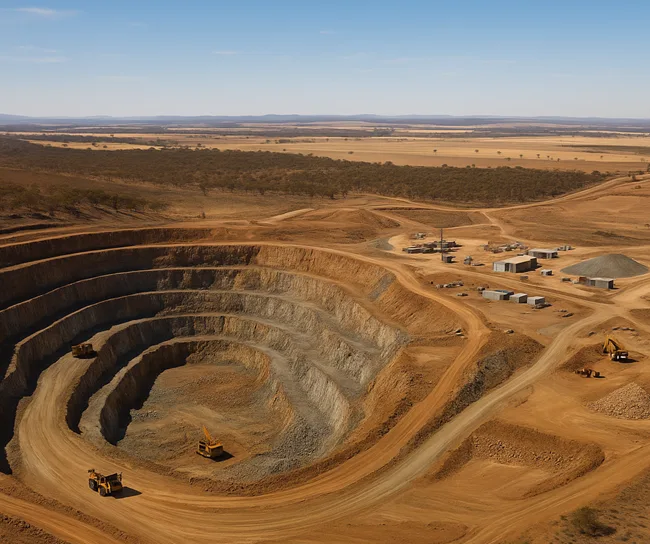

Metals One Plc (AIM: MET1) says the Barbrook Gold Mine in South Africa could produce its first gold concentrate within six months under a newly finalised Phase 1 restart plan, while an offtake contract has been signed covering 100% of planned concentrate production for an initial three-year period. The development brings the project closer to operating status, although financing, regulatory approvals, technical reporting and continuing legal proceedings mean the restart is not yet fully de-risked.
Barbrook sits in the Barberton Greenstone Belt in Mpumalanga and holds a mining authorisation over approximately 2,286 hectares. Metals One cites an approximately 2.1 million-ounce historical underground gold resource alongside surface oxidised and refractory material, an existing processing plant, tailings facilities and other infrastructure. Importantly, that 2.1 million-ounce figure is historical and dates to a 2015 Competent Persons Report rather than a newly established current resource.
The current ownership structure is also evolving. Metals One owns 30% of Lions Bay Resources Proprietary Limited and has an option for another 19.99%, while it holds 19.1% of Lions Bay Capital Inc. Under the proposed transaction, TSX Venture-listed Lions Bay Capital would acquire 100% of Lions Bay Resources, creating an indirect route through which Metals One retains exposure to Barbrook.
How does the three-phase Barbrook restart plan work?
Phase 1 is designed to recommission existing plant infrastructure and process tailings and surface oxide resources, targeting gold-concentrate production within six months. Site cleanup has already started and the scope required to bring one processing stream back into operation is being finalised.
Phase 2 would go further by recommissioning the plant and underground infrastructure, with concentrate production targeted within 12 to 18 months. Phase 3 would then involve feasibility work on additional underground mines.
The phased approach lowers initial execution complexity because Barbrook does not need to rebuild an entirely new processing facility before producing material. Existing infrastructure can potentially shorten the path to first output, although historical plants still require refurbishment, engineering work and regulatory compliance before commercial production can be assumed.
Why does Barbrook’s three-year offtake contract matter?
Lions Bay Mining entered into an agreement on July 25 with an unnamed global trading company covering 100% of Barbrook gold-concentrate production for an initial three-year term associated with Phase 2 production.
The commercial significance is straightforward: if production begins as planned and specifications are met, the mine has an identified buyer for its concentrate rather than having to develop a market after restart. That reduces one layer of commercial uncertainty, although it does not guarantee production volumes, margins or mine profitability.
Metals One also argues that selling concentrate reduces some metallurgical and recovery risk because the material does not need to be fully refined into final gold on site. Investors should nevertheless wait for the forthcoming Competent Persons Report before drawing conclusions about tonnage, grade, recovery, production levels or project economics.
What still has to happen before the Barbrook transaction can close?
Several major conditions remain. Legal documentation for financing is still underway, the Section 11 application to transfer mining rights has been submitted, shareholder documentation is being prepared and Minxcon is working on an NI 43-101-standard Competent Persons Report expected in October.
The proposed Lions Bay Capital transaction is expected to constitute a reverse takeover under TSX Venture Exchange rules, meaning exchange approval and readmission documentation are required. Metals One has explicitly stated that completion remains subject to shareholder, financing, regulatory, exchange and third-party approvals and that there is no assurance the transaction will complete as contemplated.
That qualification is important because a mine plan and offtake contract make the project more tangible but do not turn a conditional transaction into a completed acquisition or financed restart.
How serious are the legal challenges facing the Barbrook rescue plan?
Goldstream Proprietary Limited, a creditor of Barbrook, has pursued litigation around the business rescue process. An earlier urgent application was disposed of in May, while another matter seeking removal of the business rescue practitioner was scheduled for September 3 and a separate application challenging the plan for October 12.
Lions Bay Resources has said it remains confident in its position, but litigation creates schedule and completion risk even when management expects to prevail. Investors should therefore distinguish the company’s confidence from a final judicial outcome.
Barbrook has clearly moved beyond a purely conceptual restart. Site work has begun, the processing strategy is defined, an offtaker has been secured and technical documentation is advancing. The remaining milestones, particularly financing close, Section 11 approval and resolution of legal challenges, will determine whether the six-month production target becomes an operational outcome rather than another development timetable.
Discover more from Business-News-Today.com
Subscribe to get the latest posts sent to your email.