



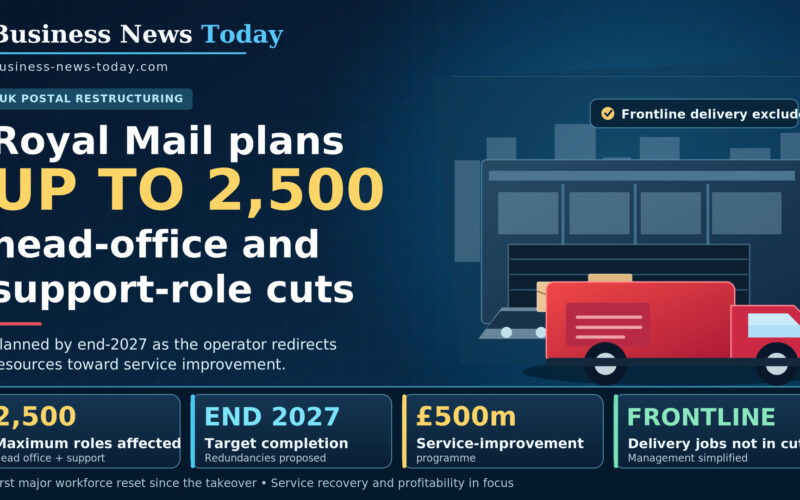
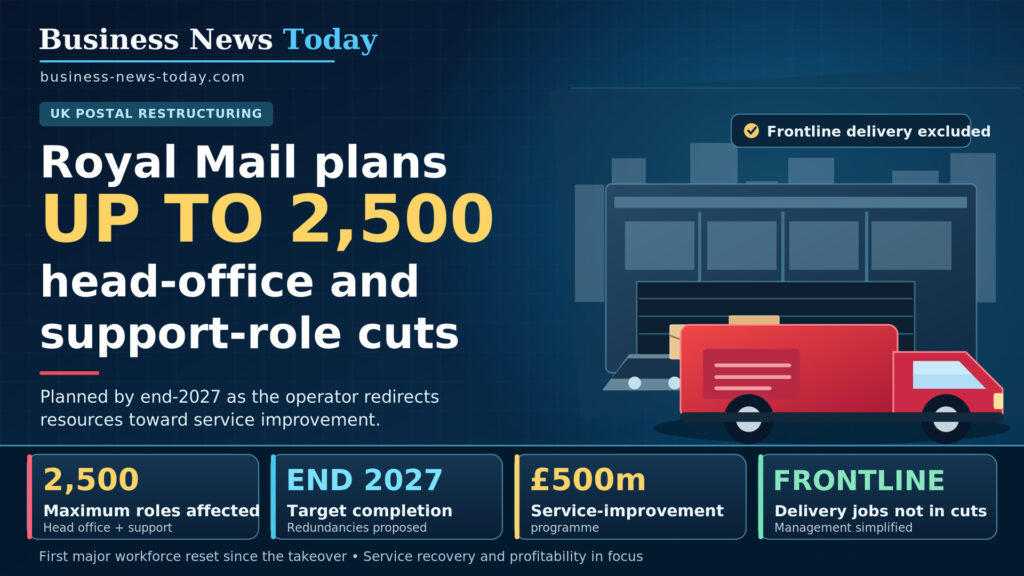
Royal Mail is preparing to cut up to 2,500 head-office and support roles by the end of 2027 as Chief Executive Officer Alistair Cochrane attempts to simplify one of Britain’s largest employers while improving chronically weak delivery performance. The proposed reduction represents less than 2% of a workforce exceeding 131,000 employees and is expected to be managed primarily through voluntary redundancies and natural attrition rather than a broad removal of postal workers and drivers.
The restructuring matters because it comes during Royal Mail’s first major strategic reset under the ownership of Czech billionaire Daniel Křetínský, whose EP Group completed its £5.3 billion acquisition of former parent International Distribution Services in 2025. Royal Mail is simultaneously preparing to invest around £500 million in service improvements, making the workforce reductions part of a wider attempt to shift money from administration and duplicated management into delivery reliability, automation and the company’s increasingly important parcels business.
The central question is whether a leaner corporate structure can solve problems that are also operational, regulatory and structural. Letter volumes have fallen by more than 70% from their peak, parcels face intense competition and Royal Mail has repeatedly missed regulated delivery targets. Removing management layers may improve speed and costs, but the company will still need to prove that those savings translate into a service customers can actually see.
Why is Royal Mail cutting 2,500 jobs while investing heavily in delivery?
The apparent contradiction reflects the type of transformation now underway. Royal Mail is not simply reducing expenditure across the entire company. Management is trying to move spending away from support activities it considers duplicated or unnecessarily complex and toward the frontline systems and infrastructure needed to modernise the network.
Head-office and support roles are therefore carrying most of the direct employment impact. Delivery employees, including postmen, postwomen and drivers, are not included in the announced reduction, an important distinction given the service problems Royal Mail is trying to address. Cutting frontline capacity while simultaneously promising better deliveries would have created an obvious strategic contradiction.
Cochrane has described the programme as part of one of Royal Mail’s biggest transformations in generations. That language reflects how far the organisation must move from the economics on which the traditional postal service was built. A network designed around enormous volumes of letters now needs to compete increasingly for parcels, where rivals often operate with more flexible employment models, denser locker networks and fewer historic infrastructure obligations.
The £500 million investment programme consequently needs to do more than replace old equipment. Royal Mail must improve routing, parcel handling, digital services and reliability while creating a cost base that can function when letters no longer subsidise the network to the extent they once did.
Can management cuts fix Royal Mail’s delivery performance problems?
Royal Mail’s performance challenge remains substantial. Only around three-quarters of first-class mail has recently arrived within the required next-day standard, well below the historic regulatory target of 93%. Ofcom has repeatedly scrutinised the company and has imposed significant penalties for failing to meet service obligations.
Reducing management layers could help if excessive bureaucracy has slowed decision-making or created overlapping functions. Large organisations accumulated over decades often develop parallel reporting structures and administrative processes that remain long after the operational reasons for them disappear. Removing those layers can theoretically allow local leaders to respond more quickly and direct more funding toward customer-facing services.
However, poor delivery performance can also stem from staffing availability, transport networks, sickness levels, local management, automation reliability and the basic economics of maintaining nationwide coverage. Those issues will not disappear merely because the organisation employs fewer administrators.
Royal Mail therefore faces an execution test. The restructuring will be judged not by the number of positions removed but by whether first-class reliability, parcel delivery performance and customer satisfaction improve afterwards. Cost savings without visible operational improvement would simply turn the programme into another efficiency exercise.
Why has the shift from letters to parcels become so difficult?
The decline of letters has been exceptionally severe. Email, digital billing, online banking and electronic government services have removed vast amounts of correspondence that once travelled through Royal Mail’s network every day. The company still needs nationwide infrastructure even as the volume flowing through it has collapsed.
Parcels should theoretically provide the replacement growth engine because e-commerce continues to generate enormous delivery demand. The problem is that parcel delivery is far more competitive than traditional addressed mail. Royal Mail competes with operators including Amazon Logistics, Evri and other specialist networks, many of which were built specifically for e-commerce rather than adapted from a centuries-old postal system.
Employment models are another source of competitive tension. Royal Mail relies heavily on directly employed workers with conventional employment protections, while some competitors make much greater use of self-employed delivery drivers. Royal Mail has argued that differences in employment models can distort competition because companies using gig-economy labour may carry lower employment costs.
The United Kingdom government is now examining employment-status rules affecting parts of the gig economy, something Royal Mail sees as potentially important for competitive balance. Nevertheless, regulation alone will not solve the operator’s challenge. Customers ultimately compare price, speed, tracking and reliability, which means Royal Mail has to compete operationally as well as politically.
What does Daniel Křetínský’s ownership change about the restructuring?
The job cuts are the first major employment programme since EP Group took control, making them an early indication of how Křetínský intends to reshape the company. The takeover attracted intense political scrutiny because Royal Mail remains a strategically important national institution despite being privately owned.
Commitments attached to the transaction included protections around the Universal Service and other aspects of the company’s British presence. Those obligations constrain the extent to which an owner can treat Royal Mail like an ordinary logistics acquisition, because the network has public-service responsibilities alongside commercial objectives.
Křetínský therefore needs to improve returns without dismantling the very network that makes Royal Mail strategically significant. Reducing central costs is one of the least disruptive ways of starting that process because it can preserve delivery capacity while freeing funds for investment.
The challenge is cultural as well as financial. Royal Mail has large union representation and a long history of industrial disputes when management attempts major operational change. Formal consultations with the Communication Workers Union and Unite therefore become an important part of the process, particularly if voluntary departures do not generate enough savings.
Could Royal Mail need further job cuts after 2027?
Management has presented the 2,500-role programme as the current restructuring plan, not as a guarantee that employment will never fall further. The long-term workforce trajectory will depend heavily on parcel market share, Universal Service reform, automation and how quickly letter volumes continue declining.
Technology will also matter. Sorting automation, route optimisation and greater use of parcel lockers can change the amount and type of labour needed across the network. Royal Mail recently expanded its locker ambitions through the acquisition of Quadient’s United Kingdom parcel-locker operations, giving it another channel beyond home delivery.
That could make the future workforce different rather than simply smaller. More investment may be directed toward engineering, data, automation and parcel infrastructure even while administrative positions disappear. Similar patterns are increasingly visible across logistics businesses attempting to modernise legacy networks.
For Royal Mail employees, however, the immediate reality is that as many as 2,500 head-office and support roles may disappear over the next 15 months. The longer-term strategic test is whether those departures genuinely help create a faster, more competitive postal operator or merely reduce costs while the underlying service problem remains unresolved.
Discover more from Business-News-Today.com
Subscribe to get the latest posts sent to your email.