

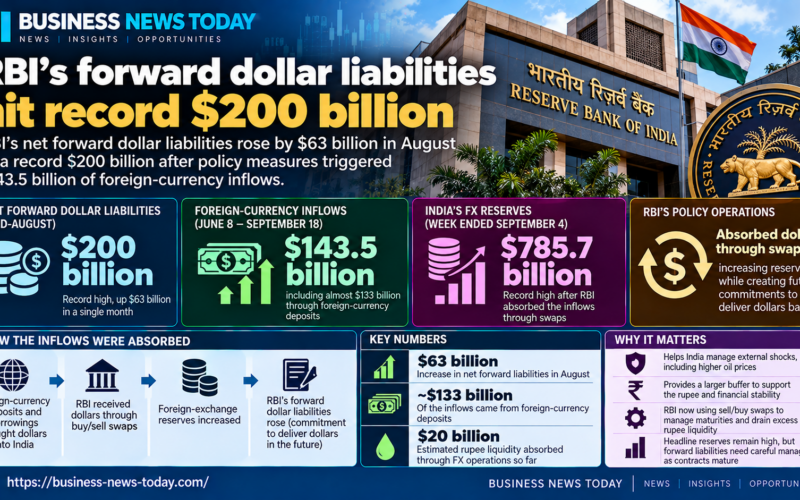
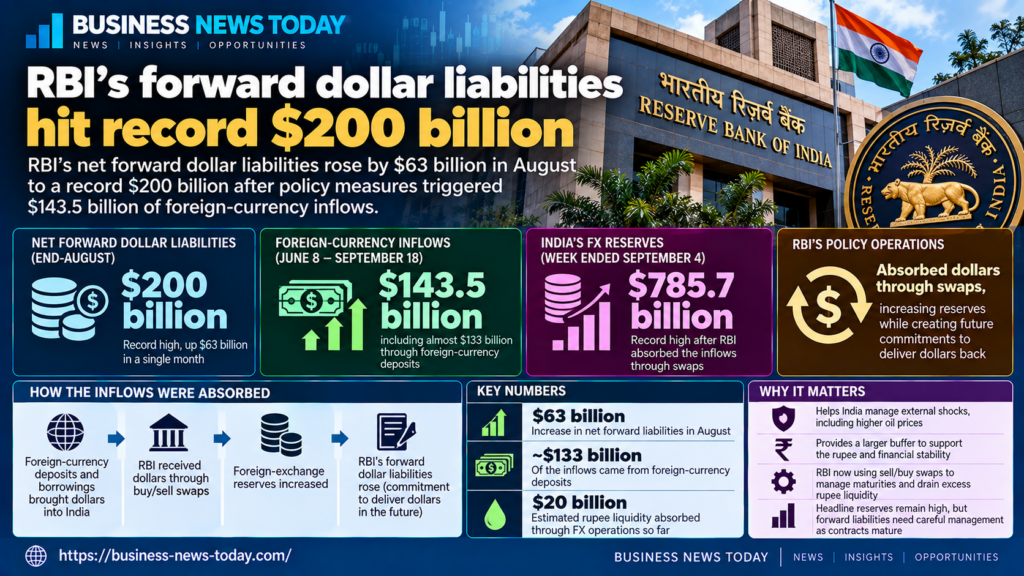
The Reserve Bank of India’s (RBI) net forward dollar liabilities climbed to a record $200 billion at the end of August, increasing by $63 billion in a single month after policy measures generated an extraordinary wave of foreign-currency inflows. The RBI absorbed those dollars through swaps, increasing India’s headline foreign-exchange reserves while simultaneously creating commitments to deliver dollars back in the future.
The temporary measures attracted $143.5 billion between June 8 and September 18, including almost $133 billion through foreign-currency deposits. India’s foreign-exchange reserves consequently reached a record $785.7 billion during the week ended September 4, but the size of the forward position means policymakers now need to manage maturities carefully while preventing excess rupee liquidity from distorting domestic money markets.
What does it mean when the RBI has $200 billion of net forward dollar liabilities?
A forward currency contract fixes an exchange of currencies at a future date. When the RBI has a net short-dollar forward position, it has effectively committed to provide dollars against rupees later, even though those dollars may not appear as an immediate reduction in headline foreign-exchange reserves.
That allows the central bank to absorb large foreign-currency inflows without creating the same immediate exchange-rate movements that could occur if all transactions were handled directly in the spot market. However, the future obligations still have to be managed as contracts mature.
The $200 billion number therefore does not mean India suddenly owes an external creditor $200 billion in the conventional sense. It represents the central bank’s net forward position created through its management of currency inflows and swaps.
Why did the RBI’s forward position jump by $63 billion in August alone?
India introduced temporary measures designed to strengthen its balance of payments during a period of intense pressure from expensive oil and geopolitical instability. Incentives included discounted hedging for overseas borrowings and arrangements encouraging foreign-currency deposits.
Banks receiving those dollars could exchange them with the RBI through buy/sell swaps. The central bank received the foreign currency immediately and agreed to reverse the transaction later, boosting reserves while increasing its future dollar commitments.
The scale was extraordinary. Almost $133 billion of the $143.5 billion attracted under the measures came from foreign-currency deposits, explaining why the forward book expanded so dramatically within only a few months.
Why did India want such large dollar inflows in the first place?
India imports most of its crude oil and therefore needs substantial foreign currency to pay for energy. The Iran conflict pushed oil prices higher and strained the country’s external balance, increasing pressure on the rupee and making additional dollar liquidity valuable.
Larger foreign-exchange reserves give the RBI greater capacity to smooth disorderly currency moves and reassure investors that India can meet external obligations even during a severe commodity shock. Reserves approaching $786 billion provide a historically large buffer.
The trade-off is that attracting foreign currency through temporary deposit or borrowing incentives can create maturity concentrations. When those deposits eventually mature, banks or investors may need dollars again, so the RBI must ensure the original stability measure does not create another liquidity problem later.
Why is the RBI now using sell-buy swaps after previously absorbing dollars?
The central bank has shifted toward dollar-rupee sell/buy swaps with shorter maturities, mostly ranging from three months to one year, according to bankers cited by Reuters. Market participants interpret those operations as an attempt to bring forward some maturities and gradually reduce the oversized forward position.
The swaps also drain rupee liquidity from the banking system. Foreign-exchange operations have already absorbed an estimated $20 billion equivalent of excess rupee liquidity, complementing the RBI’s recent government-bond sales and other monetary operations.
That is particularly useful when the RBI is simultaneously trying to control inflation. Excess banking-system liquidity can push short-term interest rates below the central bank’s desired policy setting, weakening the transmission of monetary tightening.
Does the record forward book make India’s $785.7 billion FX reserve figure misleading?
The reserve figure remains real, but analysts need to consider forward liabilities alongside headline assets when assessing the central bank’s net foreign-exchange position. A central bank that has promised to deliver part of its dollar holdings in future transactions has less completely unencumbered flexibility than the headline reserve total alone might imply.
DBS analysts said some reserves could effectively be earmarked against the forward liabilities, reducing concern that future deposit maturities or debt repayments trigger abrupt dollar demand.
This is why both measures matter. Gross reserves tell investors how many foreign assets the central bank holds, while the forward book reveals commitments that may affect how those reserves are used over time.
Could unwinding $200 billion of forwards put pressure on the rupee?
Poorly managed unwinding could create volatility, but the RBI has multiple tools and does not need to close the entire position suddenly. Staggered swaps, reserve management and natural foreign-exchange inflows can all be used to smooth maturities.
The current expectation among market participants is for the forward book to decline gradually rather than through an abrupt adjustment. That allows the central bank to balance three goals: manage banking liquidity, reduce forward liabilities and support the rupee.
India’s continuing portfolio, remittance and export inflows also matter. A central bank managing forward maturities during strong external inflows faces a very different problem from one trying to obtain dollars during a balance-of-payments crisis.
What are the key takeaways from the RBI’s record $200 billion forward-dollar position?
The RBI’s net forward dollar liabilities increased from about $137 billion in July to $200 billion in August, reflecting deliberate policy measures rather than an unexplained deterioration in India’s external finances. Those measures also helped lift headline reserves to a record $785.7 billion.
The next phase is essentially balance-sheet management. The RBI needs to reduce or restructure those future dollar obligations while draining excess rupee liquidity without destabilising currency or money markets.
The episode demonstrates that record reserves and record forward liabilities can coexist. Understanding India’s external buffer increasingly requires looking at both sides of the central bank’s foreign-exchange operations rather than relying on the reserve headline alone.
Discover more from Business-News-Today.com
Subscribe to get the latest posts sent to your email.