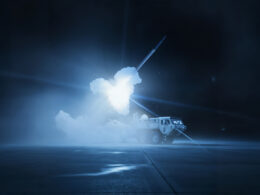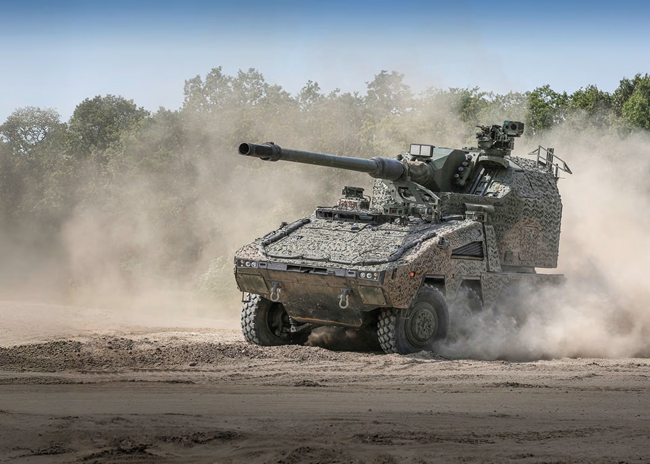
The United Kingdom has committed close to £1 billion to acquire 72 RCH 155 wheeled self-propelled howitzers from ARTEC GmbH, the joint venture between KNDS Deutschland and Rheinmetall, with the contract awarded on 13 May 2026 through the Organisation for Joint Armament Cooperation. The order restores a long-range artillery capability that has been hollowed out since the British Army donated its entire AS90 fleet to Ukraine in 2023, but the procurement sequence is unusual. The UK has elected to fold its full production purchase into the same 2028 delivery window as the Early Capability Demonstrator vehicles that were originally intended to de-risk the platform for British service, compressing two procurement phases into one. That decision sits inside a programme where the lead operational user, Ukraine, has spent the past sixteen months working through technical modifications that have repeatedly pushed back front-line introduction.
Why is the British Army accepting demonstrator and production deliveries in the same year for the RCH 155?
The standard logic of an Early Capability Demonstrator contract is to identify integration, training, and sustainment issues on a small number of platforms before locking in a serial production order. The UK signed a £52 million demonstrator contract in December 2025 for three RCH 155 vehicles to be jointly tested with Germany, with delivery slated for the second quarter of 2028. The new £1 billion contract for 72 production vehicles is also expected to begin first deliveries in 2028, meaning the British Army will receive serial systems at roughly the same time it receives the de-risking platforms those serial systems were meant to be informed by. An Army Technology assessment of the May 2026 contract notes that the demonstrator step the UK had built into its own procurement plan now appears to be functionally bypassed by the production timeline. The Ministry of Defence had not, at the point of the announcement, responded to questions on whether the 72-unit order represents a Batch 1 with subsequent tranches to follow, or whether the regimental allocation has been finalised.
This matters because the RCH 155 in 2026 is not a fully mature in-service platform. It is a system that has been delivered in small numbers to one operational user, Ukraine, where it remains subject to active modification. KNDS Deutschland transferred the first of 54 contracted units to Kyiv in January 2025, but as of August that year the company was still working through technical issues identified during testing and training, and the integration of the howitzer into Ukraine’s Kropyva battle management system was still outstanding. Reporting by the German Aid Ukraine tracker indicated that by early 2026 the original 54-unit Ukrainian contract, valued at approximately €890 million, was now expected to complete delivery by 2027 at the earliest, and more likely 2028. For the British Army, this is the closest available proxy for what a national induction of the platform will look like, and it points to a longer tail of in-service problem-solving than the procurement headlines suggest.
How does the UK’s RCH 155 order sit inside KNDS and Rheinmetall’s existing production queue?
The production calendar is the second risk vector. Germany’s Bundeswehr ordered 84 RCH 155 systems on 19 December 2025 under a €1.2 billion contract, with deliveries scheduled between 2027 and 2029, and the German Army’s overall planning envelope extends to 229 systems for a total programme cost of around €3.4 billion. The framework agreement with ARTEC covers up to 500 systems and is open to other nations to call off against, which is the mechanism the UK has now used. The Royal Netherlands Army and Qatar have also expressed procurement interest, according to public reporting in Armada International. ARTEC is therefore being asked to ramp serial production for the Bundeswehr, complete the remaining Ukrainian batches, deliver British demonstrator and production vehicles in overlapping windows, and hold open capacity for further export commitments, all within a manufacturing footprint that until early 2025 had not delivered a single completed system to any operational user.
The UK has attempted to insulate part of this risk by anchoring significant production work onshore. Rheinmetall’s large-calibre Telford facility, known internally as the Gun Hall, will manufacture the barrel, breech, recoil system, and trunnions. Around £30 million of the earlier £53 million long-lead contract from March 2026 was allocated to building out that facility. Sheffield Forgemasters will supply specialist steel, supported by the £420 million investment the British government made in the firm during 2025 under its wider steel strategy. The Boxer drive module, comprising chassis, engine, and drive train, will be manufactured by KNDS UK in Stockport. The Ministry of Defence states the programme will create 100 new skilled jobs at Telford, support 100 at Stockport, and underpin 300 across the wider supply chain. The remaining components, including the artillery gun module itself, will be produced outside the United Kingdom and integrated by ARTEC, which means the UK’s domestic content does not insulate the programme from Germany-side production bottlenecks.
What does 72 systems actually mean for British Army regimental structure and front-line capacity?
The original Mobile Fires Platform requirement, set out by the Ministry of Defence in 2021, envisaged 116 systems for a full operating capability by 2032, with an initial operating capability of 18 systems by early 2029. The 72-unit order announced in May 2026 falls 44 systems short of that requirement. The legacy AS90 fleet equipped three field regiments of the Royal Horse Artillery and Royal Artillery from a notional inventory of around 80 active platforms, and at peak the AS90 force totalled 179 systems. Industry commentary published on UK Defence Journal in March 2026 noted that the previous public aspiration had been for 100 RCH 155 systems, and the current 72 leaves limited margin once training fleets at the Royal School of Artillery and the Royal Artillery Trials and Development Unit, attrition reserves, and depot maintenance pools are accounted for. On standard regimental orbats of three batteries of eight guns, 72 platforms equip three regiments at 24 guns apiece with 0 spares, or three regiments at slightly reduced battery strength with a small training and attrition pool.
The 14 Swedish-supplied Archer 6×6 self-propelled howitzers acquired as an interim capability after the AS90 donation will be retired when the RCH 155 enters service, according to the May 2026 government announcement. Industry observers have suggested the Archers could themselves be donated to Ukraine, which already operates a small Archer fleet, although the Ministry of Defence has not confirmed this disposition. Until RCH 155 deliveries reach a deployable threshold, which the government has phrased as “minimum deployable capability within this decade,” the British Army’s heavy artillery rests on those 14 Archer systems alongside 70 M270 MLRS launchers and the towed 105mm Light Gun fleet. A House of Commons Defence Committee report in 2024 had already flagged the post-AS90 capability gap as a readiness concern.
Why the unit cost differential between Archer and RCH 155 matters for follow-on procurement
The £1 billion contract value implies a unit cost of approximately £12.5 million per RCH 155 system inclusive of training and initial in-service support, compared with approximately £7.5 million per Archer platform on a like-for-like basis. The RCH 155 delivers superior survivability, automation, and shoot-and-scoot performance, and the cost premium is broadly defensible against those capability gains. However, the differential narrows the room for follow-on orders to bring the fleet up to the original 116-unit requirement without additional Treasury allocation. The Defence Investment Plan, which is expected to set British equipment priorities for the next decade, has been repeatedly delayed and was identified by Breaking Defense as one of the factors holding up the RCH 155 contract announcement itself. Without that planning document published, the funding pathway to a second tranche of RCH 155 procurement is not visible in public budgets.
How does the Ukraine RCH 155 experience inform expectations for British in-service introduction?
The integration risk that British procurement is now compressed against is not theoretical. KNDS Deutschland delivered the first RCH 155 to Ukraine in January 2025 with the expectation that operational use would follow within months. Instead, the company spent the subsequent eight months working through modifications identified during Ukrainian testing and training, and as of March 2026 had trained more than 600 Ukrainian soldiers on the system at the Bundeswehr Artillery School in Idar-Oberstein. Reporting by Calibre Defence and the German Aid Ukraine tracker indicates that the Kropyva battle management system integration remained a live issue into 2026. The British Army will not be integrating Kropyva, but it will be integrating the RCH 155 into its own Land Environment Tactical Communications and Information Systems architecture, which is itself in mid-transition. The Bundeswehr, which begins its own RCH 155 deliveries in 2027, will run the first national-scale induction under non-combat conditions, and the lessons from that programme will not be fully available before the UK’s first production vehicles arrive.
What second-order risks does the RCH 155 procurement create for the Royal Artillery’s regimental plan?
The Royal Artillery currently faces a sequencing problem. Three regiments need re-equipping with self-propelled artillery: 1 Royal Horse Artillery and 19 Regiment Royal Artillery, which previously operated the AS90, and a third regiment that is presently equipped with the 105mm Light Gun and will need to re-role. 4 Regiment Royal Artillery, allocated to 7 Light Mechanised Brigade, has been mentioned in open-source commentary as the most likely candidate. Re-roling a Light Gun regiment to RCH 155 has knock-on effects for the 16 Air Assault Brigade and the Royal Marines Commando artillery support model, because the remaining Light Gun regiments, 7 Parachute Regiment Royal Horse Artillery and 29 Commando Regiment Royal Artillery, are committed to airmobile and amphibious roles for which the 38-tonne RCH 155 is unsuited. The A400M Atlas transport has a vehicle weight limit that the Archer fits inside and the RCH 155 does not, which constrains the British Army’s options for retaining an air-deployable heavy artillery capability if the Archers are retired or donated.
The procurement is structurally sound in intent. The RCH 155 is a credible answer to the survivability lessons of the Ukraine war, where stationary artillery systems have been systematically destroyed by drones and counter-battery fire. The British industrial benefits at Telford, Sheffield, and Stockport are real and align with the Strategic Defence Review’s framing of defence as an engine for growth. The Trinity House Agreement with Germany, signed in October 2024, gains substance from a shared platform that supports joint training, ammunition standardisation, and sustainment. But the combination of a compressed demonstrator phase, a production queue that places the British order behind German and Ukrainian commitments, a fleet size that falls short of the original requirement, and an immature in-service track record at the platform’s lead user means the 2028 first-delivery date should be read as an aspiration rather than a baseline. The risk is not that the RCH 155 fails to enter British service. It is that it enters service more slowly, in smaller numbers, and with more integration friction than the £1 billion headline implies.
Key takeaways from the UK’s RCH 155 procurement decision
- The 72-unit order falls 44 systems short of the 116-platform Mobile Fires Platform requirement set by the Ministry of Defence in 2021, leaving limited margin for training, attrition, and depot pools once three regiments are equipped.
- The Early Capability Demonstrator phase, contracted in December 2025 for £52 million and intended to de-risk the platform, now overlaps with the 2028 first-production delivery window, compressing two procurement phases that were originally sequential.
- Ukraine, the lead operational user, has been working through technical modifications and battle management system integration for sixteen months since first delivery in January 2025, with the full 54-unit order now expected to complete delivery by 2027 or 2028.
- The Bundeswehr’s 84-unit production order, signed in December 2025 for €1.2 billion, sits ahead of the UK in ARTEC’s serial production queue with deliveries running from 2027 to 2029.
- KNDS and Rheinmetall hold a framework agreement for up to 500 RCH 155 systems, with the Royal Netherlands Army and Qatar having expressed procurement interest, which intensifies competition for serial production capacity.
- UK industrial benefit is real but partial. Rheinmetall Telford produces the gun system, Sheffield Forgemasters supplies the steel, and KNDS UK Stockport produces the Boxer drive module, but the artillery gun module itself is produced in Germany.
- At £12.5 million per system inclusive of training and support, the RCH 155 costs roughly 67 percent more per platform than the £7.5 million Swedish Archer, narrowing the budgetary room for follow-on tranches without additional Treasury allocation.
- The British Army’s heavy artillery during the transition rests on 14 Archer self-propelled howitzers, 70 M270 MLRS launchers, and the towed 105mm Light Gun fleet, with the Archers set for retirement when RCH 155 enters service.
- The 38-tonne RCH 155 cannot be carried by the A400M Atlas, removing an air-deployable heavy artillery option if the Archers are retired without a like-for-like replacement.
- The Defence Investment Plan, which would clarify the funding pathway for a second RCH 155 tranche to close the gap to 116 systems, remains unpublished as of May 2026.
Discover more from Business-News-Today.com
Subscribe to get the latest posts sent to your email.