

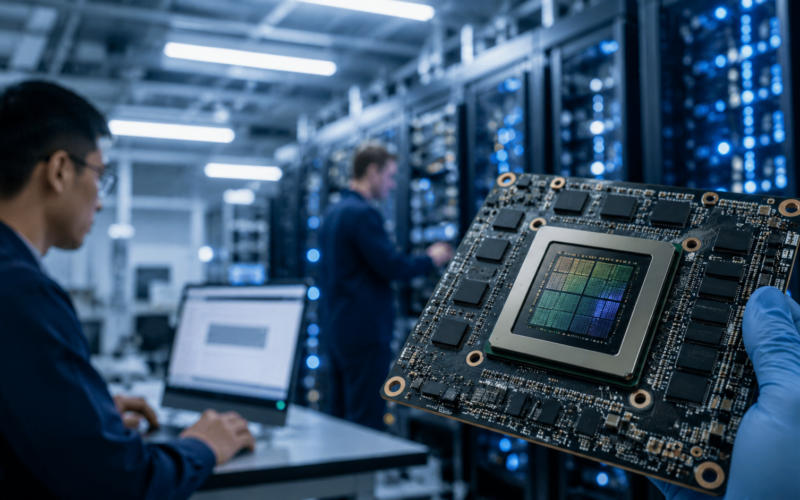
Qualcomm Incorporated (NASDAQ: QCOM) has reportedly reached a deal with ByteDance to supply application-specific integrated circuits for artificial intelligence data centres, marking a significant move by the San Diego-based chip designer beyond its traditional smartphone processor franchise. ByteDance, the Chinese owner of TikTok, is expected to procure millions of Qualcomm Incorporated chips to support its artificial intelligence agent software, with the reported deal helping turn an in-house ByteDance chip design into production-ready silicon. Qualcomm Incorporated shares recently traded at $251.02, up 3.18% on the latest available session, giving the company a market capitalisation of about $269.09 billion. The strategic importance is clear: artificial intelligence infrastructure demand is creating room for custom silicon suppliers beyond Nvidia Corporation, and Qualcomm Incorporated is trying to convert that opening into a serious data centre growth story.
Why does Qualcomm’s reported ByteDance AI chip deal matter for the data centre semiconductor market?
Qualcomm Incorporated’s reported deal with ByteDance matters because it pushes the company more visibly into a market that has been dominated by Nvidia Corporation, Broadcom Inc. and other suppliers of artificial intelligence infrastructure silicon. Qualcomm Incorporated built its global reputation around mobile processors, modem technology and smartphone ecosystems. A large artificial intelligence data centre chip order from ByteDance would signal that the company’s ambitions in custom silicon are no longer theoretical.
The deal also highlights the growing importance of application-specific integrated circuits, or ASICs, in artificial intelligence infrastructure. Unlike general-purpose graphics processing units, ASICs are designed for specific workloads or customer requirements. For companies operating massive artificial intelligence systems, custom chips can reduce power consumption, improve cost efficiency and lower dependence on expensive, supply-constrained general-purpose accelerators.

For ByteDance, the reported procurement of millions of chips would be about more than hardware supply. ByteDance operates TikTok, Douyin and a growing artificial intelligence software portfolio, which makes computing capacity strategically critical. Artificial intelligence agents need large-scale inference infrastructure, not just model training capacity. If ByteDance can use custom chips to support these workloads at scale, it could improve cost control and reduce exposure to external bottlenecks.
The broader market implication is that artificial intelligence infrastructure is becoming more diversified. Nvidia Corporation remains the benchmark for high-performance artificial intelligence acceleration, but hyperscalers, social media companies and cloud platforms are increasingly exploring custom silicon. Qualcomm Incorporated’s reported role shows that the next artificial intelligence chip race may not be only about who has the fastest accelerator. It may also be about who can help major customers build legally compliant, workload-specific and cost-efficient compute platforms.
How does the ByteDance deal support Qualcomm’s move beyond smartphone processors?
The reported ByteDance deal supports Qualcomm Incorporated’s long-term effort to reduce dependence on smartphones, a market that remains large but increasingly mature. Smartphone upgrade cycles have slowed in many regions, and handset chip competition remains intense. Qualcomm Incorporated still has a powerful position in premium Android devices, but investors have been looking for evidence that the company can build durable growth in automotive, internet-of-things, personal computing and data centre infrastructure.
Artificial intelligence custom silicon could become a more strategically valuable extension. Qualcomm Incorporated already has expertise in power-efficient chip design, edge artificial intelligence and system-on-chip integration. Those capabilities are relevant in data centres where electricity costs, thermal efficiency and workload optimisation are increasingly important. The ByteDance report suggests Qualcomm Incorporated may be able to apply parts of its mobile efficiency DNA to artificial intelligence infrastructure.
The deal also fits with management’s broader comments about working on central processing units, inference accelerators and custom ASICs. Inference may become a particularly attractive market because artificial intelligence applications require continuous, large-scale deployment after models are trained. The training market has made Nvidia Corporation the biggest winner so far, but inference workloads could become more fragmented and cost-sensitive, creating opportunities for companies such as Qualcomm Incorporated.
The challenge is execution. Data centre customers demand reliability, software support, manufacturing scale and long product roadmaps. Qualcomm Incorporated cannot simply transfer its smartphone success into server infrastructure by changing the label on the box. It must prove that its custom chips can meet ByteDance’s performance, cost and compliance requirements while competing with established artificial intelligence silicon suppliers.
Why is ByteDance seeking custom AI chips amid United States export restrictions?
ByteDance’s interest in custom artificial intelligence chips reflects the difficult position Chinese technology companies face under United States export controls. Advanced Nvidia Corporation chips have become harder for Chinese firms to access, while domestic alternatives remain under pressure from manufacturing limits, design constraints and supply-chain restrictions. That has pushed Chinese technology groups to seek compliant alternatives that fall below restricted computing thresholds while still supporting useful artificial intelligence workloads.
The reported Qualcomm Incorporated arrangement appears to sit inside that compliance logic. Reuters reported that the chips would need to fall within legally acceptable computing thresholds to avoid violating existing United States restrictions on artificial intelligence chip production for Chinese firms such as ByteDance. That makes the deal strategically sensitive. It is not only a commercial chip supply arrangement. It is also an example of how artificial intelligence competition is being shaped by export-control engineering.
For ByteDance, custom ASICs may offer a route to maintain artificial intelligence development without relying entirely on the most advanced restricted accelerators. If the company can optimise chips for specific agent workloads, it may not need the same level of general-purpose compute performance in every use case. That could help ByteDance continue scaling artificial intelligence features across products while staying within legal limits.
For the United States, the deal raises a familiar policy tension. Export controls are designed to slow access to the most advanced artificial intelligence computing capability. However, they also incentivise companies to redesign around the rules, develop alternatives and build more distributed chip ecosystems. Qualcomm Incorporated’s reported deal illustrates that restrictions may not stop artificial intelligence progress. They may redirect it into custom, lower-threshold and more specialised architectures.
What does Qualcomm’s stock reaction suggest about investor sentiment toward the AI infrastructure pivot?
Qualcomm Incorporated shares recently traded at $251.02, up 3.18% on the latest available session, with intraday trading between $245.54 and $259.84 and a market capitalisation of about $269.09 billion. That move suggests investors are receptive to evidence that Qualcomm Incorporated can participate more meaningfully in the artificial intelligence infrastructure cycle. The market is not only rewarding the reported order size. It is rewarding the possibility that Qualcomm Incorporated’s addressable market is expanding.
The investor logic is straightforward. Qualcomm Incorporated’s core smartphone business is profitable, but growth expectations in artificial intelligence infrastructure carry higher narrative value. If the company can become a credible supplier of custom data centre chips, it may receive a valuation lens closer to artificial intelligence infrastructure peers rather than only mobile semiconductor companies. That would be a meaningful shift.
However, investors will also need to be careful. The reported ByteDance deal does not yet prove that Qualcomm Incorporated has become a broad artificial intelligence data centre leader. It proves, if confirmed and executed, that the company may have won a major custom silicon opportunity. The difference matters. One large customer win can open doors, but sustainable rerating requires repeat customers, margin visibility, software ecosystem support and manufacturing execution.
The stock reaction therefore looks rational but early. Qualcomm Incorporated has earned investor attention because the ByteDance deal points to a credible new growth vector. The next test is whether the company can convert artificial intelligence custom silicon from a headline into recurring revenue and strategic customer relationships.
How could this deal affect Nvidia, Broadcom and Marvell in the AI chip race?
The reported Qualcomm Incorporated and ByteDance deal does not displace Nvidia Corporation’s leadership in artificial intelligence accelerators, but it does reinforce the idea that the market is fragmenting. Nvidia Corporation remains dominant in high-end training and broad artificial intelligence development because of its hardware performance, CUDA software ecosystem and deeply entrenched developer base. However, not every workload requires the highest-end Nvidia Corporation chips, especially when cost, power and export compliance are major constraints.
Broadcom Inc. and Marvell Technology, Inc. may feel the competitive signal more directly because both companies are strongly associated with custom silicon and ASIC opportunities. Large technology customers increasingly want bespoke chips that reduce reliance on off-the-shelf accelerators. Qualcomm Incorporated entering this market with a ByteDance-scale opportunity could create another credible competitor for custom artificial intelligence silicon design and production partnerships.
The deal could also encourage more customers to consider multi-vendor strategies. Artificial intelligence infrastructure buyers do not want to depend on one supplier if capacity is constrained, pricing is high or export rules are uncertain. Custom ASICs can help companies tailor compute to their own workloads, and suppliers that can offer design expertise plus manufacturing coordination may gain negotiating power.
That said, artificial intelligence chip competition is not a simple zero-sum market yet. Demand is growing so quickly that multiple architectures can expand simultaneously. Nvidia Corporation may keep dominating high-performance workloads, Broadcom Inc. and Marvell Technology, Inc. may continue scaling custom silicon programmes, and Qualcomm Incorporated may carve out specific inference or compliance-driven opportunities. The artificial intelligence chip market is starting to look less like a throne and more like a very expensive cafeteria.
Why does the reported deal matter for ByteDance’s AI agent ambitions?
The reported deal matters for ByteDance because artificial intelligence agents require reliable, scalable and cost-efficient inference capacity. ByteDance already operates products with huge user engagement, including TikTok and Douyin. If the company wants to embed artificial intelligence agents into content creation, recommendations, advertising tools, search, customer service or productivity applications, it needs a computing layer that can handle massive real-time demand.
Artificial intelligence agents are different from simple chatbot features. They may need to interpret user intent, retrieve information, plan actions, generate content, interact with applications and respond continuously. That creates sustained compute demand. For a company with ByteDance’s scale, even small efficiency gains per query or action can become financially meaningful.
Custom chips could give ByteDance more control over that cost structure. If Qualcomm Incorporated can help turn ByteDance’s completed in-house chip design into production-ready semiconductors, ByteDance may gain a stronger link between internal software needs and hardware execution. That vertical alignment is increasingly important in artificial intelligence. Companies do not want generic compute if their workloads have specific patterns that can be optimised.
There is also a strategic autonomy dimension. ByteDance faces regulatory scrutiny in the United States and other markets, while Chinese technology firms remain exposed to semiconductor restrictions. Building a custom chip supply pathway through Qualcomm Incorporated could help ByteDance reduce uncertainty, although the arrangement would still need to stay within United States regulatory boundaries.
What risks could challenge Qualcomm’s ByteDance AI chip opportunity?
The most obvious risk is regulatory. Any artificial intelligence chip deal involving a United States semiconductor company and a major Chinese technology platform will attract scrutiny. Qualcomm Incorporated must ensure that the chips comply with United States export rules and computing thresholds. If regulators tighten restrictions further, the economics or feasibility of the deal could change.
The second risk is technical execution. Turning an in-house chip design into production-ready silicon is complex. It requires design validation, manufacturing coordination, yield management, packaging, testing, deployment and software integration. ByteDance may be an attractive customer, but scale itself creates pressure. Supplying millions of chips means execution errors can become expensive quickly.
The third risk is customer concentration. A large ByteDance deal could be valuable, but Qualcomm Incorporated needs a broader artificial intelligence infrastructure customer base to prove strategic durability. If the opportunity remains concentrated around one customer or one specific compliance window, investors may hesitate to assign a deeper artificial intelligence infrastructure multiple.
The fourth risk is margin structure. Custom ASIC deals can generate large revenue, but profitability depends on design terms, manufacturing costs, volume commitments, pricing power and intellectual property arrangements. Investors will want to know whether Qualcomm Incorporated is building a high-return platform or simply taking on capital-intensive work to enter the data centre conversation.
What should executives and investors watch next after the Qualcomm and ByteDance report?
Executives and investors should first watch whether Qualcomm Incorporated or ByteDance confirms the arrangement or provides clearer details through regulatory filings, earnings commentary or supply-chain signals. Reuters said it could not independently verify the Bloomberg report, and neither company immediately responded to requests for comment. Confirmation matters because the reported order scale is significant and could influence expectations for Qualcomm Incorporated’s data centre pipeline.
Second, investors should monitor United States export-control developments. If new rules tighten the thresholds for chips sold to Chinese firms, the deal’s structure may need adjustment. Semiconductor diplomacy is now part of business planning. That is not ideal for executives who prefer simple sales cycles, but welcome to artificial intelligence in 2026.
Third, watch Qualcomm Incorporated’s broader artificial intelligence infrastructure disclosures. Management commentary on ASIC customers, inference accelerators, CPUs and data centre revenue timelines will help investors judge whether the ByteDance opportunity is isolated or part of a larger strategy. The strongest signal would be additional major customers or partnerships beyond ByteDance.
Fourth, watch the competitive response from Broadcom Inc., Marvell Technology, Inc. and Nvidia Corporation. Qualcomm Incorporated’s entry into ByteDance-linked custom artificial intelligence chips could reshape customer conversations in a market where buyers want cost control, supply resilience and regulatory flexibility. The companies that can deliver workload-specific performance while navigating export rules may gain advantage.
Key takeaways on what Qualcomm’s reported ByteDance AI chip deal means for semiconductors and AI infrastructure
- Qualcomm Incorporated’s reported ByteDance deal marks a significant push beyond smartphone processors into artificial intelligence data centre chips and custom silicon.
- ByteDance is expected to procure millions of Qualcomm Incorporated application-specific integrated circuits to support artificial intelligence agent software.
- The deal highlights growing demand for ASICs as technology companies seek workload-specific chips that can reduce cost, power use and dependence on general-purpose accelerators.
- United States export controls are central to the story because the chips must remain within legally acceptable computing thresholds for Chinese customers.
- Qualcomm Incorporated shares rose on the report, suggesting investors see artificial intelligence infrastructure as a potentially important new growth vector.
- Nvidia Corporation remains dominant in advanced artificial intelligence acceleration, but the market is becoming more fragmented as customers explore custom and compliant alternatives.
- Broadcom Inc. and Marvell Technology, Inc. may face a stronger competitive signal because both are established players in custom silicon opportunities.
- For ByteDance, the reported deal could support artificial intelligence agent deployment while reducing reliance on restricted high-end chips.
- The main risks are regulatory tightening, technical execution, customer concentration and whether custom chip economics generate attractive margins.
- Investors should watch for confirmation, additional Qualcomm Incorporated artificial intelligence infrastructure customers and future United States semiconductor export-control changes.
Discover more from Business-News-Today.com
Subscribe to get the latest posts sent to your email.