



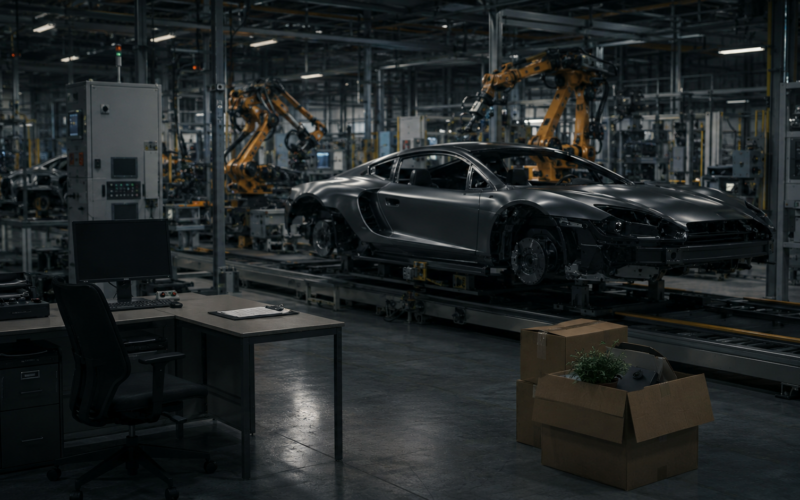
Dr. Ing. h.c. F. Porsche Aktiengesellschaft (Xetra: P911) has agreed to eliminate a further 5,000 positions by 2035 as the German luxury-car manufacturer attempts to rebuild profitability after weakening demand in China, slower electric vehicle adoption and mounting pressure on its once-industry-leading margins. The new reductions will largely be achieved through natural attrition, demographic changes, expanded partial-retirement programmes and voluntary severance agreements, rather than compulsory redundancies. Together with 3,900 previously announced reductions and more than 500 positions affected by the closure of non-core subsidiaries, Porsche’s restructuring programme now covers roughly 9,000 jobs, equivalent to around one-fifth of its late-2024 workforce.
The agreement represents more than another round of corporate cost-cutting. Porsche employees have effectively accepted slower wage growth, lower future Christmas bonuses, tighter remote-working rules and changes to production practices in exchange for extended employment protection and €2.1 billion of investment at the company’s Zuffenhausen manufacturing site and Weissach research and development centre. The pact protects those locations and rules out compulsory redundancies through the end of 2035.
For Porsche, the deal creates breathing space without removing the commercial problem. Global deliveries fell 16% to 122,306 vehicles during the first half of 2026, while deliveries in China plunged 32% to 14,501 vehicles. The company must now demonstrate that reducing labour costs and simplifying its organisation can restore sustainable margins without weakening product quality, innovation or the exclusivity that supports its premium pricing.
Why is Porsche eliminating 5,000 more jobs while protecting its German factories?
Porsche’s new Future Package is designed as a negotiated exchange between workforce security and structural cost reduction. The company has committed to keeping its principal Zuffenhausen and Weissach operations protected until 2035, extending the previous guarantee by five years. In return, the workforce will gradually become smaller and operate under more flexible and less expensive employment conditions.
The additional 5,000 positions are expected to disappear over approximately nine years. That long timetable means the programme should not be interpreted as an immediate mass dismissal. Porsche plans to rely primarily on employees retiring, voluntarily leaving or entering specially expanded partial-retirement arrangements. Voluntary severance agreements will provide another route for reducing headcount.
The distinction is significant. Compulsory layoffs can create immediate disruption, political opposition and reputational damage, particularly in Germany, where labour representatives have substantial influence over large industrial companies. Attrition-led reductions allow Porsche to lower employment costs more gradually while preserving institutional knowledge and reducing the risk of labour conflict.
However, the slower method also means savings will take time to emerge. Porsche cannot instantly remove thousands of salaries from its cost base, leaving management dependent on additional productivity measures, compensation concessions and organisational simplification to produce earlier financial improvements.
The company had approximately 42,600 employees at the end of 2024. The wider programme of roughly 9,000 planned job reductions therefore corresponds to approximately one-fifth of that workforce, although the final percentage will depend on hiring, retirements and the timing of departures during the restructuring period.

What concessions did Porsche employees accept under the Future Package agreement?
The workforce agreement reaches substantially beyond job numbers. Porsche employees covered by the company’s pay framework will defer 3.5% of current collectively agreed salary increases and future increases until 2035. Senior and top management will make an equivalent contribution by waiving increases in basic compensation during 2027 and 2028.
Christmas bonuses will also become less generous. The voluntary company-funded portion is scheduled to decline from 45% to 5% by 2035, reducing the maximum Christmas payment from 100% of a monthly salary to 60%. Other voluntary payments will become more closely tied to Porsche’s profitability and financial performance.
Remote-working flexibility will be reduced from a maximum of 12 days per month to eight days. Changes are also planned for break arrangements and production cycle times, giving Porsche greater ability to modify how work is organised across its main German locations.
These measures indicate that the negotiations were not merely about avoiding compulsory layoffs. Porsche is attempting to alter the underlying economics of employment by restraining wage growth, reducing fixed benefits and increasing operational flexibility.
Employees will receive some immediate compensation. Porsche plans to pay a one-time transformation bonus of €1,500 in August 2026. Members of IG Metall will receive an additional €411, bringing their total payment to €1,911, alongside an annual €200 voucher and an extra day of leave under the union membership arrangements.
The package therefore combines long-term concessions with short-term payments and employment protection. It is a distinctly German form of restructuring, with management and labour sharing the economic burden rather than placing it entirely on employees selected for immediate dismissal.
How did Porsche’s China slowdown turn into a global workforce problem?
China was once one of Porsche’s most important growth engines and an exceptionally profitable market for high-end sport utility vehicles, sports cars and luxury saloons. That advantage has weakened as Chinese consumers have become more cautious and domestic manufacturers have improved their electric vehicle technology, software and premium positioning.
Porsche delivered only 14,501 vehicles in China during the first half of 2026, down 32% from 21,302 vehicles in the corresponding period of 2025. The decline was substantially steeper than the company’s global reduction of 16%, confirming that China remains the most serious regional weakness within Porsche’s sales portfolio.
Management has responded with a value-over-volume strategy, meaning Porsche would rather accept fewer sales than protect market share through aggressive discounting. That approach can help defend the brand’s exclusivity, but it also leaves factories, research operations and administrative structures designed for a larger business supporting fewer vehicle deliveries.
The workforce reduction roughly mirrors the decline in sales volume, according to the market assessment cited by Reuters. This makes the restructuring less about extracting an additional percentage point of efficiency from a healthy company and more about resizing Porsche for a potentially smaller medium-term revenue base.
A rapid return to Porsche’s previous China volumes cannot be assumed. Chinese electric vehicle manufacturers are becoming stronger in design, technology and luxury features, while local buyers are increasingly willing to select domestic brands. Porsche must therefore rebuild relevance without sacrificing the premium economics that distinguish it from mass-market manufacturers.
That task is difficult because lowering prices risks weakening brand value, while maintaining prices can prolong the volume decline. Workforce reductions address the cost side of the equation, but they do not automatically restore demand.
Did Porsche expand its electric vehicle strategy faster than customers were ready to follow?
Porsche’s restructuring also reflects an electric vehicle transition that has progressed less predictably than management originally expected. The company invested heavily in battery technology, electric platforms and an increasingly electric product portfolio, but customer adoption has varied substantially across regions and vehicle categories.
First-half 2026 deliveries of the electric Taycan fell 25% to 6,219 vehicles. Total Macan deliveries declined 22% to 35,315 vehicles, including 15,620 electric models and 19,695 combustion-engine variants sold in markets where the conventional model remained available. Porsche attributed the weakness partly to slower-than-expected electromobility growth and the expiration of United States tax incentives for electric and hybrid vehicles.
The company has consequently adopted a more flexible product strategy. Chief Executive Officer Michael Leiters has emphasised that Porsche’s identity should depend on driving experience and technical quality rather than any single powertrain technology. Strategy 2035 is expected to reduce the number of model variants, concentrate development resources and align products more closely with actual customer demand.
This does not mean Porsche is abandoning electric vehicles. The company has begun customer deliveries of the electric Cayenne and continues to offer the electric Macan and Taycan. The adjustment is instead an acknowledgement that combustion engines, plug-in hybrids and fully electric models may need to coexist longer than initially anticipated.
The cost of that adjustment is substantial. Product plans, manufacturing systems, battery investments and research programmes must all be recalibrated. Closing non-core subsidiaries and reducing the workforce are part of the effort to fund this more flexible strategy without allowing capital requirements to overwhelm profitability.
Why is Porsche investing €2.1 billion while simultaneously removing thousands of roles?
The apparent contradiction between job reductions and investment becomes more understandable when the purpose of the €2.1 billion commitment is examined. Porsche is not withdrawing from its German industrial base. It is attempting to modernise a smaller and more productive version of that base.
The company intends to preserve two-door sports-car production at Zuffenhausen, expand its Sonderwunsch personalisation programme and maintain Weissach as the central development location for all model lines. These are strategically valuable activities because sports cars, personalisation and specialised engineering reinforce the characteristics that allow Porsche to command premium prices.
The investment agreement also protects the future of Zuffenhausen and Weissach amid wider uncertainty across Volkswagen’s German manufacturing network. Parent company Volkswagen Aktiengesellschaft is pursuing extensive cost reductions across its brands, and the possibility of factory closures elsewhere has increased the importance of securing long-term commitments for Porsche’s core locations.
From management’s perspective, preserving every existing role could make those facilities economically unsustainable. From the workforce’s perspective, accepting gradual reductions and compensation concessions is preferable to facing plant closures or compulsory layoffs later.
The Future Package is therefore best viewed as an industrial compact. Employees are contributing to the financing of future competitiveness, while Porsche is committing capital and extending employment guarantees. Whether that compact succeeds will depend on the company actually completing the investments and generating enough demand to utilise the upgraded facilities.
Can Porsche protect its luxury positioning while becoming smaller and more efficient?
Porsche’s challenge is more complicated than simply reducing expenses. Luxury-car profitability depends on scarcity, product desirability, pricing power and customer confidence. Excessive cost-cutting can undermine those advantages by delaying new vehicles, reducing engineering depth or weakening the buying and ownership experience.
The company’s product data provides some evidence that its strongest franchises remain resilient. Porsche 911 deliveries rose 19% to 30,534 vehicles in the first half of 2026, despite the wider decline. The Cayenne remained the company’s largest model line with 38,141 deliveries, although that represented a 9% reduction.
The strength of the Porsche 911 is strategically important. It suggests demand remains robust for vehicles most closely associated with Porsche’s traditional sports-car identity. Management’s decision to simplify the portfolio and concentrate on higher-value products could therefore improve margins even without a return to peak unit volumes.
The risk is that Porsche becomes too dependent on a limited number of established nameplates while losing momentum in electric vehicles and China. The Porsche 911 can anchor the brand, but it cannot by itself support the scale of the entire company.
Porsche must also continue investing in software, battery systems, hybrid technology and regulatory compliance. A leaner workforce may help lower costs, but innovation requirements are not becoming smaller. Management will need to remove bureaucracy and duplicated work without hollowing out the technical capabilities that support future products.
How are Porsche shares responding to the 5,000-job restructuring agreement?
Porsche preferred shares traded at approximately €44.42 during the July 28 European session, up about 1.4% from the previous close of €43.79. The stock was down roughly 0.7% over five trading days but remained about 2.1% higher over one month.
The shares were trading within a 52-week range of €35.62 to €50.66. At €44.42, Porsche was approximately 12% below its 52-week high and almost 25% above its 52-week low. The positioning indicates that investor sentiment has improved from its weakest point, although the market has not yet priced in a decisive recovery.
The mildly positive July 28 movement suggests investors may view the labour agreement as constructive because it provides a defined route to reducing personnel costs without creating an immediate confrontation with employees. The extended site protection and investment commitments also reduce uncertainty surrounding Porsche’s principal German operations.
However, the share reaction should not be attributed exclusively to the job cuts, particularly while markets are processing broader automotive, trade and economic developments. Porsche is also scheduled to publish its half-year financial report on July 29, meaning investors will shortly receive more detailed evidence on revenue, operating profit, cash flow and the cost of the strategic reset.
Porsche has forecast 2026 revenue of approximately €35 billion to €36 billion and an operating return on sales of 5.5% to 7.5%. The guidance incorporates expected one-off expenses of €800 million to €900 million and tariff costs of approximately €700 million. Those numbers illustrate how far the company has moved from the exceptionally high margins that once defined its investment case.
What must Michael Leiters deliver after securing Porsche’s workforce agreement?
Michael Leiters became Porsche Chief Executive Officer on January 1, 2026, with a mandate to simplify the organisation, improve profitability and restore strategic clarity. The workforce agreement gives him an important foundation, but it does not constitute the turnaround itself.
Management must now convert the negotiated concessions into lower structural costs. That requires disciplined implementation, clearer accountability, fewer organisational layers and measurable improvements in productivity. Merely waiting for employees to retire will not produce the operational speed Leiters has promised.
The company must also clarify its product roadmap. Porsche plans to reveal additional details of Strategy 2035 at its Capital Markets Day on October 7. Investors will expect concrete decisions on model range, electric vehicle investment, combustion-engine and hybrid programmes, China strategy and capital allocation.
External demand remains the decisive variable. Porsche can resize factories, reduce bonuses and eliminate jobs, but the turnaround will remain incomplete unless customers respond positively to its vehicles. The company needs to demonstrate that it can maintain premium prices, stabilise China, manage the electric transition and grow high-margin products.
The Future Package has removed some uncertainty surrounding German employment and investment. It has also made the scale of Porsche’s problem impossible to ignore. A company once celebrated for exceptional margins is preparing to operate with roughly one-fifth fewer positions because its market conditions and strategic assumptions have changed.
The restructuring may ultimately make Porsche more resilient, focused and profitable. It may also reveal that the company’s earlier scale was dependent on Chinese demand and electric vehicle expectations that will not return soon. The next financial reports and the October strategy presentation will begin showing which interpretation is closer to reality.
What are the key takeaways from Porsche’s latest 5,000-job reduction plan?
- Porsche will eliminate a further 5,000 positions by 2035, mainly through attrition, partial retirement and voluntary severance rather than compulsory layoffs.
- The wider restructuring now covers roughly 9,000 roles when previously announced reductions and subsidiary closures are included.
- Porsche will invest €2.1 billion at Zuffenhausen and Weissach while protecting those locations and ruling out compulsory redundancies until the end of 2035.
- Employees accepted deferred wage increases, lower future Christmas bonuses, reduced remote-working allowances and changes to production practices.
- First-half 2026 global deliveries fell 16%, while China deliveries dropped 32%, intensifying pressure to resize the company.
- Porsche shares were modestly higher on July 28, but the July 29 half-year financial report remains the more important near-term investor catalyst.
Discover more from Business-News-Today.com
Subscribe to get the latest posts sent to your email.