
Pony AI Inc. reported a sharp acceleration in commercial autonomous-driving revenue during the second quarter of 2026 as total revenue increased 68.8% year over year to $36.2 million and Robotaxi services revenue surged 691.2% to $12.1 million. The company’s Robotaxi fleet reached 1,975 vehicles at June 30 and remains on course to exceed 3,500 vehicles by year-end, while registered PonyPilot users in China surpassed 1.5 million as operating density increased across major cities. Pony AI has also secured or is negotiating international deployment agreements covering more than 4,000 Robotaxis, including a contracted plan with Uber Technologies to deploy more than 2,000 vehicles across Europe. The growth provides some of the clearest evidence yet that Robotaxi commercialization is beginning to generate meaningful revenue, although Pony AI still reported a $65.7 million operating loss and spent $32.2 million on capital expenditure during the quarter.
The financial trajectory is improving in some respects without approaching profitability. Gross profit increased 83.4% to $6.4 million and gross margin expanded to 17.5% from 16.1%, helped by the growing contribution from higher-margin Robotaxi services. Net loss narrowed to $45.4 million from $53.3 million, although net loss attributable specifically to Pony AI Inc. widened to $59.8 million because $14.5 million of income was allocated to non-controlling interests.
Pony AI shares traded around $7.94 during the August 18 session, down approximately 0.5% despite moving as high as $8.51 intraday. The muted reaction suggests investors are balancing the extraordinary Robotaxi revenue growth against continued operating losses, heavy research spending and the capital required to scale thousands of autonomous vehicles across multiple markets.
Robotaxi revenue is becoming large enough to reshape Pony AI’s overall business mix
Robotaxi services generated $12.1 million during Q2 compared with only $1.5 million a year earlier, representing growth of 691.2%. Fare-charging revenue grew even faster, rising more than eightfold as Pony AI expanded commercial operations using its seventh-generation vehicles and increased utilization within existing service areas.
The importance of that growth extends beyond percentage comparisons because Robotaxi services represented approximately one-third of Pony AI’s total quarterly revenue. For years, autonomous-driving companies have faced skepticism over whether extensive testing programs could become economically meaningful businesses, and Pony AI’s latest mix provides evidence that commercial rides are beginning to contribute at a scale that can influence consolidated financial results.
Pony AI’s joint deployment model is also becoming an increasingly important source of revenue. Under that structure, partners participate in vehicle deployment and local operations rather than requiring Pony AI to finance every vehicle and market entirely through its own balance sheet, potentially allowing the company to increase geographic coverage more quickly while limiting some of the capital burden associated with fleet expansion.
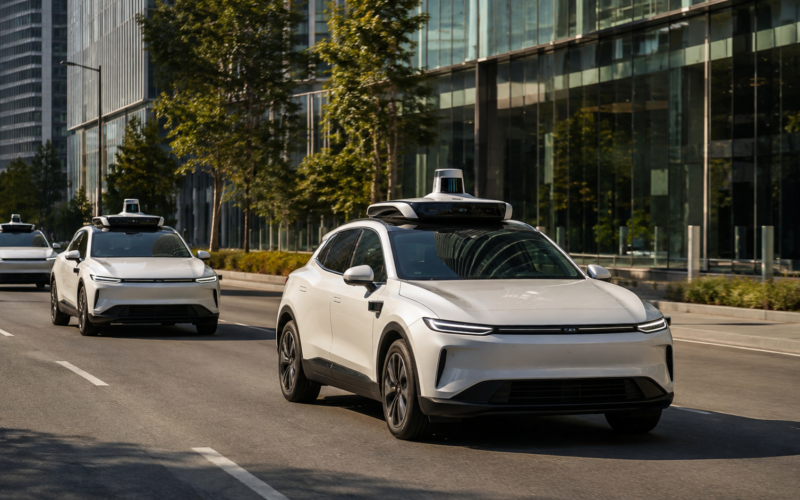
The fleet reached 1,975 Robotaxis by June 30, leaving Pony AI needing to add more than 1,500 vehicles during the second half to exceed its 3,500-vehicle year-end target. That represents another major step-up in deployment and explains why manufacturing capacity, vehicle financing, maintenance systems and local operating partnerships are increasingly important alongside autonomous-driving software itself.
Registered PonyPilot users in China exceeded 1.5 million as of August 16, supported by greater fleet density and broader coverage across key operating zones. Greater density matters because shorter passenger waiting times and more productive vehicle utilization can improve customer experience while potentially improving the economics of each deployed Robotaxi.
Uber partnership and a 4,000-vehicle overseas pipeline give Pony AI a much larger international opportunity
Pony AI’s growth strategy is rapidly expanding beyond China. The company said international deployment agreements already signed or under negotiation now cover more than 4,000 Robotaxis, while its expanded partnership with Uber includes contracted deployment of more than 2,000 vehicles across five European cities.
The international pipeline does not mean all 4,000 vehicles will immediately enter service. Deployment schedules remain dependent on permits, regulatory approvals and operational readiness in each market, making the agreements a measure of potential scale rather than recognized revenue or guaranteed near-term fleet additions.
Europe is emerging as an especially important testing ground. Pony AI and Uber have already been developing their partnership in Zagreb and are planning broader European deployment, while Pony AI is simultaneously pursuing opportunities across the Middle East and Asia as autonomous-driving companies compete for early positions in markets developing commercial regulatory frameworks.
This partner-led model could reduce one of the industry’s largest barriers to expansion. Robotaxi operators need vehicles, local fleet management, customer acquisition, regulatory relationships and ride-hailing demand, while platforms such as Uber already possess large customer networks and established mobility operations. Combining Pony AI’s autonomous-driving system with external operating partners could allow the company to expand faster than building every market independently.
International expansion nevertheless introduces additional complexity. Autonomous-driving regulations differ substantially between countries, driving environments vary and vehicles must be supported by local maintenance and operational teams, meaning agreements covering thousands of vehicles still require considerable execution before they translate into sustainable revenue.
Robotruck growth adds another commercial engine while intelligent solutions remain comparatively flat
Robotaxi is now the fastest-growing business, but Robotruck remains Pony AI’s largest individual revenue category. Robotruck services revenue increased 40% year over year to $13.3 million from $9.5 million, supported primarily by freight transportation activity through the company’s collaboration with Sinotrans.
Pony AI’s fourth-generation Robotrucks have entered mass production, providing the hardware platform for additional commercial deployments. The company has also partnered with China Merchants Port at Mawan Port in Shenzhen, where driverless Robotrucks are being deployed in mixed-fleet logistics operations alongside conventional human-driven trucks.
The port deployment is strategically significant because structured logistics environments can provide a more controlled commercialization pathway than unrestricted passenger transportation. Repetitive freight routes, defined operating areas and high vehicle utilization can make autonomous trucks attractive for industrial customers if the technology can reduce labor requirements and increase fleet productivity.
Pony AI’s third business, Intelligent Solutions, generated $10.8 million of revenue, broadly unchanged from $10.4 million a year earlier. Management attributed the comparatively flat performance primarily to fluctuations in autonomous domain-controller deliveries, meaning virtually all consolidated growth during Q2 came from Robotaxi and Robotruck commercialization rather than the company’s older solutions business.
That shift is strategically encouraging because transportation services can potentially create recurring usage-based revenue rather than relying exclusively on hardware or technology deliveries. Pony AI’s longer-term valuation increasingly depends on proving that autonomous fleets can generate sustainable service economics at large scale.
Pony AI’s improving gross margin is being overwhelmed by research spending and deployment costs
Total cost of revenue rose 66% to $29.9 million, slightly slower than the 68.8% increase in sales. Gross profit consequently increased 83.4% to $6.4 million and gross margin improved by 1.4 percentage points to 17.5%, with Pony AI attributing part of that expansion to a larger contribution from higher-margin Robotaxi services.
Operating expenses remain dramatically larger than gross profit. Research and development spending increased to $56.2 million from $49 million as Pony AI expanded engineering personnel, vehicle development and testing work required for large-scale commercial deployment. Selling, general and administrative expenses were comparatively stable at approximately $15.9 million.
The result was a $65.7 million operating loss, wider than the $61.3 million loss reported a year earlier. However, operating-loss margin improved substantially to 181.5% from 285.6% because revenue is growing far more quickly than absolute operating losses, providing early evidence of operating leverage even though the business remains far from breakeven.
Net loss declined 14.9% to $45.4 million, but that improvement was influenced by non-operating accounting movements. Pony AI recorded a $33.4 million gain from changes in the fair value of trading securities, while a one-time $25 million impairment involving prepayments for long-term investments moved in the opposite direction. Non-GAAP net loss was $44.7 million, broadly unchanged from $44.3 million a year earlier.
The non-GAAP comparison provides the more conservative interpretation. Pony AI is generating substantially more revenue and improving loss margins, but underlying absolute losses have not yet declined meaningfully because the company is continuing to spend aggressively on research, vehicles and infrastructure ahead of anticipated commercial scale.
$1.39 billion of liquidity gives Pony AI time to fund the next stage of Robotaxi expansion
Pony AI remains unusually well funded relative to its current revenue base. Cash, short-term investments, restricted cash and long-term debt instruments held for wealth management totaled approximately $1.39 billion at June 30, down from $1.44 billion three months earlier as operating cash outflows and capital expenditures consumed liquidity.
Capital expenditure increased to $32.2 million from only $9.6 million a year earlier, primarily reflecting mass production and deployment of Gen-7 Robotaxis alongside investment in data centers and servers. The increase shows why scaling autonomous mobility is not simply a software exercise, with commercial growth requiring substantial physical assets and computing infrastructure.
Operating activities used $118.2 million of cash during the first six months of 2026, while the company continued increasing property, equipment and software assets. Pony AI still carries relatively modest conventional liabilities compared with its asset base, with total liabilities of approximately $93 million against $1.74 billion of total assets at June 30.
That liquidity gives management time to pursue fleet growth without an immediate financing crisis, but it does not make capital efficiency irrelevant. A company can maintain substantial cash reserves while destroying shareholder value if each additional vehicle requires more investment than the future cash flow it generates, making unit economics increasingly important as the Robotaxi fleet approaches several thousand vehicles.
The next stage of Pony AI’s investment story will therefore be determined by more than fleet size. Continued triple-digit Robotaxi revenue growth, higher utilization and improving gross margins would demonstrate that scaling is producing stronger economics, while rapidly rising capital expenditure without corresponding margin improvement would raise questions about how much funding commercial autonomy ultimately requires.
The August 18 results provide meaningful evidence that commercialization is accelerating. Robotaxi revenue has moved from $1.5 million to $12.1 million in a year, the fleet is approaching 2,000 vehicles and international agreements could eventually expand deployment by thousands more, but the $65.7 million quarterly operating loss shows how far Pony AI still has to travel before technological scale becomes financial profitability.
Key takeaways from Pony AI’s 691% Robotaxi revenue growth and global expansion
- Pony AI’s Q2 revenue increased 68.8% to $36.2 million, driven primarily by Robotaxi and Robotruck services.
- Robotaxi services revenue surged 691.2% to $12.1 million, accounting for roughly one-third of total quarterly revenue.
- Fare-charging Robotaxi revenue increased more than 800% year over year as Gen-7 commercial deployments expanded.
- Pony AI’s Robotaxi fleet reached 1,975 vehicles and remains targeted to exceed 3,500 vehicles by year-end.
- International agreements signed or under negotiation cover more than 4,000 Robotaxis, including over 2,000 contracted with Uber for Europe.
- Robotruck revenue increased 40% to $13.3 million, supported by freight services and the Sinotrans partnership.
- Gross margin improved to 17.5% from 16.1%, helped by the growing contribution from Robotaxi services.
- Q2 operating loss remained substantial at $65.7 million, although operating-loss margin narrowed sharply as revenue scaled.
- Pony AI held approximately $1.39 billion of liquidity, while quarterly capital expenditure jumped to $32.2 million.
- Pony AI shares traded around $7.94 on August 18, down about 0.5% as investors weighed rapid commercialization against continuing losses.
Discover more from Business-News-Today.com
Subscribe to get the latest posts sent to your email.