

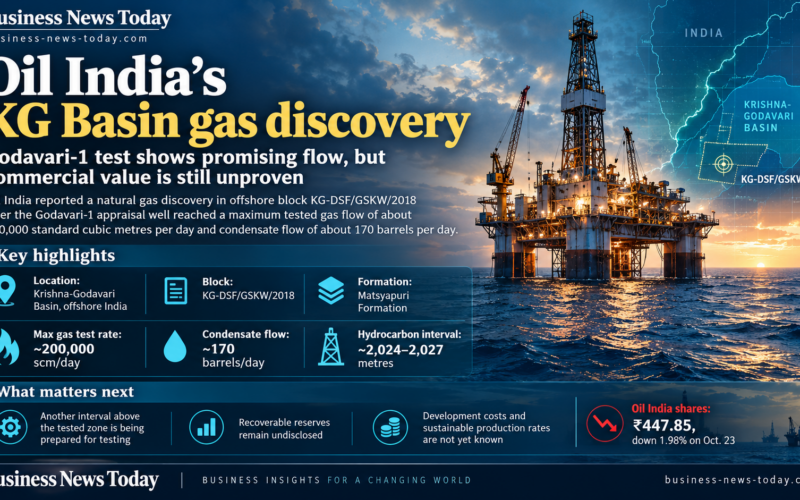
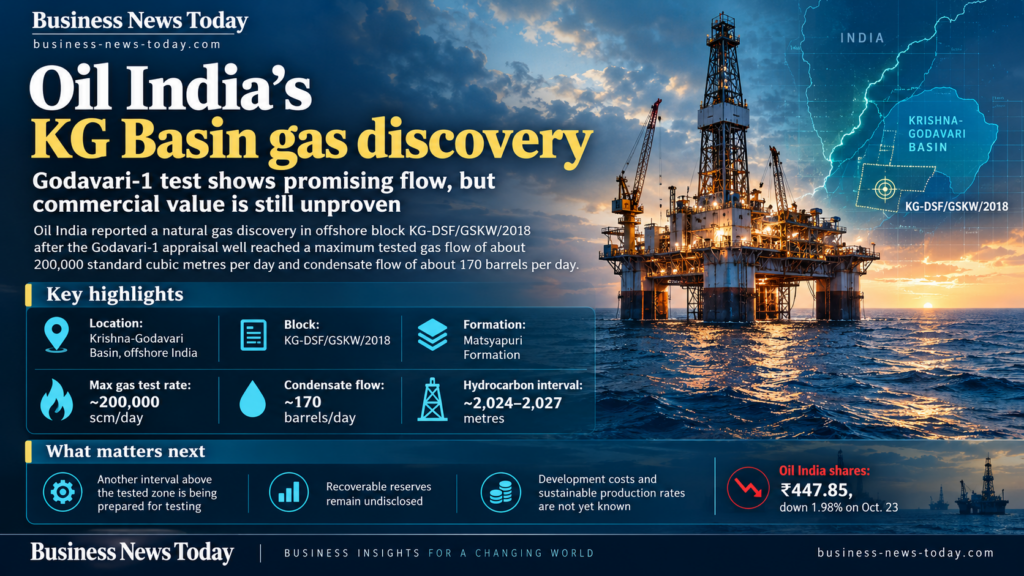
Oil India Limited (NSE: OIL, BSE: 533106), the state-controlled Indian oil and gas producer, has announced a natural gas discovery in the Krishna-Godavari Basin after its Godavari-1 appraisal well recorded a maximum tested flow rate of approximately 200,000 standard cubic metres per day. Disclosed on October 23, 2026, the discovery was made in the previously underappraised Matsyapuri Formation within shallow-water offshore block KG-DSF/GSKW/2018, where Oil India operates with a 100% participating interest. Production testing also identified condensate flow of approximately 170 barrels per day, providing preliminary evidence of potentially commercially valuable hydrocarbons beyond natural gas. Although the test results establish hydrocarbon flow from the identified interval, the company has not disclosed recoverable reserves, a sustained production forecast or a sanctioned development programme, leaving the discovery’s ultimate financial significance dependent on further technical evaluation.
What did Oil India’s Godavari-1 appraisal well discover in the Krishna-Godavari Basin?
Oil India drilled Godavari-1 as an appraisal well in the discovered small field block KG-DSF/GSKW/2018, located in the shallow offshore waters of India’s eastern continental margin. The company identified hydrocarbons within the Matsyapuri Formation, a geological interval that had not previously been adequately appraised in the relevant area. The discovery provides new subsurface information that could influence how Oil India evaluates the wider block.
The company reported hydrocarbon-bearing intervals at depths between approximately 2,024 and 2,027 metres. Production testing began on October 16, with natural gas subsequently flowing to the surface at around 100,000 standard cubic metres per day and reaching a maximum tested rate of approximately 200,000 standard cubic metres per day. The well also produced condensate during testing, indicating a hydrocarbon stream with both gaseous and liquid components.
The reported wellhead pressure was approximately 1,815 pounds per square inch. This measurement contributes to the technical assessment of reservoir conditions, although a single pressure reading cannot establish the size, continuity or long-term deliverability of the reservoir. Those questions require additional pressure interpretation, well-test analysis and geological evaluation.
Oil India also disclosed that preparations were underway to test another interval located above the initially tested zone. That subsequent testing could provide additional information about the distribution of hydrocarbons within the well, potentially identifying further productive intervals. However, the results of the next test had not been disclosed in the October 23 announcement.
The discovery is commercially relevant because it demonstrates that the previously underappraised formation can deliver hydrocarbons to the surface under test conditions. Determining whether it can support an economically viable field development will require further evidence concerning reservoir volume, production sustainability and the cost of bringing gas to market.
How significant is the 200,000 standard cubic metre daily gas flow recorded at Godavari-1?
The maximum tested flow of approximately 200,000 standard cubic metres per day provides an initial indication of the well’s productive capability. Using a conversion of roughly 35.3 cubic feet per cubic metre, the figure corresponds to approximately 7.1 million standard cubic feet of natural gas per day. This places the flow rate in a commercially relevant range for further evaluation, although its significance depends on the reservoir’s ability to sustain production.
At the lower reported rate of approximately 100,000 standard cubic metres per day, the corresponding volume is around 3.5 million standard cubic feet daily. The difference between the reported flow and maximum tested rate illustrates why the highest number should not automatically be treated as the well’s established commercial production capacity.
A preliminary test can demonstrate that hydrocarbons are present and capable of flowing through the wellbore, but sustainable output depends on reservoir pressure, connected gas volume, permeability and production-system design. The company has not reported a long-duration production test sufficient to establish how the well would perform over several years.
If the maximum tested rate were maintained continuously for an entire year, the theoretical gas volume would be approximately 73 million standard cubic metres. That calculation is illustrative and does not constitute a forecast of actual production because the reported rate was observed during testing rather than confirmed as a sustainable annual operating level.
The condensate flow is another potentially valuable characteristic. Oil India reported approximately 170 barrels of condensate per day, with an American Petroleum Institute gravity of around 55.8 degrees. Such a light hydrocarbon stream could provide additional revenue if the field is developed, although the condensate yield and recoverable volumes must be established under sustained operating conditions.
The commercial assessment must therefore distinguish tested deliverability from recoverable resources and future sales. The current announcement supports further appraisal but does not yet provide the information required to calculate field revenue, reserves or a reliable project valuation.
Why could the Matsyapuri Formation create a new exploration opportunity for Oil India?
The Matsyapuri Formation is particularly relevant because Oil India described it as previously underappraised. A successful test from an interval with limited prior evaluation can change geological understanding and potentially justify additional exploration or appraisal activity. However, confirming hydrocarbons at one well does not establish that the formation contains commercially productive resources throughout the wider block.
The Krishna-Godavari Basin is an established Indian hydrocarbon province with producing fields, discovered resources and substantial exploration history. Offshore development conditions vary significantly across the basin, including water depth, reservoir characteristics and distance from existing facilities. The technical and commercial implications of the Godavari-1 result must therefore be evaluated at the specific block level rather than inferred from other producing fields elsewhere in the basin.
Oil India’s position as sole operator gives it direct responsibility for the block’s technical programme and development decisions. Full participating ownership could allow the company to retain the economic benefits of a successful discovery, subject to applicable fiscal and contractual obligations. It also means Oil India would need to arrange the relevant capital and technical resources for subsequent appraisal and development.
Further evaluation could include additional geological mapping, reservoir interpretation and well testing before management determines whether a commercial development is justified. The costs of those activities must be weighed against the potential resource size and the availability of infrastructure capable of transporting produced hydrocarbons.
The discovery may also influence the company’s future exploration priorities in eastern India. Positive appraisal results could support additional drilling within the same geological play, while disappointing follow-up tests would limit the extent to which the initial flow result can be extrapolated.
The current technical evidence supports a potentially productive interval, but it is not yet sufficient to establish a new large-scale gas production hub.
What infrastructure and investment would be needed to commercialise Oil India’s offshore gas discovery?
Commercialising an offshore natural gas discovery requires infrastructure beyond the producing well. Depending on the field’s location and development concept, investment may be needed in subsea equipment, platforms, gathering lines, gas processing and transportation connections. Condensate handling and treatment facilities could also form part of the eventual development configuration.
The relatively shallow offshore setting may offer different engineering requirements from deepwater gas production, but shallow water alone does not guarantee low development costs. The distance to suitable receiving infrastructure, reservoir productivity and the number of wells required will be central to project economics.
A field with sufficient gas resources and high well productivity may support dedicated development infrastructure, while smaller discoveries can be more sensitive to the costs of connecting to existing facilities. Oil India has not yet announced a selected commercialisation concept for the Godavari-1 discovery, making any estimate of required capital expenditure premature.
The company must also evaluate the market for produced gas. Domestic natural gas demand creates opportunities across industrial, fertiliser, power and city-gas applications, but realised selling prices and transportation arrangements influence the economics of individual developments. The availability of a suitable customer market does not independently establish that offshore production will be profitable.
Potential gas development would also require the appropriate technical and regulatory approvals before construction and commercial operation. The October disclosure establishes an exploration milestone, not approval to begin full-scale production.
Oil India’s next development decisions will depend on whether the reservoir assessment provides sufficient confidence in recoverable resources to justify the required infrastructure and drilling expenditure.
How does the Krishna-Godavari discovery fit Oil India’s long-term production and exploration strategy?
Oil India operates across upstream production, exploration and related energy activities, with established petroleum operations in northeastern India and additional interests elsewhere. Its exploration programme seeks to replenish resources and create future production opportunities as existing fields undergo natural decline. New discoveries can support that objective, but their contribution depends on conversion into commercially recoverable reserves.
The Godavari-1 result provides a potential addition to the company’s exploration portfolio without immediately changing its reported operating production. The well remains in the testing and evaluation phase, and the company has not provided a field development schedule or annual production guidance associated with the discovery.
For an integrated energy company with existing operating assets and financial commitments, capital allocation requires comparing exploration opportunities against producing fields, development projects and other investments. A discovery’s attractiveness therefore depends not only on hydrocarbon presence but also on development cost, expected recovery and the time required before cash generation begins.
Oil India could benefit from additional domestic natural gas production if subsequent appraisal supports development. However, the degree of benefit to India’s wider gas supply will depend on the eventual scale of commercial output rather than the maximum rate observed during an initial well test.
An important future indicator will be whether the company discloses independently supportable resource estimates and a viable commercialisation pathway. Those milestones would allow a more meaningful comparison between the discovery and the company’s other investment opportunities.
How did Oil India shares perform after the October 23 gas discovery announcement?
Oil India shares closed at ₹447.85 on the National Stock Exchange on October 23, declining approximately 1.98% from the preceding session’s ₹456.90 close. The stock had traded as high as ₹458.65 before finishing near the lower end of its daily range of ₹445.60 to ₹458.65. The movement indicates that the discovery announcement did not produce a sustained positive closing-price reaction during the session.
The market response should not be interpreted as a definitive assessment of the geological discovery because Oil India’s valuation is influenced by crude oil prices, existing production, refining exposure and broader market conditions. A preliminary exploration result without a quantified reserve estimate or development budget is also difficult to incorporate into a precise earnings forecast.
The next meaningful catalyst will be additional testing of the higher interval, followed by reservoir evaluation and any updated resource estimates. Confirmation of sustainable production capability and an economically viable development concept would strengthen the financial interpretation of the discovery.
Oil India has established the presence of flowing natural gas and condensate in a previously underappraised formation, creating a credible reason for further appraisal. Its commercial significance will become clearer when the company determines how much gas can be recovered, what infrastructure would be required and whether the expected revenues justify development expenditure.
Key takeaways on Oil India’s Godavari-1 natural gas discovery in the Krishna-Godavari Basin
- Oil India announced the offshore natural gas discovery on October 23, 2026.
- The Godavari-1 appraisal well is located in block KG-DSF/GSKW/2018.
- The discovery was made in the previously underappraised Matsyapuri Formation.
- Hydrocarbons were identified at depths of approximately 2,024 to 2,027 metres.
- Natural gas testing began on October 16, 2026.
- The maximum recorded test rate reached approximately 200,000 standard cubic metres per day.
- Condensate flow was reported at approximately 170 barrels per day.
- The company is preparing to test another interval above the initial discovery zone.
- Recoverable reserves, development costs and sustainable production rates remain undisclosed.
- Oil India shares closed at ₹447.85 on October 23, declining approximately 1.98%.
Discover more from Business-News-Today.com
Subscribe to get the latest posts sent to your email.