



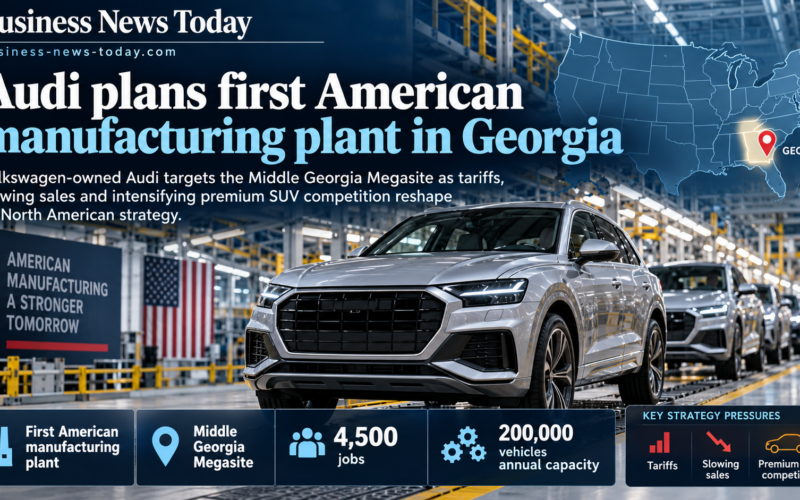
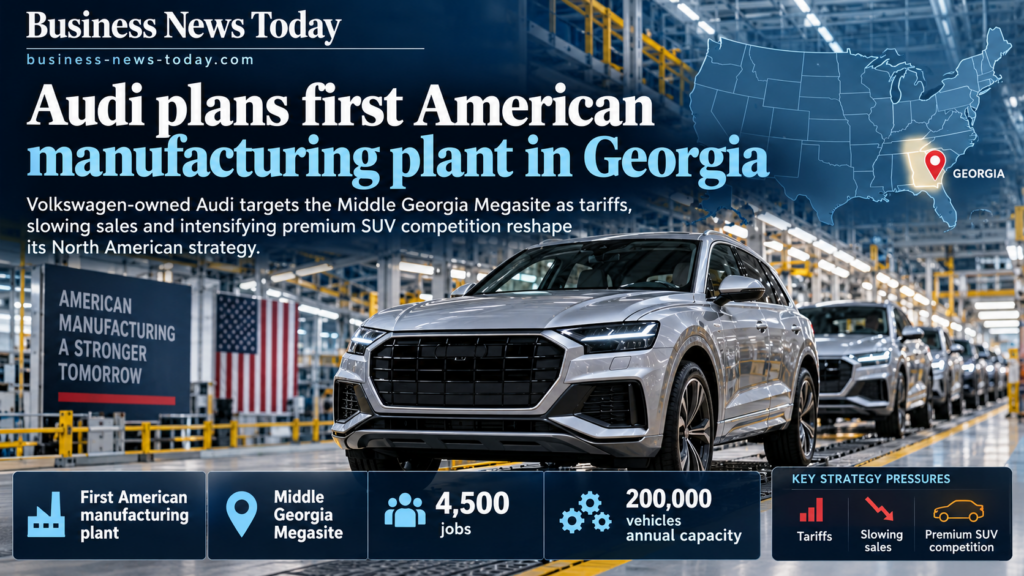
AUDI AG, the German premium automaker owned by Volkswagen AG (Frankfurt: VOW3), has announced plans to invest approximately $4 billion in its first United States manufacturing plant, selecting Georgia’s Middle Georgia Megasite for a facility designed to produce up to 200,000 vehicles annually. The investment, confirmed by Audi and the Georgia state government over October 24 and 25, 2026, is expected to create approximately 4,500 jobs and establish a major new North American production base. Audi intends to manufacture premium sport utility vehicles tailored to American customers, with full production expected in 2031 under the state’s announced timetable. The decision marks a substantial shift from the company’s existing import-dependent U.S. business, although its eventual financial return will depend on sales recovery, capital expenditure discipline and the utilization of the new factory.
The project will be developed at the Middle Georgia Megasite in Peach County, within the broader Perry and Macon regional economy. Georgia officials expect site grading to begin in 2027, physical construction in 2028 and full production in 2031. Audi’s own announcement describes construction activity beginning in 2027 and production starting in the early 2030s, making the state’s more detailed schedule a useful distinction between initial site preparation and subsequent factory development.
Some reports have described the commitment as approximately $4.2 billion, while Audi’s official company announcement and the Georgia governor’s office specify approximately $4 billion. The company has not published a detailed investment breakdown showing expenditure on buildings, production equipment, infrastructure, supplier development and other costs. The announced amount is therefore best understood as the planned overall project investment rather than expenditure already incurred.
Audi Chief Executive Officer Gernot Döllner has positioned the American factory as a central element of the automaker’s international growth strategy. Management wants North America to become a stronger manufacturing and commercial pillar alongside Europe and China. The decision follows a period in which U.S. tariffs, weak North American deliveries and intensified competition have exposed the limitations of serving a major premium vehicle market predominantly through imports.
Why is Audi building its first U.S. factory after years of relying on imported premium vehicles?
Audi has historically supplied American customers through production facilities outside the United States, including operations in Europe and Mexico. Its Mexican manufacturing presence supports the international production network, but the company has not previously operated a U.S. vehicle assembly plant. That structure has allowed Audi to serve the American market without the investment required to establish a separate domestic factory.
Import-based production becomes more complicated when tariffs, currency movements and trade agreements change the landed cost of vehicles. A vehicle manufactured outside the United States may carry different import costs depending on its country of origin, applicable duties and trade compliance. Those costs can influence retail pricing, manufacturer profitability and the flexibility available to respond to competitors producing locally.
The new Georgia factory is intended to reduce some of that exposure by placing vehicle production closer to American customers. Domestic assembly could lower the tariff burden on qualifying finished vehicles compared with importing those vehicles from countries facing duties. However, the actual financial benefit will depend on the plant’s sourcing arrangements, since imported components may continue to be affected by tariffs and other trade requirements.
Local manufacturing also provides potential logistical advantages. Producing vehicles closer to the market they serve can reduce certain shipping requirements, shorten parts of the distribution chain and improve responsiveness to demand changes. These benefits must be balanced against the capital and operating expenditure associated with developing a new factory and supplier network.
Audi’s decision also reflects a longer-term strategic concern. Major premium automotive competitors already maintain significant production capacity in the United States, including BMW Manufacturing’s operations in South Carolina and Mercedes-Benz’s manufacturing facilities in Alabama. Those established factories provide local industrial infrastructure and access to an automotive supplier base developed over many years.
Audi’s Georgia investment will allow it to compete with a more comparable regional manufacturing footprint once the facility becomes operational. Yet the advantage will not be immediate, because production is several years away. In the meantime, the company will continue facing the pricing and market conditions that shaped the investment decision.
Why did Audi select Georgia’s Middle Georgia Megasite for its $4 billion American manufacturing project?
The Middle Georgia Megasite was developed as a large industrial property intended to attract a major manufacturing investor. Georgia officials identified site readiness, infrastructure access, workforce development and proximity to established automotive supply chains as factors supporting Audi’s decision. The site provides room for a large-scale automotive facility while leaving flexibility for potential future expansion.
The development involves regional authorities representing Peach, Houston and Macon-Bibb counties. According to the Georgia governor’s office, industrial utilities are located adjacent to the site and substantial preliminary due diligence has already been completed. These preparations could reduce certain early development requirements compared with an industrial site requiring extensive initial infrastructure investment.
Georgia has developed a substantial automotive manufacturing and supplier ecosystem, supported by existing assembly plants, component manufacturers and logistics operations. This industrial concentration can help incoming manufacturers identify suppliers and recruit employees with relevant experience. However, the availability of an established regional supply chain does not guarantee that Audi can immediately source every specialized component locally.
The factory’s workforce requirements represent another significant consideration. Audi expects approximately 4,500 jobs, covering manufacturing and associated operational activities as the facility moves toward full production. The state has committed to supporting workforce development through Georgia Quick Start and the Technical College System of Georgia.
Georgia Quick Start is expected to develop customized training programs for the plant, including instruction designed around the company’s production requirements. Training activity will need to prepare employees for advanced manufacturing processes, quality management and the operational demands of premium vehicle production. The announcement does not specify the annual hiring schedule, job classifications or final wage structure.
Additional employment may emerge among construction contractors, suppliers, logistics providers and local service businesses. However, the state and company have not disclosed a verified estimate of indirect employment associated with the project. The announced 4,500 positions should therefore remain distinct from any speculative multiplier-based employment projections.
The project is geographically significant for Middle Georgia, particularly because large vehicle assembly operations can influence surrounding industrial development. Land use, housing demand, transportation infrastructure and public services may experience additional pressure as the workforce expands. The scale of those effects will depend on implementation timing and the location of supporting industrial activities.
Can the Georgia factory help Audi recover from declining North American vehicle deliveries?
The decision comes after a difficult first half of 2026 for Audi’s core vehicle business. The company delivered 727,245 Audi-branded vehicles worldwide during the first six months, down from 783,531 in the corresponding period of 2025. That represents a decline of approximately 7.2%, reflecting weaker performance in major international markets.
The North American trend was more severe. Excluding Mexico, Audi delivered 82,187 vehicles in North America during the first half of 2026, compared with 98,712 a year earlier. The decrease of approximately 16.7% illustrates the pressure facing the brand in a region where management now intends to establish a substantial manufacturing operation.
China remained another source of weakness, with deliveries declining from 287,600 to 232,227 over the same period. By contrast, Audi recorded growth in Germany and the rest of Europe. This geographic divergence indicates that the company’s challenges are not uniform across its global business.
The planned U.S. factory offers a longer-term response to the North American problem, but it does not directly address near-term demand weakness. Customers will continue making purchasing decisions based on product appeal, financing costs, price competitiveness, dealer experience and available alternatives. Local manufacturing can improve elements of the cost structure, although it cannot independently create demand for vehicles.
Audi is also renewing its premium SUV portfolio, including the introduction of the Audi Q9 as a full-size model tailored to customer preferences in North America. Larger luxury SUVs can offer opportunities for higher transaction values and product differentiation, but their competitiveness depends on design, technology, pricing and operating performance. Audi has not formally confirmed the complete model allocation for its future Georgia plant.
The new manufacturing location is therefore best understood as one component of a broader American growth strategy. Product renewal and commercial execution will determine whether customers return to the brand before the factory opens. The eventual production scale must then be aligned with actual demand rather than the theoretical maximum capacity announced for the facility.
What do Audi’s 2026 earnings reveal about the financial challenge behind the Georgia investment?
Audi Group reported revenue of €29.18 billion for the first half of 2026, down from €32.57 billion in the corresponding prior-year period. The approximately 10.4% decline reflected lower vehicle deliveries, competitive pressures and unfavorable product mix effects. Although operating profit increased slightly, the revenue contraction demonstrates the difficult environment in which the new investment has been announced.
Operating profit reached €1.12 billion, compared with €1.09 billion a year earlier. The operating margin improved to 3.8% from 3.3%, supported by cost controls, lower restructuring expenses and reduced provisions associated with emissions compliance. The improvement indicates progress in controlling costs, but the margin remained modest relative to the capital-intensive nature of premium automotive manufacturing.
The Audi Group’s reported results include Bentley, Lamborghini and Ducati alongside the Audi brand. Consequently, the consolidated revenue and profit figures should not be interpreted as representing only Audi passenger cars. The different profitability profiles of those businesses also influence group-level margins.
Audi lowered its full-year 2026 financial guidance in July following pressure from China, tariffs and broader geopolitical uncertainty. Management forecast revenue of €58 billion to €63 billion, an operating margin of 5% to 7% and net cash flow of €3 billion to €4 billion. These remain company forecasts rather than completed financial outcomes.
The planned Georgia investment introduces substantial future capital requirements during a period when management is already pursuing cost discipline and structural improvements. Expenditure will likely be distributed across several years, although the company has not published an annual spending schedule. Investors therefore cannot reliably estimate the project’s near-term free cash flow impact using the announced $4 billion total alone.
Audi generated approximately €1.89 billion in net cash flow during the first half of 2026, compared with €904 million a year earlier. The improvement was supported by working-capital movements, meaning it should not automatically be treated as a recurring increase in underlying manufacturing profitability. Funding the American project while maintaining investment in existing product and manufacturing programs will require continued capital allocation discipline.
The financial question is not simply whether Audi can afford to develop the factory. The more consequential issue is whether American production can eventually deliver returns that justify construction expenditure, equipment investment and ongoing operating costs. Without disclosure of expected production margins, supplier economics and the allocation of vehicle models, the factory’s ultimate return on invested capital remains unquantified.
How important is the proposed 200,000-vehicle annual capacity to Audi’s American business?
The planned Georgia facility is designed for annual production of up to 200,000 vehicles. This is a statement of intended manufacturing capacity rather than a commitment to produce or sell that number immediately after opening. Actual output will depend on customer demand, the number of shifts operated, production efficiency and the models allocated to the plant.
The announced capacity is substantial compared with Audi’s recent North American sales volume. Its first-half 2026 deliveries of approximately 82,000 vehicles in North America excluding Mexico demonstrate the scale of the company’s existing regional business. However, comparing six-month retail deliveries directly with annual factory capacity would be misleading because the measures cover different periods and potentially different geographic markets.
The Georgia plant may eventually serve customers beyond the United States, depending on production allocation and trade arrangements. Audi has not published a detailed export strategy for the facility. Its current announcement emphasizes premium SUVs designed around North American demand and the creation of a stronger U.S. manufacturing position.
The plant’s utilization rate will be central to its long-term economics. Fixed manufacturing costs such as equipment depreciation, maintenance, facility operations and salaried personnel must be absorbed across completed vehicles. Higher production volumes can improve the allocation of those costs per vehicle, provided pricing and variable production expenses remain commercially favorable.
Conversely, a factory operating materially below its designed capacity may generate weaker returns than initially anticipated. Premium vehicle demand can fluctuate with interest rates, economic conditions and consumer confidence, creating challenges for long-term production planning. Audi’s decision to emphasize flexibility in the factory design may help accommodate changes in market conditions and product requirements.
The company has not disclosed which powertrain technologies will be manufactured at the plant. Its broader portfolio includes internal combustion, plug-in hybrid and battery-electric vehicles, but the Georgia announcement does not confirm a specific production mix. Assigning models or technologies to the facility before official confirmation would overstate the project’s disclosed scope.
What could the Audi investment mean for Georgia’s automotive suppliers and industrial economy?
A new automotive assembly plant creates demand for a broad range of goods and services, including construction, production equipment, logistics, maintenance and manufacturing components. Some opportunities arise during development, while others depend on the facility reaching sustained production. The timing and scale of these requirements will differ across suppliers.
For regional manufacturers, the project may create opportunities to qualify for contracts associated with Audi’s production operations. Suppliers capable of meeting automotive quality requirements, cost targets and delivery schedules could benefit from proximity to the plant. However, Audi has not announced a list of suppliers or confirmed the value of local procurement contracts.
Manufacturing proximity can be especially relevant for bulky components and parts requiring frequent delivery. Logistics costs, inventory management and production scheduling may influence decisions about where suppliers establish facilities. The creation of a new assembly operation could therefore support industrial development beyond the plant itself if sufficient local sourcing demand emerges.
Georgia’s existing automotive infrastructure may make it easier to attract suppliers and technical specialists. At the same time, competition for skilled employees could increase as multiple manufacturers recruit from overlapping labor markets. Workforce training and retention will be important not only for Audi but also for businesses supporting the wider automotive sector.
The state has promoted the investment as a major regional economic development opportunity. Yet the actual economic contribution will emerge over time as construction contracts are awarded, employees are hired and production begins. Announced investment and employment targets should not be confused with spending or job creation already realized.
Environmental permitting, infrastructure delivery and other development requirements will also influence the timetable. The announcement confirms the company’s investment intention and site selection, but it does not establish that every subsequent approval or construction milestone has been completed. Public disclosures as the project advances will provide more precise evidence of execution.
How should Volkswagen investors assess Audi’s Georgia factory announcement and long-term valuation implications?
Audi is part of Volkswagen AG rather than a separately listed U.S. automotive company. Volkswagen’s Frankfurt-listed preference shares closed at approximately €69.10 on October 23, 2026, increasing about 0.35% from the preceding session. The Georgia project was publicly confirmed over the following weekend, so that closing movement cannot be attributed to the announcement.
Volkswagen Group’s wider operating environment remains challenging. The group reported approximately 6.01 million global vehicle deliveries during the first nine months of 2026, down roughly 9% from the previous year. Sales growth in parts of Europe and South America did not fully offset weaker deliveries in China and North America.
Audi’s proposed investment could eventually strengthen the group’s North American manufacturing position and reduce certain import-related costs. It may also introduce opportunities for regional sourcing and greater operational flexibility. However, those benefits must be considered alongside the substantial capital committed to an asset that will not reach full production until the next decade.
A constructive investment interpretation would emphasize the potential for higher local market competitiveness, better supply-chain positioning and reduced dependence on imported vehicles. A more cautious assessment would focus on the delay before commercial production, uncertainty over future tariffs and the possibility that demand remains below the capacity required for attractive manufacturing returns.
The investment has a long implementation period, meaning investors will have opportunities to reassess its commercial rationale as market conditions change. Changes in SUV demand, product positioning, competition and international trade arrangements could influence the project’s economics before the first vehicles are manufactured. The company’s ability to maintain flexibility in its production plans will therefore be relevant.
The most immediate evidence of progress will involve site development and more detailed capital investment disclosures. Subsequent milestones will include construction activity, supplier selection, workforce recruitment and confirmation of the vehicle programs assigned to the factory. Financial validation will come considerably later, when Audi can demonstrate that the plant is producing vehicles at sustainable volumes and commercially attractive margins.
What are the key takeaways from Audi’s $4 billion Georgia manufacturing investment?
AUDI AG has selected Georgia’s Middle Georgia Megasite for its first U.S. manufacturing facility, committing approximately $4 billion in planned investment. The plant is designed for annual production of up to 200,000 vehicles and is expected to support approximately 4,500 jobs. Georgia officials anticipate site preparation in 2027, construction in 2028 and full production in 2031, while Audi has described production beginning in the early 2030s.
The investment is intended to strengthen Audi’s American manufacturing position after North American deliveries declined approximately 16.7% in the first half of 2026. Local production may reduce some tariff and logistics exposure, but profitability will depend on model allocation, factory utilization, supplier economics and sustained customer demand. Audi’s first-half operating margin of 3.8% demonstrates why investment returns and cost discipline will remain central to the project’s financial assessment.
Discover more from Business-News-Today.com
Subscribe to get the latest posts sent to your email.


