

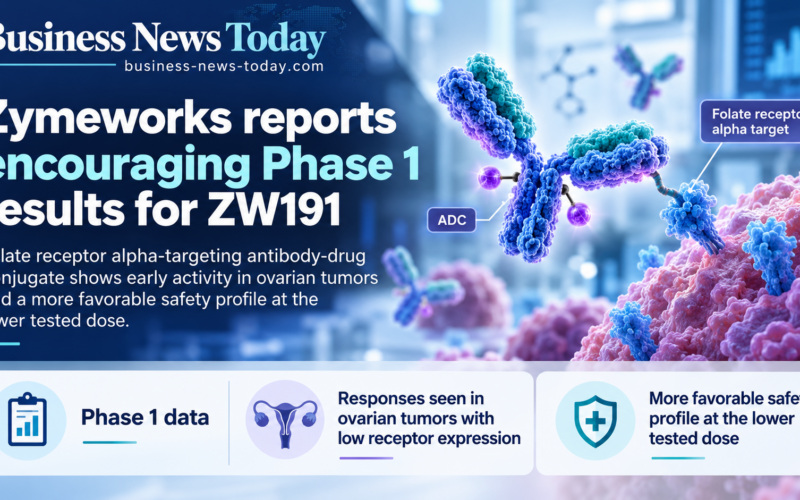
Zymeworks Inc. (NASDAQ: ZYME), the biotechnology company developing antibody-based cancer therapies alongside a portfolio of licensed and commercial healthcare assets, has reported new Phase 1 clinical results for ZW191 showing a 64.5% confirmed objective response rate at the 6.4 mg/kg dose in evaluable patients with high-grade serous platinum-resistant ovarian cancer. The findings, presented at the European Society for Medical Oncology Congress 2026 in Madrid on October 24, come from a randomized dose-optimization portion of an ongoing early-stage trial involving 80 patients assigned to two dose levels. The investigational antibody-drug conjugate demonstrated anti-tumor activity across different folate receptor alpha expression categories, including tumors with low or negative expression under the study’s classification system. Although the results support further development, the central clinical and commercial questions concern response durability, dose selection, safety and whether the apparent activity can be reproduced in larger, controlled trials.
The study evaluated ZW191 at doses of 6.4 mg/kg and 9.6 mg/kg administered every three weeks. As of the September 10, 2026 data cutoff, 37 patients had received the lower dose and 43 had received the higher dose. Participants had undergone a median of four previous treatment lines, while approximately 45% had received at least five prior lines of therapy.
The response analysis focused on patients with high-grade serous platinum-resistant ovarian cancer who were evaluable for treatment response. Zymeworks reported confirmed objective response rates of 64.5% at the lower dose and 55.3% at the higher dose. Disease control rates were 100% and 92.1%, respectively, within the corresponding response-evaluable high-grade serous groups.
The company also reported a more favorable tolerability profile at 6.4 mg/kg. Grade 3 or higher treatment-related adverse events occurred in 22% of patients receiving the lower dose, compared with 44% at 9.6 mg/kg. These findings provide a basis for evaluating whether the lower dose could offer a more appropriate balance between anti-tumor activity and treatment burden.
Zymeworks Chief Medical Officer Sabeen Mekan said the results strengthened the company’s assessment of ZW191’s potential in platinum-resistant ovarian cancer. Management highlighted the activity observed at different folate receptor alpha expression levels and the safety findings supporting continued dose optimization. The company has not announced a regulatory submission or a completed pivotal trial for ZW191.
Why does ZW191’s 64.5% confirmed response rate matter for platinum-resistant ovarian cancer?
Platinum-resistant ovarian cancer remains a difficult treatment setting because tumors have progressed despite or shortly after platinum-based chemotherapy. Patients may have already received several systemic therapies, narrowing the available options and increasing the importance of balancing potential treatment benefit against toxicity. The disease can also involve substantial clinical differences among patients, including variation in prior treatment exposure and tumor biology.
ZW191’s reported response rate is notable because the study population had received multiple previous treatments. A median of four prior lines indicates that participants were not being treated in an early-stage setting where more favorable outcomes might be expected from therapy-naive disease. Demonstrating tumor shrinkage in a heavily pretreated population can provide an early signal that a drug warrants additional investigation.
Confirmed objective response rate measures the proportion of evaluable patients whose tumors meet established criteria for a confirmed complete or partial response. It is not the same as overall survival, progression-free survival or the percentage of patients experiencing any clinical benefit. The distinction is relevant because tumors may initially shrink and subsequently progress, making response duration and disease control important complementary measures.
The 64.5% figure applies specifically to response-evaluable patients with high-grade serous platinum-resistant ovarian cancer receiving 6.4 mg/kg. It should not be generalized to all 80 randomized patients, every ovarian cancer subtype or patients with different treatment histories. The study’s early phase and limited sample size also mean that the estimate may change when additional patients are evaluated.
The lower-dose group demonstrated numerically greater confirmed response activity than the higher-dose group in the reported high-grade serous analysis. However, the study was designed to inform dose optimization rather than establish statistically definitive superiority between the two dosing regimens. Differences in patient characteristics, follow-up and the size of response-evaluable groups can influence numerical comparisons.
The practical value of the findings lies in their contribution to the next development decision. If the lower dose can maintain meaningful anti-tumor activity while reducing severe adverse events, it may provide a more appropriate regimen for further clinical evaluation. That possibility requires confirmation through mature efficacy data and a better understanding of treatment exposure over time.
How could ZW191’s activity in FRα-low and negative tumors distinguish it from existing ovarian cancer treatments?
ZW191 targets folate receptor alpha, a protein expressed on the surface of certain cancer cells, including many high-grade serous ovarian tumors. The receptor is already an established therapeutic target in ovarian cancer, making the question of patient selection commercially and clinically important. Tumors with different levels of receptor expression may respond differently to therapies designed around this target.
Zymeworks classified tumor expression using immunohistochemistry, grouping patients into low or negative expression at 0% to 24%, intermediate expression at 25% to 74%, and high expression at 75% to 100%. The percentages represent the proportion of tumor cells meeting the study’s specified staining intensity criteria. These groupings were used to evaluate whether anti-tumor activity depended on the amount of receptor expression identified in tumor samples.
Among patients with high-grade serous platinum-resistant ovarian cancer, the company reported a confirmed response rate of 69.2% in the high-expression group. Response rates were 50% among patients with intermediate expression and 55% among those classified as low or negative. The figures were reported across the evaluated treatment groups rather than as separate efficacy estimates for each dose within every expression category.
Activity outside the highest expression category is particularly relevant to ZW191’s potential positioning. Existing approved folate receptor alpha-targeted therapy is restricted to selected patients whose tumors meet defined biomarker requirements. A treatment capable of producing meaningful responses across a wider range of expression levels could potentially address patients who do not qualify for the currently approved targeted option.
AbbVie Inc.’s Elahere, the antibody-drug conjugate mirvetuximab soravtansine, received full approval from the United States Food and Drug Administration in March 2024 for certain patients with folate receptor alpha-positive, platinum-resistant epithelial ovarian, fallopian tube or primary peritoneal cancer. The approved population includes adults who have received one to three prior systemic treatment regimens and meet the requirements of an FDA-approved companion diagnostic.
ZW191 is being studied in a different clinical population, with participants in the latest analysis having received a median of four prior therapies. Differences in eligibility criteria, patient characteristics, dosing, follow-up and assessment methods prevent valid direct comparisons between the response rates of ZW191 and Elahere. The early-stage Zymeworks findings do not establish that ZW191 is more effective or safer than the approved treatment.
Nevertheless, the ability to demonstrate activity at lower receptor expression levels provides a relevant development hypothesis. If later trials confirm that patients with low-expression tumors benefit, ZW191 could potentially support a broader biomarker-defined treatment population. The commercial opportunity depends on whether that activity remains clinically meaningful and reproducible in a larger dataset.
The study’s reported expression-based results therefore deserve attention, but they are not sufficient to establish an expanded treatment indication. A future development program would need to define eligibility criteria, confirm the reliability of receptor testing and demonstrate an acceptable benefit-risk profile in the selected population.
Why does the lower ZW191 dose appear more attractive despite the higher dose showing longer median progression-free survival?
Dose selection is one of the central decisions emerging from the latest ZW191 presentation. The 6.4 mg/kg and 9.6 mg/kg regimens both produced tumor responses, but their safety profiles differed substantially. The lower dose had fewer severe treatment-related adverse events and fewer treatment-emergent adverse events requiring dose reductions.
At 6.4 mg/kg, grade 3 or higher treatment-related adverse events occurred in 22% of patients, compared with 44% at 9.6 mg/kg. This represents a 22-percentage-point difference in the reported incidence of severe treatment-related toxicity. Dose reductions associated with treatment-emergent adverse events occurred in approximately 5% of lower-dose patients, compared with 33% in the higher-dose group.
Treatment discontinuations due to adverse events occurred in 14% and 19% of patients, respectively. No deaths attributed to treatment-emergent adverse events were reported in either dosing group. These findings indicate a more favorable reported tolerability profile at the lower dose, although treatment-related adverse events and treatment-emergent adverse events represent different safety categories.
The progression-free survival findings introduce another consideration. Median progression-free survival was 7.9 months at 6.4 mg/kg and 9.8 months at 9.6 mg/kg among patients with high-grade serous platinum-resistant ovarian cancer. Both groups had a reported six-month progression-free survival rate of 61%.
The numerically longer median progression-free survival at the higher dose should not automatically be interpreted as evidence of superior efficacy. The study was relatively small, follow-up remains limited and progression-free survival estimates can change as additional events occur. The randomized dose-optimization design does not establish that the observed difference is statistically reliable or clinically attributable to dose alone.
The company reported a median follow-up period of approximately seven months. Median duration of response had not yet been reached at either dose, meaning the available data did not establish the point at which half of responding patients had experienced an end to their response. At the cutoff, approximately 45% of patients remained on treatment.
This creates an important clinical trade-off. A higher dose may produce greater drug exposure, but that exposure can increase toxicity and the likelihood of dose modification. A lower dose that supports sustained treatment with fewer severe adverse events may prove preferable, provided its efficacy remains sufficiently durable.
Zymeworks has indicated that the lower-dose tolerability findings are particularly supportive of further development. The eventual regimen will need to be selected using the complete efficacy, safety, exposure and response-duration dataset rather than the headline response rate alone.
How does ZW191’s antibody-drug conjugate design support activity across different receptor expression levels?
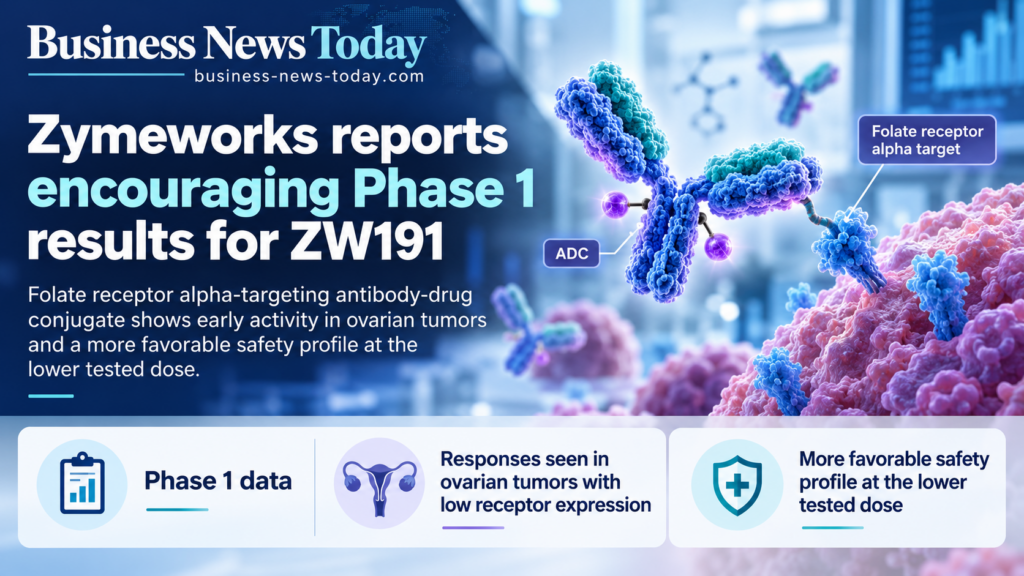
ZW191 is an investigational antibody-drug conjugate designed to deliver a cancer-killing payload to cells expressing folate receptor alpha. The treatment combines a receptor-targeting antibody with ZD06519, a proprietary topoisomerase I inhibitor payload developed by Zymeworks. The goal is to concentrate cytotoxic activity around tumor cells while limiting unnecessary exposure to healthy tissues.
Antibody-drug conjugates use a targeting component to recognize selected cellular markers and deliver an attached drug payload. After the antibody binds to its target, the conjugate can be internalized, allowing the payload to be released and interfere with processes required for cancer cell survival. The effectiveness of this approach depends on several characteristics, including binding, internalization, payload activity and the properties of the connecting linker.
ZW191 has been designed with a relatively high drug-to-antibody ratio, meaning each antibody molecule carries multiple payload molecules. Zymeworks also describes the payload as capable of producing a bystander effect, through which released drug may affect nearby tumor cells. Such activity could be relevant in tumors where receptor expression is uneven.
The bystander-effect hypothesis offers one possible biological explanation for activity in tumors classified as having lower receptor expression. However, the clinical results do not independently prove which mechanism was responsible for individual patient responses. Tumor biology, payload sensitivity and differences in receptor distribution may all influence observed treatment activity.
For the company, the design potentially differentiates ZW191 from existing folate receptor alpha-targeting therapies. That differentiation must ultimately be demonstrated through clinical outcomes rather than inferred solely from molecular architecture. A treatment with a novel payload or different drug-to-antibody ratio does not automatically have a superior clinical profile.
The relationship between drug exposure and safety will also be important as the program progresses. Cytotoxic payloads can produce adverse effects even when delivered through a targeted antibody. Identifying a dose that provides consistent tumor activity while maintaining acceptable tolerability will be central to the future clinical strategy.
The latest trial results provide preliminary evidence supporting the drug’s mechanism and continued development. They do not establish the precise contribution of each design feature to efficacy or safety. Further translational analyses and clinical data may help clarify which patients benefit most from the treatment.
What are the main clinical limitations of Zymeworks’ Phase 1 ovarian cancer results?
The strongest limitation is the early stage of development. Although the study includes randomized dose optimization, it does not provide the type of comparison against an established treatment that would be expected in a definitive efficacy trial. Both groups received ZW191, meaning the data primarily inform comparisons between dosing regimens rather than demonstrating superiority over standard care.
The response findings are also based on a smaller subset of the overall 80-patient population. The reported 64.5% and 55.3% confirmed response rates apply to evaluable patients with high-grade serous disease, while the overall safety analysis includes the 37 and 43 participants assigned to the two doses. These populations should not be treated as interchangeable when interpreting trial outcomes.
Biomarker subgroup analysis adds further uncertainty. The reported high, intermediate and low or negative receptor-expression groups contain fewer patients than the full trial population. Smaller subgroups produce less precise response estimates and can be more sensitive to individual outcomes, making confirmation essential before drawing conclusions about the potential treatment population.
Duration of follow-up is another relevant limitation. Seven months of median observation is sufficient to identify early treatment activity and some safety concerns, but it may not fully characterize long-term response durability or delayed adverse events. Mature progression-free survival and response-duration results will therefore be important for determining whether early tumor shrinkage translates into sustained benefit.
The population’s extensive prior treatment history also complicates broader generalization. Results in patients who have received multiple lines of therapy may not predict the same benefit-risk profile in earlier treatment settings. Future trials will need to specify the intended clinical population and establish appropriate comparisons for that setting.
The latest findings nevertheless provide a substantial body of information for an early-stage program. Randomized dose optimization, response assessment across biomarker groups and comparative safety observations can guide the design of subsequent studies. The value of the dataset lies in supporting informed development decisions while preserving the distinction between preliminary efficacy and proven clinical benefit.
How does the ZW191 clinical update fit Zymeworks’ broader commercial and financial transformation?
Zymeworks’ financial position has changed materially during 2026 through its acquisition of Theravance Biopharma and the expansion of commercial and royalty-related revenue sources. The company completed the Theravance Biopharma acquisition in September, adding economic interests associated with YUPELRI, a treatment for chronic obstructive pulmonary disease. This provides a different source of business activity from the development of investigational oncology drugs.
The acquired business includes a collaboration with Viatris under which Zymeworks is entitled to a 35% share of net U.S. profits from YUPELRI and royalties on sales outside the United States. The acquisition is intended to generate recurring operating cash flows that can support the company’s broader capital allocation strategy. However, financing arrangements associated with the transaction affect how much of those cash flows are available to Zymeworks.
The company financed part of the transaction through a $350 million non-recourse note from OMERS. Under the disclosed structure, 75% of the YUPELRI profit-share cash flows are contractually assigned toward servicing the associated financing obligations until repayment. Zymeworks retains the remaining 25% during that period, with its share increasing after the note is repaid.
This structure creates a distinction between the economic value of the underlying commercial asset and the cash immediately available for new investment. Although YUPELRI adds an established revenue source, the company must continue managing acquisition financing and other capital commitments. Development spending on ZW191 therefore competes with alternative uses of resources across the wider business.
Zymeworks has also strengthened its licensed oncology portfolio through the development and regulatory progress of zanidatamab, marketed as Ziihera. In August 2026, the United States Food and Drug Administration approved Ziihera for first-line treatment of certain patients with HER2-positive advanced gastroesophageal adenocarcinoma. The approval provides another source of potential milestone and royalty income under the company’s licensing arrangements.
Following the Theravance Biopharma acquisition and the August approval, Zymeworks updated its financial guidance for 2026. Management forecast total revenue of $278 million to $292 million and adjusted EBITDA of $114 million to $128 million, excluding the effects of future transactions. These figures reflect the company’s broader commercial and licensing activities and should not be attributed to ZW191, which remains investigational.
The company has also undertaken share repurchases, reflecting a strategy that combines investment in research with shareholder capital returns. In September, Zymeworks reported approximately $49.3 million of repurchases under its 2026 authorization. The allocation of capital among buybacks, acquired revenue-generating assets and internal research programs will remain relevant to the company’s long-term financial strategy.
ZW191’s latest results therefore arrive at a time when Zymeworks is seeking to become less dependent on the funding profile of a conventional clinical-stage biotechnology company. Its commercial assets may provide additional financial flexibility, but the decision to advance ZW191 will still depend on development costs, partnership opportunities and expected risk-adjusted returns.
Why is Zymeworks exploring partnerships for ZW191 instead of committing immediately to independent late-stage development?
Zymeworks has engaged MTS Healthcare to evaluate strategic partnering opportunities for ZW191. The company has identified potential partnership or collaboration structures as a means of supporting additional development while seeking to maximize the program’s longer-term value. The engagement does not establish that a licensing transaction has been completed or that a partner has committed funding.
Developing an oncology drug through later-stage trials can require substantial capital, specialized operational resources and regulatory expertise. Larger controlled studies may involve multiple countries, longer follow-up periods and extensive safety monitoring. Manufacturing scale-up and preparation for potential commercialization can introduce additional commitments before a product generates revenue.
A development partner could potentially contribute funding, clinical infrastructure or commercial capabilities. In return, Zymeworks might agree to share development costs, regional rights or future economic interests. The attractiveness of such an arrangement would depend on its financial terms and the degree of control retained by the company.
The new clinical data may improve the program’s position in partnership discussions by providing additional evidence of response activity and dose-related safety differences. However, prospective partners will also examine the maturity of the dataset, regulatory development requirements, competing therapies and the potential patient population. The company has not disclosed an agreed valuation for ZW191 or a timetable for completing a partnership.
A decision to advance the program independently would preserve more potential future economics but require greater internal funding and operational commitment. Partnering could reduce certain financial risks while also limiting Zymeworks’ ultimate share of commercial returns. The appropriate balance will depend on the probability of clinical success, anticipated trial expenditure and the economics offered by prospective collaborators.
The company’s current financial model gives it several possible ways to allocate capital, but that flexibility does not remove the uncertainties associated with drug development. A clinically promising program can still face setbacks during dose selection, controlled efficacy testing or regulatory review. The partnership process will provide an additional indication of how other industry participants assess ZW191’s prospects.
How did ZYME shares perform before the latest ovarian cancer results, and what could drive the next valuation change?
Zymeworks shares closed at $28.22 on October 23, 2026, declining approximately 0.8% from the previous session’s $28.44 closing price. The stock had gained approximately 12.7% from its October 16 closing level of $25.03, indicating substantial positive momentum during the preceding trading week. The latest ZW191 findings were publicly announced on October 24, after the Friday trading session, so that earlier price performance should not be attributed to the new data.
The stock’s reported 52-week range stood between $16.00 and $31.34, placing the October 23 close approximately 10% below the annual high. Its market capitalization was approximately $2 billion based on the latest closing price and reported share count. These figures provide context for the market value of the overall company, which includes existing commercial interests, licensed assets and investigational programs beyond ZW191.
The clinical announcement introduces a potential catalyst because it strengthens the reported efficacy and safety profile of an internally developed oncology asset. Investors may focus particularly on activity in patients with lower folate receptor alpha expression and the lower incidence of severe treatment-related adverse events at 6.4 mg/kg. Those findings support a potentially differentiated development strategy, but they do not establish the ultimate probability of approval or commercial success.
A more cautious valuation interpretation would emphasize the limited follow-up, lack of a standard-treatment comparator and uncertainty over the next clinical development structure. Larger studies could produce lower response rates or identify safety issues not apparent in the present dataset. A future partnership could also alter the economic value retained by Zymeworks.
Investors must additionally distinguish between value associated with ZW191 and the company’s other financial catalysts. Commercial revenue from YUPELRI, zanidatamab-related milestones, acquisition integration and share repurchases can all influence the stock independently of the ovarian cancer program. The company’s valuation therefore cannot be explained through the ZW191 response rate alone.
Zymeworks has scheduled a conference call for October 27, 2026, at 8:30 a.m. Eastern Time to discuss the clinical results. Management’s explanation of dose selection, patient subgroup outcomes, development costs and potential partnerships may provide additional context. However, new guidance or partnership terms should not be assumed before they are formally announced.
The next meaningful clinical milestones will involve more mature response-duration and progression-free survival data, selection of the preferred dose and clarification of the next study design. Additional biomarker analysis may also help identify the patient population most suitable for later-stage evaluation.
The strongest basis for a sustained reassessment of ZW191 would be confirmation that its early response activity can be reproduced with acceptable safety and meaningful durability in a larger trial. A financially attractive development collaboration could strengthen the commercial case, although the value of such an agreement would depend on disclosed terms. Until those milestones are achieved, ZW191 remains a promising investigational asset rather than an approved or independently validated treatment.
What are the key takeaways from Zymeworks’ ZW191 Phase 1 ovarian cancer results?
Zymeworks reported a 64.5% confirmed objective response rate at 6.4 mg/kg among response-evaluable patients with high-grade serous platinum-resistant ovarian cancer. The randomized dose-optimization analysis included 80 heavily pretreated patients, with 37 assigned to the lower dose and 43 to 9.6 mg/kg. Confirmed response rates across the reported high, intermediate and low or negative folate receptor alpha expression categories were 69.2%, 50% and 55%, respectively.
The lower dose produced fewer grade 3 or higher treatment-related adverse events, at 22% compared with 44% for the higher dose. Median duration of response had not been reached at either dose after approximately seven months of median follow-up, while six-month progression-free survival was reported at 61% in both groups. Zymeworks is evaluating strategic partnership opportunities, with further clinical development needed to establish whether the early efficacy and safety signals translate into a durable treatment benefit.
Discover more from Business-News-Today.com
Subscribe to get the latest posts sent to your email.