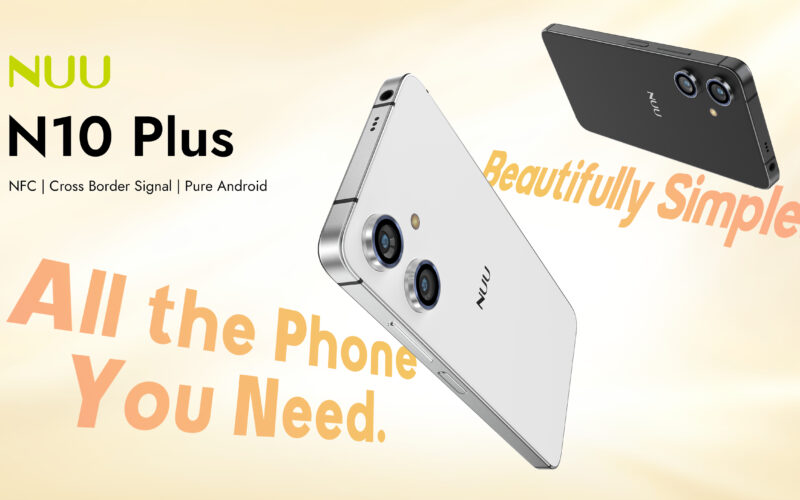
NUU, the Irving, Texas-based smartphone company specializing in affordable unlocked mobile devices, has introduced the N10 Plus at $169.99, expanding its entry-level Android smartphone portfolio. Announced on October 15, 2026, the device combines Android 16, a 6.6-inch HD+ display with a 90Hz refresh rate, a 50-megapixel main camera and a 5,000mAh battery. It also includes 128GB of internal storage, NFC connectivity and dual-SIM support, targeting consumers seeking everyday smartphone functionality without the higher expenditure associated with premium devices. The launch strengthens NUU’s position in the budget handset market, although the absence of 5G connectivity could influence purchasing decisions as competing manufacturers increasingly offer the technology at similar prices.
The N10 Plus is positioned as a practical smartphone for budget-conscious households, first-time users and consumers seeking a secondary device. NUU is emphasizing features relevant to daily communication, browsing, photography and mobile payments rather than performance specifications associated with premium handsets. This approach allows the company to compete around affordability and functionality, but it also requires careful differentiation from established smartphone brands.
The company announced availability beginning October 15 through its online store and Amazon, with a complimentary tempered glass screen protector included. Its product listing also identifies additional bundled accessories, including a protective case, charging cable and charger. These inclusions could improve the value proposition for buyers who prefer a complete device package without purchasing several accessories separately.
What specifications does the NUU N10 Plus offer for consumers spending less than $200?
The N10 Plus features a 6.6-inch display with a resolution of 1612 by 720 pixels and a 90Hz refresh rate. The refresh rate is higher than the traditional 60Hz standard used by many basic smartphones, allowing smoother scrolling and interface animations where supported. However, the HD+ resolution offers fewer pixels than the Full HD+ displays available on some competing devices, which may affect sharpness when reading small text or viewing detailed images.
The phone is powered by an octa-core processor with a maximum clock speed of 1.8GHz, paired with 4GB of RAM and 128GB of internal storage. Users can expand storage by up to 512GB through a microSD card, providing additional space for photographs, videos and locally stored files. The company has not identified the processor model in its launch announcement or published technical specifications, limiting detailed comparisons of computational performance and graphics capabilities.
The camera system includes a 50-megapixel autofocus main camera, a 2-megapixel secondary rear camera and a 5-megapixel front-facing camera. NUU also includes Pro Photo Mode, allowing users to adjust selected camera settings rather than relying entirely on automatic image processing. Although the 50-megapixel specification provides a recognizable selling point, camera quality also depends on sensor characteristics, optics, processing software and performance under different lighting conditions.
A 5,000mAh battery provides the foundation for the company’s all-day battery positioning. The phone uses USB Type-C connectivity, but NUU has not specified a fast-charging capability for the model. Its own device comparison identifies fast charging as unavailable, meaning buyers should not assume charging performance comparable with some higher-priced alternatives.
Additional features include Bluetooth 5.0, dual-band Wi-Fi, GPS, a side-mounted fingerprint reader, a 3.5mm headphone connection and near-field communication technology. The inclusion of NFC is commercially relevant because contactless payment capability is not universal across the lowest-priced Android devices. Together, these features create a functional package for everyday use, although actual responsiveness and battery endurance require independent testing.
Why does the NUU N10 Plus use 4G LTE when affordable 5G smartphones are widely available?
One of the most consequential specifications is the N10 Plus’s reliance on 4G LTE connectivity rather than 5G. The company’s official technical specifications list multiple 4G frequency bands and identify the device as a 4G smartphone. That positions the N10 Plus differently from some competing models that support newer mobile networks while remaining close to the $200 price level.
For consumers primarily using messaging applications, standard-definition video streaming, web browsing and mobile payments, reliable 4G connectivity may remain sufficient. Actual performance depends on network coverage, congestion and the capabilities of the carrier being used. The presence of 5G does not automatically guarantee a better experience in every location, particularly where coverage or signal conditions are unfavorable.
However, 5G support can influence the longer-term usefulness of a smartphone purchased for several years of service. Consumers who increasingly rely on high-bandwidth mobile applications may prefer a device capable of accessing both established LTE infrastructure and newer networks. The absence of 5G also limits how NUU can position the N10 Plus against similarly priced devices that already support the technology.
NUU describes the phone as unlocked and emphasizes flexibility across compatible mobile networks. Its published carrier compatibility information identifies several T-Mobile-related and other mobile service providers, including Metro by T-Mobile, Mint Mobile, Tello Mobile and Ultra Mobile. Buyers should nevertheless distinguish an unlocked device from one supporting every United States carrier, because network compatibility depends on the device’s supported bands and each operator’s certification and provisioning requirements.
The company is therefore targeting a market segment where low upfront cost, straightforward operation and existing LTE coverage may outweigh the desire for newer network technology. That could be attractive for secondary devices, controlled household spending or users with relatively modest data requirements. Nevertheless, 4G-only connectivity remains a specification trade-off that could become more visible as competing devices improve.
How does the NUU N10 Plus compare with Samsung Galaxy A17 5G and other budget Android phones?
The United States budget smartphone market has become increasingly competitive as larger manufacturers introduce devices combining modern Android software, substantial batteries and improved displays. Samsung Electronics, for example, introduced the Galaxy A17 5G in the United States with a starting price of $199.99. Its specifications include a 6.7-inch Full HD+ Super AMOLED display, 5G connectivity and a 50-megapixel main camera.
At the announced starting prices, the Samsung Galaxy A17 5G costs $30 more than the NUU N10 Plus. That represents a premium of approximately 17.6% over NUU’s $169.99 price, before any retailer promotions or carrier-specific discounts. The additional expenditure offers access to 5G and a higher-resolution display, potentially making the Samsung device attractive to consumers with more flexible budgets.
Samsung Electronics has also committed to six generations of operating system upgrades and six years of security updates for the Galaxy A17 5G. This creates a substantial difference in publicly stated long-term software support. NUU launched the N10 Plus with Android 16, but its announcement does not disclose an equivalent multi-year operating system or security maintenance commitment.
Motorola Mobility provides another competitive reference through its Moto G family. The Moto G 2026 includes 5G connectivity, a 6.7-inch display with a 120Hz refresh rate and a 5,200mAh battery. These specifications illustrate how competition around network technology, display smoothness and battery capacity extends into relatively affordable smartphones.
NUU’s response centers on providing a functional device at a lower upfront price. The N10 Plus offers a recent Android version, NFC, expandable storage and a bundled accessory package without pushing the price beyond $170. Whether that combination outweighs the advantages of alternative devices will depend on the buyer’s specific requirements.
The company may also benefit from consumers who prefer to purchase unlocked devices without entering into carrier installment agreements. However, that segment remains competitive because established brands and online retailers also sell unlocked smartphones. NUU must therefore build its proposition around a combination of price, availability, ease of use and customer support rather than unlocked status alone.
How does the N10 Plus compare with NUU’s existing N10 smartphone?
Within NUU’s own product lineup, the N10 Plus sits above the standard N10, which is listed at $119.99. The $50 price difference represents an increase of approximately 41.7% over the standard model’s advertised price. That premium is substantial within the entry-level smartphone category, where relatively small differences in expenditure can influence purchasing decisions.
The standard N10 already offers a 6.6-inch HD+ display, a 90Hz refresh rate, 128GB of storage and a 5,000mAh battery. Consequently, the N10 Plus does not represent a major increase in screen size, storage capacity or battery capacity. Instead, NUU has concentrated improvements in software, camera resolution, processing specifications and selected connectivity features.
The N10 Plus runs Android 16, compared with Android 15 on the standard N10. Its 50-megapixel main camera represents a significant nominal resolution increase over the standard model’s 13-megapixel main camera, although that does not establish a proportional improvement in image quality. The newer device also offers NFC and Bluetooth 5.0, while the original N10 lacks NFC and uses Bluetooth 4.2.
NUU has increased the advertised maximum processor clock speed from 1.6GHz on the N10 to 1.8GHz on the N10 Plus. Clock speed alone does not determine application performance, particularly when the underlying processor architecture has not been identified. Both devices use 4GB of physical RAM, so buyers should not assume that the more expensive model delivers substantially greater multitasking capacity.
This comparison suggests that the N10 Plus is a feature-focused upgrade rather than a complete redesign of the company’s entry-level smartphone platform. Its appeal will depend on whether consumers value a newer Android version, improved camera specifications and NFC sufficiently to justify the higher price. For households focused primarily on basic communication, the standard N10 may remain an alternative within the same brand.
Why is Android 16 and parental control functionality important for the NUU N10 Plus?
Launching with Android 16 gives the N10 Plus a relatively recent software foundation, particularly relevant to consumers who want access to current applications and familiar Google services. NUU markets the device around a straightforward Android experience rather than extensive manufacturer-specific customization. This may appeal to users who prioritize simple navigation and everyday reliability.
The company also positions the N10 Plus as a potential first smartphone for children. Its product information highlights Google parental control functionality, including the ability to manage application access, downloads and screen time. These features provide households with tools for introducing younger users to smartphones while retaining some oversight over device usage.
The first-phone positioning creates a commercial opportunity distinct from traditional smartphone upgrades. Parents may prioritize purchase price, basic functionality, location-related features and ease of management rather than advanced gaming performance or high-end cameras. A relatively inexpensive unlocked device could serve that use case, particularly where an existing family mobile plan offers a compatible additional connection.
However, long-term software support remains an important consideration for devices used by children and other consumers who may retain a smartphone for several years. Receiving Android 16 at launch does not automatically establish how many future Android versions or security updates the manufacturer will provide. A published support schedule would help buyers compare the N10 Plus with alternatives offering explicit maintenance commitments.
The same issue extends to consumers considering the device as a secondary phone. A secondary handset may receive relatively infrequent use but still require reliable security updates, application compatibility and dependable battery performance. The value of such a device therefore depends partly on ownership costs and support beyond the initial purchase.
Can NUU compete in the United States budget smartphone market through pricing and unlocked distribution?
NUU’s business strategy emphasizes affordable mobile hardware sold through direct and online retail channels. This approach can provide access to customers seeking devices without the financing commitments or carrier restrictions associated with certain promotional offers. It also allows the company to serve multiple price points through its N Series, B Series and X Series product families.
The N10 Plus broadens the company’s offering around the $170 price level, positioned between its lowest-priced devices and more expensive models with 5G capabilities. That creates opportunities to serve consumers with different budgets while keeping them within the same brand. The company’s wider portfolio includes higher-priced 5G smartphones, allowing buyers to move up to more capable devices if their requirements change.
The economics of the segment are demanding because smartphones require investment in components, manufacturing, software integration, certification, logistics and after-sales support. Low selling prices can make it difficult to absorb unexpected component costs or generous promotional discounts without affecting margins. NUU has not disclosed manufacturing costs, expected sales volumes or profitability forecasts for the N10 Plus.
The inclusion of accessories could help differentiate the device at the point of purchase. A case, charging cable, charger and screen protector provide immediate practical value for consumers who might otherwise need to purchase those items separately. However, the commercial cost of bundling accessories must be balanced against the company’s ability to maintain competitive pricing.
Online distribution through Amazon also places NUU alongside numerous competing budget devices, where customer reviews, delivery availability, product specifications and price comparisons influence buying decisions. The company may therefore face pressure to demonstrate reliability and after-sales support alongside hardware features. Consistent customer satisfaction could prove especially important for attracting shoppers unfamiliar with the brand.
What will determine whether the $169.99 NUU N10 Plus succeeds against affordable 5G alternatives?
The N10 Plus enters the market with a clearly defined value proposition centered on everyday smartphone functionality, updated software and a price below $170. Its 90Hz display, 50-megapixel main camera, NFC and 128GB storage provide features that budget-conscious consumers can assess without requiring extensive technical knowledge. These characteristics may support demand among households, first-time smartphone users and people seeking inexpensive secondary devices.
The largest competitive uncertainty is whether enough consumers will accept 4G-only connectivity when alternatives offering 5G are available at relatively modest additional cost. NUU must also demonstrate acceptable real-world processing performance, camera quality and battery endurance, particularly because the announced specifications do not establish those outcomes independently. A clearer long-term software support commitment could further strengthen the device’s position.
The launch does not provide sales targets, shipment expectations or revenue forecasts, preventing a reliable assessment of its likely financial contribution. Initial availability, customer reviews, retail pricing and demand across compatible networks will provide more meaningful evidence of market acceptance. Longer-term performance will depend on whether NUU can retain the value advantage while competing against manufacturers with larger distribution networks and established consumer recognition.
The N10 Plus illustrates the increasingly difficult economics of selling basic smartphones in a market where many formerly premium features have become relatively inexpensive. NUU has assembled a practical feature package at $169.99, but the measurable test will be whether the lower purchase price is sufficient to persuade consumers to choose a 4G smartphone over more future-oriented 5G alternatives.
Key takeaways from the NUU N10 Plus Android 16 smartphone launch
- NUU announced the N10 Plus on October 15, 2026, at $169.99.
- The unlocked smartphone runs Android 16 and targets budget-conscious United States consumers.
- Its display measures 6.6 inches with HD+ resolution and a 90Hz refresh rate.
- The phone includes a 50-megapixel main camera, a 2-megapixel secondary rear camera and a 5-megapixel front camera.
- It offers 4GB RAM, 128GB internal storage and microSD expansion up to 512GB.
- Additional features include NFC, dual SIM, fingerprint authentication and a 5,000mAh battery.
- The N10 Plus supports 4G LTE rather than 5G connectivity.
- Samsung’s Galaxy A17 5G starts $30 higher at its announced United States price.
- The standard NUU N10 costs $119.99, making the Plus model $50 more expensive.
- Pricing competitiveness, software support, customer satisfaction and real-world performance will influence adoption.
Discover more from Business-News-Today.com
Subscribe to get the latest posts sent to your email.