



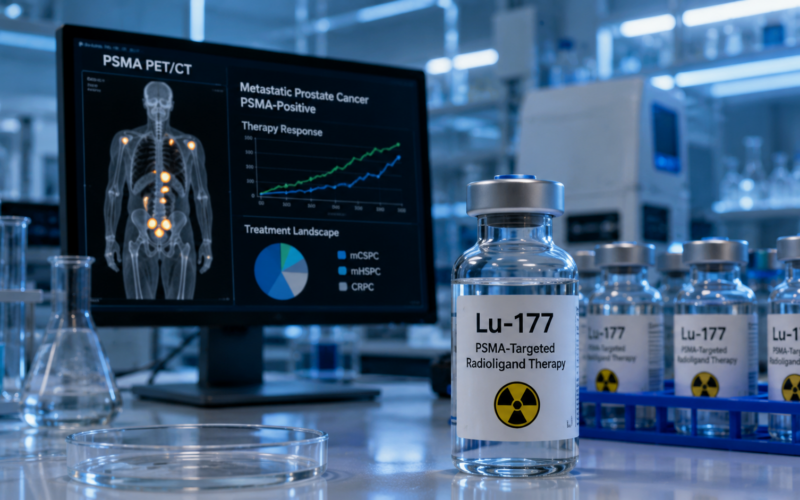
Novartis AG (NYSE: NVS; SIX: NOVN) said on July 31, 2026, that the US Food and Drug Administration had approved Pluvicto (lutetium Lu 177 vipivotide tetraxetan) in combination with an androgen receptor pathway inhibitor for patients with prostate-specific membrane antigen-positive metastatic hormone-sensitive prostate cancer, the earliest-stage metastatic setting where a targeted radioligand therapy has ever been cleared. The decision, formally covering what Novartis now labels metastatic androgen pathway modulation-naive/sensitive prostate cancer, extends Pluvicto’s label across the full continuum of PSMA-positive metastatic disease and, on the company’s own numbers, nearly doubles the eligible patient population. It arrives at a point when Pluvicto is already Novartis’s fastest-growing oncology brand, with second-quarter 2026 sales of $651 million, up 43.4 percent year on year. The strategic significance is not the incremental patient volume alone; it is the shift of a radioligand therapy from a late-line rescue option to first-line intensification alongside the standard ARPI plus androgen deprivation therapy doublet. The tension is straightforward: Novartis now has a much larger addressable market on paper, but converting that potential into cash flow depends on manufacturing throughput, reimbursement, referral pathways and an overall survival read-out that is still maturing.
Why this expanded Pluvicto label matters more than the earlier mCRPC line extension
The mHSPC clearance is a step change in scope, not a routine label extension. Pluvicto has, until now, been positioned as a treatment for patients whose disease had already progressed on hormone-based therapy, first after chemotherapy under the original 2022 approval and then, from March 2025, in the pre-chemotherapy castration-resistant setting after one ARPI. Each step earlier in the treatment sequence enlarges the addressable pool, because a meaningful proportion of patients do not live long enough to reach later lines. Novartis has previously cited that roughly half of metastatic castration-resistant prostate cancer patients never receive a second treatment. Moving into the hormone-sensitive setting removes that attrition problem entirely, because these are patients being diagnosed with metastatic disease for the first time.
The company puts the global mHSPC incidence at more than 186,000 men each year across major markets, and cites that PSMA is expressed in more than 80 percent of prostate cancer cases. Even after adjusting for testing infrastructure, physician adoption and payer gating, the incremental patient pool is materially larger than the mCRPC expansions delivered so far. That is why management is describing this as a shift toward Pluvicto being used across all stages of PSMA-positive metastatic prostate cancer rather than as a single new indication.

What the PSMAddition trial actually showed on progression and survival
Approval is based on the Phase III PSMAddition trial, which tested Pluvicto in combination with standard-of-care ARPI plus androgen deprivation therapy against standard of care alone. At the primary analysis, the Pluvicto combination reduced the risk of radiographic progression or death by 28 percent, with a hazard ratio of 0.72 and a 95 percent confidence interval of 0.58 to 0.90. In an updated analysis, the effect strengthened to a 33 percent reduction, hazard ratio 0.67, confidence interval 0.55 to 0.82. Overall survival showed a positive trend favouring the Pluvicto arm, with a hazard ratio of 0.80 and a confidence interval of 0.63 to 1.01. Management has been transparent that overall survival data continue to mature ahead of the final analysis, and the upper bound of that confidence interval crossing 1.0 is significant. It means a statistically significant survival benefit has not yet been demonstrated, even though the direction of effect is favourable.
That distinction matters commercially. Progression-free survival benefits typically drive faster uptake in oncology; overall survival data drive durable guideline positioning, National Comprehensive Cancer Network category classifications and payer coverage decisions in the longer term. If the maturing OS analysis crosses the significance threshold, Pluvicto’s competitive position in mHSPC hardens meaningfully. If it does not, Pluvicto still has a strong rPFS story, but the ARPI-plus-ADT incumbent doublet retains room to argue that intensification with a radioligand therapy is optional rather than default.
Safety was broadly consistent with the prior Pluvicto profile from PSMAfore and VISION. Grade 3 or higher adverse events occurred in 50.7 percent of patients on Pluvicto plus standard of care, versus 43.0 percent on standard of care alone. That is a real incremental toxicity burden of roughly seven percentage points that oncologists and patients will weigh against the progression benefit. Novartis reports that health-related quality of life was maintained across arms in longitudinal assessments, which is a helpful data point for adoption in a patient population that is largely asymptomatic or minimally symptomatic at the point of diagnosis.
How this reshapes the competitive picture around ARPI intensification and PSMA-targeted therapy
The immediate competitive implication sits with the ARPI franchises that anchor current first-line mHSPC treatment: enzalutamide, marketed as Xtandi by Pfizer and Astellas Pharma; apalutamide, marketed as Erleada by Johnson and Johnson; and darolutamide, marketed as Nubeqa by Bayer and Orion. None of those products is displaced by Pluvicto’s approval; ARPIs remain the backbone. However, Novartis has now positioned Pluvicto explicitly as an intensification layer on top of the doublet, in a disease setting where a growing share of urologists and oncologists have been moving toward triplet therapy for high-volume disease. Adding a radioligand therapy layer creates a genuinely new commercial category rather than a straight substitution.
For competitors developing PSMA-targeted radioligand therapies of their own, most notably Lantheus Holdings via its PNT2002 asset acquired through Point Biopharma, and privately held Curium, Novartis’s earlier-line approval raises the strategic stakes. First-mover positioning in mHSPC lets Novartis start building the treatment centre relationships, physician training pipelines, patient-support infrastructure and payer contracts that later entrants will have to displace. In a therapy class where the physical distribution model matters as much as the molecule itself, that head start is more durable than an equivalent lead in an oral drug.
Why the five US manufacturing sites are as important as the label itself
Radioligand therapy is uniquely constrained by supply chain. Lutetium-177 has a half-life of about 6.7 days, which means a dose leaving a manufacturing site loses meaningful activity every day it spends in transit. Novartis has explicitly framed the mHSPC opportunity around its five US manufacturing sites, described as either operational or under construction, and cites the ability to deliver Pluvicto to US treatment centres within five days. That footprint is the operational precondition for realising the label expansion. Without it, doubling the eligible patient pool would generate waiting lists rather than revenue.
Investors should therefore treat Novartis’s manufacturing commentary at the next quarterly update as an important operational proof point. Batch capacity, incident-free supply weeks, average delivery times and the proportion of demand met without deferrals are the metrics that will translate the label into cash flow. Any commentary on ex-US expansion, particularly for European Union and Japanese authorisations in mHSPC, will indicate how quickly the peak sales curve can be pulled forward globally.
What the mHSPC label means for the Pluvicto sales trajectory and Novartis’s oncology mix
Pluvicto delivered second-quarter 2026 sales of $651 million, growing at 43.4 percent year on year. On an annualised run rate the product is already tracking around $2.6 billion in 2026. Novartis has reaffirmed its full-year 2026 guidance of low single-digit net sales growth at group level, so Pluvicto’s incremental contribution has to be viewed against declining Entresto sales as generic competition intensifies. Within the innovative-medicines mix, Pluvicto sits alongside Kisqali, Kesimpta and Scemblix as the priority-brand growth engines that need to offset patent-cliff pressure on the older cardiovascular franchise.
The mHSPC label expansion does not translate into an immediate step-change in reported sales. Uptake in oncology tends to build over three to six quarters as treatment centres validate scheduling, radiation safety, imaging workflows and reimbursement pathways. However, it does materially extend the peak sales potential of Pluvicto and pushes its likely peak revenue year further out. That has implications for how equity analysts model the drug’s contribution to Novartis’s post-2028 growth profile, and specifically for how they weight radioligand therapy versus other pipeline optionality in the fair-value calculation.
What the market response says and where the shares stand today
Novartis has been trading in a $155 to $158 range in recent sessions, off the 52-week high of $170.46 recorded earlier this year and materially above the 52-week low of $112.34. The company’s market capitalisation sits at approximately $295 billion, with the shares having recovered ground after the second-quarter results confirmed the oncology franchise momentum. Business News Today did not identify a widely published broker consensus explicitly attributing near-term price-target changes to the July 31 approval, and the announcement lands into a summer trading period when equity coverage tends to be lighter. Investor attention to the news has been supported by Novartis’s decision to frame the mHSPC clearance as a category-defining moment for the radioligand therapy platform, alongside its earlier mCRPC line extensions.
For investors modelling the setup into the third quarter 2026 report, likely on October 27, the questions to watch are whether Pluvicto’s sequential growth accelerates as launch dynamics take hold, whether management gives more granular commentary on manufacturing utilisation, and whether the maturing PSMAddition overall survival data reach the significance threshold. A confirmed OS benefit would strengthen guideline positioning ahead of the 2027 update cycle. A negative or ambiguous OS read-out would leave Pluvicto still commercially strong but potentially vulnerable to intensified competition from next-generation ARPIs and other radioligand therapies moving through late-stage development.
Key takeaways for executives and investors tracking Novartis and the radioligand therapy space
- The FDA has approved Pluvicto in combination with an ARPI for PSMA-positive metastatic hormone-sensitive prostate cancer, extending its label across all stages of PSMA-positive metastatic disease.
- Novartis estimates the mHSPC clearance nearly doubles the eligible patient population, moving Pluvicto from a late-line rescue therapy toward first-line intensification.
- Approval is based on the Phase III PSMAddition trial, which showed a 28 to 33 percent reduction in the risk of progression or death when added to ARPI plus ADT, with a positive but immature overall survival trend.
- Pluvicto’s second-quarter 2026 sales reached $651 million, up 43.4 percent year on year, making the drug the fastest-growing brand in the Novartis oncology portfolio.
- The Grade 3 or higher adverse-event rate was 50.7 percent for the Pluvicto combination versus 43.0 percent for standard of care alone, an incremental toxicity load that will inform adoption decisions.
- Five US radioligand therapy manufacturing sites, either operational or under construction, are central to the ability to serve the expanded label without creating patient waiting lists.
- Competitors including Pfizer and Astellas Pharma with Xtandi, Johnson and Johnson with Erleada, and Bayer with Nubeqa retain the ARPI backbone, but face a new intensification layer above their franchises.
- Lantheus Holdings and privately held Curium developing competing PSMA-targeted radioligand therapies now face a first-mover incumbent with an earlier-line indication.
- The next measurable catalyst is the maturing PSMAddition overall survival analysis, followed by third-quarter 2026 results likely on October 27 for launch-momentum commentary.
- Sustained rerating of the Novartis oncology franchise will require both confirmed OS benefit in PSMAddition and evidence that manufacturing throughput can match the enlarged addressable market.
Discover more from Business-News-Today.com
Subscribe to get the latest posts sent to your email.