


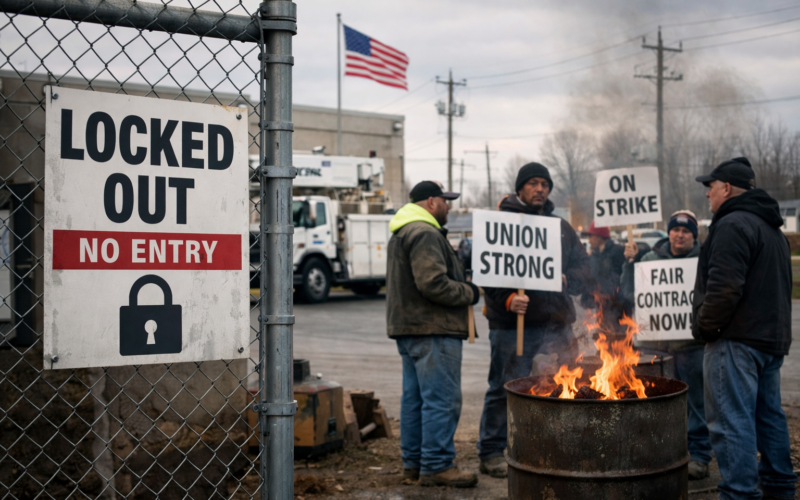
Northern Indiana Public Service Company (NIPSCO), the Indiana-based electric and gas utility owned by NiSource Inc. (NYSE: NI), locked out approximately 1,600 union workers on April 2, 2026, after collective bargaining negotiations with the United Steelworkers failed to produce a new agreement by an extended deadline. The standoff, which has now entered its second week with no active talks underway, spans two bargaining units covering field workers and clerical staff and represents one of the most significant utility labour disruptions in the Midwest in recent years. The dispute goes well beyond wage arithmetic and cuts to structural questions about how NIPSCO intends to staff and operate its network in the years ahead. NiSource shares are trading around $48.18 as of April 11, near their 52-week high of $48.76, suggesting the market has so far absorbed the disruption without alarm.
What are the core issues driving the NIPSCO United Steelworkers lockout in April 2026?
On the surface, the breakdown looks like a conventional overtime pay dispute. NIPSCO says the principal sticking point was the union’s demand for double-time pay for hours worked beyond a regular shift, a provision the company characterised as outside industry norms. The company’s final offer included a 4% across-the-board wage increase for the life of the contract for both physical and clerical employees, additional increases bringing total year-one raises to 9% for lineworkers and 7% for senior building mechanics, a $5,000 ratification bonus if signed by April 10, two weeks of paid parental leave, expanded bereavement leave, and a phased reduction in maximum continuous work hours from 32 down to 16.
The United Steelworkers tell a different story. For the union, wages were a secondary concern. The primary dispute is structural: NIPSCO’s push to expand the use of outside contractors, mandatory overtime acceptance rates, and limitations on continuous work hours during outages. From the union’s vantage point, the contractor expansion threatens to erode the core bargaining unit over time while simultaneously reducing the institutional knowledge available during emergencies. The union argues those proposals were rejected during negotiations despite being safety-related, not compensation-related, a distinction that carries regulatory and public interest dimensions beyond the immediate contract dispute.
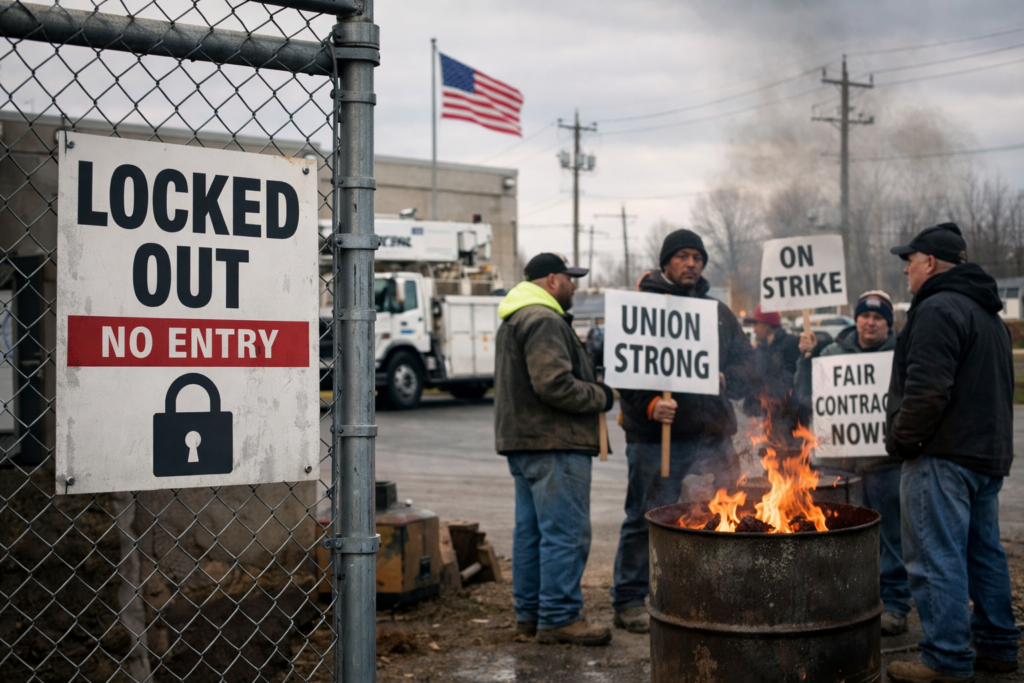
The two sides sat at the bargaining table for more than 20 continuous hours on the day before the deadline, working through what NIPSCO says were nearly 200 proposals over the course of negotiations dating back to January 20, 2026. The original contracts expired at midnight on March 31, and NIPSCO voluntarily extended them through 4 p.m. on April 2 to allow additional time. When the extended deadline passed without resolution, management initiated a lockout rather than continuing to allow union members to work under the expired agreement, which would have been the alternative path available to both parties.
How does NIPSCO’s use of outside contractors connect to the broader utility workforce debate across the US?
The contractor question is where this dispute intersects with a much wider industry tension. American utilities across the country have been steadily shifting maintenance and emergency response work toward contractor models for more than a decade, driven partly by cost pressures, partly by flexibility requirements during peak periods, and partly by a strategic preference for variable rather than fixed labour costs. For investors and regulators, the contractor model can look efficient on a per-incident basis. For union members and, as events in northern Indiana have now illustrated, for fire departments and local emergency services, the model introduces response-time and accountability variables that a fully staffed in-house workforce avoids.
The Marshall County Fire Department incident during the lockout’s first night is instructive. During a severe thunderstorm warning, fire crews responding to a pole fire near Plymouth had to wait approximately two hours for NIPSCO to send personnel. Whether that delay was a direct consequence of the lockout or a pre-existing capacity issue is not confirmed by either side, but the incident crystallised the union’s argument that the staffing model NIPSCO is pursuing carries real costs for public safety that do not appear in its labour budgets. Hammond firefighters went further, posting publicly that they routinely rely on utility workers to de-energise buildings during fires and that the lockout creates conditions where lives are at risk.
NIPSCO insists it has implemented continuity plans using trained non-represented employees, qualified contractors, and support from affiliated companies within NiSource’s broader portfolio. The company says all work is being performed under established safety procedures and supervision. That may be operationally accurate under normal conditions, but the question the emergency services community is raising is whether a contractor-heavy workforce is adequately prepared for simultaneous, geographically dispersed emergency response during major weather events, which northern Indiana experiences with regularity.
What does the Schahfer coal plant dimension add to the NIPSCO lockout’s regulatory and energy market stakes?
A dimension of this dispute that has received less attention than the immediate community impact is the R.M. Schahfer generating station in Wheatfield, Indiana. Some of the locked-out union members hold positions at Schahfer, which operates coal and natural gas generation units with a combined capacity of approximately 848 megawatts across units 17 and 18. These units were originally scheduled to retire by the end of 2025 but remain operational under an emergency order from the US Department of Energy, which instructed NIPSCO to keep them available for grid dispatch through the Midcontinent Independent System Operator. NIPSCO has stated it is continuing to comply with the DOE order during the lockout, relying on non-represented employees and contractors to maintain those units.
The Schahfer plant consumed over 588,000 short tons of coal during 2025 and drew nearly 95,000 short tons from Peabody Energy’s Gateway mine in Illinois in January 2026 alone. The significance of this is that a regulated utility running ageing coal infrastructure under a federal emergency order, while simultaneously operating with a locked-out workforce, represents a risk profile that is more complex than a standard labour dispute. Any operational incident at Schahfer during this period would invite scrutiny from federal energy regulators, the DOE, and MISO, and could have implications for NiSource’s regulatory relationships at a time when the parent company is executing a capital-intensive transition toward renewable and grid infrastructure investment.
How is Indiana’s political environment responding to the NIPSCO lockout and what pressure is building on both parties?
The political dimension is beginning to take shape. Indiana Governor Mike Braun’s office has scheduled meetings with members of USW Local 12775, signalling that state-level pressure is building on NIPSCO to return to the table. That is not a trivial development. As a regulated utility, NIPSCO’s rate cases, infrastructure investment approvals, and operational licence renewals all pass through Indiana’s regulatory apparatus. A utility that is visibly in conflict with its workforce, drawing criticism from local fire departments, and generating negative coverage in communities across northern Indiana is not in the strongest position when it next approaches the Indiana Utility Regulatory Commission.
The USW at the international level has been vocal. USW International President Roxanne Brown characterised the lockout as a decision that places profits ahead of community welfare. District-level leadership has been equally direct, calling out NIPSCO’s dismissal of union-generated safety proposals as evidence that the negotiations were not genuinely focused on worker welfare. The union’s position heading into any resumed talks is that the lockout must end before negotiations can restart, a condition NIPSCO has not yet accepted given its stated position that the lockout will remain until the union accepts the company’s final offer.
What are the financial and strategic implications for NiSource of a prolonged NIPSCO labour dispute?
NiSource’s market positioning complicates the pressure calculus in interesting ways. The stock has run sharply from a 52-week low of around $37 to its current level near $48, trading essentially at its all-time high and at a meaningful premium to Morningstar’s fair value estimate of $45. Analysts covering the stock carry an average 12-month price target of approximately $48.57, with the majority of the 13 analysts tracked recommending a buy. NiSource’s investment thesis is built on a decade-long capital deployment programme targeting electric and gas infrastructure, with data centre load growth in Indiana cited as a meaningful demand catalyst. That thesis depends on operational stability, regulatory goodwill, and execution credibility.
A prolonged lockout introduces friction into all three. Operationally, contractor workforces are generally less efficient at complex emergency response than trained in-house union personnel with years of system-specific knowledge. From a regulatory standpoint, NIPSCO depends on constructive relationships with Indiana’s utility commission to secure timely and adequate rate case outcomes for its infrastructure investment programme. And from a capital markets perspective, while the immediate stock reaction suggests investors are not pricing in significant disruption risk, a lockout that extends into weeks or months and generates a service reliability incident would test that equanimity. Industrial customers, who account for an above-average share of NIPSCO’s electric sales relative to peer utilities, are particularly sensitive to supply interruptions.
The ratification bonus of $5,000 that NIPSCO offered if the union signed by April 10 has now passed without resolution, removing one potential accelerant. What remains is a hardened standoff with no active talks, a union that has made clear it will not accept the current offer, and a utility that has publicly committed to maintaining its position. The most likely path to resolution runs through either a mediator or political intervention, and the involvement of the governor’s office suggests the latter is already being quietly explored.
Key takeaways on what the NIPSCO lockout means for the company, its workforce, and the broader US utility sector
- Northern Indiana Public Service Company initiated a lockout of approximately 1,600 United Steelworkers members on April 2, 2026, after contract negotiations failed across two bargaining units covering field workers and clerical staff.
- The core dispute is structural rather than purely financial, centring on NIPSCO’s expansion of outside contractors, mandatory overtime acceptance requirements, and limitations on continuous work hours, all of which carry safety and job security implications that extend beyond wage levels.
- Real-world service disruptions have already emerged, with emergency response delays during a severe storm during the lockout’s first night raising questions about contractor workforce readiness for simultaneous multi-site incidents.
- The R.M. Schahfer generating station, operating under a US Department of Energy emergency order to remain available for grid dispatch, is being maintained by non-union staff during the lockout, adding a federal regulatory and grid reliability dimension to the dispute.
- NiSource shares are trading near their 52-week high of $48.76, suggesting the market is not currently pricing in significant operational risk, though that calculus could shift if the lockout extends and a service reliability incident occurs.
- The contractor expansion strategy NIPSCO is pursuing mirrors a broader trend across US utilities, where variable labour models are being tested against fixed workforce structures, often with complex consequences for emergency response capability and regulatory relationships.
- Indiana Governor Mike Braun’s office is engaging with union leadership, signalling that political intervention is becoming a more likely mechanism for breaking the deadlock than a direct return to bilateral negotiations.
- NiSource’s investment thesis, anchored to a decade-long infrastructure capital programme and data centre load growth in Indiana, depends on regulatory goodwill and operational stability, both of which a prolonged lockout erodes gradually.
- With the April 10 ratification bonus deadline now passed and no active talks underway, resolution timelines are uncertain, and the longer the lockout continues, the greater the risk of a regulatory or reputational event that aligns with NiSource’s next rate case cycle.
- The dispute illustrates a structural tension across the utility sector between cost-optimised labour models that look efficient in normal conditions and institutional workforce depth that proves its value during the emergency response scenarios utilities exist to manage.
Discover more from Business-News-Today.com
Subscribe to get the latest posts sent to your email.