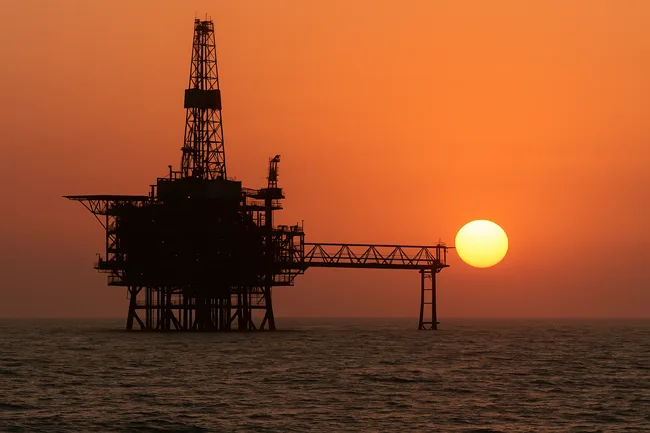



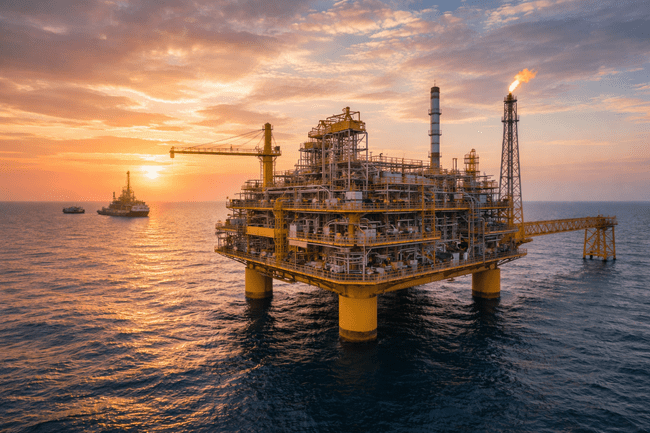
Abu Dhabi National Oil Company (ADNOC) has reached a final investment decision (FID) on the SARB Deep Gas Development project, part of its broader strategy to unlock offshore gas potential in the United Arab Emirates. Located in the Ghasha Concession, the development is expected to deliver 200 million standard cubic feet per day (scfd) of gas before 2030, furthering the UAE’s ambition for gas self-sufficiency and reinforcing ADNOC’s role as a long-term gas exporter.
The project will be remotely operated from Arzanah Island, integrating artificial intelligence and advanced automation, while tying into ADNOC Gas infrastructure via Das Island. By leveraging existing offshore assets and digital technologies, ADNOC is positioning SARB as a capital-efficient, high-reliability contributor to its upstream gas portfolio.
Why is ADNOC doubling down on offshore deep gas development now?
The decision to sanction SARB Deep Gas comes at a critical inflection point in global energy markets. For ADNOC, this is less about incremental volume and more about reinforcing strategic optionality. The United Arab Emirates is pursuing a twin-track policy: accelerate the shift to lower-carbon energy domestically while maintaining its export position as a reliable hydrocarbon supplier.
Natural gas, in this context, is both a domestic baseload enabler and a geopolitical export hedge. SARB Deep Gas allows ADNOC to deepen its position in both arenas. With the UAE’s peak power demand rising and industrial demand projected to expand through green ammonia, hydrogen, and desalination projects, the need for a diversified and modular gas supply base has never been greater.
Unlike new onshore developments, offshore projects such as SARB can be engineered for better tie-in flexibility, safety, and integration. The platform’s remote operation from Arzanah Island demonstrates how ADNOC is trying to scale up automation without scaling up exposure to operational risk. By embedding artificial intelligence into platform control systems and real-time telemetry, ADNOC is future-proofing SARB for digital twin modeling, predictive maintenance, and centralized control room orchestration.
The SARB Deep Gas field itself lies 120 kilometers offshore Abu Dhabi. While the reserves are challenging, the infrastructure is not greenfield. This is a deliberate attempt to minimize capital expenditure while accelerating time-to-first-gas. The wells will connect to Das Island—one of ADNOC’s cornerstone processing hubs—tying into ADNOC Gas facilities and ensuring downstream compatibility.
How does SARB Deep Gas fit into ADNOC’s wider Ghasha Concession development roadmap?
The SARB Deep Gas project is a subset of the larger Ghasha Concession, one of the world’s largest offshore sour gas developments, which also includes Hail, Ghasha, and Dalma fields. ADNOC has consistently emphasized that the Ghasha Concession is central to its 2030 Gas Self-Sufficiency Strategy.
This FID signals a phased sequencing model: instead of bringing the entire Ghasha megaproject online at once, ADNOC is choosing modular execution via discrete subfields. It reduces systemic project risk, aligns with cash flow prioritization, and allows for lessons learned across each field to be applied iteratively.
ADNOC has also committed to keeping the Ghasha development net-zero ready. That commitment implicitly applies to SARB, where the integration with Arzanah and Das Island enables emissions-reducing measures such as electrification, centralized flaring management, and AI-based leak detection. The project’s embedded AI architecture is expected to play a central role in optimizing production while minimizing environmental footprint.
What are the capital allocation and integration signals embedded in this project?
SARB Deep Gas is not just a gas development; it is an infrastructure orchestration play. ADNOC’s upstream strategy has increasingly focused on utilizing existing infrastructure to extract incremental value rather than defaulting to greenfield CAPEX. SARB exemplifies that strategy.
The tie-in to Das Island reduces the need for standalone processing and export pipelines, while remote operations via Arzanah Island de-risks manning and safety logistics. This capital-light model is indicative of ADNOC’s broader pivot toward ROI-optimized, digitally enhanced brownfield expansion.
At a time when many national oil companies are scaling back offshore gas due to complexity, ADNOC is signaling the opposite. Its appetite for offshore integration, paired with AI-driven operations, suggests a strategic thesis that sees gas infrastructure not as stranded risk but as future export leverage, especially with LNG demand expected to outpace supply beyond 2026.
How does this development affect regional gas dynamics and ADNOC Gas?
Regionally, the SARB Deep Gas project strengthens the UAE’s ability to serve both domestic and export markets without compromising one for the other. In particular, it supports ADNOC Gas, the entity created through the consolidation of ADNOC’s processing and distribution units, with new feedstock to maintain throughput, utilization, and potential LNG flexibility.
Das Island’s role as a gas integration node also aligns with broader efforts to reposition ADNOC Gas as a globally competitive LNG player, not just a domestic processor. ADNOC Gas is expected to benefit from volume growth, efficiency optimization, and margin enhancement as it receives higher-value, high-pressure sour gas volumes from SARB.
For regional competitors like QatarEnergy, this signals that ADNOC is not backing down from offshore complexity. For ADNOC’s domestic stakeholders, SARB helps reduce reliance on pipeline gas imports while supporting industrial diversification objectives under the UAE’s Net Zero 2050 and Operation 300bn frameworks.
What are the execution and regulatory risks to watch as SARB progresses?
The key execution risk lies in the complexity of remote operations across offshore infrastructure nodes. While ADNOC has a proven track record with AI integration, such as in the Upper Zakum field, scaling these digital systems to manage multi-well deep gas production remains non-trivial.
Logistics also remain a concern. The 120-kilometer distance from shore, combined with the sour gas nature of the reservoir, raises operational safety, corrosion management, and flow assurance risks. Additionally, any delays in upgrading Das Island facilities or Arzanah Island control systems could create downstream bottlenecks.
On the regulatory front, ADNOC must balance gas monetization with decarbonization. Investors and potential gas offtakers will watch closely how ADNOC aligns SARB with methane reduction targets, fugitive emission controls, and ESG benchmarks, especially given its recent moves to expand in international LNG partnerships.
Could SARB become a template for low-cost, AI-integrated offshore gas plays?
If SARB Deep Gas meets its targets on time and within budget, it may serve as a proof point for ADNOC’s next wave of offshore digitalization. That includes not only other Ghasha fields but potentially other sour gas or marginal plays that would otherwise struggle with cost competitiveness.
SARB’s compact footprint, automation-first design, and use of shared infrastructure may appeal to peer national oil companies facing similar constraints. More broadly, it positions ADNOC as a candidate to influence offshore gas development norms, particularly where resource complexity and cost sensitivity intersect.
Key takeaways on ADNOC’s SARB Deep Gas FID and offshore strategy
- ADNOC has approved the final investment decision for the SARB Deep Gas project, targeting 200 million scfd of gas output by decade-end.
- The project is part of the Ghasha Concession and will be remotely operated from Arzanah Island, integrating advanced AI systems.
- SARB ties into Das Island and ADNOC Gas infrastructure, avoiding greenfield capex and enhancing margin resilience.
- The FID signals ADNOC’s intent to modularize offshore development while leveraging brownfield efficiency across its upstream portfolio.
- SARB supports UAE energy security goals and enhances ADNOC’s credibility as a long-term gas exporter amid rising global LNG demand.
- The use of AI and remote operations sets SARB apart as a potential model for future sour gas developments globally.
- Execution risks include corrosion, logistics, and digital integration complexity over a dispersed offshore footprint.
- Regulatory expectations around methane, ESG alignment, and decarbonization may influence commercial uptake and stakeholder scrutiny.
Discover more from Business-News-Today.com
Subscribe to get the latest posts sent to your email.