



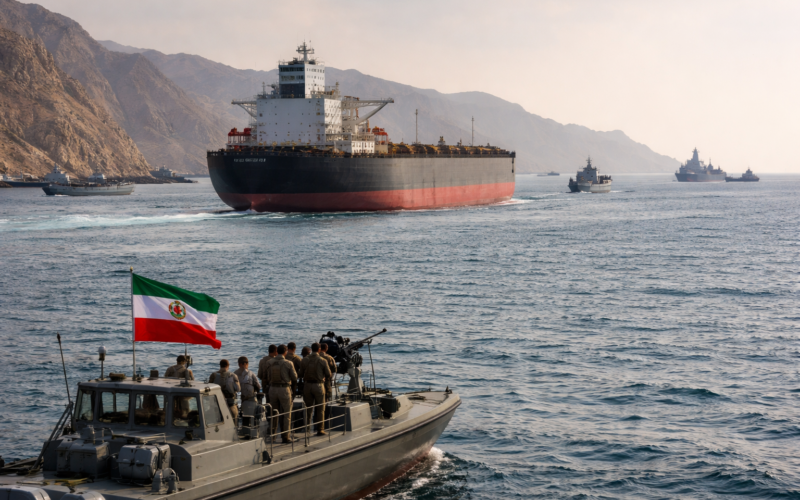
Iran said on April 17 that the Strait of Hormuz had reopened to commercial shipping, but the announcement was immediately shadowed by a direct warning from Tehran that the waterway could be shut again if the United States continued its naval blockade of Iranian ports. That left one of the world’s most sensitive maritime chokepoints formally reopened, yet operationally uncertain, with vessel movements and industry reactions showing that normal traffic had not yet resumed.
The immediate trigger for Iran’s announcement was a United States-brokered 10-day ceasefire agreed on Thursday between Israel and Lebanon. Reuters reported that Foreign Minister Abbas Araqchi said on social media that the strait would be open for all commercial vessels for the remainder of that truce. United States President Donald Trump publicly welcomed that move, but at almost the same time said the American blockade targeting ships sailing to Iranian ports would remain in force until what he described as a complete transaction with Iran was concluded.
That dual messaging created the central contradiction shaping events through Friday. Iran was presenting the strait as open, but under new conditions. The United States was presenting maritime passage as restored for general shipping, while making clear that pressure on Iran itself had not ended. Tehran then responded by saying the strait would not remain open if the blockade continued, turning what had looked like a de-escalatory maritime step into a conditional and reversible arrangement.
How did vessel traffic and shipping industry reactions show the Strait of Hormuz was not yet operating normally?
The strongest evidence that the reopening had not yet translated into a clean return to normal traffic came from shipping movements themselves. Reuters reported that some vessels made unsuccessful attempts to cross the strait on Friday before turning back. A group of roughly 20 ships, including container ships, tankers, and bulk carriers, moved toward the waterway on Friday evening, but most later reversed course. It was not immediately clear why they turned back, yet the pattern strongly suggested that operators were still treating passage as uncertain in practice.
That caution was reinforced by shipping and maritime bodies. Reuters reported that shipping companies said they still needed clarification before resuming normal operations, especially on navigation safety and the risk of mines. The United States Navy warned mariners that the mine threat in parts of the waterway was not fully understood and advised that avoidance of the area should be considered. Reuters separately reported that the advisory specifically referred to uncertainty over mine risks in the Traffic Separation Scheme used for entry to and exit from the Gulf.
BIMCO, one of the most closely watched shipping associations, said the claim that the strait was fully open was inaccurate because the status of mine threats in the Traffic Separation Scheme remained unclear. Reuters reported that BIMCO’s chief safety and security officer, Jakob Larsen, said shipping companies should consider avoiding the area. The International Maritime Organization also said it was reviewing the situation and verifying whether the reported reopening met the standards of freedom of navigation and secure passage for merchant vessels.
This matters because the Strait of Hormuz is not merely a symbolic maritime route. Reuters reported that it has handled about one-fifth of the world’s oil trade and around 20% of global oil and liquefied natural gas flows. Reuters also reported that hundreds of ships and about 20,000 seafarers had remained stranded inside the Gulf waiting to pass through the waterway. So even a reopening announcement that sounds simple in diplomatic terms becomes highly technical and commercially consequential once insurers, fleet operators, port planners, and naval authorities begin asking whether the route is actually safe, lawful, and predictable.

What conditions did Iran place on shipping through the Strait of Hormuz after the reopening announcement?
Iran’s message was not that the strait had returned to its pre-war operating status. Reuters reported that Tehran said all ships would now need to coordinate with the Islamic Revolutionary Guard Corps. A senior Iranian official told Reuters that navigation would take place only in lanes Iran considered safe and that passage would require authorization from both the Guards and Iran’s Ports and Maritime Organization. Reuters also reported that military vessels remained barred from crossing the strait and that ships linked to what Iran described as hostile forces, meaning the United States and Israel, were not permitted to pass.
That is a major operational change. Before the war, shipping through the waterway was not conditioned in the same way on Iranian military coordination. The new framework effectively means that Iran is presenting reopening not as a return to ordinary maritime passage, but as passage under Iranian supervision and selective access rules. Even Reuters’ reporting that United States vessels could be permitted, excluding military ships, was tied to the conditions set out by Tehran and to routes that Iran itself would determine as secure.
Reuters also reported that Iran linked the reopening to broader negotiations. A senior Iranian official said the release of Iranian funds frozen under United States sanctions was part of the arrangement surrounding the reopening, with the sum estimated at about $30 billion in blocked revenue from oil and gas exports. That detail underlined that the maritime move was part of a larger bargaining process, not a standalone concession.
Why did the United States maintain blockade pressure even after Iran announced the reopening?
Washington’s public position was that maritime access through the strait for general trade and the blockade on Iran were separate questions. Reuters reported that Donald Trump said the Strait of Hormuz was open and ready for business, but also said the naval blockade would remain fully in force as it pertained to Iran until an agreement with Tehran was complete. Reuters separately reported that the blockade had been announced after talks with Iran the previous weekend ended without agreement.
That stance preserved American leverage even while allowing the United States to welcome the apparent reopening of the chokepoint. It also ensured that the maritime issue remained tied to the broader diplomatic dispute, especially over Iran’s nuclear program. Reuters reported that it remained unclear how the two sides would address Iran’s nuclear program, which has been a major sticking point in peace talks, and that Trump said the United States would remove Iran’s enriched uranium while Iran’s Foreign Ministry spokesperson Esmaeil Baghaei said the material would not be transferred anywhere.
In practical terms, this meant that both sides were speaking past each other on what the reopening actually signified. Iran was signaling that access could resume, but only on terms that acknowledged Iranian control and produced relief from American pressure. The United States was signaling that shipping could move again, but without conceding the broader coercive framework it had imposed on Iran. That gap explains why the reopening produced relief in financial markets but hesitation on the water. Reuters reported that oil prices fell about 10% and global stocks rose on the prospect that traffic might resume, even as ship operators held back and naval warnings remained in place.
Why does the Strait of Hormuz reopening matter for oil markets, diplomacy, and regional stability?
The reopening matters first because the Strait of Hormuz sits at the intersection of energy security, maritime law, and conflict management. When a waterway carrying such a large share of global oil and liquefied natural gas flows becomes uncertain, the shock is felt well beyond the Gulf. Reuters reported that markets reacted immediately, with oil prices falling sharply and global stocks rising when the prospect of resumed passage emerged.
It matters second because the maritime question is now inseparable from the diplomatic one. Reuters reported that Iran hoped a preliminary agreement could be reached in the coming days to extend the ceasefire due to expire next week, which could create more time for negotiations on sanctions relief and compensation for war damage. That means the status of the strait is no longer just a shipping issue. It is part of the leverage structure surrounding ceasefire durability, sanctions, nuclear negotiations, and military de-escalation.
It matters third because Friday’s events showed how thin the line remains between formal reopening and real reopening. A diplomatic statement can reopen a chokepoint in principle. But until naval warnings are lifted, insurance risk is reassessed, shipping associations are satisfied, and vessels stop turning back, maritime normality has not truly returned. That was the defining takeaway from Friday: the Strait of Hormuz may have reopened in official messaging, but commercial confidence had not yet reopened with it.
Key takeaways on what this development means for the countries, institutions, and global context involved
- Iran said the Strait of Hormuz was open to commercial vessels during the 10-day ceasefire, but Tehran also warned that the waterway could close again if the United States kept its naval blockade on Iranian ports.
- The United States maintained that the blockade on Iran would remain in force even as Donald Trump described the strait as open for broader passage.
- Vessel tracking and industry reactions showed that shipping had not returned to normal, with some ships turning back and maritime bodies warning that mine risks and passage conditions were still unclear.
- Iran said passage now required coordination with the Islamic Revolutionary Guard Corps and Iranian maritime authorities, showing that the reopening came with new operational controls.
- The status of the Strait of Hormuz remains tied to wider negotiations involving sanctions, ceasefire terms, and the dispute over Iran’s nuclear program.
Discover more from Business-News-Today.com
Subscribe to get the latest posts sent to your email.