


Fresnillo plc is the world’s largest primary silver producer and Mexico’s biggest gold miner — a 137-year-old operation that spent most of the last decade in the shadows before a historic precious metals rally turned it into one of the FTSE 100’s standout performers. The stock has surged more than six-fold over the past 12 months, a run driven by silver and gold prices reaching levels that have rewritten the rulebook for the whole sector. The near-term story is more nuanced: Fresnillo trimmed its 2026 silver and gold production guidance in January, citing near-term operational phasing and lower grades at key mines. The question retail investors are asking right now is whether that guidance cut is a temporary dip in a multi-year bull story — or the first crack in an overextended trade.
What does Fresnillo actually do and why is it a proxy for the silver price?
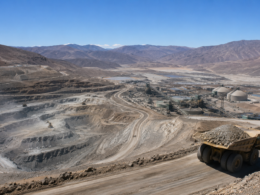
Fresnillo is not a junior explorer or a single-asset play. It operates a portfolio of nine mines across Mexico — underground silver operations at Fresnillo, Saucito, Juanicipio and Ciénega, and open-pit gold mines at Herradura, Soledad-Dipolos and Noche Buena. The company produces silver, gold, lead and zinc, but silver dominates the revenue mix and the investment narrative. As the world’s largest primary silver producer, Fresnillo’s financials move in near-lockstep with spot silver prices in a way that few other listed equities can match.
That leverage cuts both ways. Throughout 2025, the silver price rose around 150% while the gold price increased by around 65%, and Fresnillo’s financials reflected exactly that. Adjusted revenue rose 27.6% year on year to $4.65 billion, EBITDA climbed 80.7% to $2.80 billion, and gross profit more than doubled to $2.66 billion. For retail investors, the key insight is that Fresnillo is not a way to own a mine — it is effectively a leveraged position on silver with a production cost structure that makes margins expand rapidly when the metal runs.
The company is majority-owned by Mexican industrial conglomerate Industrias Peñoles, which holds a controlling interest and has historically been a stabilising force in governance. That structure limits the risk of hostile M&A and gives Fresnillo long-term operational continuity, but it also caps the free float and can dampen the price discovery that pure-play retail investor activity drives in smaller peers.

Why did Fresnillo cut 2026 production guidance and what does that mean for investors?
The guidance reduction announced in January 2026 was the headline that stopped the momentum trade momentarily in its tracks. The London-listed miner reduced its 2026 silver production forecast to 42–46.5 million ounces from 45–51 million ounces previously, and gold production guidance was cut to 500–550 thousand ounces from 515–565 thousand ounces — revisions representing a roughly 9% reduction in silver guidance and a 4–5% cut in gold forecasts against consensus estimates.
The causes are mine-plan specific rather than systemic. Production shortfalls stemmed from mine-plan changes at the Fresnillo mine, where lower throughput and grades resulted from mining shifting to narrower veins; at Ciénega, reduced silver grades and recoveries occurred as the operation transitions to narrower gold-rich zones; Saucito faced lower volumes due to a delayed shaft connection; and Herradura’s gold output fell after production was pulled forward into 2025. None of these are geologically terminal problems — they are operational sequencing issues that experienced mine planners work through routinely. The market’s concern is whether they indicate a broader structural grade deterioration across the portfolio.
Looking to 2027 and 2028, silver output of 45–51 million ounces is expected for both years, and gold production of 535,000–595,000 ounces is expected for each year. If that recovery trajectory holds, 2026 is a trough, not a turning point — and the current share price is implicitly pricing some version of that rebound. Retail investors watching FRES should treat the Q1 2026 production report, due in late April, as the first data point to validate or challenge that assumption.
What did Fresnillo’s record 2025 results reveal about its financial quality?
The full-year 2025 numbers released in March confirmed the scale of what precious metals prices delivered to a well-run miner. Revenue and profitability reached record highs, with revenue up 30.5% to $4,561.2 million, gross profit increasing 114% to $2,664.1 million, and operating profit rising 142% to $2,292.5 million. Profit for the year surged to $1.57 billion from $226.7 million in 2024.
The cash generation story is what distinguishes Fresnillo from smaller precious metals producers that dilute shareholders to fund growth. The company ended 2025 with a net cash position of $1.92 billion, up from $458.3 million a year earlier. Fresnillo returned a record $950 million to shareholders in dividends, representing 69% of earnings — well above the stated dividend policy of distributing 50% of adjusted profit. The company also captured $46 million in cost savings during the year.
For retail investors assessing whether FRES is a quality business rather than a momentum play, those metrics matter. A company generating over $1.5 billion in net profit with nearly $2 billion of net cash on its balance sheet and the discipline to return most of its earnings to shareholders is a fundamentally different proposition from a leveraged miner running thin margins.
How does the Probe Gold acquisition change the long-term investment thesis?
The $556 million acquisition of Probe Gold — completed in Q1 2026 — is the most significant strategic decision Fresnillo has made in years. The deal gives Fresnillo access to Probe’s 10 million ounces of gold reserves, including 8 million ounces at the Novador project in Quebec’s Val-d’Or mining camp, and also includes the early-stage Detour Gold Quebec property. The deal was priced at CA$3.65 per share, a 39% premium over Probe’s last closing price.
For investors, the strategic logic is straightforward: Fresnillo’s Mexican mines are producing at or near peak output, grade profiles are declining at key assets, and the company needs a pipeline of high-quality development projects to sustain long-term production. Val-d’Or is one of Canada’s most proven gold districts, and the Novador project gives Fresnillo optionality on a resource base it can develop on its own timetable. Exploration spending for 2026 is expected to rise sharply to around $260 million, up from $173.5 million in 2025, as the company steps up drilling at operating mines and begins work at Probe Gold.
The risks of the Probe deal are equally worth understanding. Fresnillo has never operated outside Mexico. Integrating a Canadian development portfolio will require new regulatory, cultural and technical navigation, while deeper and more complex Mexican mines still need capital and management focus. The company is effectively running two strategic priorities simultaneously — stabilising near-term Mexican output and building a Canadian growth asset — and execution on both fronts will need to be tracked over the coming reporting periods.
What does the macro environment for silver and gold mean for the FRES thesis in 2026?
Fresnillo’s share price does not exist in isolation from spot metals prices, and any retail investor analysis of the stock needs to account for where silver and gold are heading. Global silver ETF inflows reached 95 million ounces by mid-2025, surpassing total inflows for all of 2024, with total ETF holdings reaching approximately 1.13 billion ounces valued at over $40 billion. That structural demand from financial investors, layered on top of industrial demand from solar, EV and electronics manufacturing, has created a supply-demand dynamic that most analysts expect to persist.
Citi has issued a silver price target of $110 for the second half of 2026, citing an acute shortage of physical silver available for immediate industrial delivery. If that scenario materialises, Fresnillo’s revenue and margin expansion in 2026 could offset the volume guidance reduction entirely — the price effect can and has outrun production headwinds in this company’s recent history. The flip side is equally clear: a 15–20% correction in metals could translate into a far larger reset in Fresnillo’s equity value, especially if sentiment swings from a safe-haven darling to an over-owned commodity play.
The macro tailwinds that drove the 2025 rally — elevated geopolitical tension, central bank gold buying, US dollar weakness, and inflation hedging — remain broadly in place in April 2026. That does not guarantee continuation, but it does mean Fresnillo is not operating in a deteriorating macro environment when it guides for a near-term production dip.
How is the market pricing FRES relative to peers and what do analysts think?
At 3,782p on the LSE at the time of writing, Fresnillo is trading with a 52-week range of 716p to 4,472p — a range that tells the story of one of the FTSE 100’s most dramatic re-ratings in recent memory. The share price has outperformed the FTSE All Share Index by more than 230% over the past year. The average 12-month analyst price target sits at approximately 3,795p, implying limited near-term upside from current levels, with a wide range from around 2,498p on the low end to 5,521p at the high end.
Analyst consensus is broadly neutral, with four analysts recommending buying the stock and one suggesting selling. The Morgan Stanley underweight call — with a 2,210p price target — is the most bearish outlier, driven by concerns over volume guidance risk and elevated capex spend. Morgan Stanley described the FY2025 results as a strong beat tapered by higher spend, and flagged that 2026 capital expenditure guidance was substantially above estimates on deferrals and higher maintenance costs.
Fresnillo’s trailing P/E was approximately 80x in early 2026, while its forward P/E was around 24.8x — still at a premium to many silver peers such as Pan American Silver, which trades at a forward P/E of around 14.8x. That premium reflects the market assigning a quality rating to Fresnillo’s scale, balance sheet and free cash flow, but it also means the valuation is not forgiving of operational surprises.
What are the key risks a retail investor in FRES needs to understand before taking a position?
No article on Fresnillo is complete without a clear-eyed look at what can go wrong. The first risk is commodity cyclicality: silver and gold prices are the primary driver of earnings and sentiment, and both metals have already moved to levels that are extreme by historical standards. A reversal would compress Fresnillo’s valuation from multiple directions simultaneously.
The second risk is execution. The 2026 guidance reduction demonstrated that Fresnillo’s mines are complex, grade-sensitive operations where plan changes can materialise quickly. Morgan Stanley noted that the Q4 production figures underscored the challenging nature of Fresnillo’s mines and the near-term deterioration in grades, maintaining its underweight rating with a 2,210p price target.
The third risk is legal and regulatory. The El Bajío case and broader scrutiny of mining ESG practices in Mexico could lead to financial charges, delays at certain assets, or a higher required risk premium from investors. Mexico’s regulatory environment for mining has been unsettled in recent years, and while the Sheinbaum administration is seen as somewhat less hostile than its predecessor, permitting risk has not gone away. Two fatalities occurred in 2025, highlighting ongoing safety challenges despite improvements in injury frequency rates.
A fourth risk is specific to the capex trajectory. Capital expenditure for 2026 is expected at approximately $765 million, focused on the deepening of the Jarillas shaft at Saucito and a haulage conveyor at Juanicipio. At that run rate, the balance sheet strength that distinguished the 2025 results begins to be consumed, reducing the company’s capacity for further M&A or incremental shareholder returns if metals prices soften.
What are the key takeaways from Fresnillo (LSE: FRES) for retail investors watching the stock in April 2026?
- Fresnillo is the world’s largest primary silver producer and Mexico’s leading gold miner, listed on the London Stock Exchange at approximately 3,782p per share, with a market capitalisation of around £27.8 billion and a 52-week range of 716p to 4,472p.
- The company posted record 2025 financial results — EBITDA of $2.80 billion up 80.7% and net profit of $1.57 billion — driven by a historic rise in silver and gold prices, while ending the year with $1.92 billion of net cash on the balance sheet.
- 2026 production guidance was trimmed in January, with silver output now guided to 42–46.5 million ounces (down from 45–51 million) and gold to 500–550 thousand ounces, reflecting mine-plan changes, narrower veins at Fresnillo, and grade transition issues at Ciénega and Herradura. Management expects volume recovery from 2027 onwards.
- The $556 million Probe Gold acquisition completed in Q1 2026 adds 10 million ounces of gold resources in Quebec’s Val-d’Or district, extending Fresnillo’s growth runway beyond its Mexican asset base — but introduces execution risk in a jurisdiction where the company has no prior operating history.
- The macro backdrop for silver and gold remains broadly supportive heading into H2 2026, with structural supply deficits, central bank buying, and industrial demand from solar and EV manufacturing underpinning price levels — though metals have already moved far and quickly, leaving the stock exposed to a sharp reversal if sentiment shifts.
- Analyst consensus is Neutral, with the 12-month average price target at approximately 3,795p implying minimal near-term upside from current levels; the stock carries material downside risk to the 2,210p Morgan Stanley bear case if production disappoints again or metals prices correct.
- The next key catalyst for FRES shareholders is the Q1 2026 production report, expected in late April, which will indicate whether the guided near-term volume dip is tracking in line with expectations or running ahead of schedule.
Discover more from Business-News-Today.com
Subscribe to get the latest posts sent to your email.