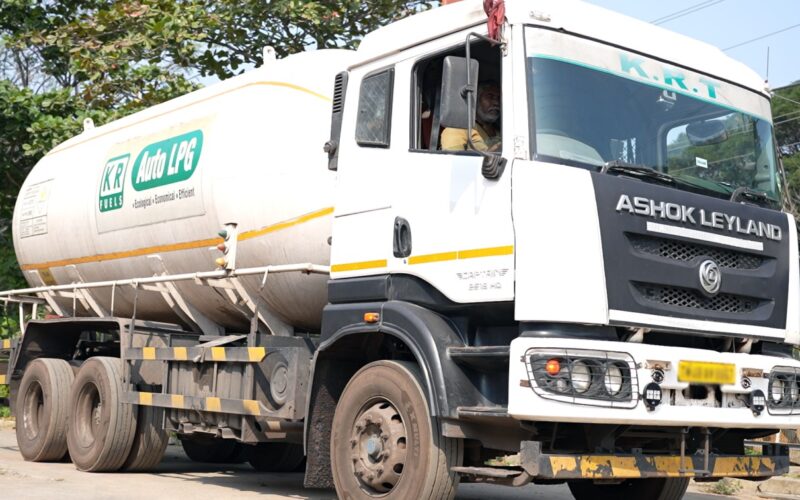
Netradyne has reported measurable safety outcomes from the deployment of its Driver i AI video-telematics platform across KR Trans Fuels Pvt. Ltd., KR Gases Pvt. Ltd., and KRT Carriers, three privately held Indian fleet businesses operating in LPG distribution, ammonia gas haulage, and passenger transit. These companies, which are part of KR Group, recorded a 64% reduction in driver distraction events, a 65% decline in drowsiness alerts, 100% speeding correction at KR Gases, and a more than 90% fall in mobile phone use after the system was introduced across the fleet. The announcement is strategically relevant because it moves fleet safety from policy enforcement into real-time behavioural intervention in some of India’s highest-consequence transport environments. For Netradyne, the KR Group results strengthen its India positioning at a time when AI-based driver monitoring is shifting from compliance software into operational risk infrastructure.
The central point is not simply that cameras and alerts were installed in vehicles. KR Group was already using safety protocols such as GPS tracking, regulated driver rest cycles, and strict no-phone policies before the Netradyne deployment. The problem was that those measures were largely procedural, while the most dangerous moments in road transport happen inside a narrow behavioural window: a distracted glance, a fatigue lapse, an unsafe following distance, or a brief decision to speed. Netradyne’s deployment matters because it gives fleet operators a way to intervene in that window rather than investigate it later.
Why does Netradyne’s KR Group deployment matter for India’s hazardous goods transport sector?
The KR Group deployment sits at the intersection of three risk categories that are unusually difficult to manage together: hazardous materials, long-distance commercial driving, and passenger movement in urban and semi-urban traffic. KR Trans Fuels, KR Gases, and KRT Carriers operate in sectors where a single accident can create consequences beyond vehicle damage, especially when LPG, ammonia, propylene, or passenger buses are involved. For an ordinary fleet, driver distraction is a cost, safety, and insurance issue. For hazardous goods transport, it can become an industrial safety event on a public road, which is where the stakes rise quickly and the paperwork starts sweating.
That makes the reported metrics more than a vendor success story. A 64% reduction in distraction events suggests that the system was not just recording driver behaviour but influencing it. A 100% speeding correction rate at KR Gases is particularly meaningful because ammonia haulage and other high-risk chemical transport operations depend heavily on driver discipline, route adherence, and rapid response to early warning signals. The 96% corrective response to unsafe following-distance alerts also matters because following distance is one of the most operationally actionable behaviours in heavy vehicle safety.
The broader Indian context gives the deployment more weight. Road safety remains a major policy and commercial risk for India’s logistics economy, with overspeeding, mobile-phone use, wrong-side driving, lane indiscipline, and other behavioural factors repeatedly appearing in official crash classifications. Hazardous-goods transport is already subject to rule-based obligations around vehicle readiness, driver training, route planning, emergency information panels, and safety equipment. What the KR Group case shows is that rules and training remain necessary, but they may not be sufficient without real-time visibility into whether drivers are actually following safe operating behaviour during the journey.

How does real-time driver coaching change fleet safety economics for LPG, ammonia and passenger operators?
The business case for real-time coaching is different from the business case for passive telematics. Traditional monitoring can tell management what happened, where a vehicle went, and sometimes how fast it was moving. Real-time coaching attempts to change the outcome while the risk is still developing. That distinction is central to Netradyne’s pitch and to the KR Group results, because the improvement came from drivers responding to in-cab alerts at the moment of risk rather than from managers reviewing reports after a route was complete.
For LPG and ammonia operators, that shift can affect multiple cost lines at once. Fewer distraction, drowsiness, speeding, and following-distance incidents can reduce accident exposure, lower vehicle downtime, limit cargo-related risk, and protect the company from third-party claims where liability is disputed. The case study is especially important on this point because KR Trans Fuels used video evidence after a two-wheeler collision complaint involving a tanker. The footage helped establish that the tanker driver was not at fault, allowing the company and driver to avoid wrongful liability. That is a practical example of video telematics moving beyond coaching into legal defensibility.
Passenger transport adds a separate layer. KRT Carriers operates in urban and semi-urban conditions where the risk environment changes constantly because of pedestrians, two-wheelers, stop-start traffic, and unpredictable road behaviour. A 65% reduction in drowsiness alerts compared with peak levels matters because passenger operators face reputational consequences that can be disproportionate to the direct financial cost of an incident. In passenger mobility, safety is not merely compliance. It is brand trust, route reliability, driver retention, and customer confidence bundled into one unforgiving operating metric.
What do KR Trans Fuels, KR Gases and KRT Carriers results reveal about operational risk?
The results across the three KR Group entities show that AI fleet safety is most useful when it is mapped to the operating realities of each business rather than treated as a generic dashboard. KR Gases operates some of the group’s highest-risk vehicles, including ammonia tankers, so speeding correction and safe following distance become critical compliance and public safety indicators. KR Trans Fuels runs the group’s largest fleet, making distraction reduction and phone-use control more important at scale. KRT Carriers faces a passenger safety challenge, where drowsiness reduction is directly tied to the reliability of daily operations.
This segmentation is important because it shows how fleet safety systems can become operational management tools rather than standalone safety add-ons. A single enterprise may need different behavioural priorities across different vehicle types, route profiles, cargo categories, and driver work cycles. For Netradyne, the KR Group results provide a useful proof point because the deployment was not limited to a single easy use case. It covered hazardous goods, fuel distribution, and passenger transit, which gives the outcome broader relevance for Indian fleet operators evaluating whether AI coaching can work across mixed operations.
There is also a management lesson in the sequencing. The case study indicates that KR Group evaluated providers, piloted the system, addressed driver concerns, and then moved to full deployment. That process matters because AI fleet safety systems can fail culturally even when the technology works technically. Drivers may see camera-based systems as surveillance, punishment, or mistrust. KR Group appears to have reduced that resistance by linking performance data to recognition and financial incentives rather than using the platform only as a disciplinary tool.
Why could driver recognition and GreenZone Score incentives matter more than surveillance alone?
The most strategically interesting part of the KR Group deployment may be the incentive design. GreenZone Scores are reviewed monthly and tied to recognition and financial incentives, which changes the relationship between driver and system. Instead of treating the platform as a digital traffic policeman sitting in the cabin, KR Group appears to have positioned it as a scoring and reward framework. That matters because fleet safety depends on consistent behaviour over thousands of kilometres, not occasional compliance when management is watching.
Suresh Kumar, managing director and owner of KR Trans Fuels, KR Gases, and KRT Carriers, has indicated that the company needed greater driver-level visibility because policies alone could not prevent fatigue, distraction, or phone use in real time. His broader message was that the technology helped the group act faster and build a more preventive approach to safety. Saravana Kumar, safety coordinator at KR Trans Fuels, has also indicated that most operations are now running smoothly and that drivers responded positively when they understood the intent of the system. That driver buy-in is not a soft issue. It is the operating system beneath the operating system.
The incentive model also helps explain the double-digit improvement in driver performance reported by KR Group. If drivers understand how they are scored, how scores are reviewed, and how good performance is rewarded, the data becomes actionable at the individual level. That creates a feedback loop in which drivers ask why scores dropped and seek recognition when scores improve. For commercial fleets, that is a more durable behavioural model than one built purely on fear of penalty.
What execution risks could limit wider adoption of AI video telematics across Indian fleets?
The KR Group results are strong, but wider market adoption will not be automatic. The first execution risk is driver acceptance. Camera-based monitoring, audio alerts, and behavioural scoring can be perceived as intrusive if fleet owners do not communicate clearly how data is used, who reviews it, and how drivers benefit. KR Group’s example suggests that transparency and incentives are essential. Without those elements, similar systems could produce resistance, workarounds, or morale problems.
The second risk is data interpretation. A platform can generate alerts, scores, and video evidence, but fleet managers still need the discipline to use that information intelligently. Too many alerts can create fatigue for both drivers and supervisors. Too little coaching can turn a sophisticated system into an expensive archive. The best fleet operators will be those that convert raw event data into training priorities, route policy, driver rostering, and maintenance decisions.
The third risk is uneven economics across fleet sizes. Large or high-risk operators can justify AI safety systems more easily because the cost of a serious incident is high and the fleet base is large enough to produce measurable savings. Smaller operators may see the benefits but hesitate over installation cost, training effort, and management bandwidth. For Netradyne and similar providers, the next growth challenge in India may be packaging the technology in ways that work not only for enterprise fleets but also for mid-sized operators that still carry meaningful public safety risk.
What does this deployment signal for Netradyne’s India and APAC fleet safety strategy?
For Netradyne, the KR Group deployment is a useful India proof point because it connects the company’s AI safety narrative to measurable outcomes in a difficult operating environment. The company has positioned its platform around full drive-time visibility, real-time coaching, fleet safety, compliance support, and driver scoring. KR Group gives that positioning a concrete sectoral example across hazardous materials and passenger transport, two areas where safety outcomes are commercially and socially visible.
The deployment also fits into a broader strategic pattern. Netradyne has been expanding its global footprint and building visibility across regions, including Europe and India. In India, where logistics growth, highway expansion, electric mobility corridors, and commercial fleet modernization are moving together, the ability to provide an intelligence layer for fleet operations could become a stronger competitive differentiator. Fleet operators are no longer only buying cameras. They are buying risk reduction, driver accountability, incident evidence, insurance leverage, and operational consistency.
The real test will be repeatability. One deployment can demonstrate impact, but the market will watch whether similar outcomes can be delivered across different cargo types, fleet sizes, road conditions, and driver cultures. If Netradyne can show that its model works beyond KR Group, the company could strengthen its position in India’s commercial transport safety stack. If adoption remains concentrated among a smaller group of sophisticated operators, the technology may still be valuable but less transformative at the sector level.
Key takeaways on Netradyne, KR Group and India’s AI-powered fleet safety market
- Netradyne’s deployment across KR Trans Fuels, KR Gases, and KRT Carriers turns AI fleet safety into a live operational case study across hazardous goods, fuel distribution, and passenger transport.
- The reported 64% reduction in driver distraction events suggests that real-time coaching can influence driver behaviour before risk becomes an incident, which is the core value shift from passive monitoring.
- KR Gases’ 100% speeding correction rate is strategically important because ammonia and other high-risk cargo operations have limited tolerance for delayed intervention or repeated driver non-compliance.
- KR Trans Fuels’ more than 90% reduction in phone-use incidents shows how AI coaching can convert a policy-level rule into a measurable operating behaviour across a larger fleet.
- KRT Carriers’ 65% reduction in drowsiness alerts points to the relevance of driver monitoring in passenger mobility, where fatigue risk can directly affect public trust and route reliability.
- The GreenZone Score incentive model is a critical part of the story because driver recognition and financial rewards appear to have reduced resistance to cabin-based monitoring.
- Video evidence adds a second business case beyond coaching, as it can help fleet owners defend drivers and companies when third-party liability claims are disputed.
- Wider adoption across Indian fleets will depend on cost, driver acceptance, manager training, data governance, and whether operators treat AI alerts as coaching inputs rather than punishment triggers.
- For Netradyne, KR Group provides a credible proof point in India at a time when fleet safety technology is moving toward real-time risk intelligence and corridor-level transport visibility.
- The broader industry implication is clear: fleet safety is shifting from compliance manuals and post-incident reviews to continuous behavioural management, and the winners will be operators that make drivers part of the system rather than targets of it.
Discover more from Business-News-Today.com
Subscribe to get the latest posts sent to your email.