


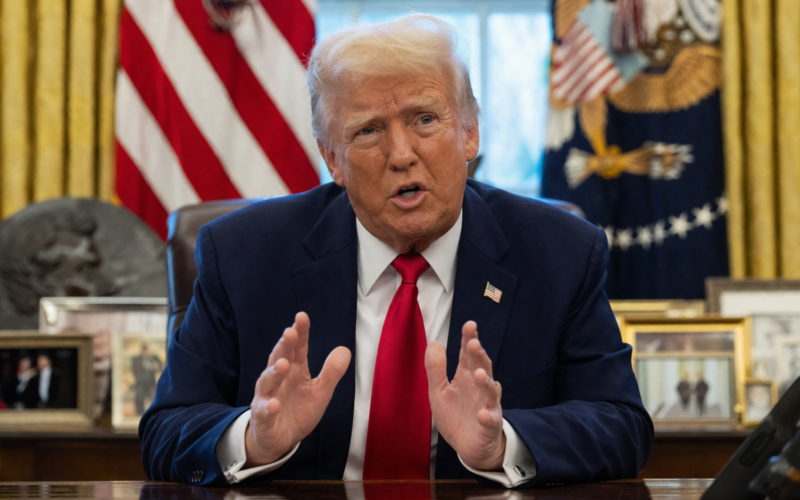
United States President Donald Trump announced on July 30, 2026, that a framework had been reached for the complete disarmament of Hamas and other armed groups in Gaza, with Israeli forces expected to withdraw in stages as weapons and military infrastructure are surrendered.
Donald Trump described the framework as a major step in the implementation of his 20-point Gaza plan. The proposed process would combine phased disarmament, a gradual Israeli military withdrawal, an international security presence and the transfer of civilian authority to a new Palestinian administration.
The announcement is potentially the most important development in the Gaza ceasefire process since the second phase of the United States-backed plan became stalled over Hamas weapons, Israeli security demands and the future governance of the territory.
The immediate status of the announcement nevertheless remained uncertain. Neither Hamas nor the Israeli government issued an immediate public statement confirming that it had formally accepted every term described by Donald Trump.
An Israeli official had already indicated that the proposals under discussion did not fully satisfy Israel’s demand for complete demilitarisation before military withdrawal. Hamas representatives had presented their negotiating position positively but had not publicly confirmed unconditional acceptance of full disarmament.
The framework therefore represents a diplomatic breakthrough claim rather than a completed peace settlement. Its significance will depend on written commitments, agreed verification rules and whether the parties begin carrying out reciprocal steps on the ground.
What did Donald Trump announce about Hamas disarmament and Israel’s withdrawal from Gaza?
Donald Trump said the Board of Peace had reached an agreement covering the complete disarmament of Hamas and other armed groups operating in Gaza.
The proposed arrangement would be implemented in structured phases. Israeli forces would withdraw as disarmament progressed, rather than leaving the territory before Hamas weapons and military infrastructure were addressed.
The International Stabilization Force would work alongside a newly organised Palestinian police service to assume responsibility for security. A new Palestinian administration would gradually take over civilian governance from institutions previously controlled by Hamas.
Donald Trump thanked Egypt, Qatar and Turkey for supporting the negotiations. All three countries have maintained channels with Hamas and have played roles in previous ceasefire, hostage and humanitarian discussions.
The framework is part of Donald Trump’s wider 20-point plan, which seeks to end armed rule by Hamas, remove militant infrastructure, establish a transitional governance system and begin reconstruction across Gaza.
The announcement did not include a signed document, a detailed map of Israeli withdrawal positions or a complete public timetable. Those omissions mean that several central issues remain subject to negotiation and interpretation.
The diplomatic achievement is therefore the apparent acceptance of a common sequence rather than the immediate completion of disarmament. The parties still need to agree on what weapons must be surrendered, who verifies compliance and what Israeli actions follow each completed stage.
Why has neither Israel nor Hamas immediately confirmed the Gaza disarmament framework?
Neither side immediately issued a statement matching the full language used by Donald Trump. That silence is important because Israel and Hamas have previously interpreted the same ceasefire commitments differently.
Israel has demanded the complete removal of weapons from Gaza, the destruction of tunnels and the elimination of facilities used to manufacture rockets or explosives. Israeli authorities have also sought guarantees that Hamas cannot retain political or security influence through informal networks.
Hamas has resisted disarmament without firm commitments covering a permanent end to Israeli attacks, the withdrawal of Israeli forces and a recognised Palestinian governing structure. Hamas has treated its weapons as both a source of political leverage and a central element of its identity.
The framework attempts to bridge those positions by linking each stage of disarmament to an Israeli withdrawal step. That reciprocal structure reduces dependence on trust, but it creates difficult questions when either side believes the other has not completed its obligations.
Israel may argue that weapons remain concealed or that tunnels have not been fully destroyed. Hamas may argue that Israeli forces have not withdrawn far enough or that airstrikes and military restrictions continue despite Palestinian compliance.
The absence of immediate confirmation may also reflect internal political considerations. Israeli Prime Minister Benjamin Netanyahu faces pressure from political allies who oppose withdrawing before full demilitarisation, while Hamas must manage armed factions that may reject surrender.
A formal agreement will require more than broad approval of a diplomatic principle. Israel and Hamas must accept the same definitions, timetable, verification mechanism and consequences for non-compliance.
How would Hamas and other armed groups surrender weapons under the phased Gaza plan?
The first stage would focus on weapons held by police and organised security personnel linked to the existing Gaza administration. Those weapons could be transferred to the new Palestinian authority within an initial period of approximately two weeks.
That first transfer would not cover most Hamas fighters or the organisation’s heavier arsenal. Rockets, anti-tank weapons, explosives, military drones, concealed ammunition and underground infrastructure would require a much longer process.
The proposed timetable for heavy weapons and tunnel decommissioning could extend over approximately 200 to 350 days. The length reflects the scale of the arsenal, the difficulty of locating hidden facilities and the need to verify destruction across heavily damaged urban areas.
Disarmament could involve the collection, registration, removal or destruction of weapons. Some programmes may also include financial support or reintegration opportunities for lower-level fighters who surrender equipment and return to civilian life.
The practical challenge is determining whether every weapon has been declared. Gaza contains extensive tunnel networks, damaged buildings and restricted areas where weapons or manufacturing equipment could be concealed.
Palestinian Islamic Jihad and smaller armed organisations would also need to participate. An agreement involving Hamas alone would not create a fully demilitarised Gaza if other factions retained rockets or independent command structures.
International monitors would require secure access to weapons sites, storage areas and tunnel entrances. They would also need intelligence cooperation from Israel, Palestinian authorities and regional mediators to assess whether undeclared military infrastructure remained operational.
The process could fail if armed groups split, conceal weapons or reject the authority of negotiators. A faction excluded from the agreement could use even a limited attack to interrupt Israeli withdrawal and discredit the wider framework.
How would Israeli military withdrawal be connected to verified disarmament across Gaza?
Israeli forces would withdraw gradually as agreed disarmament targets were completed and verified. The arrangement is intended to prevent either side from carrying out all its obligations before receiving a corresponding concession.
The first withdrawals would likely involve areas where local security responsibilities can be transferred to Palestinian police and the International Stabilization Force. Later stages would depend on the removal of heavier weapons and military infrastructure.
The precise geographic sequence had not been published. Maps will be essential because Israel currently controls substantial parts of Gaza and has established military positions, restricted areas and operational corridors.
Israel will seek the ability to respond if it detects weapons transfers, tunnel construction or attacks against Israeli territory. Palestinians will seek guarantees that Israeli military action cannot restart whenever Israel disputes compliance.
The verification system must therefore distinguish between a confirmed violation, incomplete implementation and an allegation that still requires investigation. Without an accepted dispute-resolution process, each incident could halt the withdrawal.
Israel has also sought lasting security arrangements along Gaza’s borders. The Palestinian side is likely to oppose any framework that creates permanent Israeli-controlled buffer zones or leaves Gaza divided into separate security areas.
The withdrawal question is connected to reconstruction. Large-scale rebuilding cannot proceed efficiently while military zones, unexploded weapons and uncertain access restrictions remain across the territory.
A credible timetable must specify which institution certifies completion of each phase. If Israel alone decides whether disarmament is sufficient, Palestinians may view the process as open-ended. If international monitors possess final authority, Israel may question whether its security concerns are being fully addressed.
Who would govern Gaza after Hamas transfers authority under the proposed agreement?
The plan envisages a new Palestinian technocratic administration taking responsibility for civilian governance. The National Committee for the Administration of Gaza has been identified as the principal body expected to assume that role.
Hamas announced earlier in July that it had dissolved its governing structure and was preparing to transfer civilian authority to a technical committee. That step separated the question of governance from the more difficult dispute over military disarmament.
The new administration would be expected to manage public services, municipal functions, reconstruction coordination, education, healthcare and economic recovery. It would operate with support from the Board of Peace and international partners.
A technocratic structure is intended to avoid direct rule by Hamas while also preventing an immediate administrative vacuum. Gaza requires functioning institutions even before a final political settlement is reached.
The committee’s legitimacy will depend on Palestinian acceptance. An administration perceived as imposed externally may struggle to recruit staff, enforce decisions or maintain authority outside heavily protected areas.
The relationship with the Palestinian Authority remains another unresolved issue. International governments have frequently supported eventual Palestinian Authority responsibility for Gaza, but political divisions and reform demands have complicated that transition.
The new administration must also be protected from armed coercion. Civilian officials cannot govern effectively if Hamas or another faction retains the ability to overrule decisions through weapons or informal security structures.
Financial independence will matter as well. The committee will require transparent funding, reliable salary payments and controls preventing reconstruction contracts or public resources from being captured by political or armed networks.
What role would the International Stabilization Force and Palestinian police play in Gaza?
The International Stabilization Force would support the transfer from Israeli military control and armed-group rule towards a Palestinian civilian security system.
The force would work with a new Palestinian police service responsible for public order, protection of government institutions and ordinary law enforcement. The police would not be structured as a military organisation capable of conducting offensive operations against Israel.
International personnel could help secure weapons collection sites, protect transport routes and support the verification of demilitarised areas. They may also assist in training, communications and the rebuilding of police facilities.
The number of participating countries, troop commitments and rules of engagement remained unclear. Governments may support the concept politically while hesitating to deploy personnel into an unstable environment where they could face attacks from multiple sides.
The force would need authority to protect itself, intervene during armed confrontations and investigate ceasefire violations. An international mission without a clear mandate could become dependent on Israeli forces for security, undermining its credibility among Palestinians.
Palestinian police recruitment will also require vetting. The new force must exclude individuals involved in serious abuses while retaining enough experienced personnel to operate throughout Gaza.
Police officers may initially surrender existing weapons before receiving newly registered equipment under the authority of the technocratic government. That process would help distinguish lawful policing weapons from undeclared factional arsenals.
The International Stabilization Force will succeed only if it is viewed as temporary and connected to Palestinian self-government. A mission perceived as an indefinite foreign occupation could face resistance and lose local cooperation.
Why do Israel’s objections and Hamas’s internal structure threaten implementation of the deal?
Israel’s principal objection is that phased disarmament may allow Hamas to delay surrendering its most important weapons while receiving partial Israeli withdrawals.
Israeli officials are likely to demand access to intelligence, inspection findings and verification reports before approving each military movement. Israel may also insist on retaining the ability to strike what it identifies as an immediate threat.
Hamas faces a different problem. Its political representatives may approve a framework that field commanders, local cells or allied factions refuse to implement.
The organisation’s weapons are distributed across different units and locations. Central leaders may not possess complete operational control over every fighter, tunnel or stored weapon.
The conflict with Iran also affects the calculation. Iran has supported Hamas and Palestinian Islamic Jihad, but Iran’s confrontation with the United States may reduce its capacity to provide funding, weapons or political support.
Reduced external backing could encourage Hamas to compromise. It could also motivate factions to preserve hidden weapons because they fear future isolation or renewed Israeli military action.
Benjamin Netanyahu must manage political partners who may treat any withdrawal as dangerous unless Gaza is already fully demilitarised. Hamas negotiators must justify surrendering weapons after decades of presenting armed resistance as essential.
The agreement therefore depends on leaders persuading their own constituencies, not merely reaching terms with the opposing side. Internal opposition could derail implementation even when mediators believe the central negotiations are complete.
Why did Israeli strikes continue in Gaza despite Donald Trump’s peace announcement?
Israeli strikes continued on July 30, killing at least six Palestinians, including two children. The continuing violence demonstrated that the diplomatic framework had not yet produced a complete halt to military operations.
The existing ceasefire has remained fragile, with repeated accusations of violations and disputes over military access, armed activity and civilian movement.
A political announcement does not automatically change operational orders. Military commanders require formal instructions, agreed implementation times and clear rules before altering deployments or planned actions.
Israel may also argue that it retains the right to respond to immediate threats until disarmament begins. Palestinians may view continued strikes as evidence that Israel is not committed to reciprocal implementation.
Civilian casualties can rapidly weaken support for negotiations. Each strike creates pressure on Hamas and mediators to suspend talks, while attacks against Israel would strengthen demands for a renewed military campaign.
The ceasefire process therefore needs an immediate operational protocol alongside the longer disarmament plan. That protocol should specify when attacks stop, how violations are investigated and who communicates during emergencies.
Without a stable security environment, inspectors cannot collect weapons, international forces cannot deploy and a civilian government cannot establish authority.
The events of July 30 illustrate the central contradiction. Diplomats are discussing a year-long demilitarisation and withdrawal process while civilians continue facing immediate military danger.
What could cause the Gaza disarmament and Israeli withdrawal framework to collapse?
The greatest risk is disagreement over verification. Israel and Hamas may both claim compliance while accusing the other side of delaying or concealing obligations.
A single rocket launch, airstrike or armed confrontation could suspend implementation. Smaller organisations may deliberately provoke such incidents to prevent Hamas from surrendering weapons.
The absence of a complete public timetable creates another risk. Each side may expect the other to act first, causing delays that gradually destroy confidence.
The International Stabilization Force may also struggle to obtain sufficient personnel. Governments will require clarity about command, legal authority, funding and protection before deploying forces.
The Palestinian technocratic administration could fail if it lacks money, legitimacy or control over police. Civil servants may remain dependent on older political structures even after a formal transfer of authority.
Reconstruction disputes could become politically explosive. Palestinians will expect rapid housing, water and healthcare recovery, while donors may delay funds until security and governance requirements are met.
Israeli domestic politics and Palestinian factional divisions could alter the agreement after negotiations. A leadership crisis, election development or major attack could produce demands for revised terms.
The framework remains important because it places disarmament, withdrawal, governance and international security within one reciprocal process. It remains fragile because every element depends on the others progressing at approximately the same speed.
What are the key takeaways from Donald Trump’s Gaza disarmament announcement?
- Donald Trump announced on July 30, 2026, that the Board of Peace had reached a framework for the complete disarmament of Hamas and other armed groups, with implementation planned through reciprocal and carefully structured phases.
- Neither the Israeli government nor Hamas issued an immediate public statement confirming unconditional acceptance of every term, while Israeli officials had already indicated that the proposals did not fully satisfy Israel’s demilitarisation demands.
- The framework links Israeli military withdrawal to verified Palestinian disarmament, meaning Israeli forces would leave areas gradually as weapons, tunnels, production facilities and other militant infrastructure are removed.
- Palestinian police could transfer existing weapons during an initial period of approximately two weeks, while the surrender of heavy arms and decommissioning of tunnels may require an estimated 200 to 350 days.
- A new Palestinian technocratic administration, identified as the National Committee for the Administration of Gaza, would assume civilian responsibility while working with the Board of Peace and international reconstruction partners.
- The International Stabilization Force would support weapons collection, security transfers and the development of a new Palestinian police service, although participating countries, troop numbers and rules of engagement remain unresolved.
- Israel remains concerned that phased implementation could allow Hamas to delay surrendering heavy weapons, while Hamas continues to demand firm commitments covering an end to attacks and a complete Israeli military withdrawal.
- Continued Israeli strikes on July 30 showed that the diplomatic announcement had not yet produced a comprehensive operational ceasefire, leaving civilian protection and immediate security arrangements as urgent unresolved issues.
Discover more from Business-News-Today.com
Subscribe to get the latest posts sent to your email.