




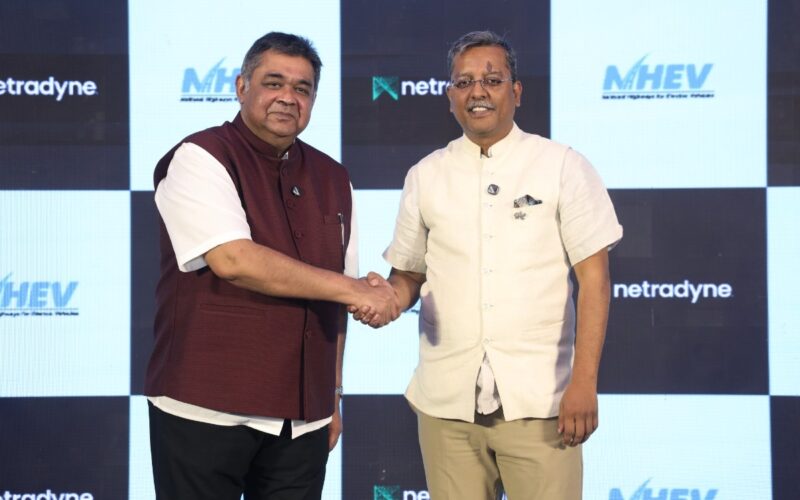
Netradyne has partnered with National Highways for Electric Vehicles (NHEV) to provide the artificial intelligence safety and intelligence layer for India’s emerging Electronic Highway network. The collaboration will see Netradyne’s AI-powered fleet safety and performance technology deployed in phases across connected commercial electric vehicles operating on NHEV-supported corridors. The move matters because India’s long-distance electric mobility challenge is no longer only about installing chargers, but about making freight movement safer, trackable, dependable and financially credible at highway scale. For fleet operators, financiers and policymakers, the partnership pushes the e-highway conversation from infrastructure availability to operational trust.
The announcement places Netradyne inside one of India’s more ambitious electric mobility experiments, where charging stations, roadside support, energy systems, digital monitoring and commercial operating models are being stitched into a corridor-based freight ecosystem. National Highways for Electric Vehicles has positioned the programme around a 5,500-kilometre nationwide e-highway network, with expansion across major corridors under hybrid public-private participation models. The planned buildout has been linked to 26 highway corridors by 2027, creating a policy and infrastructure canvas large enough to test whether commercial electric freight can move beyond urban delivery fleets and into intercity logistics.
Why does the Netradyne and NHEV partnership matter for India’s long-distance electric freight strategy?
The immediate significance of the Netradyne and NHEV partnership is that it treats intelligence as core infrastructure, not as an optional software add-on. India’s EV transition has often been measured through vehicle sales, charging station counts and battery economics. Those metrics still matter, but long-haul freight adds a tougher operating question: can commercial electric vehicles deliver predictable uptime, safe highway operations and lender-friendly asset reliability across long distances?
That is where Netradyne’s role becomes strategically important. Its AI platform is expected to provide real-time fleet visibility, predictive risk detection, driver behaviour insights and operational monitoring. In practical terms, this gives fleet operators a better view of what happens between charging stops, depots and delivery points. For financiers, it may improve confidence in vehicle utilization, residual value and risk controls. For insurers and logistics customers, it can create a more measurable safety and compliance layer around electric freight operations.
The partnership also reflects a subtle shift in India’s EV infrastructure debate. Early-stage EV policy focused heavily on passenger adoption and urban charging. The next battleground is commercial transport, where fuel savings can be meaningful but the margin for operational disruption is thin. A stranded passenger car is inconvenient. A stranded freight vehicle on a high-value logistics route can trigger delivery delays, asset downtime, customer penalties and working-capital stress. That makes safety intelligence and corridor monitoring commercially relevant, not just technologically interesting.
How could AI-powered driver monitoring make India’s e-highways more bankable for fleet operators?
The bankability question is central to this story. Commercial electric mobility will not scale on policy ambition alone. Fleet owners must see dependable total cost of ownership, financiers must be comfortable underwriting assets, and logistics customers must trust service reliability. Netradyne’s AI-driven safety layer could help address all three by reducing the opacity that usually surrounds long-haul fleet operations.
Driver behaviour analytics can identify fatigue, distraction, harsh driving patterns and unsafe road conduct before they convert into major incidents. Vehicle monitoring can help detect distress signals or abnormal operating conditions. Corridor-level oversight can support better fleet scheduling, issue response and maintenance planning. These functions matter because electric freight operations depend heavily on route discipline, charging predictability and asset uptime.
The deeper implication is that data can become a financing tool. If e-highway fleets generate credible operating records, lenders and leasing companies may become more comfortable with commercial EV asset exposure. That does not remove battery degradation risk, utilization risk or charging infrastructure risk. However, it can reduce uncertainty around driver safety, route reliability and operational governance. In a capital-intensive transition, reducing uncertainty is often as important as reducing cost.
What does the NHEV corridor model reveal about India’s shift from charging infrastructure to mobility systems?
National Highways for Electric Vehicles is not simply promoting isolated charging stations. Its model attempts to combine charging infrastructure, energy management, digital systems, financing enablement and roadside operational support into an integrated highway ecosystem. That distinction matters because India’s freight transition cannot be solved by hardware deployment alone.
A corridor-based model allows stakeholders to test repeatable economics. If a route such as Delhi–Jaipur or Chennai–Trichy can validate vehicle throughput, charging intervals, uptime, driver behaviour, safety outcomes and support response times, the same operating logic can be scaled to additional corridors. This is closer to building a mobility operating system than placing charging assets along a road.
The risk is execution complexity. Public agencies, private infrastructure providers, fleet operators, financiers, technology vendors and vehicle manufacturers all need aligned incentives. If one layer underperforms, the whole corridor experience weakens. Chargers without fleet intelligence create blind spots. Fleet intelligence without reliable charging produces limited benefits. Financing without operational visibility raises risk premiums. The Netradyne partnership therefore strengthens one missing piece, but it does not eliminate the need for disciplined execution across the wider NHEV architecture.
Why could the Netradyne deployment change the competitive equation in India’s EV logistics market?
For logistics operators, the ability to demonstrate safer, monitored and more reliable EV operations could become a differentiator. India’s freight market is cost-sensitive, fragmented and intensely competitive. Diesel still has the advantage of familiarity, refuelling density and operational habit. Electric freight must overcome not only upfront cost concerns but also the fear of downtime, range uncertainty and weak support outside major cities.
If NHEV-supported corridors can offer structured charging, roadside assistance and AI-backed fleet visibility, larger logistics operators may find it easier to pilot electric vehicles on fixed routes. That could create early advantages for companies willing to build route-specific EV capabilities before the market matures. The same data layer may also help third-party logistics providers pitch lower-emission transport to corporate customers facing sustainability reporting pressure.
There is also a competitive signal for vehicle manufacturers and fleet technology companies. Trucks, buses and commercial EV platforms will increasingly be evaluated not only on battery range and acquisition cost, but also on how well they integrate with digital fleet systems, predictive maintenance platforms, route analytics and safety monitoring. The Netradyne and NHEV partnership points toward a future where EV hardware suppliers must fit into a broader connected mobility stack.
What are the biggest execution risks for Netradyne, NHEV and India’s e-highway programme?
The opportunity is large, but the execution risks are equally real. The first risk is adoption. Fleet operators are pragmatic buyers. They will not adopt long-distance EVs at scale unless the economics work route by route. AI monitoring can improve safety and oversight, but it cannot compensate for poor vehicle availability, weak charging uptime or unattractive financing terms.
The second risk is data governance. AI-powered fleet monitoring depends on continuous data collection, driver behaviour analysis and operational visibility. That creates questions around privacy, consent, worker acceptance, cybersecurity and data ownership. Drivers may resist systems perceived as punitive surveillance unless fleet operators use the technology to improve safety, coaching and incentives rather than only discipline. Netradyne’s positioning around driver scoring and safer behaviour could help, but implementation culture will matter.
The third risk is corridor consistency. A national network is only as strong as its weakest high-volume route. If certain corridors deliver reliable charging and roadside support while others lag, fleet operators may restrict EV usage to selected lanes rather than committing to broader electrification. For NHEV, the challenge is to turn pilot validation into repeatable infrastructure delivery across geographies, traffic profiles and state-level administrative environments.
How does Netradyne’s role fit into the broader AI transformation of transport infrastructure?
Netradyne’s participation in NHEV reflects a wider trend: transport infrastructure is becoming software-defined. Highways are no longer just physical roads. They are increasingly layered with charging systems, energy data, route intelligence, vehicle telemetry, safety analytics and emergency response coordination. In that setting, AI is not replacing infrastructure. It is making infrastructure measurable.
For India, this matters because highway freight is deeply tied to inflation, supply-chain resilience and industrial competitiveness. NHEV Program Director Abhijeet Sinha framed e-highways as part of India’s preparedness for supply-chain disruptions and oil shocks. That framing is important. Electric highways are not only a decarbonisation story. They are also an energy security and logistics resilience story.
Netradyne’s executives have positioned the company’s contribution around real-time intelligence, driver safety, fatigue detection, unsafe behaviour alerts and vehicle distress identification. The strategic value lies in making commercial EV operations observable at scale. The less guesswork there is in highway operations, the easier it becomes for policymakers, fleet owners and investors to decide which corridors deserve more capital.
What happens next if India’s AI-enabled e-highway model succeeds or stalls?
If the model succeeds, India could create a template for emerging-market electric freight corridors that goes beyond subsidy-led EV adoption. The combination of charging infrastructure, roadside support, AI fleet safety and financing enablement could help commercial EVs move into intercity logistics faster than expected. It could also create exportable operating knowledge for other markets dealing with similar constraints around highway charging, fleet safety and logistics fragmentation.
Success would likely attract more technology providers into the NHEV ecosystem. Telematics companies, battery analytics providers, charging operators, energy storage companies, insurers and logistics platforms may all see corridor-level data as a route to new commercial models. The most valuable prize may not be the charging station alone, but the data-rich operating layer that surrounds it.
If the model stalls, the lesson will be equally important. India may discover that infrastructure ambition requires more disciplined coordination between transport policy, energy planning, fleet economics and digital governance. The risk is not that e-highways are a bad idea. The risk is that partial execution could leave the market with scattered assets, uneven utilization and cautious financiers. In that scenario, long-haul EV freight would remain trapped in pilot mode, impressive on paper but slow to reshape daily logistics.
For now, the Netradyne and NHEV partnership gives India’s electric highway plan a sharper operating spine. It moves the discussion from where vehicles will charge to how fleets will behave, how routes will be monitored and how commercial operators will trust the system. That is the right question to ask at this stage of the EV transition. In freight, confidence is infrastructure too.
Key takeaways on what the Netradyne and NHEV partnership means for India’s electric highway ecosystem
- Netradyne’s partnership with National Highways for Electric Vehicles adds an AI safety and intelligence layer to India’s e-highway programme, expanding the focus beyond charging infrastructure.
- The phased deployment across connected commercial electric vehicles could improve fleet visibility, driver behaviour monitoring and predictive risk detection on long-distance routes.
- The collaboration strengthens the commercial case for electric freight by addressing safety, uptime, operational reliability and financier confidence.
- National Highways for Electric Vehicles is positioning its network as an integrated corridor ecosystem rather than a simple charging station rollout.
- The model could help India test whether commercial EV freight can scale on intercity routes where diesel has historically dominated.
- Fleet operators may gain stronger route-level data, which can support maintenance planning, insurance discussions and asset financing.
- The biggest risks remain charging reliability, operator adoption, driver acceptance, data governance and cross-stakeholder execution.
- The partnership signals that future EV infrastructure competition may depend as much on digital intelligence as on physical charging capacity.
- If the model works, India could develop a replicable framework for AI-enabled electric freight corridors in other emerging markets.
- If execution falls short, the e-highway strategy may remain a promising pilot rather than a scalable logistics transformation.
Share this:
Discover more from Business-News-Today.com
Subscribe to get the latest posts sent to your email.