





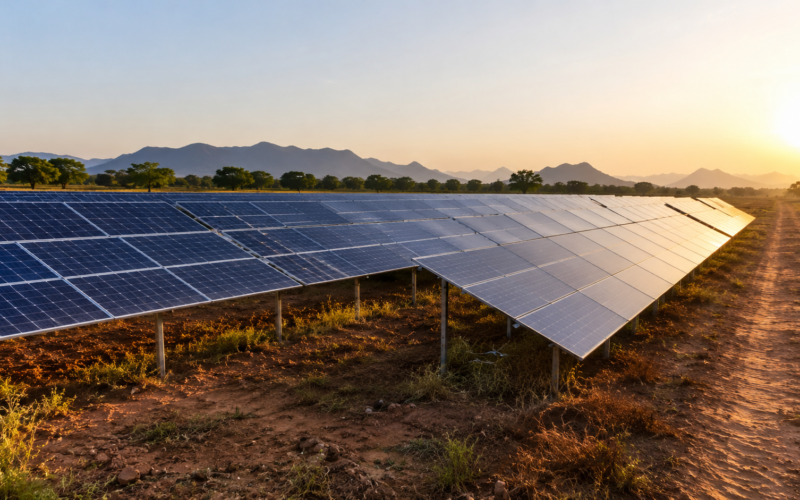
Premier Energies Limited (NSE: PREMIERENE; BSE: 544238) secured ₹4,001 crore in new orders during the second quarter of FY27, strengthening demand visibility as the Hyderabad-based solar manufacturer scales up its integrated production capabilities. The orders, disclosed on October 9, 2026, cover 2,308 MW of solar cell and module supplies alongside engineering, procurement and construction (EPC) projects. The company has simultaneously expanded its solar module manufacturing capacity to 11.1 GW and solar cell capacity to 10.6 GW following the commissioning of a 7 GW TOPCon facility at Naidupeta, Andhra Pradesh. The development follows a strong first quarter in which revenue increased 34.1% and profit after tax rose 53.3%, but newly commissioned production lines must still achieve stable utilisation before their full financial potential can be assessed. The immediate opportunity is to convert a larger manufacturing footprint and expanding customer commitments into sustained revenue without sacrificing margins or cash generation.
The latest order inflow comes from major power producers, solar module manufacturers, EPC contractors and other customers, reflecting demand across different parts of India’s solar supply chain. Premier Energies clarified that the ₹4,001 crore figure excludes orders received from its retail market segment, meaning the disclosed value does not represent its entire commercial activity during the quarter. The company has not provided a detailed breakdown between solar cells, modules and EPC work or disclosed the complete execution schedule. As a result, the order announcement strengthens business visibility but does not establish how much revenue will be recognised during the remainder of FY27.
How significant are Premier Energies’ ₹4,001 crore Q2 FY27 orders for future revenue growth?
The ₹4,001 crore order inflow is substantial relative to the company’s recent financial scale. Premier Energies reported approximately ₹8,026 crore in consolidated revenue during FY26, meaning the new orders represent nearly 50% of its previous annual revenue. This is a comparison of new bookings against historical sales, not an order-book-to-revenue conversion forecast. The actual financial contribution will depend on product delivery schedules, contractual milestones and the proportion of orders executed during future reporting periods.
The announced 2,308 MW of solar cell and module supplies also demonstrates meaningful physical demand for manufactured products. However, the company has combined the value of equipment supplies with EPC contracts in the ₹4,001 crore total, so dividing the overall contract value by the disclosed megawatt volume would produce a misleading estimate of product selling prices. Similarly, the announcement does not identify how much of the order volume relates specifically to cells rather than modules. Those distinctions matter because the two product categories have different manufacturing economics and customer relationships.
Premier Energies Managing Director Chiranjeev Saluja indicated that the order inflow reflected demand for manufacturing scale, financial reliability and advanced solar technology. The commercial significance extends beyond the headline contract value because the orders have arrived around the time of a major manufacturing expansion. If the company can align production volumes with confirmed customer requirements, the new facilities could support stronger operating leverage. Delays in ramp-up, pricing pressure or changes in product mix could nevertheless limit the earnings benefit of higher sales volumes.
Why is Premier Energies’ 7 GW Naidupeta TOPCon solar cell facility a major expansion milestone?
The new Naidupeta plant represents one of Premier Energies’ largest manufacturing investments, adding 7 GW of annual solar cell capacity and increasing its total installed cell capacity from 3.6 GW to 10.6 GW. This represents an increase of approximately 194% over the earlier base, substantially strengthening the company’s ability to manufacture cells internally. The facility was commissioned in September 2026 and has entered trial runs, meaning installed capacity should not be confused with stabilised commercial output. Its production performance will depend on equipment calibration, manufacturing yields, product certification and the progression toward sustained utilisation.
Developed across approximately 101 acres at a reported cost of ₹3,293 crore, the facility uses N-type TOPCon technology and incorporates automation and digital manufacturing systems. The plant has a stated manufacturing capability of approximately 88,000 solar cells per hour once operating at designed performance levels. TOPCon technology can improve conversion efficiency compared with older cell architectures, helping manufacturers meet customer demand for higher-output solar modules. However, production efficiency, manufacturing yield and commercial realisation will ultimately determine the plant’s contribution to earnings.
Premier Energies has also expanded module manufacturing capacity to 11.1 GW following the commissioning of its 5.6 GW Seetharampur facility in Telangana. The combination brings solar cell and module manufacturing capacity closer together, potentially allowing the company to supply more internally manufactured cells to its module production lines. This could reduce certain sourcing dependencies and improve production coordination, subject to customer requirements and the relative economics of internal consumption versus external sales. The recent order inflow provides a demand pipeline, but the new facilities must deliver reliable production before their full capacity becomes commercially effective.
How do Premier Energies’ Q1 FY27 results support its manufacturing expansion strategy?
Premier Energies entered the September quarter after reporting strong financial performance in Q1 FY27. Total revenue increased 34.1% year-on-year to ₹2,507.6 crore, while EBITDA increased 27.2% to ₹759.4 crore. Profit after tax grew faster, rising 53.3% to ₹471.9 crore, with a reported EBITDA margin of 30.3% and a net profit margin of 18.8%. The results demonstrated that the business was generating substantial earnings before the newly commissioned Naidupeta facility reached stable commercial production.
Manufacturing output during the June quarter included 844 MW of solar cells, 953 MW of solar modules and 570 MVA of transformers. Those production figures provide a useful operating baseline against which subsequent capacity utilisation can be assessed. They also indicate that the company’s manufacturing activities extend beyond solar cells and modules into electrical equipment used in power infrastructure. However, higher installed capacity does not necessarily mean a proportional increase in output during the next quarter, particularly while recently commissioned production lines undergo trial operations.
The company’s FY26 financial performance reinforces the importance of protecting profitability as it expands. Premier Energies reported annual EBITDA of approximately ₹2,579 crore and profit after tax of around ₹1,510 crore, supported by growth in solar manufacturing and improved operating scale. Its planned capacity additions require substantial investment in machinery, working capital and operating infrastructure, potentially increasing depreciation and financing requirements as facilities become operational. Sustained revenue growth and cash conversion will be necessary to demonstrate that the expansion is generating appropriate financial returns.
Can India’s solar manufacturing rules strengthen demand for Premier Energies’ domestic cells?
Premier Energies’ capacity expansion is taking place as India strengthens domestic sourcing requirements across the solar manufacturing industry. The Ministry of New and Renewable Energy’s Approved List of Models and Manufacturers framework has expanded beyond solar modules to include solar photovoltaic cells, with requirements applying from June 1, 2026, subject to notified exemptions and transitional arrangements. The ministry issued its twelfth revision of the approved solar cell manufacturer list in October 2026, illustrating the continuing implementation of the framework. The policy environment increases the commercial relevance of domestically manufactured cells for projects subject to these sourcing rules.
The company’s expanded cell manufacturing base could improve its ability to serve customers seeking compliant domestic supply, provided the relevant products and facilities satisfy applicable listing and technical requirements. Domestic sourcing policies can support demand for Indian manufacturers, but they do not guarantee specific customer contracts, prices or profit margins. Competition among approved producers, technological differences and available manufacturing capacity will continue to influence commercial outcomes. As more companies commission cell production facilities, supply growth could also intensify pricing competition.
Premier Energies is additionally developing 10 GW of ingot and wafer manufacturing capacity at Naidupeta to strengthen its upstream integration. Its disclosed plan envisages an initial 5 GW phase by December 2027 and a second 5 GW phase by December 2028. The expansion is strategically relevant because wafers are critical inputs for solar cell manufacturing, and India’s domestic production base remains less developed than its module manufacturing capacity. The government has also extended its ALMM framework to ingots and wafers, with implementation scheduled from June 2028, adding a regulatory dimension to the company’s proposed investment.
The upstream programme remains under development and should not be included in Premier Energies’ current operating capacity. Construction progress, equipment installation, technology selection and commissioning performance will determine whether the company achieves its proposed timeline. Successful integration could reduce dependence on externally sourced wafers, although manufacturing costs and global input prices will influence whether local production offers an enduring economic advantage.
Why is Premier Energies expanding into battery storage and other clean energy equipment?
Beyond solar manufacturing, Premier Energies is preparing to enter battery energy storage equipment production through a planned 12 GWh battery container manufacturing programme. The project, being developed with Germany’s RCT Solutions, is intended to broaden the company’s participation in clean energy infrastructure as developers increasingly combine solar generation with storage systems. Management has targeted commissioning of an initial 6 GWh phase by June 2027. This remains a future development milestone rather than an existing source of commercial production.
The storage programme reflects a changing requirement within India’s renewable energy market. Solar capacity additions increase electricity generation during daylight hours, while storage technologies can help shift energy availability to other periods depending on system design and operating conditions. For equipment manufacturers, this creates an opportunity to supply products associated with integrated renewable energy projects instead of concentrating entirely on solar panels. However, battery container manufacturing is a different industrial activity from solar cell production, and Premier Energies will need to establish the relevant manufacturing, supply-chain and customer capabilities.
The company also operates in power transformers through its acquired and developing business portfolio, providing another potential connection to electricity infrastructure investment. These adjacent activities could expand its addressable market, but they also increase the range of projects requiring management attention and capital. The economics of solar cells, transformers and battery storage systems differ considerably, making segment-specific financial performance important as the business diversifies. Until these newer activities reach meaningful commercial scale, solar manufacturing remains the clearest measure of Premier Energies’ operating progress.
What does the PREMIERENE share price suggest about investor sentiment after the order announcement?
Premier Energies shares closed at approximately ₹891 on the National Stock Exchange of India on October 12, 2026, declining around 0.5% from the previous close of ₹895.35. The stock traded between approximately ₹883.80 and ₹904 during the session, indicating that the ₹4,001 crore order announcement did not coincide with a sustained positive share-price move that day. The shares remained approximately 21.4% below their 52-week high of ₹1,134, despite the company’s strong June-quarter earnings and manufacturing expansion. This market performance suggests that investors are evaluating the growth opportunity alongside expectations already reflected in the valuation, although the precise reasons for the movement cannot be established from trading data alone.
At approximately ₹891 per share, Premier Energies had an indicative market capitalisation of around ₹40,400 crore. That valuation reflects expectations of continued earnings growth and successful deployment of substantial manufacturing investment. The recent contract inflow provides evidence of customer demand, but the valuation case also depends on production utilisation, pricing, margins and the returns achieved on new capital expenditure. The company’s next quarterly results will offer a more direct assessment of these factors than the order announcement alone.
Premier Energies now has an expanded manufacturing platform, a substantial pipeline of new orders and additional upstream and storage investments under development. The immediate priority is demonstrating that the 7 GW Naidupeta facility can move from trial production to sustained commercial output while maintaining product quality and profitability. Strong operating results from the newly expanded facilities would support the company’s growth strategy, while commissioning delays or weaker margins could place pressure on projected returns. The most meaningful upcoming evidence will be actual cell and module production, financial performance and cash generation as the additional capacity becomes operational.
What are the key takeaways from Premier Energies’ ₹4,001 crore solar order announcement?
- Premier Energies secured ₹4,001 crore in orders during Q2 FY27.
- The orders include 2,308 MW of solar cell and module supplies alongside EPC contracts.
- The disclosed order value excludes retail market orders.
- Solar cell manufacturing capacity increased to 10.6 GW following commissioning of the 7 GW Naidupeta TOPCon facility.
- Module manufacturing capacity expanded to 11.1 GW.
- Q1 FY27 revenue increased 34.1% to ₹2,507.6 crore, while net profit rose 53.3% to ₹471.9 crore.
- The company is developing 10 GW of ingot and wafer capacity for upstream integration.
- A separate 12 GWh battery container manufacturing programme is planned.
- PREMIERENE shares closed near ₹891 on October 12, approximately 21.4% below their 52-week high.
- Production ramp-up, order execution, profitability and cash generation will determine the financial benefits of expansion.
Discover more from Business-News-Today.com
Subscribe to get the latest posts sent to your email.