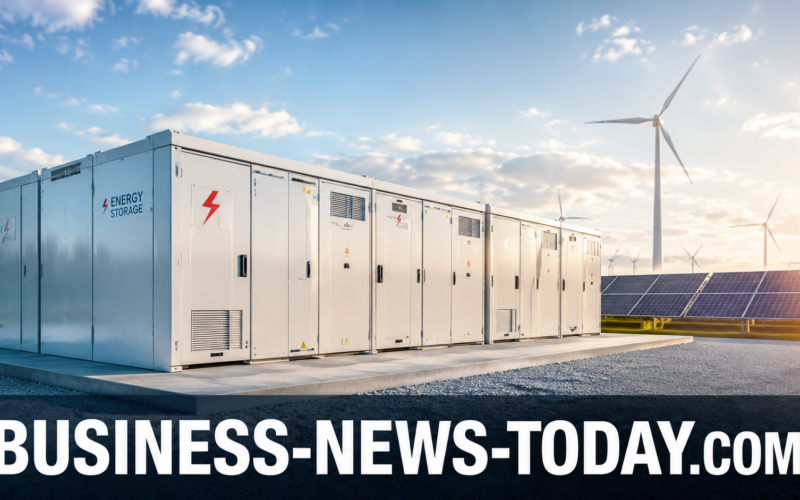
AB Ignitis grupė (Nasdaq Vilnius: IGN1L; LSE: IGN) has approved the final investment decision for a 107.2 MW battery energy storage system at its Tume renewable energy site in Latvia. The Tume BESS will provide 214.5 MWh of storage capacity and will be integrated with the 173.6 MW Tume solar farm already under construction in Tukums municipality. Ignitis Group expects battery construction to begin during 2026, with commercial operations targeted for 2028 and total investment estimated at approximately €35 million. The project strengthens the company’s shift from simply adding renewable generation towards building flexible assets capable of responding to electricity demand, balancing requirements and grid constraints. The main investment question is whether shared infrastructure, a relatively disciplined capital commitment and multiple potential revenue streams can generate attractive returns in a Baltic storage market that is expanding rapidly but becoming increasingly competitive.
Why does combining the 107.2 MW Tume battery with a 173.6 MW solar farm improve the project economics?
The Tume battery will have 107.2 MW of power capacity and 214.5 MWh of energy capacity, giving it a discharge duration of approximately two hours at maximum output. That configuration is suitable for responding quickly to grid imbalances, shifting solar production between different parts of the day and participating in short-duration flexibility markets.
The most important commercial feature is not simply the size of the battery. Ignitis Renewables intends to integrate it with the Tume solar farm through the same grid connection and associated infrastructure. This should reduce the amount of duplicated investment required for substations, grid access, cables, land preparation and other supporting equipment.
Grid connections are becoming one of the most valuable and difficult elements of renewable energy development. Solar and wind projects can often be developed faster than transmission infrastructure can be expanded. A battery located behind or alongside an existing renewable connection can make more intensive use of infrastructure that might otherwise be underutilised during periods of weak solar production.
The hybrid structure also gives Ignitis Group greater control over when electricity reaches the market. The solar farm will produce most strongly during daylight hours, when growing regional solar capacity can push wholesale prices lower. The battery can potentially store some output during those periods and discharge it when demand or prices are higher.
That does not mean every megawatt-hour generated by the solar farm will pass through the battery. Storage creates conversion losses, and the most profitable use of the system may vary between energy trading, balancing services and grid support. Management will need to optimise the battery dynamically rather than treat it as a simple extension of the solar plant.
The Tume BESS investment is equivalent to approximately €326,000 per MW of power capacity or around €163,000 per MWh of energy capacity. These simplified calculations exclude the separate investment already being made in the solar farm and do not represent the project’s final accounting cost per installed unit.
The figures nevertheless illustrate the advantage of using common infrastructure. Ignitis Group previously approved investment of up to €106 million for the Tume solar farm, which was designed as one of the largest solar projects in the Baltic region. The battery adds operational flexibility without requiring the company to replicate the full development platform created for the solar asset.
What does the €35 million investment reveal about Ignitis Group’s value-over-volume strategy?
Ignitis Group’s latest strategic plan places greater emphasis on green flexibility, electricity networks and selective capital allocation. The company is targeting total investments of between €2.5 billion and €3 billion from 2026 to 2029, with approximately €1 billion to €1.2 billion directed towards green generation and flexibility technologies.
Within that programme, a €35 million battery project is financially manageable. It represents roughly 5% to 6% of Ignitis Group’s expected investment range of €590 million to €690 million for 2026, although spending on Tume BESS will be distributed across its construction period rather than recognised entirely during one year.
The project therefore appears consistent with a selective development model rather than a scale-at-any-cost expansion strategy. Ignitis Group has stated that new projects must respond to market demand and system needs while meeting return requirements.
Pairing a battery with a solar farm already under construction is a practical example of that approach. The company is adding another commercial capability to an existing development rather than acquiring an unrelated storage site that would require a new grid connection and standalone infrastructure.
The battery could create several layers of value. It may reduce renewable generation curtailment, improve the timing of electricity sales, provide balancing capacity, respond to short-term system needs and strengthen the economics of the Tume site as a whole.
Those revenue streams should not be assumed to occur simultaneously at their maximum potential. A battery cannot use all its capacity for energy arbitrage while reserving the same capacity for grid services. Commercial performance will depend on how Ignitis Renewables allocates the asset between competing markets.
Battery degradation must also be included in the economic assessment. Frequent charging and discharging can increase revenue, but it can also accelerate the decline in usable capacity. The project will therefore require disciplined operating software, warranty management and long-term maintenance planning.
The investment decision does not change Ignitis Group’s 2026 adjusted EBITDA guidance of €550 million to €600 million or its investment guidance of €590 million to €690 million. That is unsurprising because the battery is not expected to enter commercial operation until 2028, but it confirms that the project was already accommodated within the company’s broader capital framework.
How can the Tume battery create value in Latvia’s changing balancing and flexibility markets?
Latvia’s electricity system has entered a new operating phase following the Baltic states’ synchronisation with the Continental European Network on February 9, 2025. Estonia, Latvia and Lithuania disconnected from the Russian and Belarusian electricity system and now operate under the European continental framework.
That transition strengthened regional energy independence, but it also increased the importance of domestic and regional balancing capabilities. Electricity systems must continuously match supply and demand while maintaining stable frequency, even when generation or consumption changes unexpectedly.
Battery systems are useful because they can respond faster than many conventional power plants. They can charge when the grid has excess electricity and discharge when additional supply is required. They can also reserve capacity for frequency containment, automatic frequency restoration and manual balancing services.
Latvia already operates a Baltic balancing capacity market, with Augstsprieguma tīkls publishing capacity and service information for frequency and reserve products. The presence of multiple balancing service providers indicates that storage developers will face competition, but it also demonstrates that an identifiable market framework exists for flexible assets.
The country’s transmission operator has also installed battery systems at Rēzekne and Tume to support system reliability. Augstsprieguma tīkls previously estimated that its own batteries could reduce the cost of maintaining balancing capacity across Latvia and the wider Baltic region by approximately €20 million annually from 2026.
Ignitis Group’s Tume project is commercially different from a transmission-system asset, but the underlying system requirement is related. More renewable generation increases the need for assets capable of absorbing excess production and responding when solar or wind output changes.
Battery economics may therefore improve as renewable penetration rises, but the relationship is not automatic. More batteries can reduce balancing prices and narrow energy-market spreads as competition increases. Early projects may benefit from scarcity, while later assets may need lower costs, better optimisation or contracted revenues to achieve similar returns.
Ignitis Group has not disclosed the expected revenue mix, contracted capacity, target returns or payback period for Tume BESS. Those omissions do not weaken the strategic logic, but they limit the ability of investors to calculate the project’s stand-alone value.
The strongest commercial outcome would involve several complementary revenue sources rather than dependence on a single balancing product. The battery’s shared connection with the solar farm should provide flexibility to switch between solar optimisation and wider market services as conditions change.
Why is Latvia becoming a central part of Ignitis Renewables’ Baltic expansion strategy?
Ignitis Renewables has built a substantial Latvian solar portfolio over a relatively short period. Its Vārme solar farm, with 94 MW of installed capacity, reached commercial operation in July 2025. The two-stage Stelpe solar development, totalling 145 MW, subsequently reached full commercial operations.
The Tume solar farm adds another 173.6 MW, taking Ignitis Renewables’ major Latvian solar portfolio beyond 400 MW. The company has previously estimated that Vārme, Stelpe and Tume could collectively generate enough electricity to serve nearly 200,000 households each year.
Tume BESS changes the character of that portfolio. Ignitis Group is no longer treating Latvia only as a market for utility-scale solar generation. It is beginning to combine renewable assets with storage and grid flexibility.
This matters strategically because Latvia sits inside an increasingly integrated Baltic electricity market. Generation, balancing and transmission conditions in Latvia cannot be considered entirely separately from Lithuania and Estonia. Regional interconnection allows power and balancing resources to respond across borders, subject to available transmission capacity and market rules.
Ignitis Group also has an established customer and trading presence in Latvia. Ignitis Latvija is registered among the country’s balancing service providers, giving the wider group market knowledge that could support the commercial operation of storage assets.
The Latvian portfolio also diversifies Ignitis Group beyond Lithuania, where the state remains its controlling shareholder and where a large part of its networks and generation operations are concentrated. Geographic diversification can spread construction and regulatory exposure, although the Baltic markets remain economically and electrically interconnected.
The Tume site could become a reference project for future hybrid developments. If shared grid infrastructure improves returns and the battery performs well in Latvian flexibility markets, Ignitis Renewables may apply a similar structure to other solar and wind assets.
The opposite scenario must also be considered. Delays in battery procurement, grid commissioning, permitting or market qualification could reduce the period during which the project benefits from relatively limited storage competition. The planned 2028 commercial operation date gives the market two more years to evolve before Tume BESS begins generating revenue.
How does Tume BESS fit alongside Ignitis Group’s 291 MW Lithuanian battery portfolio?
Tume is not an isolated experiment. Ignitis Group is developing three Lithuanian battery projects with combined power capacity of approximately 291 MW and energy capacity of about 584 MWh.
The Lithuanian portfolio includes battery systems near the Kelmė and Mažeikiai wind farms and close to the Kruonis pumped storage hydroelectric power plant. The projects are intended to support renewable integration, respond to changing electricity demand, improve network reliability and reduce curtailment.
Adding the 107.2 MW Tume project would take Ignitis Group’s disclosed Baltic BESS development portfolio to approximately 398 MW of power capacity and nearly 799 MWh of storage capacity, assuming all four projects proceed according to their current plans.
That scale would make battery storage a meaningful component of the company’s Green Capacities segment rather than a peripheral technology investment. It would also give Ignitis Group operational experience across solar-linked, wind-linked and system-flexibility locations.
Different sites may generate different revenue profiles. A battery next to a wind farm can respond to production patterns that differ from those of solar. A project near Kruonis pumped storage may operate within a broader portfolio of flexible assets. Tume can focus on the interaction between daytime solar production, grid access and Latvian balancing markets.
Portfolio scale may improve procurement and operating economics. Ignitis Group could standardise equipment, software, maintenance, insurance and market optimisation across several sites. Larger procurement volumes may also strengthen negotiating power with battery suppliers.
However, concentration in similar technology creates shared risks. Battery prices, warranty conditions, software performance, fire-safety requirements and market regulation could affect several projects simultaneously. The company must avoid assuming that diversification across locations eliminates technology and commercial exposure.
Ignitis Group’s 2029 target is to reach between 2.8 GW and 3.2 GW of installed green capacity, compared with 2.1 GW at the end of 2025. Its long-term strategic goal remains 4 GW to 5 GW. The company has specifically identified storage and flexibility as central to the next phase of growth.
Tume BESS therefore represents more than an incremental 107.2 MW addition. It is evidence that the portfolio is shifting from a generation-led model towards a system-oriented model in which renewable production and flexibility are developed together.
Can Ignitis Group finance the battery expansion without placing pressure on its balance sheet?
Ignitis Group reported adjusted EBITDA of €192.2 million for the first three months of 2026, up 2% from the prior-year period. Growth in the Networks and Customers & Solutions segments offset a weaker contribution from Green Capacities.
Investments increased 7.1% to €156.9 million, with Networks accounting for 70.6% of total expenditure. Green Capacities investment declined to €39.1 million because six renewable projects had reached commercial operations during 2025.
Net debt stood at €1.893 billion on March 31, 2026, compared with €1.912 billion at the end of 2025. The net debt to adjusted EBITDA ratio improved to 3.44 times from 3.50 times, while funds from operations to net debt increased to 21.5%.
The €35 million Tume commitment is modest relative to the group’s balance sheet and multiyear investment programme. The issue is not whether Ignitis Group can fund one battery, but whether it can deliver networks, renewables and flexibility investments simultaneously while maintaining an investment-grade credit profile and growing dividends.
Management targets net debt to adjusted EBITDA of between three and four times over the 2026 to 2029 period and intends to retain a credit rating of BBB or above. It also plans to increase the dividend per share by at least 3% annually.
Those commitments create discipline around capital allocation. Storage projects need to compete with regulated network investments, renewable generation and other flexibility assets for financial resources.
Ignitis Group has also demonstrated that it can use asset rotation to recycle capital. The company completed the sale of a 49% stake in Vilnius Combined Heat and Power Plant to Quaero Capital in March 2026, improving leverage while retaining operational exposure to the asset.
A similar strategy could eventually be applied to mature renewable or hybrid assets, although Ignitis Group has not announced any plan to sell a stake in Tume. The relevance is that the company has more than one financing mechanism available as its portfolio grows.
The next financial update on August 12, 2026, will provide the first-half results and a more current view of investment spending, debt and segment performance. It should also help investors assess whether the company remains comfortably within its guidance after approving additional projects.
What does Ignitis Group’s recent share performance indicate about investor sentiment?
Ignitis Group’s ordinary shares closed at €22.50 on Nasdaq Vilnius on July 20, 2026, while the London-listed global depositary receipts were quoted at €22.40. The company’s ordinary share price had risen from €22.20 on July 14, representing a five-session increase of approximately 1.4%.
Compared with the €21.35 close recorded on June 19, the July 20 price represented an increase of approximately 5.4% over one month. The shares were also near the upper end of their recent 52-week range of €20.45 to €22.80.
The performance suggests cautiously positive sentiment towards Ignitis Group’s combination of regulated networks, renewable growth and dividend income. The company’s 2025 dividend of €1.366 per share represented a yield of more than 6% based on year-end prices, while management has committed to annual dividend growth of at least 3%.
Tume BESS is unlikely to alter the group’s valuation independently because the €35 million investment is small relative to its existing asset base. Its significance lies in what it indicates about portfolio quality and strategic direction.
Investors may respond positively if Ignitis Group demonstrates that storage can improve returns from existing renewable assets without materially increasing leverage. Sentiment could become more cautious if multiple battery projects increase capital expenditure faster than earnings or if market revenues decline as storage competition expands.
The current valuation therefore reflects more than renewable capacity growth. It also reflects confidence in financial discipline, dividend delivery and management’s ability to allocate capital across networks, generation and flexibility.
Which milestones will determine whether the Tume BESS creates value before its 2028 launch?
The first measurable milestone will be the start of construction during 2026. Ignitis Group has not yet disclosed the battery supplier, engineering contractor, final equipment configuration or detailed procurement timetable.
Those decisions will influence construction risk, warranty protection and long-term availability. Battery supply contracts must address performance degradation, replacement responsibilities, safety systems and operating limits.
The second milestone will be physical and commercial integration with the Tume solar farm. Sharing infrastructure is central to the project’s economic logic, so grid commissioning and operating coordination must proceed without constraining solar output.
The third milestone will be qualification for Latvian and Baltic balancing services. A technically completed battery cannot capture all potential revenue until it satisfies the requirements for market participation and demonstrates reliable response performance.
The fourth milestone will be the market structure prevailing in 2028. Balancing prices, wholesale volatility, renewable curtailment and competing storage capacity will determine how attractive the battery’s available revenue streams have become.
The final test will be financial disclosure after commercial operation. Investors will need evidence that the asset is earning returns above its cost of capital, improving the value of the Tume solar site and contributing to Ignitis Group’s targeted adjusted return on capital employed of between 6.5% and 7.5% across the strategic period.
The project strengthens Ignitis Group’s strategic position because it combines a substantial solar asset, secured grid infrastructure and a two-hour battery within one Latvian site. The unresolved question is whether the company can translate that technically attractive structure into durable cash generation as the Baltic storage market matures.
Key takeaways from Ignitis Group’s 107.2 MW Tume battery investment in Latvia
- Ignitis Group has approved a 107.2 MW and 214.5 MWh battery energy storage system in Tukums municipality, Latvia.
- The approximately €35 million Tume BESS investment is expected to begin construction in 2026 and reach commercial operation in 2028.
- The battery will provide around two hours of storage at full power.
- Tume BESS will share its grid connection and infrastructure with the 173.6 MW Tume solar farm.
- The hybrid structure could reduce duplicated infrastructure costs and improve the timing of renewable electricity sales.
- The project may earn revenue from balancing services, electricity-market optimisation and reduced renewable curtailment.
- Ignitis Group is also developing 291 MW and 584 MWh of battery capacity across three projects in Lithuania.
- The combined disclosed Baltic storage portfolio would reach approximately 398 MW and nearly 799 MWh after including Tume.
- The project does not change Ignitis Group’s 2026 adjusted EBITDA or investment guidance.
- Construction progress, market qualification and realised returns after the planned 2028 launch will determine whether Tume creates durable value.
Share this:
Discover more from Business-News-Today.com
Subscribe to get the latest posts sent to your email.