How does the inauguration of Navi Mumbai International Airport redefine India’s aviation capacity and connectivity goals for 2025 and beyond?
Prime Minister Narendra Modi inaugurated the first phase of the Navi Mumbai International Airport (NMIA) on October 8, 2025, calling it a transformative leap in India’s infrastructure strategy. The project, jointly developed by Adani Airports Holdings Ltd and CIDCO, represents a bold step in addressing Mumbai’s chronic air-traffic congestion and positioning Maharashtra as a logistics powerhouse.
The inauguration formally activates the airport’s first runway and terminal, with commercial operations expected in December 2025. Built at a cost of around ₹19,650 crore, NMIA is designed to handle 20 million passengers annually in its initial phase and eventually scale to 90 million through successive expansions.
Speaking at the event, Modi framed the project as a cornerstone of Viksit Bharat, highlighting its role in connecting farmers, small industries, and exporters from Maharashtra’s hinterland to international markets. The Prime Minister said the airport symbolizes India’s new growth model—where logistics, urban design, and inclusive development intersect.
What challenges and milestones shaped the decades-long journey to build Mumbai’s second international airport from concept to completion?
The idea of a second international airport for Mumbai first surfaced in the 1990s but faced repeated delays due to land-acquisition disputes, environmental hurdles, and financing issues. The City and Industrial Development Corporation (CIDCO) identified Panvel as the ideal site, but the terrain—marked by rivers, mangroves, and villages—made construction technically and politically complex.
After environmental clearance in 2010 and foundation-stone laying by Modi in 2018, progress was slow until Adani Group took majority control in 2021. The project involved significant land reclamation and river-diversion works. Even in 2025, the timeline saw multiple adjustments due to heavy monsoon seasons and procedural approvals.
The Directorate General of Civil Aviation (DGCA) granted the aerodrome license only weeks before inauguration, enabling the runway to host test flights. The licensing milestone was crucial for regulatory compliance before commercial launch.
NMIA is now the first major airport in India built under the public-private partnership model since the Hyderabad and Bengaluru airports, signaling renewed investor confidence in large-scale infrastructure.
How does the architecture, capacity, and design of Navi Mumbai International Airport compare with global aviation hubs like Heathrow and Incheon?
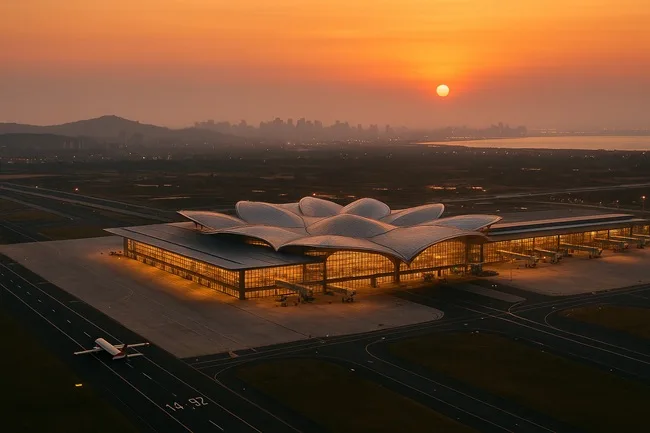
The airport’s design, developed by Zaha Hadid Architects, draws inspiration from India’s national flower, the lotus. The petal-shaped terminal columns and sweeping rooflines symbolize fluidity and light. The architectural plan focuses on energy efficiency, passenger flow, and natural lighting—a deliberate move to make NMIA comparable to iconic global terminals in Singapore’s Changi and South Korea’s Incheon.
The first terminal spans over 250,000 m² with 66 check-in counters, 29 aerobridges, and a runway capable of handling Code F aircraft such as the Airbus A380. Future phases will add a second parallel runway, inter-terminal metro links, and expanded cargo terminals.
Cargo handling is positioned as a growth engine. In later phases, NMIA aims to manage up to 2.5 million tonnes of cargo annually, positioning it as western India’s logistics hub. The master plan integrates smart baggage handling, AI-assisted air-traffic control, and sustainable water-management systems—making it one of India’s most digitally-enabled airports.
Why is the new airport expected to decongest Mumbai’s skies and trigger economic, real-estate, and employment growth across Maharashtra?
Mumbai’s existing Chhatrapati Shivaji Maharaj International Airport has long operated beyond optimal capacity, handling over 50 million passengers a year with just two intersecting runways. NMIA provides a vital release valve. It is expected to absorb traffic overflow, attract new airlines, and increase cargo throughput.
Experts predict NMIA could catalyze economic activity across Navi Mumbai, Panvel, Ulwe, and Kharghar. Brokerages such as Jefferies have identified real-estate beneficiaries, noting that property values near the airport could rise sharply. Infrastructure developers are already marketing “aerocity”-style projects combining retail, hotels, and logistics spaces.
Beyond real estate, the airport is expected to generate over 250,000 direct and indirect jobs across aviation, logistics, construction, and ancillary industries. Local authorities are planning to link the airport with Mumbai Trans Harbour Link, coastal roads, metro lines, and suburban rail to expand its catchment.
What political, financial, and strategic factors make this project a key test of India’s public-private infrastructure model under Adani Group?
NMIA’s inauguration comes at a politically sensitive time. The Adani Group, which holds a 74 percent stake through its airports arm, has faced intense scrutiny from investors and regulators. The timing of Modi’s public endorsement of an Adani-built mega-project has been interpreted by analysts as both a show of confidence and a message to global markets about India’s infrastructure resilience.
From a governance standpoint, the airport represents a complex balance between state ownership and private execution. CIDCO retains a 26 percent shareholding, ensuring local government participation in oversight, while the private partner manages design, construction, and operations under a 60-year concession.
Financially, NMIA’s ₹19,650 crore investment underscores the depth of India’s project-finance ecosystem. The model could become a benchmark for future airport PPPs, including those proposed in Pune and Jewar.
Politically, the airport is symbolic—it represents Maharashtra’s ambition to remain India’s economic nerve centre, and the federal government’s strategy to use large-scale infrastructure as a driver of electoral and economic credibility.
What environmental, safety, and operational risks could challenge Navi Mumbai International Airport’s smooth transition to full commercial operations?
While the project’s ambition is unquestionable, its location presents ecological challenges. The site sits amid reclaimed marshlands once home to mangroves and creeks. Environmental groups continue to warn of long-term flood risks, arguing that storm-water drainage and river diversion must be closely monitored.
Air-safety concerns have also emerged. Reports indicate the re-emergence of slaughterhouses and waste-dumping sites within 3 km of the runway, violating DGCA’s bird-strike mitigation norms. The regulator has directed local authorities to relocate such operations and maintain monthly audits.
Operational readiness remains another variable. Airlines will test systems through proving flights in November, followed by phased passenger operations. Industry observers believe the airport’s early success depends on strong coordination among DGCA, CISF, and customs authorities to avoid first-phase teething issues.
How will airline partnerships, passenger uptake, and connectivity infrastructure determine the airport’s success over the next 24 months?
The airport’s ability to attract anchor airlines will determine its early trajectory. IndiGo is expected to become the first carrier to commence operations, followed by Air India Express and Akasa Air, serving both domestic and short-haul international routes. Over time, NMIA could position itself as a secondary base for long-haul carriers seeking slot flexibility unavailable at CSMIA.
However, success depends equally on surface connectivity. The Mumbai Trans Harbour Link, Navi Mumbai Metro Line 1, and coastal road projects must align on timeline and access. A dedicated metro corridor linking NMIA to the central business districts of Mumbai is under construction and will be critical to ensure passenger convenience.
Freight operators, too, are monitoring road access to Jawaharlal Nehru Port Trust (JNPT). Seamless integration between air and sea cargo could make Navi Mumbai a tri-modal logistics powerhouse—one that ties together aviation, shipping, and manufacturing.
What broader message does this inauguration send about India’s infrastructure ambition, policy priorities, and global investment narrative?
The inauguration of NMIA is as much about narrative as it is about infrastructure. It signals that India is transitioning from incremental infrastructure building to iconic, globally benchmarked assets. For policymakers, it is a showcase of capability; for investors, it is proof of bankable PPP frameworks; for citizens, it is a statement of aspiration.
In my view, the real test now lies in execution discipline. The success of NMIA will be judged not by the ribbon-cutting moment, but by the airport’s ability to operate seamlessly, attract airlines, generate returns, and maintain environmental balance. If these ambitions align, the project could redefine India’s aviation geography and become a case study in balancing growth with governance.
Discover more from Business-News-Today.com
Subscribe to get the latest posts sent to your email.