
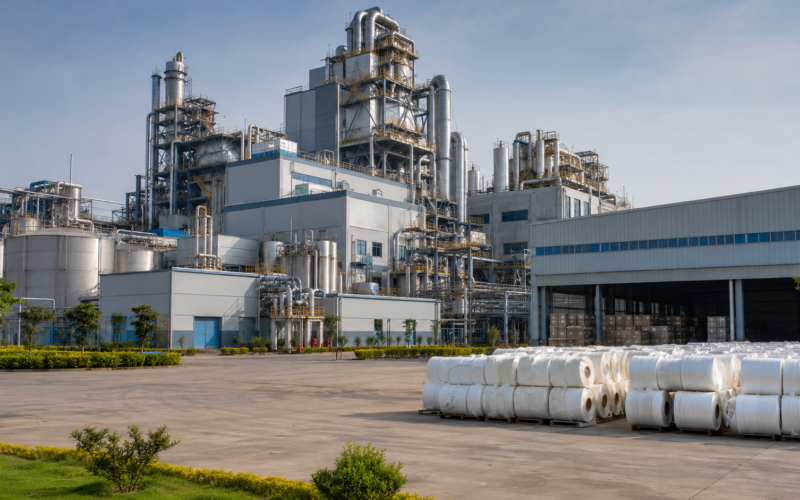
Grasim Industries Limited (NSE: GRASIM, BSE: 500300) has approved a ₹3,094 crore investment for the second phase expansion of its Lyocell plant at Harihar in Karnataka. The Aditya Birla Group company will add 110,000 tonnes per annum of Phase II Lyocell capacity through two lines of 55,000 tonnes per annum each, with the first line targeted for commissioning in 2028 and the second in 2030. The investment will complement the 55,000 tonnes per annum Phase I Lyocell plant already under construction at Harihar, which is expected to be commissioned by mid-2027. Strategically, the move matters because GRASIM is trading close to its 52-week high, placing greater investor attention on whether large capital expenditure can translate into durable earnings growth rather than just headline capacity.
Why is Grasim Industries investing ₹3,094 crore in Lyocell capacity at Harihar now?
Grasim Industries Limited’s decision to invest another ₹3,094 crore in Lyocell capacity is a clear signal that the company sees cellulosic fibres as a long-duration manufacturing opportunity, not a side extension of its legacy textiles business. Lyocell is used across apparel, home textiles and technical textile applications, and its demand case is tied to a wider shift toward fibre materials that can offer performance, comfort and a more sustainable positioning than many conventional textile inputs. For a diversified company such as Grasim Industries Limited, the timing is important because global textile supply chains are being reshaped by sustainability scrutiny, brand sourcing policies and the search for scalable alternatives to resource-intensive fibres.
The investment also strengthens the company’s manufacturing base in Karnataka. Harihar is already central to the company’s Lyocell plan, and adding Phase II capacity before Phase I is commissioned shows a willingness to plan ahead of visible demand rather than wait for full utilisation proof. That is commercially ambitious, but not reckless if Grasim Industries Limited can lock in downstream demand, maintain cost discipline and use its existing cellulosic fibre relationships to secure customers before capacity arrives.
The risk is that capacity-led strategies work beautifully only when demand arrives on schedule. If global textile demand softens, fashion inventory cycles turn volatile, or competing fibre producers add capacity aggressively, Grasim Industries Limited may face slower payback. The company is therefore making a strategic bet on the direction of textile materials. It is not simply buying machines. It is buying future relevance in a market where sustainability claims increasingly need industrial scale behind them.
How could the Harihar Lyocell expansion reshape Grasim Industries Limited’s fibre business?
The Harihar expansion could make Grasim Industries Limited a more influential player in the Lyocell market by lifting its total Lyocell capacity to nearly 210,000 tonnes per annum after completion. That matters because scale is central in speciality fibres. Larger capacity can improve customer confidence, support export ambitions, improve procurement leverage and allow the company to serve textile manufacturers that need consistent supply rather than niche volumes. In fibre markets, being early helps, but being reliable at scale helps more.

The phased commissioning structure also gives Grasim Industries Limited some flexibility. Phase I is expected by mid-2027, Phase II’s first line is targeted for 2028 and the second line is targeted for 2030. This staggered structure can help the company align capacity ramp-up with demand absorption, customer qualification and operational learning. It also reduces the risk of switching on all capacity at once and then discovering that the market needs time to catch up.
However, the size of the investment also raises the execution bar. Lyocell production requires process control, technology reliability, effluent and solvent recovery discipline, consistent pulp sourcing and strong quality assurance. If the Harihar project faces commissioning delays, cost overruns or slower customer acceptance, the market may reassess the return profile. Grasim Industries Limited has experience in cellulosic fibres, but Phase II still needs to prove that scale can improve competitiveness without dragging down returns during ramp-up.
What does this Lyocell investment reveal about Aditya Birla Group’s capital allocation priorities?
The investment shows that Aditya Birla Group is still willing to back large manufacturing bets in sectors where it sees structural relevance. Grasim Industries Limited is already exposed to multiple capital-heavy businesses, including cellulosic fibres, chemicals, cement through UltraTech Cement Limited, financial services through Aditya Birla Capital Limited and paints through Birla Opus. Against that backdrop, a ₹3,094 crore fibre investment indicates that the group is not viewing textiles as a tired legacy segment. It is treating speciality fibres as part of a future-facing materials platform.
This is also a diversification signal. In recent years, investor attention around Grasim Industries Limited has often been pulled toward paints, cement-linked value, financial services and chemicals. The Harihar Lyocell expansion reminds the market that the fibre business still has strategic depth. If the Lyocell platform scales successfully, it can give Grasim Industries Limited a more differentiated growth story than a simple conglomerate discount narrative.
The capital allocation question is whether Grasim Industries Limited can manage multiple growth priorities at once. Building out paints, supporting chemicals, scaling cellulosic fibres and holding strategic stakes all require management bandwidth and capital discipline. The company’s balance sheet and cash flows are stronger than those of smaller manufacturers, but investors will still ask whether returns on capital can improve across businesses. Growth is impressive. Profitable growth is the part that pays the bills, keeps investors calm and prevents conference calls from turning into therapy sessions.
Why does GRASIM’s stock position make this capacity expansion more important for investors?
GRASIM’s market position makes the announcement more interesting because the stock is trading close to its 52-week high rather than recovering from a depressed base. Market data on June 11, 2026 showed the share around ₹3,056.40, compared with a 52-week low of ₹2,502.50 and a 52-week high of ₹3,197.50. The stock was about 4.4 percent below that 52-week high and about 22.1 percent above its 52-week low, while its one-month return was positive at around 2.92 percent. That suggests investors have already given Grasim Industries Limited some credit for its broader growth profile.
This means the Lyocell expansion will likely be judged through a returns lens rather than a simple announcement lens. A ₹3,094 crore investment can support long-term growth, but the market will want evidence that new capacity can achieve healthy utilisation, stable margins and stronger cash generation. Since the second Phase II line is expected only by 2030, investors will also need patience. The investment is strategic, but the financial payoff will be phased.
Near-term stock reaction may therefore not fully capture the importance of the announcement. For a large diversified company, one plant expansion rarely rewrites valuation overnight. However, it can strengthen investor confidence if it supports a wider pattern of disciplined expansion. The key question for GRASIM shareholders is whether Lyocell can become a higher-quality growth lever inside the portfolio, or whether it remains one more capital-intensive business competing for management attention.
How does the Lyocell expansion connect with global textile sustainability trends?
The Lyocell expansion is closely tied to the textile industry’s sustainability pivot. Global apparel brands, home textile suppliers and technical textile customers are under pressure to reduce environmental impact, improve traceability and diversify fibre mixes. Lyocell benefits from this transition because it is positioned as a cellulosic fibre with applications across categories that are seeking alternatives to conventional fibre inputs. For Grasim Industries Limited, this creates a chance to serve both domestic and international customers seeking large-scale, commercially available fibre solutions.
India’s role in this shift is also important. The country has a large textile manufacturing ecosystem, a growing domestic apparel market and policy interest in strengthening manufacturing exports. A larger Lyocell base can support India’s ambition to move up the textile value chain from volume-led production toward higher-value materials and performance-led applications. Grasim Industries Limited’s Harihar investment therefore has implications beyond one company’s plant capacity.
The risk is that sustainability-linked demand is not automatically profitable demand. Customers may want greener materials, but they still negotiate aggressively on price. Textile brands can be vocal about sustainability and brutal about sourcing costs in the same breath. Grasim Industries Limited will need to balance environmental positioning with commercial realism, ensuring that Lyocell capacity does not depend solely on premium pricing assumptions that may prove difficult to sustain across market cycles.
What competitive pressure could Grasim Industries Limited create in cellulosic fibres?
A larger Grasim Industries Limited Lyocell platform could increase competitive pressure on other fibre producers serving apparel, home textiles and technical textiles. Scale at Harihar may allow the company to offer more dependable volumes, support long-term customer contracts and improve its positioning with textile manufacturers seeking secure supply. This could matter particularly for customers that need consistency across multiple production cycles and geographies.
The expansion may also pressure competitors to accelerate their own investments in speciality fibre capacity, sustainability certifications, application development and customer partnerships. Fibre markets are not only about production capacity. They also depend on technical support, downstream processing compatibility, quality stability and the ability to co-develop products with textile manufacturers. Grasim Industries Limited will need to compete on all of those dimensions, not just tonnes per annum.
For Indian competitors and import-linked supply chains, the investment could gradually reduce reliance on external sources for certain higher-value fibre requirements. That is not an immediate disruption, because capacity will be phased through 2030. Still, the strategic direction is clear. Grasim Industries Limited wants to be an industrial-scale supplier in a segment where customer expectations are becoming more sophisticated and where sustainability credentials may increasingly influence sourcing decisions.
What are the execution risks investors should watch after the ₹3,094 crore announcement?
The first risk is project execution. Large manufacturing expansions can be affected by equipment delivery, civil construction, environmental approvals, commissioning complexity and cost inflation. Grasim Industries Limited’s timeline stretches from Phase I commissioning in mid-2027 to the second Phase II line in 2030, giving the company a long runway but also exposing the project to multiple market and execution cycles. Investors should watch whether the company maintains the schedule without material cost escalation.
The second risk is demand absorption. Adding 110,000 tonnes per annum of Phase II capacity is meaningful, but the capacity must find customers at acceptable margins. The company will need to build order pipelines, qualify products with customers and manage the transition from commissioning to commercial utilisation. A slow ramp-up could weigh on returns, especially if depreciation and operating costs begin before sales volumes mature.
The third risk is portfolio complexity. Grasim Industries Limited is not a single-product textile company. It is a diversified business with several moving parts, and that creates both resilience and complexity. If multiple segments demand capital at the same time, investors may focus harder on capital efficiency. The Harihar expansion can strengthen the company’s growth profile, but only if management proves that the project improves long-term return on capital rather than merely increasing industrial scale.
What should industry watchers track next as Grasim Industries Limited scales Lyocell?
The first thing to track is Phase I commissioning at Harihar. If the 55,000 tonnes per annum Phase I plant is delivered on schedule by mid-2027 and ramps up smoothly, investor confidence in the larger Phase II plan will improve. If Phase I faces delays or operational issues, the market may become more cautious about the 2028 and 2030 Phase II milestones.
The second area is customer demand. Watch for signs that Grasim Industries Limited is securing partnerships, downstream customer engagement or export-linked opportunities for Lyocell. Capacity announcements are useful, but customer adoption is the real validation. In speciality fibres, qualification cycles and product trials can shape utilisation as much as headline demand.
The third area is margin behaviour across the cellulosic fibre business. If Lyocell supports better product mix, stronger pricing and improved profitability, the investment could strengthen GRASIM’s long-term narrative. If the business faces commodity-style pricing pressure, the expansion may still be strategically relevant but financially less exciting. For investors, the difference between a growth platform and a capital sink will show up in margins, utilisation and cash conversion.
Key takeaways on what Grasim Industries Limited’s Lyocell expansion means for GRASIM and India’s textile materials sector
- Grasim Industries Limited’s ₹3,094 crore Phase II Lyocell investment signals a serious long-term bet on cellulosic fibres, sustainable textile materials and higher-value manufacturing at Harihar in Karnataka.
- The company will add 110,000 tonnes per annum of Phase II Lyocell capacity through two 55,000 tonnes per annum lines, with commissioning targeted for 2028 and 2030.
- The expansion will complement the 55,000 tonnes per annum Phase I Lyocell plant already under construction, which is expected to be commissioned by mid-2027.
- After completion, Grasim Industries Limited’s total Lyocell capacity is expected to reach nearly 210,000 tonnes per annum, improving its scale and customer relevance in speciality fibres.
- GRASIM’s stock is trading close to its 52-week high, which means investors are likely to focus on project returns, utilisation and margins rather than treating the announcement as a simple sentiment trigger.
- The investment strengthens Aditya Birla Group’s manufacturing-led capital allocation strategy and keeps Grasim Industries Limited’s fibre business central to the company’s long-term growth story.
- The key execution risks include project delays, cost inflation, commissioning complexity, customer qualification timelines and the possibility of slower demand absorption.
- The strategic upside lies in rising demand for sustainable fibre alternatives across apparel, home textiles and technical textiles, particularly as global brands sharpen sourcing standards.
- The investment could increase competitive pressure on other fibre producers by giving Grasim Industries Limited greater scale, stronger customer reliability and deeper application-development potential.
- The next major investor checkpoints will be Phase I commissioning, Phase II project progress, Lyocell utilisation, pricing discipline and evidence that the fibre business can improve return on capital.
Discover more from Business-News-Today.com
Subscribe to get the latest posts sent to your email.