



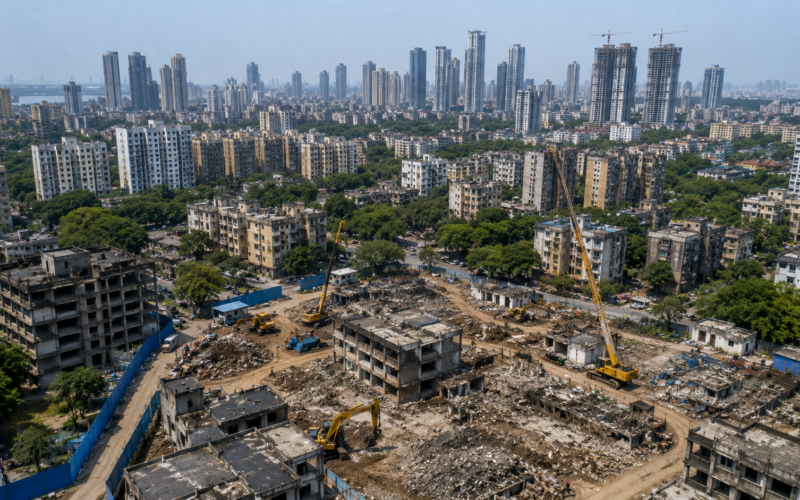
Maharashtra Housing and Area Development Authority is advancing a redevelopment pipeline spanning approximately 925 acres across 11 Mumbai projects that could attract investment of nearly ₹4 lakh crore, creating one of the largest concentrated urban-renewal programmes under consideration in the city. The programme is expected to provide around 75,000 rehabilitation tenements for existing residents while generating roughly 30,000 additional MHADA homes, taking the combined housing potential above 100,000 units before considering free-sale inventory created for private developers.
The projects are being pursued through MHADA’s Construction and Development Agency model, under which large private developers can participate in redevelopment while MHADA retains a more direct role in structuring and supervising the process. The headline ₹4 lakh crore represents potential investment associated with the wider 11-project pipeline rather than capital already committed or spent, making individual project appointments, resident approvals, planning permissions and construction starts the milestones that will determine how much of that investment ultimately materialises.
How large is MHADA’s 925-acre redevelopment programme?
The 925-acre footprint is unusual even by Mumbai redevelopment standards because the programme aggregates multiple large urban-renewal opportunities rather than focusing on a single housing society or ageing building. With 75,000 rehabilitation homes and 30,000 additional MHADA units envisaged, the authority could ultimately receive or facilitate around 105,000 homes across the programme before accounting for developers’ sale components.
Using the ₹4 lakh crore investment estimate across 925 acres gives an average implied investment intensity of more than ₹430 crore per acre, although that calculation is only a broad scale indicator because land values, permissible development, infrastructure requirements and project economics differ sharply by location. Dividing the same estimate across the approximately 105,000 rehabilitation and MHADA homes would produce more than ₹3.8 crore of estimated investment per such unit, but that would be misleading as a construction-cost measure because total investment would also support free-sale development, commercial components, infrastructure and the economics required to fund rehabilitation.
The real significance is the concentration of redevelopment value inside already urbanised Mumbai. Unlike greenfield townships on the metropolitan fringe, these schemes deal with occupied land, existing tenants and constrained infrastructure, which can increase both the value of redevelopment rights and the complexity of delivering new buildings.

How does MHADA’s Construction and Development Agency model change redevelopment?
Under conventional society-led redevelopment, residents typically select a developer and negotiate commercial terms, while public agencies primarily exercise planning and regulatory functions. The Construction and Development Agency framework gives MHADA a more central role and is intended to provide additional institutional oversight for large or difficult redevelopment clusters where fragmented ownership, ageing structures and rehabilitation obligations can complicate private deals.
The model also attempts to address one of the largest practical risks for residents: what happens during the years between vacating an old building and receiving a replacement home. Transit rent, maintenance support and clearer institutional responsibility become important because delays can impose significant financial costs on displaced households. The attractiveness of the model will ultimately depend on whether those protections work through the entire construction period rather than only at the project-award stage.
For developers, the attraction is access to very large redevelopment opportunities in land-constrained Mumbai, where outright acquisition of comparable contiguous land can be extraordinarily expensive. The trade-off is that rehabilitation obligations, transit payments and phased construction can absorb substantial capital before enough free-sale inventory is available to generate cash.
Are MHADA redevelopment projects actually moving through approvals?
MHADA’s own 2026 approval records show continued redevelopment activity across several Mumbai layouts. Recent authority records include amended approvals and commencement-related certificates for projects in Charkop, Vikhroli, Andheri, Worli, Bandra, Santacruz and other locations, demonstrating that the broader redevelopment system is active even though individual projects are at different stages.
That distinction is essential when reading the 925-acre headline. An 11-project pipeline cannot be treated as 11 simultaneously funded construction sites because redevelopment projects move through resident consent, developer appointment, planning approval, rehabilitation, demolition and construction at different speeds. Some may progress rapidly while others can remain delayed by litigation, financing, ownership disputes or planning changes.
The ₹4 lakh crore estimate therefore describes the potential economic scale of the programme rather than current annual construction expenditure. For contractors, building-material suppliers, banks and developers, the opportunity emerges gradually as individual schemes receive executable approvals.
Why could the programme reshape Mumbai’s housing supply?
Mumbai has a structural land constraint, so redevelopment increasingly serves as a mechanism for creating new residential inventory without pushing all construction to distant suburban land. Replacing ageing low-rise colonies and congested developments with higher-density buildings can create rehabilitation homes, authority inventory and market-sale units on the same underlying land, but the approach also places more pressure on roads, water, drainage, transport and social infrastructure.
A 105,000-unit rehabilitation and MHADA pipeline would be material for the city’s housing system if executed over time. The additional private free-sale component could be substantially larger in value terms because developers need market inventory to fund rehabilitation, infrastructure and commercial returns, meaning the ultimate amount of construction could exceed what the rehabilitation numbers alone suggest.
Large redevelopment programmes can also alter micro-market pricing. New supply in established locations may command substantial premiums because it combines modern housing with existing transport and employment access, yet heavy simultaneous construction can temporarily increase local inventory and infrastructure disruption. The effect will therefore vary sharply across the 11 locations.
What could prevent the projected ₹4 lakh crore investment from materialising?
The biggest risk is execution rather than stated developer interest. Mumbai redevelopment routinely faces resident negotiations, title complexity, regulatory approvals, litigation, temporary accommodation costs and financing requirements, while construction delays can materially increase the cost of transit rent. These factors become more demanding when projects involve thousands of households rather than a single building.
Financing conditions also matter because developers typically incur substantial expenditure before free-sale apartments generate enough collections to fund later phases. Higher borrowing costs, slower premium-home sales or regulatory delays can therefore affect project economics even when the underlying land is highly valuable.
MHADA’s 925-acre pipeline should consequently be viewed as a major investible opportunity rather than a completed ₹4 lakh crore programme. If even a substantial proportion of the 11 projects reaches construction, the resulting activity could generate years of demand across real estate, cement, steel, contracting, finance and urban infrastructure, while potentially producing one of Mumbai’s largest waves of replacement housing.
Discover more from Business-News-Today.com
Subscribe to get the latest posts sent to your email.

