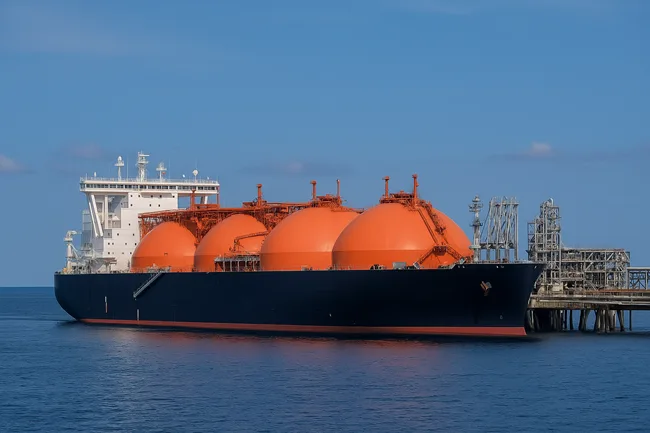
METLEN Energy & Metals PLC (LSE: MTLN; Athens: MTLN) has signed a five-year liquefied natural gas supply agreement with PETRONAS subsidiary PETCO Trading (UK) Limited covering six LNG cargoes annually from 2027. The agreement will provide approximately 0.6 billion cubic metres of natural gas equivalent each year from PETRONAS’ Atlantic portfolio, implying roughly 30 cargoes and 3 billion cubic metres over the full five-year term if scheduled volumes are delivered. Financial and pricing terms have not been disclosed. The transaction adds another contracted supply source to a METLEN gas business that is increasingly positioned around regional trading rather than Greek domestic consumption alone.
The deal arrives as Greece’s role in Southeast European gas flows is expanding. Natural-gas exports from Greece tripled to 8.72 TWh during the first half of 2026, while domestic consumption remained broadly flat at 34.37 TWh. Revithoussa was the country’s largest gas entry point, and imports through the Alexandroupolis floating LNG terminal also increased materially.
Why does 0.6 bcm of annual PETRONAS LNG matter when METLEN already trades substantial gas volumes?
The agreement increases predictability in METLEN’s supply portfolio. Spot LNG gives traders flexibility but exposes them directly to global cargo prices and shipping conditions, while multi-year agreements can provide a more stable volume base around which additional short-term trading positions are built. METLEN has not disclosed the pricing formula, destination flexibility or other commercial terms, so the deal’s profitability cannot be calculated from the announced volume alone.
The size nevertheless becomes clearer when viewed over five years. Six cargoes annually means approximately 30 cargoes during 2027 to 2031, while 0.6 bcm per year translates to around 3 bcm over the contract period. Those volumes can support METLEN’s own utility activities, Greek customers and potentially cross-border sales into Southeast Europe.
METLEN has already been broadening its long-term LNG sourcing strategy. In February 2026 it signed a cooperation framework with Shell contemplating approximately 0.5 to 1.0 bcm of LNG supply and trading annually during 2027 to 2031 through the Revithoussa and Alexandroupolis terminals. The PETRONAS agreement therefore looks less like an isolated purchase and more like part of a deliberate portfolio-building strategy.
How is Greece becoming a regional LNG gateway rather than simply an importing country?
Greece now combines multiple entry routes with expanding northbound interconnection. Revithoussa remains a major LNG terminal, Alexandroupolis entered commercial operation in October 2024, the Greece-Bulgaria Interconnector provides access toward Bulgaria and the Vertical Corridor is intended to increase movements toward Central and Eastern Europe. The Trans Adriatic Pipeline provides another supply route through the country.
The first-half 2026 numbers show the commercial impact. Total Greek gas demand including exports increased by more than 15% year over year to 43.09 TWh because exports more than tripled, even though domestic consumption edged lower. Revithoussa alone received 18.61 TWh during the period, up 27%, while Alexandroupolis supplied another 3.46 TWh.
That changes the economics for companies such as METLEN. A trader with access to import capacity, power generation, retail customers and regional pipelines can optimise cargoes across several markets rather than simply importing LNG to satisfy one national customer base. The greater the interconnection with Bulgaria and markets farther north, the more valuable optionality can become when price differentials emerge between regions.
What do METLEN’s first-half results say about the financial importance of gas trading?
METLEN reported first-half 2026 revenue of €3.99 billion, up 11%, while EBITDA increased 23% to a record €550 million and net profit after minorities rose to €313 million. Energy was the largest revenue contributor, and natural-gas trading revenue increased to €853 million from €618 million a year earlier. The company reaffirmed 2026 EBITDA guidance of €1.0 billion to €1.15 billion.
The PETRONAS deal therefore enters a business where trading scale is already financially material. It also gives METLEN more supply diversity at a time when global LNG markets remain exposed to geopolitical disruption, infrastructure outages and competition between European and Asian buyers.
Diversification does not eliminate commodity-price risk. A long-term contract can be advantageous when its pricing formula compares favourably with alternative supply, but it can become less competitive if market conditions move sharply in the opposite direction. Without disclosed pricing, the appropriate interpretation is that METLEN has strengthened volume security and portfolio optionality rather than automatically improved future margins.
Why did METLEN shares fall on September 14 despite announcing the PETRONAS agreement?
METLEN shares closed at €46.72 in Athens on September 14, down 2.38%, while the London listing finished at €46.82, down 1.64%. The company itself reports those prices through its investor-relations page. There is no evidence that the declines were caused by the LNG announcement, and the contract economics were not disclosed in enough detail for investors to quantify an immediate earnings impact.
The stock remains better evaluated through the company’s broader integrated model spanning energy, metals, infrastructure and concessions. Record first-half EBITDA and the reduction in leverage to around 1.7 times following strong operating cash flow provide a more substantial financial backdrop than one LNG agreement.
For the PETRONAS transaction itself, the important evidence will begin in 2027. Cargo deliveries, regional gas exports, trading margins and utilisation of Greek LNG and pipeline infrastructure will show whether contracted supply translates into profitable regional market share.
What could turn the PETRONAS contract into a larger strategic advantage for METLEN?
One route is additional customer and geography expansion. If Greece continues increasing gas exports through Bulgaria and the Vertical Corridor, METLEN can use its contracted LNG portfolio to service a market substantially larger than Greek domestic consumption.
A second route is portfolio optimisation. PETRONAS is supplying from an Atlantic portfolio rather than one specifically identified liquefaction plant, potentially providing sourcing flexibility within the seller’s global LNG system. METLEN can combine those cargoes with other supply agreements, spot purchases and its own utility requirements.
The investment case will ultimately depend on spreads rather than volumes alone. Thirty cargoes sound substantial, but profitable trading requires METLEN to acquire, regasify, transport and resell gas at attractive margins. The deal strengthens the company’s position in the regional gas chain, while future financial results will reveal how effectively that position converts into cash generation.
Key takeaways from METLEN’s PETRONAS LNG agreement
- METLEN and PETRONAS have signed a five-year LNG supply agreement.
- Deliveries begin in 2027.
- PETRONAS will supply six cargoes annually.
- Annual volume is approximately 0.6 bcm.
- The full contract therefore represents around 30 cargoes and 3 bcm.
- Commercial pricing terms have not been disclosed.
- METLEN previously established a 2027-2031 LNG cooperation framework with Shell.
- Greek gas exports tripled during the first half of 2026.
- METLEN’s first-half gas trading revenue increased to €853 million.
- METLEN shares fell September 14, but no causal link to the LNG agreement is established.
Discover more from Business-News-Today.com
Subscribe to get the latest posts sent to your email.