




The Mero oil field stands as one of the most consequential deepwater developments in the world today. Located in the Libra block of the Santos Basin approximately 180 kilometres south of Rio de Janeiro in the Atlantic Ocean, Mero is a giant deep-water oil field development in the pre-salt area of Brazil, involving multiple floating production, storage, and offloading units. Its emergence as a fully operational, multi-FPSO asset in 2025 and 2026 has cemented its role as a structural pillar of Brazilian upstream output and a key earnings driver for every company in the Libra Consortium.
The field’s significance cannot be separated from the broader pre-salt story. Brazil’s Santos Basin pre-salt province, first unlocked commercially in the mid-2000s, rewrote global assumptions about deepwater resource potential. Mero sits within this province as the third-largest field by recoverable resource, behind Tupi and Búzios, and its trajectory from early production testing in 2017 to a four-FPSO asset operating at over 770,000 barrels per day of installed capacity in 2026 represents one of the most ambitious phased offshore developments of the last decade. The field currently accounts for approximately 6% of Brazil’s daily oil output, a share that positions it as a material contributor to national energy supply and export revenue.
What is the Mero oil field and where is it located
The Mero oil field is also referred to in regulatory and commercial documentation as Libra Noroeste, reflecting its position in the north-western portion of the Libra concession area. Discovered in 2010, the field lies in approximately 2,100 metres of water, about 180 kilometres offshore Rio de Janeiro, within the Libra block in the Santos Basin. The Libra block is spread over approximately 1,548 square kilometres, and the Mero deep-water field contains high-yield carbonate reservoirs with oil column thickness estimated at up to 400 metres. These reservoir characteristics, particularly the thickness and permeability of the carbonate formations, underpin the productivity per well that has allowed Mero to ramp production so rapidly across its development phases.
The field is estimated to hold recoverable oil reserves of 3.3 billion barrels, with TotalEnergies citing a range of 3 to 4 billion barrels across the full Mero resource base. These figures place Mero among the largest offshore fields brought into production globally since 2010 and give the asset a reserve life that extends well into the 2050s under current production assumptions. Based on economic modelling, production is expected to continue until the field reaches its economic limit in 2056.
Who operates Mero and what is the ownership structure of the Libra Consortium
The Mero field is operated by Petrobras within the framework of Brazil’s Libra Production Sharing Contract. The consortium structure assigns Petrobras a 38.6% stake and operatorship, with TotalEnergies EP Brasil holding 19.3%, Shell Brasil Petróleo at 19.3%, CNPC at 9.65%, CNOOC Petroleum Brasil at 9.65%, and Pré-Sal Petróleo S.A. (PPSA) at 3.5%, representing the Brazilian government in the non-contracted area. This consortium structure has remained stable since the contract was first awarded, though Petrobras later acquired additional participation through PPSA non-contracted area auctions. In December 2025, Petrobras filed documentation detailing acquisitions of additional participation in the Mero and Atapu shared reservoirs through a PPSA Non-Contracted Areas Auction.
The Libra Consortium acquired Mero in 2013 under Brazil’s first production sharing contract. That contract structure differs from the earlier concession regime that governed Tupi: the production sharing model assigns Petrobras the role of mandatory operator with a minimum 30% stake and grants PPSA a management and oversight role on behalf of the Union. This framework was designed to maximise state participation in pre-salt resources while still attracting international capital and technology. The Chinese partners, CNPC and CNOOC, each with near-10% stakes, represent part of a broader Chinese strategic investment in Brazilian pre-salt assets that has expanded considerably since 2013.
Mero oil field production capacity, reserves, and FPSO ramp-up through 2026
The field produced first oil with the start of an early production system in November 2017. That early production system used the Pioneiro de Libra FPSO, a 50,000-barrel-per-day vessel deployed specifically to test reservoir behaviour and generate cash flow while the larger permanent production systems were designed and constructed. Cumulative production from the Pioneiro de Libra stood at 22.8 million barrels of oil by the end of December 2019.
The step-change in capacity came with the commissioning of four permanent FPSOs in successive phases. Production started from the Mero field using the FPSO Guanabara platform in April 2022, and each permanent FPSO was designed to process 180,000 barrels of oil per day, giving a theoretical combined permanent capacity of 720,000 barrels per day. With the start-up of Mero-3, overall production capacity across the field reached 590,000 barrels per day. The addition of the fourth FPSO then brought total installed capacity to its current level of 770,000 barrels per day. Petrobras announced that crude output from the Mero field crossed 500,000 barrels per day on 28 February 2025, making Mero the company’s third pre-salt field to reach that milestone after Tupi and Búzios. Peak production for the field was expected in 2026, a timeline consistent with the plateau ramp-up that follows full FPSO commissioning across all phases.
Infrastructure and FPSO design across the Mero field development phases
The physical architecture of the Mero development is built entirely around a subsea-to-FPSO model. There is no fixed platform, pipeline to shore, or onshore terminal. Each FPSO receives produced fluids from a network of subsea wells connected via rigid production and injection flowlines, flexible service lines, and control umbilicals, processes the oil and gas onboard, stores crude in the vessel hull, and offloads periodically to shuttle tankers for export.
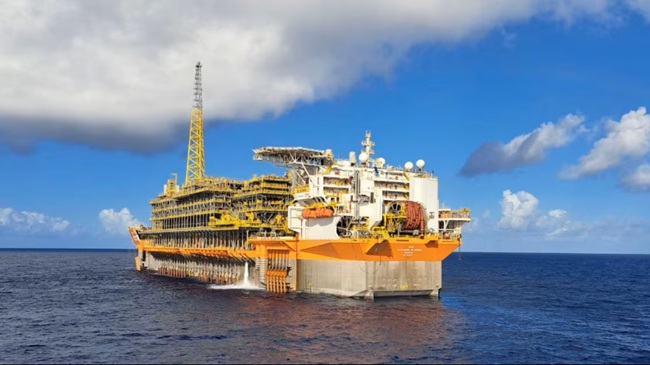
The Mero-1 FPSO Guanabara MV31 is operated by MODEC and has a water injection capacity of 225,000 barrels per day and a storage capacity of 1.4 million barrels of crude oil. It is deployed at a water depth of 1,930 metres and features a spread mooring system integrated with a gas reinjection system to maintain pressure and enhance oil recovery. The Mero-2 phase uses the FPSO Sepetiba, while Mero-3 utilises the Marechal Duque de Caxias FPSO, which was designed to minimise greenhouse gas emissions with full gas reinjection into the reservoir and zero routine flaring. The Mero-4 FPSO Alexandre de Gusmão is deployed approximately 160 kilometres off Arraial do Cabo, Rio de Janeiro, in roughly 2,000 metres of water, connected to 12 wells with a capacity to produce 180,000 barrels of oil daily alongside 12 million cubic metres of gas compression per day.
All four permanent FPSOs reinject associated gas back into the reservoir rather than flaring, a design choice driven by both regulatory requirements from Brazil’s National Petroleum Agency and the Libra Consortium’s commitment to minimising emissions intensity. This approach also supports reservoir pressure maintenance, which in turn sustains oil recovery rates over the field’s multi-decade life.
Mero oil field development history and key investment decisions
The story of Mero’s investment lifecycle begins with the original Libra block licensing round in December 2013, which attracted the consortium of Petrobras, TotalEnergies, Shell, CNPC, and CNOOC under Brazil’s newly established production sharing framework. The final investment decision for the Mero-1 development was reached in December 2017, the same month that first oil was achieved from the Pioneiro de Libra early production vessel. The final investment decision for the second development phase, Mero-2, was announced in June 2019, and the third phase FID came in August 2020. The Libra Consortium took a positive final investment decision on the Mero-4 project in 2021.
The sequencing of these decisions, roughly every one to two years across a decade, reflects the structured multi-phase delivery model that Petrobras adopted for all major pre-salt assets, de-risking capital allocation while maintaining production growth momentum. The Mero-2 FPSO Sepetiba began production in January 2024, completing a four-year construction and commissioning cycle from its FID. Mero-3 achieved first oil on 30 October 2024, less than a year after Mero-2. The FPSO Alexandre de Gusmão, the fourth permanent platform at the Mero field, began operations on 24 May 2025, ahead of the date scheduled in the business plan.
Contracts awarded for Mero: EPC, subsea, FPSO, and HISEP suppliers
The Mero development has generated one of the most extensive offshore contractor supply chains in the Southern Hemisphere over the last decade. MODEC received a contract for the engineering, procurement, construction, mobilisation, installation, and operation of the Mero-1 FPSO in December 2017. TechnipFMC received a contract for all rigid lines for Mero-1 in February 2019, followed by a full EPCI contract for the Mero-2 project in August 2020. Subsea 7 was engaged to provide engineering, fabrication, installation, and pre-commissioning of 80 kilometres of risers and flowlines, 60 kilometres of flexible service lines, 50 kilometres of umbilicals, and associated infrastructure for the Mero-3 project in May 2021. Aker Solutions was contracted to provide a subsea production system and associated services for Mero-4 in November 2021, having previously received a similar contract for Mero-1 in 2018.
The most significant contract awarded in the Mero lifecycle in recent years relates to the HISEP technology project. In January 2024, Petrobras awarded TechnipFMC an integrated engineering, procurement, construction, and installation contract for the Mero-3 HISEP project, with TechnipFMC confirming the contract is worth more than one billion US dollars. The contract covers the design, engineering, manufacture, and installation of subsea equipment including manifolds, flexible and rigid pipes, umbilicals, and power distribution, as well as life-of-field services. In November 2024, Cladtek was awarded a contract by TechnipFMC for the Mero-3 HISEP project to supply corrosion-resistant alloy cladded pipes and bends engineered for durability in highly corrosive subsea environments, described as one of Petrobras’ largest weld overlay agreements. Other contractors and suppliers across the Mero project lifecycle include Benthic, Blue Marine Telecom, DOF Subsea, Geospace Technologies, Maersk Supply Service, Ocyan, Siemens Energy, SOFEC, Teekay Offshore, Tenaris, and TMC Compressors.
Regulatory framework, environmental policy, and geopolitical context for Mero
Mero operates under Brazil’s Production Sharing Contract regime, administered by the ANP and overseen by PPSA as the government’s representative in non-contracted areas. This regulatory framework requires Petrobras to serve as mandatory operator, mandates minimum local content thresholds across procurement and services, and governs profit oil distribution between the consortium and the Brazilian state.
Brazil’s environmental regulator IBAMA oversees offshore licensing and operational approvals. The Mero consortium’s decision to design all permanent FPSOs with zero routine flaring and full gas reinjection has largely addressed emissions scrutiny for the asset specifically, though Brazil’s broader offshore sector faces growing pressure to demonstrate alignment with the country’s climate commitments. The production sharing structure also shields the project from some forms of fiscal risk: if crude prices decline, the state’s profit oil take falls proportionally, providing the consortium with a natural hedge. Geopolitical risk at Mero is relatively contained given the asset’s Brazilian jurisdiction and the diversified nationality of the consortium partners, spanning European, North American, Chinese, and Brazilian entities.
How Mero affects Petrobras earnings and Brazil’s pre-salt export strategy
Mero’s scale makes it a material contributor to Petrobras earnings in any quarter where the FPSOs are running at or near capacity. The FPSO Alexandre de Gusmão was specifically cited by Petrobras as one of the production additions that drove approximately 585,000 barrels per day of new production capacity, contributing to the company’s 2025 annual production record. Petrobras reported net income of approximately 19.6 billion US dollars for 2025, supported by higher oil and gas production, even against a lower average Brent price environment.
At the national level, Mero is a cornerstone of Brazil’s pre-salt export strategy. Petrobras noted that 81% of its production comes from pre-salt fields in the Santos Basin, with Mero the third field in that cluster to cross the 500,000-barrel-per-day threshold. For 2026, Petrobras has set a commercial oil and gas production target of 2.8 million barrels of oil equivalent per day, with pre-salt volumes expected to remain at 82% of total share. Mero’s contribution at or near plateau is essential to meeting that guidance. For TotalEnergies, full capacity across all Mero phases is expected to represent over 100,000 barrels per day in the company’s net share, making it one of TotalEnergies’ most significant equity production assets in the Americas. Shell’s 19.3% stake provides similar materiality for that company’s deepwater production portfolio.
Mero oil field production update 2026: FPSO ramp-up and plateau trajectory
The FPSO Marechal Duque de Caxias, whose production start-up was on 30 October 2024 at the Mero field, reached its peak production of 180,000 barrels of oil per day on 19 May 2025 with just four producing wells active at that point, ahead of full well tie-in. The Alexandre de Gusmão FPSO completing commissioning ahead of schedule in May 2025 brought total Mero installed capacity to 770,000 barrels per day. In December 2025, Petrobras detailed acquisitions of additional participation in the Mero shared reservoir through a PPSA Non-Contracted Areas Auction, indicating continued government-backed efforts to consolidate Petrobras’ economic interest in the field as production matures. With all four permanent FPSOs now in ramp-up or plateau phase, 2026 represents the year in which Mero crosses into full multi-system operational maturity.
HISEP technology at Mero-3: Petrobras’ subsea separation pilot explained
The most significant technological development underway at Mero in 2026 is the HISEP subsea separation pilot. The Mero-3 project will implement Petrobras’ high-pressure separation technology, known as HISEP, which is scheduled to become operational in 2028. HISEP is an acronym for High Pressure Separator and enables underwater separation between the extracted oil and the associated gas produced, rich in CO2, which is then reinjected into the reservoir at the seabed. TechnipFMC’s engineers have been developing the technology to move this separation process from the topside of an FPSO to the sea floor since a conceptual study began in 2017. The HISEP technology has the potential to boost production by freeing up surface gas processing capacity while reducing greenhouse gas emissions, and is expected to reduce FPSO size requirements by up to 30% for future deployments. If the pilot at Mero-3 delivers the expected results, HISEP has the potential to be applied across other high gas-oil-ratio pre-salt fields in Brazil and internationally.
Mero oil field future outlook, reserve life, and long-term production potential
Based on economic assumptions, the Mero field’s production will continue until it reaches its economic limit in 2056, giving the asset approximately three decades of remaining productive life from 2026. Mero expects to increase its production capacity to over 700,000 barrels per day as the full well count across all four FPSOs is tied in and production ramps toward field plateau. The main variables that could alter this trajectory include crude oil prices sustained at levels that affect consortium reinvestment decisions, any significant geomechanical challenges in the carbonate reservoir that affect well productivity, and the pace at which the HISEP technology reaches commercial maturity and alters the field’s emissions and production economics. Enhanced recovery through optimised water and gas injection will also play a growing role as the field ages and natural reservoir pressure support diminishes.
Petrobras incorporated approximately 1.7 billion barrels of proven reserves in 2025, achieving the highest proven reserve level in ten years with a reserve replacement rate of around 175% and extending the company’s reserves-to-production life to 12.5 years. Mero remains one of the assets underpinning that reserve quality and longevity. Within Brazil’s broader pre-salt narrative, Mero occupies a unique position: large enough to be strategically significant, diverse enough in consortium structure to attract sustained international capital, and technically complex enough to serve as a global proving ground for subsea separation and emissions reduction technology.
Discover more from Business-News-Today.com
Subscribe to get the latest posts sent to your email.


