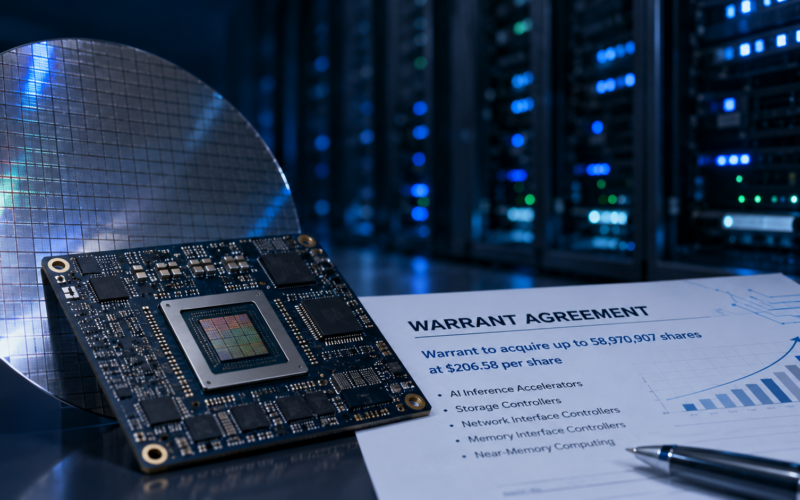
Marvell Technology, Inc. (NASDAQ: MRVL) has given Google LLC a warrant to acquire up to 58,970,907 Marvell shares at $206.58 each as part of an expanded custom-semiconductor relationship spanning artificial intelligence inference accelerators, storage controllers, network interface controllers, memory interface controllers and near-memory computing products attached to Google’s tensor processing unit ecosystem. The headline value of roughly $12.18 billion represents what Google would pay to exercise all of the warrants at the stated exercise price, not cash being invested immediately and not guaranteed revenue for Marvell. More importantly, almost all of the warrant shares vest only as Google generates qualifying custom-product revenue for Marvell, creating one of the more unusual customer incentive structures in the current AI semiconductor boom.
Marvell and Google entered the underlying commercial agreement on July 29, while the warrant was issued on August 18 and publicly disclosed through Marvell’s August 19 regulatory filing. Only 1,360,867 shares are scheduled to vest in equal quarterly installments during the first year. The remaining roughly 57.61 million shares vest in 240 equal tranches, with one tranche becoming eligible for every $500 million of qualifying custom-product revenue generated from Google and its affiliates through Marvell’s fiscal 2033.
Why does Marvell’s Google warrant point toward a potential $120 billion revenue threshold?
The arithmetic behind the warrant is more consequential than the $12.18 billion exercise value attracting most of the attention. With 240 performance-linked tranches and each tranche tied to $500 million of custom-product revenue, full performance vesting corresponds to $120 billion of cumulative qualifying revenue. That does not mean Google has committed to spend $120 billion, because the filing specifically ties vesting to discretionary purchases rather than a mandatory procurement schedule.
The structure nevertheless signals the scale of business that the two companies have contemplated when designing the agreement. For comparison, Marvell generated $2.418 billion of company-wide revenue in its first quarter of fiscal 2027 and guided to approximately $2.7 billion for the second quarter, meaning the full warrant-linked revenue threshold would represent many years of Marvell’s current quarterly sales. First-quarter revenue was already up 28% year over year as AI-related demand drove growth across data-center products.
That makes partial vesting a far more useful near-term framework than assuming the entire $120 billion is destined to materialize. Every $500 million increment of qualifying Google revenue becomes an observable milestone, effectively allowing investors to judge how quickly the commercial relationship is scaling. The warrant therefore aligns Google’s potential equity upside with increasing purchases from Marvell while allowing Google to retain procurement flexibility.

What custom AI silicon will Marvell develop for Google’s TPU ecosystem?
The agreement is broader than a single accelerator program. Marvell disclosed that the expanded relationship includes AI inference accelerators, storage controllers, network interface controllers, memory interface controllers and near-memory compute technologies connected to Google’s TPU infrastructure. This positions Marvell across several layers of the AI system rather than limiting its opportunity to one processor design.
That system-level breadth is increasingly important because AI infrastructure spending is moving beyond GPUs and accelerators toward networking, memory movement, optical connectivity, storage and specialized controllers. Performance bottlenecks can emerge anywhere along the path between compute, memory and network fabric, which means hyperscalers are allocating capital across entire architectures rather than purchasing processors in isolation. Marvell has been building around precisely that trend through custom silicon, electro-optics, switching and other data-infrastructure products.
Its first-quarter fiscal 2027 performance shows the strategy already has financial weight. Marvell reported record revenue of $2.418 billion, with data-center sales rising 27% year over year amid demand for electro-optics, custom products, storage and switching. Management also said AI-related bookings had strengthened enough to support higher revenue expectations for fiscal 2027 and fiscal 2028, while guiding second-quarter revenue to approximately $2.7 billion, plus or minus 5%.
Does the Google-Marvell expansion threaten Broadcom’s role in custom AI chips?
The initial market reaction suggested investors immediately interpreted Marvell’s expansion as a competitive development for Broadcom Inc., another major supplier involved in Google’s custom AI infrastructure. Marvell shares gained about 9.9% on August 19 after the agreement became public, while Broadcom declined more than 4% in the same session. Google had already entered a separate long-term arrangement with Broadcom covering future generations of custom AI chips and other components through 2031, making diversification rather than outright supplier replacement the more cautious interpretation.
Hyperscalers have strong reasons to use multiple semiconductor partners. AI infrastructure programmes are becoming large enough that supply resilience, negotiating leverage, technical specialization and speed of product development can justify distributing work across more than one vendor. Google also benefits strategically from avoiding excessive dependence on a single custom-silicon partner as its TPU architecture becomes more important to its internal infrastructure and external cloud offering.
For Marvell, even a fraction of the potential Google programme could be material because the company is still substantially smaller than the largest semiconductor suppliers. The agreement strengthens its credibility as a hyperscaler custom-silicon partner, but it also increases the importance of execution across advanced design, manufacturing coordination and product ramps. Revenue milestones matter only when silicon enters volume production and customers actually purchase the resulting products.
What is Marvell’s share price saying after the initial Google deal surge?
Marvell’s market reaction has been strongly positive but volatile. Shares rose 9.85% on August 19 and another 5.79% on August 20 before retreating roughly 5.6% on August 21 to around $237. Over five trading sessions the stock was still ahead by about 6.7%, while its gain from July 21 was approximately 13.9%.
The stock remains well below its 52-week high near $330, leaving significant distance between the enthusiasm around new AI programmes and the valuation investors assigned at the peak. That combination suggests sentiment is constructive toward Marvell’s improving AI exposure while remaining sensitive to expectations already embedded in the share price. The next major checkpoint is the company’s fiscal second-quarter earnings release scheduled for August 27, when investors will be looking for additional evidence that bookings and custom-silicon ramps are translating into revenue.
The Google warrant should therefore be read as a long-duration commercial alignment rather than a conventional $12.2 billion investment announcement. Google has gained the right to buy a substantial amount of Marvell equity, but most of that right must be earned through actual purchasing activity. For Marvell, the opportunity could become enormous if the relationship scales toward the warrant’s revenue thresholds, yet the contract structure itself makes disciplined tracking of realized revenue more useful than extrapolating the maximum theoretical figure.
Discover more from Business-News-Today.com
Subscribe to get the latest posts sent to your email.