



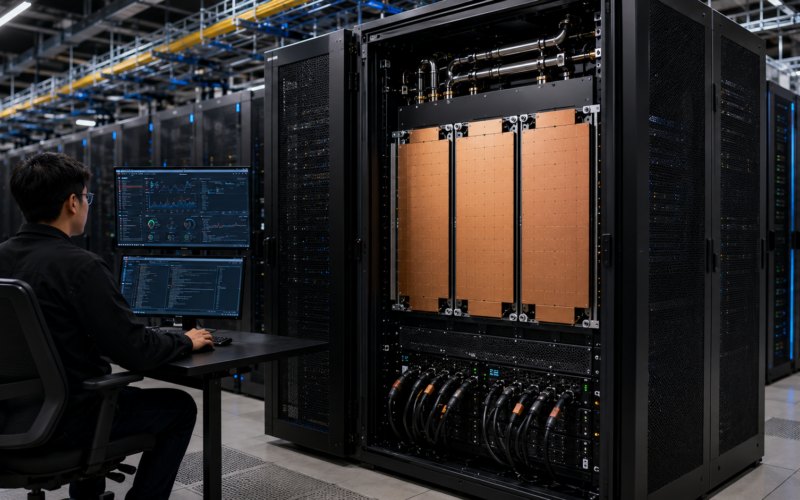
Cerebras Systems Inc. (NASDAQ: CBRS) has launched CS-4, a new rack-scale artificial intelligence system built around three WSE-3 Turbo wafer-scale processors and a modular Nexus architecture designed primarily for high-speed inference. Cerebras says CS-4 can deliver up to 30 times faster inference than selected GPU-based systems, while offering up to 10 times more throughput per watt than its previous CS-3 generation, claims that remain dependent on model, workload and serving configuration. The launch matters because Cerebras is simultaneously expanding toward more than 600 megawatts of contracted data centre capacity and trying to convert $25.4 billion of remaining performance obligations into a much larger cloud business. Second-quarter cloud and other services revenue jumped 281% to $126 million, but core gross margin remained about 41% and near-term guidance points to continued infrastructure costs before capacity scales. Cerebras shares closed at $220.01 on August 18, down 12.7% during a broad semiconductor selloff, although CS-4 was announced after the regular market session and therefore should not be treated as the cause of that decline.
Why is Cerebras redesigning the entire AI rack instead of simply producing a faster wafer-scale processor?
CS-4 is more than a new semiconductor generation. Cerebras has redesigned how compute, power, cooling and networking are assembled around its wafer-scale processors, suggesting the company sees physical deployment speed as an increasingly important competitive variable alongside tokens per second.
Each CS-4 rack contains three WSE-3 Turbo processors. Cerebras says the combined system provides 750 petaflops of artificial intelligence compute, 129.6 petabytes per second of memory bandwidth and 7.2 terabits per second of system I/O bandwidth.
The processor itself remains unusual. Each WSE-3 Turbo contains four trillion transistors and 900,000 artificial intelligence-optimised cores spread across 46,225 square millimetres of silicon, essentially using almost an entire wafer as one processor rather than cutting a wafer into hundreds of conventional chips.
That architecture allows Cerebras to keep enormous amounts of communication and memory traffic on the wafer. Conventional GPU clusters need to move information repeatedly between processors, high-bandwidth memory and networking components. Those transfers consume electricity and introduce latency.
CS-4 attempts to push the architectural advantage beyond the processor. The new Nexus Platform Architecture separates the rack into modular compute, power and I/O components, allowing each part to be upgraded more independently.
The most visible change is Cerebras’ new Wafer-Scale Backpack. It combines the processor with direct liquid cooling, power conversion, control electronics and high-speed connectivity in a removable module mounted behind the power system.
Cerebras says the redesigned assembly contains 50% fewer components than the previous generation and uses 60% more automated manufacturing. Installation time can fall from days to hours, according to the company.
That may sound less dramatic than a 30 times performance claim, but it matters when Cerebras intends to deploy hundreds of megawatts of capacity. A system requiring fewer parts, less manual assembly and faster installation can reduce construction complexity, technician hours, component failures and time between equipment delivery and revenue generation.
This makes CS-4 partly a manufacturing and deployment product. Cerebras needs a rack architecture that can be produced repeatedly across multiple contract manufacturers and data centres, not merely an engineering demonstration capable of setting benchmark records.

Does Cerebras’ claim of up to 30 times faster inference translate into better economics for real AI services?
Cerebras says CS-4 delivered more than 4,400 tokens per second per user on GPT-OSS-120B in a head-to-head comparison using identical prompts, producing up to 30 times the inference speed of selected GPU systems.
That is a company-supported benchmark rather than a universal performance guarantee. Cerebras itself notes that throughput varies according to model architecture, context length, precision and serving configuration.
The distinction matters because artificial intelligence inference cannot be reduced to one tokens-per-second number. Customers also consider output quality, batching, time to first token, total throughput, hardware utilisation, electricity consumption and the cost of serving each request.
Where Cerebras may have a particularly interesting commercial argument is latency.
For an ordinary chatbot, reducing a response from several seconds to fractions of a second improves user experience. For coding agents, research systems and autonomous software, faster token generation can affect the amount of useful work completed within a fixed period.
An agent does not necessarily produce one answer and stop. It may generate a plan, call a tool, analyse the result, revise the plan, run another tool and repeat that process several times before presenting an output.
Every inference delay accumulates through that sequence. A system that produces tokens substantially faster can therefore allow an agent to perform more reasoning and tool calls during the same wall-clock interval.
This is why Cerebras increasingly describes inference performance in economic rather than purely technical terms. Faster output can allow an artificial intelligence service to complete more useful work for each user while reducing the number of concurrent users required to occupy expensive infrastructure for long periods.
CS-4 also claims up to 10 times more throughput per watt than CS-3. If demonstrated consistently in production, that metric could matter even more than maximum single-user speed because electricity availability is becoming a binding constraint on artificial intelligence infrastructure.
A data centre operator with a fixed 100 MW power allocation cannot simply add unlimited accelerators. The economically relevant question becomes how much useful model output can be produced within that electrical envelope.
Cerebras must now demonstrate these advantages across commercial workloads rather than carefully selected benchmarks. Independent measurements across different model sizes, context lengths and concurrency levels will determine whether the claimed advantage remains meaningful outside the launch environment.
Why is Cerebras embracing disaggregated inference instead of trying to replace every GPU and AI accelerator?
One of the most strategically significant parts of CS-4 is that Cerebras is explicitly designing it to work alongside competing artificial intelligence infrastructure.
That may appear counterintuitive for a semiconductor company trying to challenge Nvidia Corporation, but it acknowledges an important reality. Customers have already invested enormous amounts of capital in GPUs, custom accelerators and cloud infrastructure. Convincing them to replace everything simultaneously creates a much higher barrier to adoption.
Cerebras instead wants to separate artificial intelligence inference into different stages.
The first stage, commonly called prefill, processes the user’s incoming prompt and context. It can involve substantial parallel computation, particularly when context windows are very large.
The second stage, decode, generates output tokens sequentially. This stage is more latency sensitive because every generated token depends on preceding computation.
Cerebras is positioning its wafer-scale systems particularly strongly for decode. Under a disaggregated architecture, another system can process prefill and then transfer the resulting state to Cerebras infrastructure for rapid token generation.
The new programmable I/O architecture is designed around this model. Cerebras supports standards-based RoCE v2 remote direct memory access over Ethernet and direct wafer connections, allowing the system to exchange information with external infrastructure at lower latency.
The company has already named Advanced Micro Devices’ Helios architecture and Amazon Web Services’ Trainium as ecosystem partners for disaggregated inference. Cerebras and Advanced Micro Devices expect their joint architecture to reach production during the fourth quarter of 2026, while an Amazon Web Services implementation is expected to reach Amazon Bedrock in the first quarter of 2027.
This is strategically clever because Cerebras does not have to win an all-or-nothing hardware decision.
A customer using AMD accelerators can continue using them for workloads where they perform well while adding Cerebras for latency-sensitive decode. An Amazon Web Services customer could eventually access a similar architecture without leaving the cloud environment.
Cerebras can therefore penetrate existing artificial intelligence estates without asking customers to discard infrastructure they already own.
It also creates a more realistic competitive position against Nvidia. Nvidia benefits from an enormous installed base, CUDA software and a rapidly expanding range of integrated systems. Attempting to replace that ecosystem outright would require an extraordinary migration.
Winning one valuable part of inference is a narrower objective.
If decode becomes increasingly important as agentic artificial intelligence expands, Cerebras could capture a meaningful portion of infrastructure spending while remaining complementary to other accelerators. The company may ultimately gain more by becoming indispensable to part of the workload than by insisting it must replace every GPU.
Can 50% fewer components make Cerebras’ planned 600 MW data centre expansion easier to execute?
Cerebras reported more than 600 MW of data centre capacity live or contracted for delivery by the end of 2027, with a development pipeline measured in gigawatts.
The scale dramatically changes what matters operationally.
A specialist semiconductor company can build a limited number of complex systems with substantial manual engineering. A cloud infrastructure company serving major customers such as OpenAI needs a design that can be manufactured, shipped, installed and repaired repeatedly across hundreds of megawatts.
Cerebras is addressing this through several layers.
The new Wafer-Scale Backpack reduces component count by 50% and increases manufacturing automation by 60%. The modular design allows compute assemblies to be installed or replaced more quickly without rebuilding the entire rack.
Cerebras has also expanded manufacturing relationships with Flex, Sanmina and Rocket EMS. Management expects manufacturing capacity to increase more than tenfold during 2026.
The company says it has secured the TSMC wafer supply required for its expansion. WSE-3 and WSE-3 Turbo are manufactured using Taiwan Semiconductor Manufacturing Company’s 5-nanometre process.
Those arrangements reduce one bottleneck, but data centre deployment involves much more than processor availability. Cerebras still needs buildings, transformers, substations, cooling infrastructure, networking equipment and sufficient utility power before systems can generate customer revenue.
The company disclosed approximately $1.6 billion of undiscounted future minimum payments under additional non-cancelable data centre leases executed during the second quarter alone.
This illustrates how quickly infrastructure commitments are becoming part of Cerebras’ financial model.
Fewer rack components can improve reliability and installation time, but they do not eliminate the need to finance facilities before customer revenue arrives. A delay in utility energisation or construction can leave expensive processors waiting for infrastructure while contractual obligations continue accumulating.
CS-4 therefore becomes part of the solution to an execution problem created by Cerebras’ own success. A $25.4 billion remaining performance obligation base gives the company unusually strong visibility, but fulfilling those commitments requires turning semiconductor manufacturing capacity into operational data centre capacity at unprecedented speed.
Does avoiding HBM and advanced packaging give Cerebras a durable supply advantage over GPU competitors?
One of Cerebras’ most unusual semiconductor advantages is what its current architecture does not require.
The WSE-3 generation is manufactured using TSMC’s 5-nanometre process and incorporates 44 GB of SRAM directly on the wafer. Cerebras therefore does not depend on external high-bandwidth memory in the same way as conventional high-performance GPU systems.
It also avoids CoWoS advanced packaging, another capacity-constrained part of the artificial intelligence semiconductor supply chain.
This gives Cerebras a potentially valuable sourcing advantage at a time when artificial intelligence infrastructure demand has pushed HBM prices higher and forced major chip companies to compete for advanced packaging capacity.
The company is also not relying on the most advanced 2-nanometre or 3-nanometre manufacturing nodes for WSE-3 Turbo. Management argues that 5-nanometre wafer capacity currently faces less pressure than the leading-edge nodes used by several competing accelerators.
That does not make Cerebras supply independent.
TSMC remains a critical manufacturing partner, and producing a processor that occupies almost an entire wafer presents its own manufacturing challenges. Wafer-scale design requires fault tolerance and architecture capable of working around manufacturing defects that would normally cause a conventional semiconductor die to be discarded.
Cerebras has spent several product generations solving that problem, giving it specialised engineering knowledge that would be difficult for a new entrant to reproduce quickly.
The on-chip SRAM design also involves a trade-off. Forty-four gigabytes is enormous for processor-integrated SRAM but much smaller than the external memory capacity available around large GPU systems.
Cerebras compensates through its MemoryX architecture and system design, but different workloads can favour different memory arrangements.
The supply advantage should therefore be viewed as diversification rather than immunity. Cerebras avoids several of the components currently constraining GPU production, giving customers another architecture whose bottlenecks are not identical to Nvidia’s or AMD’s.
For hyperscalers planning gigawatts of artificial intelligence infrastructure, that diversification itself has value.
How does CS-4 fit Cerebras’ rapid shift from selling hardware toward operating an AI inference cloud?
Cerebras’ latest financial results reveal a business changing much faster than the underlying semiconductor product cycle might suggest.
Second-quarter GAAP cloud and other services revenue increased 281% to $126 million from $33 million a year earlier. Hardware revenue, by contrast, declined 23% to $54.1 million from $70.3 million.
Cloud services therefore generated approximately 70% of quarterly GAAP revenue.
This is an important shift because a company selling AI systems has very different economics from one building and operating the infrastructure itself.
Hardware revenue is recognised when equipment is sold or delivered under applicable accounting rules. Cloud revenue can recur as customers consume computing capacity, creating potentially longer relationships and greater revenue visibility.
The model also requires substantially more capital.
When Cerebras sells a CS system to a customer, the customer ultimately funds the physical infrastructure. When Cerebras sells cloud inference, Cerebras or its infrastructure partners must finance processors, racks, buildings and power before customers can use the service.
The $20 billion multiyear OpenAI agreement demonstrates both sides of this opportunity. It gives Cerebras a major anchor customer and substantial future revenue potential, but the company has to build enormous amounts of capacity to fulfil it.
Remaining performance obligations reached $25.4 billion at June 30. Compared with the $885 million midpoint of Cerebras’ new 2026 core revenue guidance, that figure is roughly 28.7 times expected current-year revenue.
That comparison should not be interpreted as 29 years of guaranteed sales. Revenue recognition depends on performance, contract schedules and capacity delivery, while large customers create concentration risk.
It nevertheless demonstrates how far contracted demand has moved ahead of reported revenue.
CS-4 is therefore primarily important as a cloud economics product. Cerebras needs each megawatt of installed infrastructure to generate more tokens and more revenue without requiring power and costs to rise proportionately.
If the company’s claim of up to 10 times more throughput per watt than CS-3 translates into production environments, it could materially improve the economics of capacity deployed against those long-term commitments.
Can Cerebras improve gross margins while funding the infrastructure required for $25.4 billion of obligations?
Cerebras’ financial results show why performance per watt and deployment efficiency matter so much.
Second-quarter GAAP revenue increased 74% to $180.1 million, while core revenue increased 103% to $209.9 million. Yet GAAP gross margin was only 14%, and the company recorded a GAAP operating loss of approximately $477 million.
The GAAP result was heavily affected by stock-based compensation associated with the May initial public offering. Stock-based compensation reached approximately $377 million during the quarter, meaning the headline operating loss substantially overstates current cash operating deterioration.
Core results provide a cleaner view of the underlying business, but they also reveal pressure.
Core gross margin was approximately 41%, down from about 47% in the first quarter. Core operating margin remained negative at approximately 16%.
Management said gross margin fell partly because Cerebras was paying to rent back computing capacity it had previously deployed at customer locations while waiting for additional data centre capacity to become available.
That is an unusual but revealing consequence of demand arriving faster than infrastructure.
The company had customers willing to pay for inference, but insufficient capacity available under its preferred ownership and operating structure. Renting systems back allowed Cerebras to serve that demand, but at weaker margins.
Management expects the pressure to continue temporarily. Third-quarter core gross margin is forecast between 38% and 40%, below the second-quarter level, before expected improvement as new capacity comes online.
Full-year core gross margin guidance was nevertheless increased to 41% to 43%.
Cerebras has significant financial resources to support the buildout. Cash, cash equivalents, restricted cash and short-term investments totalled approximately $8.6 billion at June 30, following approximately $6.4 billion of gross proceeds from its May initial public offering. The company also reported about $850 million of additional debt capacity.
Liquidity therefore provides a substantial cushion.
The scale of expansion means investors still need to monitor capital efficiency. More than 600 MW of capacity and a gigawatt-scale pipeline can absorb billions of dollars even when customers provide strong contractual visibility.
The long-term investment case depends on gross margin improving as infrastructure scales. If cloud revenue grows rapidly but additional capacity continues requiring expensive leasing or temporary arrangements, revenue growth will not automatically translate into attractive shareholder returns.
CS-4 has to help solve that equation by producing more valuable inference from each rack and each megawatt.
Why did Cerebras shares fall almost 13% before investors could fully evaluate the CS-4 launch?
Cerebras shares closed at $220.01 on August 18, falling 12.7% from the previous close of $251.98.
Timing is important. Cerebras announced CS-4 at approximately 8 p.m. Eastern Time, several hours after the regular Nasdaq session closed. The August 18 decline therefore cannot reasonably be interpreted as the market rejecting the new system.
The selloff occurred during a difficult session for semiconductor stocks generally. The Philadelphia Semiconductor Index fell approximately 5%, while Micron Technology dropped about 7%, Nvidia fell 2.3% and several other artificial intelligence infrastructure names experienced sharper losses.
Rising long-term bond yields and concerns about stretched artificial intelligence valuations contributed to the sector-wide pressure.
Cerebras nevertheless fell considerably more than the broad semiconductor benchmark, showing that company-specific valuation concerns remain elevated after its second-quarter results.
At $220.01, Cerebras was approximately 6.3% below its August 11 close of $234.76. Over a one-month period, however, the stock remained about 27.3% above its July 17 close of $172.86.
The post-IPO trading range has been exceptionally wide. Cerebras has traded between approximately $160.81 and $386.34 since becoming a public company in May.
The August 18 close was about 43% below the high while remaining nearly 37% above the low.
That volatility reflects an unresolved valuation debate. Cerebras has a differentiated architecture, a $20 billion OpenAI agreement, rapidly expanding cloud revenue and $25.4 billion of remaining performance obligations. It also remains loss-making, requires large infrastructure investment and has substantial exposure to a limited number of major customers.
The CS-4 launch strengthens the technology side of the argument but does not settle the financial side.
Investor sentiment can improve if Cerebras demonstrates that new capacity materially increases cloud revenue while gross margins recover. A continuation of rapid revenue growth alongside weak margin conversion would make the stock much more sensitive to interest rates and artificial intelligence valuation sentiment.
The August 19 session will therefore provide the first regular-market opportunity for investors to react directly to CS-4.
What milestones will show whether CS-4 is becoming a commercial inference platform rather than another benchmark story?
The first milestone is shipment timing. Cerebras says initial CS-4 shipments will begin during the third quarter of 2026. Meeting that schedule matters because customers cannot monetise benchmark advantages until production hardware arrives.
The second is independent performance validation. Cerebras needs external benchmarking across a wider range of models, workloads and concurrency levels to demonstrate where the up-to-30-times claim holds and where the advantage narrows.
The third is disaggregated inference deployment. The AMD Helios implementation expected in the fourth quarter of 2026 and the Amazon Web Services deployment targeted for early 2027 will show whether Cerebras can become an interoperable component inside larger AI infrastructure ecosystems.
The fourth is cloud gross margin. Cerebras expects near-term pressure before new data centre capacity improves economics. Investors should watch whether gross margin begins recovering after the third-quarter trough management currently anticipates.
The fifth is data centre delivery. More than 600 MW needs to move from contracted capacity to operating infrastructure by the end of 2027.
The sixth is revenue conversion. Cerebras plans to more than triple revenue in 2027. That target requires its enormous remaining performance obligation base to begin converting into recognised cloud sales at a much faster rate.
The seventh is customer diversification. OpenAI provides enormous strategic validation, but dependence on OpenAI, G42, Mohamed bin Zayed University of Artificial Intelligence, Amazon Web Services and other large customers means contract concentration remains significant.
The eighth is manufacturing execution. A more-than-tenfold increase in 2026 manufacturing capacity will test Cerebras’ ability to coordinate TSMC wafer supply with Flex, Sanmina, Rocket EMS and data centre deployment schedules.
CS-4 should therefore be evaluated as part of an operating system around Cerebras’ growth rather than solely as a faster accelerator. The product has to improve manufacturing scalability, infrastructure density, interoperability and cloud economics simultaneously.
What are the key takeaways from Cerebras CS-4 and the company’s expanding AI inference strategy?
- Cerebras launched CS-4 on August 18, with first shipments scheduled to begin during the third quarter of 2026.
- Each CS-4 rack contains three WSE-3 Turbo wafer-scale processors delivering a combined 750 petaflops of AI compute.
- Cerebras claims up to 30 times faster inference than selected GPU systems, but actual performance varies materially according to model, context, precision and serving configuration.
- The Nexus rack architecture uses 50% fewer components and 60% more automated manufacturing than the previous design, potentially reducing deployment complexity as Cerebras scales capacity.
- CS-4 supports disaggregated inference, allowing AMD Helios, AWS Trainium or other infrastructure to handle prefill while Cerebras specialises in low-latency decode.
- Cerebras now has more than 600 MW of data centre capacity live or contracted for delivery by the end of 2027 and a further development pipeline measured in gigawatts.
- Q2 cloud and other services revenue increased 281% to $126 million and represented approximately 70% of GAAP quarterly revenue, while hardware revenue declined to $54.1 million.
- Remaining performance obligations of $25.4 billion equal roughly 28.7 times the midpoint of Cerebras’ 2026 core revenue guidance, creating enormous visibility but equally large execution requirements.
- Cerebras closed August 18 at $220.01, down 6.3% over five trading sessions but up approximately 27.3% over one month, with the shares about 43% below their post-IPO high.
- The investment case increasingly depends on whether CS-4 and new data centre capacity can convert rapid cloud growth into higher gross margins rather than simply producing more revenue at greater capital intensity.
Can Cerebras turn wafer-scale inference speed into durable AI infrastructure economics?
Cerebras has reached a more consequential stage than proving that wafer-scale processors can run artificial intelligence models quickly. The company now has major customers, billions of dollars of liquidity, more than 600 MW of contracted capacity and $25.4 billion of remaining performance obligations. That scale moves the debate from semiconductor novelty toward industrial execution.
CS-4 addresses several problems simultaneously. The faster processor attacks inference latency, the redesigned rack reduces manufacturing and installation complexity, the higher claimed throughput per watt addresses data centre power constraints, and disaggregated inference lowers the barrier for customers already committed to AMD, Amazon Web Services or other computing platforms. Together, those changes suggest Cerebras is becoming more pragmatic about where its architecture fits within the broader AI infrastructure market.
That pragmatism may ultimately be more important than attempting to defeat Nvidia across every workload. Artificial intelligence infrastructure is becoming heterogeneous because no single accelerator is likely to be optimal for training, prefill, decode, retrieval, recommendation and every future agentic workload. Cerebras can build a large business if its wafer-scale architecture becomes the preferred option for latency-sensitive inference even while GPUs continue dominating other parts of the stack.
The financial evidence is beginning to support that transition. Cloud revenue nearly quadrupled year over year and now contributes about 70% of GAAP revenue. Yet the same shift exposes Cerebras to infrastructure economics that hardware suppliers can leave to their customers. Data centres must be financed, power must be secured and processors must remain highly utilised long enough to recover their cost.
That is why the most important CS-4 specification may eventually prove to be neither 750 petaflops nor 4,400 tokens per second. It may be how many commercially valuable tokens Cerebras can produce from every megawatt and every dollar invested in infrastructure. The company already has more demand than its current revenue base can serve. CS-4 now has to show that satisfying that demand can become increasingly profitable rather than merely increasingly large.
Discover more from Business-News-Today.com
Subscribe to get the latest posts sent to your email.

