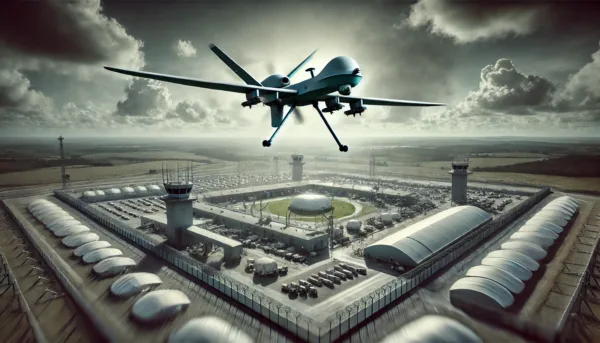
At least 37 people have been killed after a Russian drone strike hit a warehouse storing ammunition near Kyiv and triggered a massive secondary detonation, turning what might otherwise have been another attack on Ukrainian military infrastructure into one of the deadliest incidents around the capital in recent months. Another 42 people were injured, hundreds were evacuated and nearby residential buildings suffered extensive damage as ammunition exploded inside the facility in Myla, west of Kyiv.
The scale of the civilian losses has generated anger inside Ukraine because the disaster was not caused solely by the incoming Russian drone. President Volodymyr Zelenskiy said regulations prohibit storing ammunition near homes and other residential infrastructure and announced that criminal proceedings had already been opened over possible official negligence. Ukraine’s Defence Ministry has also ordered a broader review of weapons-storage locations, raising the prospect that the Myla disaster could lead to changes in how ammunition is dispersed and protected during Russia’s continuing long-range strike campaign.
The explosion damaged more than 50 residential buildings according to subsequent reporting, while a facility caring for elderly people and people with disabilities was also affected. Among those killed was Taras Didych, the head of the nearby Dmytrivka community, who had gone to the area to help following the strike. Four children were reported among the injured.
What happened when the Russian drone struck the ammunition warehouse near Kyiv?
The strike occurred late on August 28 in the Bucha district of the Kyiv region, where Russian forces have repeatedly used drones and missiles against logistical, industrial and military infrastructure. Ukrainian officials said a drone struck a warehouse in Myla containing ammunition and other military material, after which the stored explosives detonated and produced a much larger blast.
The secondary explosions appear to have caused much of the devastation around the site. Residential structures, nearby infrastructure and a care facility were damaged, while authorities evacuated more than 380 people from the surrounding area as emergency crews dealt with fires, unexploded material and structural hazards. The death toll rose during August 29 as rescuers continued searching the damaged zone.
Russia’s Defence Ministry acknowledged striking military-related infrastructure and said its forces had targeted facilities connected with long-range Ukrainian drones and weaponry. Kyiv, however, has focused increasingly on the domestic decisions that allowed a Russian strike against a military target to produce such severe consequences for civilians living nearby.
That distinction does not reduce Russia’s responsibility for launching the strike, but it does explain why Ukrainian authorities are investigating whether the resulting casualty level was worsened by improper ammunition storage.
Why is Volodymyr Zelenskiy demanding an investigation into possible Ukrainian negligence?
Zelenskiy said the storage of ammunition near residential areas violated established safety requirements and argued that those responsible for permitting the arrangement should be held accountable. His intervention is significant because Ukraine normally focuses public messaging after Russian attacks on Moscow’s responsibility for civilian losses, whereas the Myla incident has also generated unusually explicit criticism of Ukrainian administrative decisions.
The underlying issue is basic explosives management during wartime. Ammunition depots are inherently high-value targets, and a successful strike can trigger sympathetic detonations capable of producing blast effects far greater than the original weapon. Locating large quantities of explosive material close to homes therefore creates a risk that military losses can rapidly become mass-casualty civilian events.
Ukraine has faced extraordinary logistical pressure during more than four years of full-scale war. Weapons, shells, drones and components have to be stored close enough to transport networks and combat units to remain usable, while Russia continuously searches for depots using reconnaissance drones, satellites, intelligence networks and long-range strike systems. That operational pressure does not remove safety obligations, however, particularly when ammunition is concentrated beside civilian communities.
Criminal proceedings on potential official negligence indicate that investigators will now examine who authorised the storage site, what material was kept there, whether appropriate separation distances were maintained and whether earlier warnings had been ignored.
Why is the Myla explosion drawing comparisons with an earlier Kyiv-region weapons depot disaster?
The August 28 incident follows another deadly explosion involving military storage infrastructure near Kyiv only weeks earlier. A Russian strike in Vyshneve in July triggered explosions at a weapons-related facility and killed 10 people, creating uncomfortable questions about whether authorities had adequately reviewed ammunition-storage practices after that event.
Ukraine’s government is therefore confronting the possibility of a recurring vulnerability rather than a single exceptional mistake. Prime Minister Serhii Koretskyi criticised the failure to learn sufficiently from the earlier incident, according to reporting on the Myla disaster, while the Defence Ministry ordered a wider audit of storage sites.
That audit could have operational consequences well beyond Kyiv. Moving ammunition into smaller, dispersed storage locations reduces the potential damage from one successful Russian strike but makes logistics more complex and can require additional transport, security and infrastructure. Larger warehouses are easier to manage efficiently, yet they create concentrated targets whose destruction can eliminate significant stocks and endanger surrounding communities.
Ukraine will therefore have to balance battlefield efficiency against survivability and civilian safety as Russian reconnaissance and precision-strike capabilities continue evolving.
How does the deadly blast fit into Russia’s expanding drone campaign against Kyiv?
The attack came during several consecutive days of heavy Russian drone activity against Kyiv and surrounding regions. Ukrainian officials have described increasingly persistent waves intended not only to damage military and industrial targets but also to stretch air-defence resources and disrupt normal life.
Russia has dramatically expanded its use of long-range unmanned aircraft during the war. Large numbers of relatively inexpensive drones can be launched alongside decoys, forcing Ukraine to identify and engage targets across wide areas while preserving expensive interceptor missiles for more dangerous weapons.
The Myla strike demonstrates why even a single drone that penetrates those defences can cause disproportionately large consequences when it reaches a vulnerable target. The explosive energy released from stored ammunition transformed the attack into a disaster affecting an entire surrounding community.
For Ukraine, this creates a dual defence problem. Air defences must intercept incoming weapons, while military logistics have to be organised on the assumption that some strikes will inevitably get through.
What does the disaster reveal about the vulnerability of ammunition depots during modern warfare?
Weapons storage has always been a major military vulnerability, but drones have made it increasingly difficult to conceal large depots far behind conventional front lines. Small reconnaissance systems can identify traffic patterns and storage buildings, while long-range attack drones can reach targets hundreds of kilometres away without requiring manned aircraft to penetrate air defences.
That means survival increasingly depends on dispersal, concealment, hardened structures and rapid movement rather than simply locating ammunition far from combat. Large concentrations of shells or drones offer logistical advantages but also create extremely attractive targets because one successful strike can trigger secondary explosions and destroy equipment far beyond the original impact point.
Ukraine has adapted by decentralising portions of its logistics network, but the Myla blast suggests significant vulnerabilities remain. Russia faces similar problems, with Ukrainian drones repeatedly striking ammunition storage facilities and military installations deep inside Russian-controlled territory.
The strategic lesson cuts both ways: modern long-range drones have effectively expanded the battlefield, making logistics hubs hundreds of kilometres from frontline positions part of the active combat zone.
What are the key takeaways from the Russian strike and ammunition explosion near Kyiv?
- At least 37 people were reported killed after a Russian drone struck an ammunition-storage facility in Myla near Kyiv.
- Another 42 people were injured, including children, while hundreds of residents were evacuated.
- The drone strike triggered a much larger secondary detonation involving ammunition stored inside the warehouse.
- More than 50 residential buildings and other nearby infrastructure were reportedly damaged.
- President Volodymyr Zelenskiy said ammunition should not have been stored so close to civilian areas.
- Ukrainian authorities have opened criminal proceedings examining possible official negligence.
- The Defence Ministry has ordered a wider audit of weapons-storage locations.
- The incident follows another deadly ammunition-related explosion in the Kyiv region in July, increasing pressure on authorities to demonstrate that storage practices will change.
Why could the Myla disaster lead to wider changes in how Ukraine stores weapons?
The uncomfortable reality exposed by Myla is that military effectiveness and civilian safety can become directly linked when ammunition is stored inside or close to populated areas. Russia launched the attack and remains responsible for striking Ukrainian territory, but the magnitude of the resulting explosion has forced Kyiv to examine whether its own storage decisions made civilian losses substantially worse.
That makes the investigation important beyond questions of individual accountability. If authorities conclude that ammunition was improperly concentrated near homes, Ukraine may have to accelerate the dispersal of military stockpiles, increase hardened storage, create larger safety buffers around depots and strengthen oversight of facilities operated outside conventional military bases.
Those changes would impose logistical costs during an intense war, but the alternative is increasingly difficult to defend. With Russian drones capable of reaching targets deep behind the front and Ukraine having already experienced two deadly depot-related explosions around Kyiv within a short period, the assumption that rear-area warehouses are relatively protected is no longer sustainable.
Discover more from Business-News-Today.com
Subscribe to get the latest posts sent to your email.