



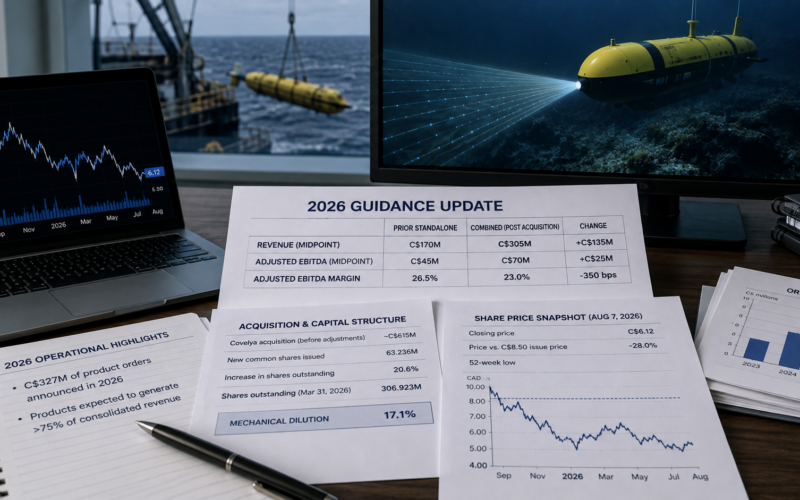
Kraken Robotics Inc. (TSXV: PNG) raised the midpoint of its 2026 revenue guidance by C$135 million after completing the approximately C$615 million acquisition of Covelya Group Limited, before closing adjustments, but the midpoint adjusted EBITDA margin fell by approximately 350 basis points from the company’s previous standalone outlook.
The earlier guidance implied C$170 million of revenue and C$45 million of adjusted EBITDA at the midpoint, producing a 26.5% margin. The combined guidance implies C$305 million of revenue and C$70 million of adjusted EBITDA, equivalent to 23.0%. The transaction has therefore bought substantial scale, but the first forecast for the enlarged group carries a lower implied adjusted EBITDA margin than Kraken Robotics’ former standalone target.
Shareholders also paid through the capital structure. The acquisition financing created 63.236 million new common shares, equivalent to a 20.6% increase against the 306.923 million shares outstanding at March 31, 2026. On that mechanical comparison, a shareholder who did not add to their position experienced at least 17.1% proportional dilution.
Kraken Robotics shares closed August 7 at C$6.12, exactly 28.0% below the C$8.50 price used for both the subscription receipts and the seller’s consideration shares. The stock remained above its 52-week low, but the discount indicates that investors want evidence that acquired revenue can become per-share earnings.
Kraken Robotics has operational support for its case. The combined company announced C$327 million of product orders during 2026, and management expects products to generate more than 75% of consolidated revenue. However, announced orders are not the same as backlog scheduled for 2026, leaving timing, margin conversion and integration execution as the variables that will decide whether the transaction creates value.
Why did the Covelya acquisition reduce Kraken Robotics’ 2026 adjusted EBITDA margin midpoint?
Before closing the acquisition, Kraken Robotics guided to 2026 revenue of C$165 million to C$175 million and adjusted EBITDA of C$40 million to C$50 million. The post-acquisition forecast raised those ranges to C$290 million to C$320 million and C$65 million to C$75 million. At the midpoints, the revenue target increased 79.4% and the adjusted EBITDA target rose 55.6%, causing the implied margin to decline from 26.5% to 23.0%.
The mechanical difference between the two guidance midpoints is C$135 million of revenue and C$25 million of adjusted EBITDA. That incremental guidance carries an 18.5% margin. It should not be treated as a clean forecast for Covelya alone because the revised group outlook may incorporate foreign exchange assumptions, transaction timing, integration effects and changes elsewhere in the business. It nevertheless identifies the central issue: the first combined forecast adds more scale than near-term margin.
That result looks conservative beside Covelya’s preliminary 2025 estimates of C$249 million to C$275 million of revenue and C$60 million to C$67 million of adjusted EBITDA. The midpoints imply a 24.2% margin before targeted synergies.
Kraken Robotics has not explained why the partial-year guidance increment implies 18.5%, rather than something closer to Covelya’s estimated historical margin. Seasonality, the July 2 closing date and revenue mix may explain part of the difference. The first combined results must separate those effects before the lower margin can be judged.

How much dilution did Kraken Robotics accept to finance the C$615 million transaction?
The approximately C$615 million purchase price before closing adjustments comprised approximately C$480 million of cash and C$135 million of shares, or 78.0% cash and 22.0% equity. Dilution exceeded the seller shares alone because Kraken Robotics raised most of the cash through subscription receipts that converted into common shares at closing.
The company issued 47,353,550 subscription receipts at C$8.50 each for gross proceeds of approximately C$402.5 million. It separately issued 15,882,352 consideration shares to the seller at the same deemed price. Together, those two components produced 63,235,902 acquisition-related shares.
Against the exact March 31 share count of 306,922,785, those shares represent a 20.6% increase. Dividing the new shares by the resulting 370,158,687-share base produces 17.1% passive-holder dilution. Option exercises between the reporting date and completion mean the company’s July presentation showed approximately 370.9 million basic shares and 385.1 million on a fully diluted basis.
Kraken Robotics also drew a new C$125 million secured term facility in full and increased its revolving facility from C$35 million to C$60 million through March 2031. Management described post-closing net debt as minimal, but the final balance sheet and interest expense await combined financial statements.
The seller received approximately 4% of the enlarged basic share base, with one-third of those shares scheduled to be released from lock-up after 12, 18 and 24 months. That arrangement creates some alignment with future performance while delaying, rather than eliminating, potential selling pressure.
Do C$327 million of announced product orders protect Kraken Robotics’ 2026 guidance?
Kraken Robotics and Covelya had announced C$327 million of combined product orders during 2026 by July 20. That amount equals 107.2% of the C$305 million midpoint of combined revenue guidance and appears, at first glance, to provide strong coverage.
The comparison measures demand, not revenue coverage. The company called the figure product orders announced during the year, not backlog scheduled entirely for 2026. Defence and offshore-energy programmes can extend across several years, with revenue dependent on manufacturing, acceptance and delivery schedules.
The latest C$35 million orders covered navigation, positioning, monitoring and sonar systems. The combined product portfolio is integrated, or being integrated, on more than 30 autonomous underwater vehicle platforms, widening the content Kraken Robotics can sell into each vehicle.
That breadth reduces product dependence but does not remove concentration risk. The company estimated that its ten largest customers represented approximately 50% of estimated combined 2025 revenue despite a base of more than 700 customers.
The economic test is whether selling more content into each platform raises gross profit faster than bid complexity, working capital and delivery risk.
Can Kraken Robotics’ second-half ramp bridge the gap left by a modest first quarter?
Kraken Robotics entered the transaction with strong product growth but a demanding second-half target. First-quarter revenue rose 35% to C$21.705 million, including a contribution from the 2025 acquisition of 3D at Depth. Product revenue increased 50%, while adjusted EBITDA grew only 7% to C$3.004 million and margin declined from 17% to 14%.
Gross margin fell from 63% to 56%, while C$2.798 million of acquisition and restructuring costs contributed to a C$3.326 million net loss. Adjusted net income was C$311,000, making the difference between adjusted and statutory performance material.
The first quarter supplied only 12.8% of the C$170 million midpoint of Kraken Robotics’ standalone revenue target and 6.7% of the C$45 million adjusted EBITDA midpoint. Reaching those standalone figures would require C$148.295 million of additional revenue and C$41.996 million of additional adjusted EBITDA over the final nine months.
Management expects second-half weighting, so a straight-line comparison would be misleading. Even so, the late-August second-quarter release must show whether manufacturing and purchase-order conversion accelerated before Covelya entered the accounts.
Kraken Robotics reported C$108.682 million of cash and C$394.528 million of subscription-receipt proceeds held in escrow at March 31. The escrowed amount was paired with an obligation and designated for the acquisition, not ordinary operating liquidity. Operating and investing activities used C$11.734 million combined during the quarter.
Combined capital-expenditure guidance increased from C$15 million to C$18 million before the deal to C$27 million to C$33 million after closing. The midpoint rose 81.8%, broadly in line with the expanded revenue base. Kraken Robotics’ new 60,000-square-foot battery facility provides additional capacity, but utilisation and production yield will determine whether that investment supports margins or adds under-absorbed fixed costs.
What does Kraken Robotics’ headline consideration imply before the planned synergies?
The approximately C$615 million headline purchase price before closing adjustments can be compared mechanically with Covelya’s preliminary estimated 2025 figures, provided their unaudited status is kept explicit. Using the revenue midpoint of C$262 million produces a consideration-to-revenue ratio of approximately 2.35 times. Using the C$63.5 million adjusted EBITDA midpoint produces a consideration-to-adjusted-EBITDA ratio of approximately 9.69 times.
Neither ratio is a transaction enterprise-value multiple because Kraken Robotics did not disclose Covelya’s acquired cash, debt or final closing adjustments in the announcement. The calculation is therefore useful only as a headline consideration comparison and should not be presented as price-to-sales or enterprise-value-to-adjusted-EBITDA.
Kraken Robotics targets C$10 million of cost synergies within 24 months through procurement, facilities, research and development, systems and administrative efficiencies. If the full target represents an annual run-rate, adding it mechanically to Covelya’s preliminary adjusted EBITDA midpoint lowers the consideration-to-adjusted-EBITDA ratio to approximately 8.37 times.
That synergy-adjusted figure is an unrealised scenario excluding integration costs, financing expense, purchase-price accounting and closing adjustments. The C$10 million target equals 15.7% of Covelya’s estimated adjusted EBITDA midpoint, making delivery economically meaningful.
Management expects low-to-mid double-digit earnings-per-share accretion in 2027 after synergies. That forecast cannot yet be tested against combined audited earnings. The first evidence will come from margin, interest expense and cash conversion, not revenue scale alone.
What does Kraken Robotics’ latest share price reveal about post-acquisition sentiment?
Kraken Robotics shares closed August 7 at C$6.12, up 1.0% in the session. The stock gained 5.3% across the five trading days from July 31 and rose approximately 1.2% from its July 8 close. It traded within a 52-week range of C$3.31 to C$10.72.
The latest price was 42.9% below the 52-week high but 84.9% above the low, pointing to mixed sentiment after an exceptionally volatile period. Investors still assign substantial value to the company’s position in subsea defence and offshore technology, but the market has not accepted the C$8.50 acquisition financing price as the present per-share value.
Using the approximately 370.9 million basic shares disclosed in July, the August 7 close implies a basic equity market capitalisation of about C$2.27 billion. The approximately 385.1 million fully diluted shares imply C$2.36 billion. The basic figure equals roughly 7.4 times the midpoint of 2026 revenue guidance.
That 7.4-times figure is a market-capitalisation comparison, not an enterprise-value-to-revenue multiple. A reliable enterprise value and enterprise-value-to-adjusted-EBITDA multiple cannot be calculated until Kraken Robotics discloses the post-closing cash, debt and other relevant balance-sheet items. Even with that limitation, the equity valuation shows that investors are already paying for significant execution. The valuation needs margin recovery, cash generation and contract conversion, rather than acquired growth masking weaker underlying delivery.
Why the first combined results must separate acquired scale from operating improvement
Kraken Robotics has transformed from a C$102 million annual-revenue company into a group targeting C$290 million to C$320 million in 2026 across subsea power, sonar, navigation, communications, imaging and software.
The headline consideration was below ten times Covelya’s estimated adjusted EBITDA midpoint, combined orders are strong and the target brought more than 50 years of operating history. That ratio is not an enterprise-value multiple, but the synergy target and seller equity provide additional routes to value creation.
The counterweight is visible in the same figures. The combined guidance margin is lower than Kraken Robotics’ prior standalone midpoint, the acquisition financing increased the share base by more than one-fifth against March 31, and the stock trades 28% below the issue price used to fund the transaction.
Late-August second-quarter results should establish whether Kraken Robotics’ standalone operation entered the acquisition with the required momentum. The November third-quarter report will be more decisive because it should include Covelya and provide the first consolidated evidence on revenue mix, gross margin, interest expense, working capital and integration costs.
The disclosure capable of changing the current interpretation is a complete bridge from standalone to combined performance. Investors need organic Kraken Robotics revenue, Covelya revenue after July 2, adjusted EBITDA by business, realised synergies, acquisition-related costs, net debt and an exact post-closing share count.
Until that bridge is available, the balanced conclusion is that Kraken Robotics has purchased a compelling strategic position at a potentially defensible headline consideration ratio, but has not yet demonstrated that the larger company will generate more value per share. The next phase is no longer about proving demand for subsea technology. It is about converting that demand into margins and cash quickly enough to overcome dilution and the market’s post-deal discount.
Discover more from Business-News-Today.com
Subscribe to get the latest posts sent to your email.