





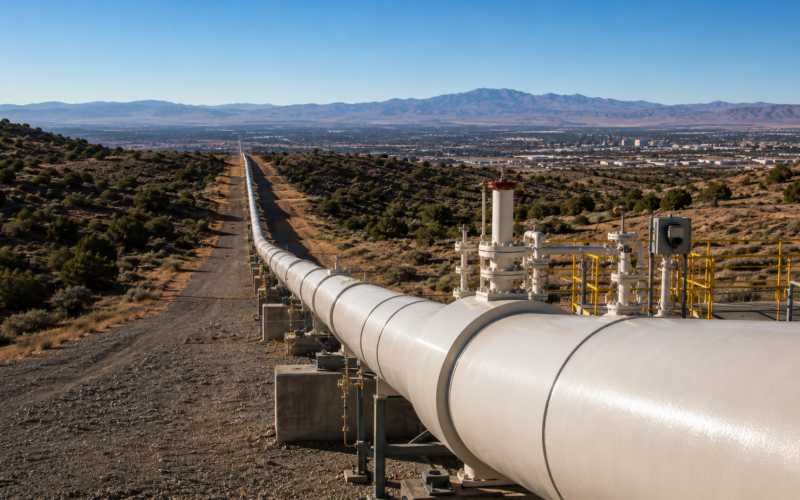
Phillips 66 (NYSE: PSX), Kinder Morgan (NYSE: KMI) and HF Sinclair Corporation (NYSE: DINO) have taken a final investment decision on the Western Gateway Pipeline system, a proposed 1,300-mile refined products network connecting St. Louis, Missouri, and Gulf Coast origin points to fast-growing markets in Arizona and California. The joint venture, structured with Phillips 66 holding 49.9%, Kinder Morgan 35.1% and HF Sinclair 15%, carries an enterprise value of approximately $5.0 billion and targets a 2029 in-service date, subject to permits and regulatory approvals. The decision converts an April 2026 open-season commitment into a fully sanctioned build, with primarily 10-year take-or-pay contracts underwriting the economics. It also arrives at a moment when California has lost roughly 290,000 barrels per day of in-state refining capacity through the closures of Phillips 66’s own Wilmington complex and Valero Energy’s Benicia refinery. The central tension for investors is whether a long-cycle, $5 billion capital commitment into refined-products logistics can generate compelling returns in a region where policymakers, electric-vehicle penetration and boutique fuel specifications are simultaneously reshaping demand.
How does the Western Gateway final investment decision change the West Coast fuel supply architecture over the rest of the decade?
The strategic logic of Western Gateway sits at the intersection of a supply shock and a structural realignment. California lost approximately 139,000 barrels per day when Phillips 66 ceased operations at its Wilmington refinery in the fourth quarter of 2025, and lost a further 145,000 barrels per day with Valero Energy Corporation’s decision to close its Benicia refinery in April 2026. Together, those two closures removed close to 18% of the state’s refining base within roughly six months. Arizona, which imports the majority of its transportation fuels, has been growing steadily on the back of population inflows, data-centre construction and industrial expansion. Western Gateway is calibrated for that combined gap. The system will move up to 230,000 barrels per day of refined products through approximately 900 miles of new-build pipeline from Borger, Texas, to Phoenix, Arizona, connecting to Kinder Morgan’s SFPP East Line, West Line and CALNEV Pipeline to reach Phoenix, Las Vegas and, via a planned reversal between Watson and Colton, Los Angeles.
For Phillips 66, the decision has a second layer of significance. The company is deliberately shifting from in-state California refining toward supplying California and Arizona from its Midwest and Gulf Coast refining base through owned pipeline capacity. That reshapes its exposure to California’s refining regulation, storage-inventory rules and refining-margin volatility while retaining participation in the downstream fuel supply chain.
Why does Phillips 66 shoulder the largest cash commitment while retaining construction and operating control?
The capital split is disciplined and revealing. Phillips 66 will make cash contributions of approximately $2.5 billion, HF Sinclair approximately $750 million, and Kinder Morgan approximately $250 million. Kinder Morgan will also contribute its existing SFPP East Line and West Line assets to the joint venture upon completion of the new-build pipeline at an assessed value of approximately $1.5 billion, which is what allows Kinder Morgan’s cash contribution to be materially lower than Phillips 66’s while still supporting 35.1% ownership. Phillips 66 will construct and operate the new-build pipeline, giving it operational leverage over cost, schedule and long-term throughput management.
The logic is consistent with Phillips 66’s stated capital allocation direction. The company reported second-quarter 2026 net income of $3.85 billion and continues to run its refining fleet in the mid-90% utilisation range, generating cash that management has been directing toward debt reduction, buybacks and selective midstream growth. Western Gateway, funded gradually through the construction phase to 2029, is an investment in captive downstream logistics for its remaining refining system rather than a bet on a new commodity or unproven technology. The trade-off is that $2.5 billion of cash outflow over roughly three years is a material call on capital at a company where investors have rewarded balance-sheet repair and shareholder returns; management will need to demonstrate that the incremental EBITDA contribution justifies the deferred deployment.

What role do the 10-year take-or-pay contracts play in reducing execution risk for the joint venture?
The Western Gateway economics rest on primarily 10-year take-or-pay contracts, which are the key de-risking element of the FID. Take-or-pay commitments oblige shippers to pay a minimum tariff whether or not they physically move the contracted volume, insulating the joint venture from short-term demand swings and providing lenders and equity holders with predictable cash flow through the contracted period. The first open season in 2025 did not secure enough commitments to sanction the project; the second open season, which closed in March 2026, delivered the missing volumes and produced access to the Los Angeles market via the reversal of the SFPP line between Watson and Colton, California. That combination of expanded destinations and new origin points was what made the FID possible.
For investors, take-or-pay contracts do not eliminate risk. They shift it. Counterparty credit quality becomes the operative question, particularly over a 10-year horizon in which the composition of the West Coast refining base, boutique gasoline specifications and electric-vehicle penetration will all continue to move. The joint venture partners are also the natural counterparties for a large share of the flows, which delivers alignment of interest but concentrates the risk pool.
How does Kinder Morgan’s existing SFPP asset contribution change the effective capital efficiency of the deal?
Kinder Morgan’s contribution is structurally different from those of its partners. Rather than write a large cash cheque, Kinder Morgan will contribute the SFPP East Line and West Line assets, which today move refined products from Texas and New Mexico into Arizona and California, at an assessed value of approximately $1.5 billion. That transaction crystallises value that has sat inside Kinder Morgan’s Products Pipelines segment for years and repositions those assets as part of a larger integrated corridor rather than as standalone regulated pipelines. Kinder Morgan’s incremental cash outlay of approximately $250 million is limited relative to its 35.1% ownership stake because of the asset contribution.
For Kinder Morgan shareholders, the arrangement is a capital-efficient way to expand exposure to a growth pipeline while continuing to earn returns on legacy assets that are being redeployed rather than sold outright. Kinder Morgan raised its full-year 2026 guidance following record second-quarter results, and the Western Gateway structure supports its stated preference for growing through partnership and utilisation of existing infrastructure. The main uncertainty is regulatory: the reversal of the Watson-to-Colton line and the recharacterisation of SFPP assets as joint-venture property may require Federal Energy Regulatory Commission approvals, and the tariff structure will need to align with the joint venture’s economics.
What execution, permitting and policy risks could delay the 2029 completion target?
Any 900-mile new-build pipeline across Texas, New Mexico and Arizona faces layered permitting exposure. The project will require federal, state, tribal and local approvals covering rights-of-way, environmental review, water crossings, cultural resources and, in parts of the route, engagement with sensitive land users. Each of those workstreams introduces schedule risk. A 2029 target implies approximately three years to move from FID to full commercial operation, which is achievable but not generous for a project of this scale. Any material litigation or a prolonged federal review would compress the construction window.
Policy risk is a distinct variable. California’s regulatory posture toward refined-products logistics, its minimum-inventory framework for refined fuels, and the state’s continued push on low-carbon fuel standards are all factors that could reshape both counterparty demand and the political environment around the project. Arizona and New Mexico have their own political dynamics on interstate energy infrastructure. Federal permitting practice has also shifted noticeably in recent years, which cuts both ways depending on the administration in office during the peak construction period.
How does Western Gateway complement HF Sinclair’s mid-continent refining footprint and specialty-products strategy?
HF Sinclair’s 15% stake and approximately $750 million cash contribution are smaller in absolute terms but strategically significant. HF Sinclair operates refineries across Oklahoma, Kansas, New Mexico, Utah and Wyoming, and the proposed Western Gateway route runs alongside or near several of those facilities. Direct access to a large, contracted pipeline into Arizona and California gives HF Sinclair a durable outlet for mid-continent refining output at a moment when West Coast supply is structurally shorter. The company also markets Sinclair-branded fuels through a large retail dealer network, and secure downstream logistics into the West is consistent with defending that marketing franchise.
HF Sinclair reported adjusted second-quarter 2026 earnings per share of $5.31 against a consensus estimate of $4.46 and announced plans to explore a spin-off of its lubricants business by the second half of 2027. Committing $750 million of cash into a 2029 pipeline while simultaneously exploring a lubricants separation is a signal that management sees the refining and marketing platform as a long-cycle business worth reinforcing rather than harvesting. For DINO shareholders, the near-term test is whether operating cash flow can comfortably absorb both the Western Gateway commitments and the transaction-related costs of the proposed lubricants separation without pressuring the capital return programme.
What would strengthen and what could weaken the Western Gateway investment case?
What has improved with today’s decision is visibility. Two open seasons, contracted volumes, a defined ownership structure, a construction operator, an enterprise value and a target in-service year are now on record. That gives investors, counterparties and regulators a concrete framework to evaluate the project. What remains unresolved is the pace and outcome of the permitting workstreams across three states, the confirmation of shipper credit quality over the 10-year contract period, and the precise capital deployment schedule for Phillips 66’s $2.5 billion cash contribution. The next measurable proof point will be the receipt of major federal and state permits and the confirmation of a detailed construction schedule.
The investment thesis strengthens if the joint venture publishes contract-life EBITDA guidance, confirms permit milestones on schedule, and delivers first mechanical construction milestones during 2027. It weakens if permit timelines slip materially, if California’s regulatory environment sharpens against refined-products infrastructure, or if actual capital costs exceed the current $5.0 billion enterprise-value framework.
Key takeaways for investors following PSX, KMI and DINO after the Western Gateway FID
- Phillips 66, Kinder Morgan and HF Sinclair have sanctioned the 1,300-mile, 230,000 barrels per day Western Gateway Pipeline at an approximately $5.0 billion enterprise value.
- Ownership is split 49.9% Phillips 66, 35.1% Kinder Morgan and 15% HF Sinclair, with Phillips 66 constructing and operating the new-build segment.
- Cash contributions total approximately $3.5 billion, with Phillips 66 committing $2.5 billion, HF Sinclair $750 million and Kinder Morgan $250 million.
- Kinder Morgan will contribute its existing SFPP East Line and West Line assets to the joint venture upon completion at an assessed value of approximately $1.5 billion.
- Primarily 10-year take-or-pay contracts underpin the economics, shifting risk from throughput volatility to counterparty credit quality.
- The system is designed to help refill roughly 290,000 barrels per day of California refining capacity lost through the Phillips 66 Wilmington and Valero Benicia closures.
- Access to Los Angeles is planned through a reversal of the SFPP line between Watson and Colton, California, adding tariff optionality but also incremental regulatory workload.
- The 2029 target date depends on federal, state, tribal and local permits across Texas, New Mexico, Arizona and California.
- For Phillips 66, the project signals a strategic pivot from in-state California refining to remote refining supported by owned pipeline capacity.
- The next measurable catalysts are federal and state permit milestones, published contract-life EBITDA guidance and confirmation of a detailed construction schedule.
Discover more from Business-News-Today.com
Subscribe to get the latest posts sent to your email.

