




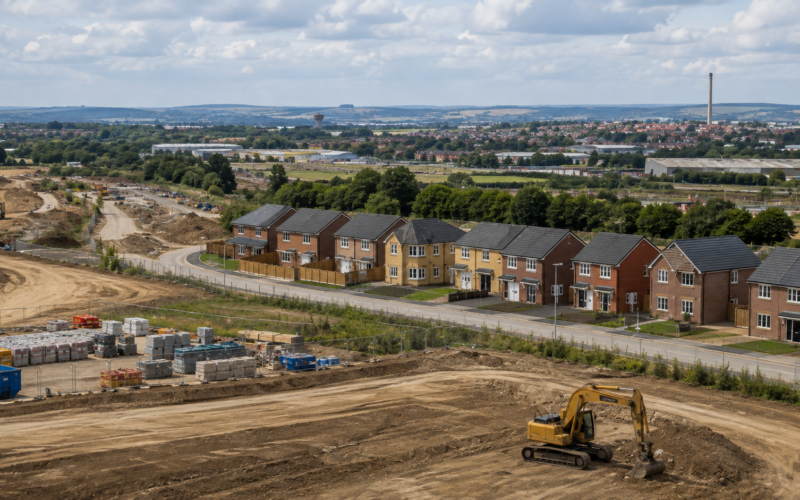
The board of Harworth Group plc (LSE: HWG), the Rotherham-based regeneration and strategic land developer, on Friday unanimously rejected an unsolicited 172.5 pence per share cash offer from Peel Pepper (UK) Limited, a bidding vehicle indirectly wholly owned by Peel Holdings Group Limited, the private property group majority-controlled by Manchester businessman John Whittaker. The Rule 2.7 firm offer, announced on Thursday, 6 August 2026, values Harworth’s entire issued and to-be-issued share capital at approximately £582.88 million, or roughly $787 million at prevailing exchange rates, and represents a premium of 36.0 per cent to Harworth’s three-month volume-weighted average share price and 20.1 per cent to the 143.6p closing price on 5 August 2026. Harworth’s board, advised by Barclays and Peel Hunt as joint financial advisers and corporate brokers and Allen Overy Shearman Sterling LLP as legal adviser, said it had no substantive engagement with Peel Pepper or Peel Holdings before the offer was announced, described the terms as fundamentally undervaluing Harworth and its near and longer-term prospects, and stated that the timing was designed to exploit a material dislocation between the share price and the value of the group’s underlying assets. The central tension is uncomfortable for both sides: Peel already controls approximately 29.96 per cent of Harworth through Goodweather Holdings Limited and needs acceptances covering just over 20 per cent of the register to cross the 50 per cent threshold, while shareholders are being asked to accept 172.5p for a business the company itself last reported as carrying an EPRA net disposal value of 224.4p per share at 31 December 2025.
What is Peel Pepper actually offering and how does the offer compare with Harworth’s last reported net asset value?
The offer from Peel Pepper is a Rule 2.7 firm cash proposal under the UK Takeover Code, conditional on acceptances covering more than 50 per cent of Harworth’s voting rights. Rothschild & Co, acting as financial adviser to Peel Pepper, confirmed that the maximum cash consideration of approximately £417.5 million required to acquire the shares not already controlled by the Peel group can be funded from Peel Pepper’s own cash resources. The 172.5p headline price sits well above where Harworth shares had been trading over the last three months but well below the group’s own most recently reported EPRA net disposal value of 224.4 pence per share, which underpinned a total EPRA NDV of £727.3 million at 31 December 2025. That gap, roughly 23 per cent between offer price and last reported NDV, is the numerical heart of the board’s rejection, and it is the reason why Harworth’s shares closed on Friday around 180p, above the offer price, as investors began pricing in either a higher revised bid or a competing approach.

Why did the Harworth board describe the timing of the Peel Pepper offer as opportunistic rather than fairly valued?
Harworth’s rejection statement is unusually direct for a UK takeover situation, describing the offer as opportunistically timed to take advantage of what the board characterised as a material dislocation between Harworth’s share price and the value of its underlying assets, driven predominantly by macroeconomic factors. In practice, that phrasing points to the broader UK real estate sector weakness that has weighed on listed property vehicles since 2023, with elevated gilt yields, cautious residential demand and slower institutional capital flows into UK property compressing quoted valuations across the sector. Harworth said it remains confident in its ability to deliver attractive long-term returns for shareholders and pointed to an average 8.1 per cent total accounting return over the past five years as evidence that the underlying business model has produced value even through a challenging cycle. The board also noted that its Tuesday trading update, delivered just two days before the Peel Pepper announcement, described strong momentum in the industrial and logistics pipeline and confirmed a second hyperscale data centre transaction was in advanced negotiations, meaning the bid arrived at a moment when management believed operational momentum was strengthening rather than fading.
What is the strategic significance of Harworth’s 15,000-acre land bank and 0.8 gigawatt powered land portfolio?
Harworth’s core commercial argument for standalone value rests on a portfolio of more than 15,000 acres of strategic land across approximately 100 sites in the North of England and the Midlands, with capacity to deliver in excess of 35 million square feet of industrial and logistics space and to enable around 29,000 homes over the longer development horizon. The most distinctive element of that land bank in the current cycle is its powered land component, with roughly 0.8 gigawatts of grid-connected or grid-enabled capacity, a scarce and increasingly valuable feature as UK data centre operators, battery storage developers and manufacturing occupiers compete for sites with committed power. Harworth has pointed specifically to embedded value in the powered land bank as still to be realised, a statement that carries additional weight against the backdrop of an advanced-stage second hyperscale data centre transaction confirmed in the Tuesday trading update. In an environment where powered industrial land in the UK is trading at a substantial premium to standard consented industrial sites, the board’s argument is that the Peel Pepper offer captures the current listed real estate discount but does not credit the medium-term optionality embedded in the power-enabled portion of the portfolio.
How has Peel Pepper framed its critique of Harworth’s cost base and cash flow trajectory?
Peel Pepper’s Thursday offer document set out a pointed critique of Harworth’s recent financial performance, and it is a critique that the Harworth board must answer publicly if it wants to hold the line on rejection. Peel Pepper pointed to Harworth’s 2025 administrative expenses of £36.34 million, which Peel said had risen 9.5 per cent year on year, and to net interest expenses of £10.6 million, which Peel calculated had jumped 58.2 per cent year on year, against investment portfolio rental income of £14.70 million that Peel said had declined by 7.0 per cent. On Peel’s arithmetic, the recurring rental income no longer covers the fixed cost base and financing charges, making the cash flow profile less sustainable and increasing the reliance on lumpy disposal proceeds. Peel Pepper also argued that Harworth’s direct development and hold strategy is capital-intensive, slow to deliver value and increasingly unable to generate appropriate risk-adjusted returns, and it questioned whether the group’s stated target of growing EPRA NDV toward a £1 billion valuation is realistically achievable, given the roughly 8 per cent per annum growth rate that goal implies. Peel Pepper further noted that Harworth has not raised new equity in nine years and expressed the view that Harworth could not raise new equity accretively today given its persistent discount to net asset value, a line of argument aimed squarely at the strategic rationale for remaining publicly listed.
Why does the concentrated Harworth shareholder register and the 29.96 per cent Peel Group holding shape the takeover outcome?
The mechanics of the acceptance condition explain why Peel Pepper felt able to launch a hostile Rule 2.7 offer without a recommended path. Goodweather Holdings, the Peel Group subsidiary that already holds approximately 29.96 per cent of Harworth’s shares, sits just below the 30 per cent Takeover Code threshold that would otherwise trigger a mandatory offer, and the Rule 2.7 announcement effectively converts the standing minority position into a launching platform for control. Peel Pepper requires acceptances covering more than 50 per cent of Harworth’s voting rights, which given the existing 29.96 per cent stake means only around 20 to 21 per cent of the remaining register needs to accept. Harworth itself has acknowledged in past disclosure that its shareholder register is concentrated, and Peel Pepper argued in its offer document that the concentration limits share liquidity and constrains growth. That concentration cuts both ways in practice, since a small number of institutional decisions will effectively determine whether the offer succeeds, fails or is forced to be raised, and it also means that even a modestly higher revised offer could unlock the acceptance level Peel Pepper requires.
How does the Peel Pepper plan for significant headcount reduction and delisting affect the Harworth stakeholder case?
Peel Pepper’s offer document made clear that if the offer becomes or is declared unconditional, BidCo intends to review overlapping functions across the Harworth group, including senior management, corporate, operational, finance, human resources, compliance and other support functions. Peel Pepper said the preliminary assessment is that the acquisition would result in a significant headcount reduction and synergies from overlapping functions, together with the elimination of costs associated with Harworth’s status as a listed company. Peel Pepper also stated that Harworth’s headquarters, governance structure and senior management team would be under review, and confirmed the intention to delist Harworth from the London Stock Exchange following any successful acquisition. For the Harworth board, that framing turns a valuation debate into a broader stakeholder and stewardship question, since Harworth is one of Yorkshire’s most recognised regeneration businesses, is headquartered at the Advanced Manufacturing Park in Rotherham, and has positioned itself as a long-term partner to local authorities and communities across the former coalfield areas of the North and Midlands. The workforce and community angle gives the board additional non-price arguments to deploy in its formal circular response.
What does the 172.5p offer imply for Harworth’s shift from residential land to industrial and logistics?
The Peel Pepper offer arrives at a strategic inflection point for Harworth. The group has already been accelerating a shift away from residential land toward industrial and logistics and powered land as the residential development market has softened under the weight of higher mortgage rates and slower housebuilder demand, and it has stated a target of moving toward roughly 85 per cent industrial and logistics portfolio composition by the end of its current strategic plan. Harworth’s 2025 full-year results, disclosed in March 2026, showed pre-tax profits of £17.4 million against £69.4 million a year earlier, an 8.4 per cent total property return that the group said outperformed the MSCI UK benchmark, a net loan-to-value ratio of 15.6 per cent that sits below the 20 per cent internal ceiling, and an 11th consecutive annual dividend increase. Under the standalone case, the argument is that the industrial and logistics rotation, the two hyperscale data centre transactions in the pipeline and the recently signed £275 million revolving credit facility give Harworth the financial flexibility to deliver on its NDV growth ambition through the next cycle. Under the Peel Pepper case, the same portfolio would be reshaped more aggressively, with a stronger emphasis on strategic land activities and selective development and a lower cost base as a private company.
Why does the Harworth share price trading above the Peel Pepper offer price matter for the next stage of the takeover battle?
The clearest single market signal since the Peel Pepper announcement is that Harworth’s shares closed on Friday, 7 August 2026, at approximately 180.20p, about 4.5 per cent above the 172.5p headline offer, and briefly traded up to 181p during the session. That trading pattern is consistent with market participants pricing in either a higher revised offer from Peel Pepper, a competing approach from an alternative bidder, or an outcome in which Peel Pepper fails to secure the 50 per cent acceptance threshold and the standalone case reasserts itself. The market signal aligns with the analyst view captured in the pre-bid consensus, where the last widely published broker price target sat at approximately 210p, comfortably above both the offer and the current share price, although Harworth investors should be aware that broker consensus in an active bid situation can shift quickly. The half-year results scheduled for 15 September 2026 will be an important next data point, since they will confirm the H1 2026 EPRA net disposal value, which Harworth said in its Tuesday trading update is expected to be modestly below the £727.3 million and 224.4p per share reported at 31 December 2025, and they will give the board a formal platform to defend the standalone valuation case with hard numbers rather than qualitative rebuttal.
What should investors track as Harworth prepares its formal defence circular and the Peel Pepper offer document is posted?
The next stage of the timetable is governed by the UK Takeover Code, which requires Peel Pepper to post its formal offer document within 28 days of the Rule 2.7 announcement, and requires Harworth’s board to publish a formal defence circular in response. Investors should watch for the substance of the defence circular, in particular how the board addresses Peel Pepper’s cost and cash flow critique with segmental detail, the H1 2026 results on 15 September 2026 including the updated EPRA NDV, the number and identity of the counterparties on the second hyperscale data centre transaction confirmed as advanced, and the response of large institutional shareholders in the concentrated register. Investors should also watch for any indication of a revised offer from Peel Pepper, which after a Rule 2.7 firm offer would be constrained by no-increase statements or their absence, and for any sign of a competing approach from a private-market UK real estate investor with an interest in the powered industrial land theme. The board’s decision to reject unanimously without engagement means the takeover contest will now be fought in public through defence circulars, offer documents and shareholder consultations, and the substance of those documents rather than the initial 172.5p headline will determine whether Harworth remains a listed independent regeneration business or is delisted as part of the Peel Group.
What are the key numbers and forward catalysts investors should track as Harworth Group defends against the Peel Pepper 172.5p cash offer?
- Peel Pepper (UK) Limited, a subsidiary of Peel Holdings Group Limited, made a Rule 2.7 firm cash offer of 172.5p per share for Harworth Group plc on 6 August 2026, valuing the entire issued and to-be-issued share capital at approximately £582.88 million, or roughly $787 million equivalent.
- The offer represents a 36.0 per cent premium to Harworth’s three-month volume-weighted average share price and a 20.1 per cent premium to the 143.6p closing price on 5 August 2026, but is priced at approximately 76.9 per cent of the last reported EPRA net disposal value of 224.4p per share, a discount that sits at the heart of the board’s rejection.
- The Peel group already controls approximately 29.96 per cent of Harworth through Goodweather Holdings Limited, meaning Peel Pepper needs acceptances covering just over 20 per cent of the remaining register to cross the 50 per cent voting rights threshold, and Rothschild & Co has confirmed the maximum cash consideration of approximately £417.5 million is funded from Peel Pepper’s own resources.
- Harworth’s board, advised by Barclays and Peel Hunt as joint financial advisers and corporate brokers and Allen Overy Shearman Sterling LLP as legal adviser, unanimously rejected the offer on 7 August 2026, describing it as fundamentally undervaluing Harworth and opportunistically timed to exploit a macroeconomic dislocation between share price and underlying asset value.
- Peel Pepper’s critique of Harworth focused on 2025 administrative expenses of £36.34 million up 9.5 per cent year on year, net interest expenses of £10.6 million up 58.2 per cent, and a 7.0 per cent decline in investment portfolio rental income to £14.70 million, arguing that recurring rental income no longer covers the fixed cost base and that the £1 billion NDV target is highly unlikely to be achieved.
- Peel Pepper has stated the acquisition is expected to result in a significant headcount reduction, a review of Harworth’s headquarters, governance and senior management team, and a delisting from the London Stock Exchange, adding a stakeholder and community dimension to the valuation debate.
- Harworth’s shares closed on Friday, 7 August 2026, at approximately 180.20p, roughly 4.5 per cent above the 172.5p headline offer, signalling that the market is pricing in either a higher revised offer, a competing approach, or a failure of the offer to reach the 50 per cent acceptance threshold.
- Harworth’s standalone case rests on a 15,000-plus-acre land bank across the North of England and the Midlands, capacity for more than 35 million square feet of industrial and logistics space and around 29,000 homes, and a 0.8 gigawatt powered land component that Harworth has flagged as carrying embedded value still to be realised, particularly relevant to the second hyperscale data centre transaction confirmed as advanced in the Tuesday trading update.
- Harworth’s half-year results on 15 September 2026 will confirm the H1 2026 EPRA net disposal value, which management has said is expected to be modestly below the 31 December 2025 level of £727.3 million or 224.4p per share, and will provide the board with a formal platform to defend the standalone valuation case against Peel Pepper’s cash flow critique.
- The next measurable proof points are the posting of the Peel Pepper offer document within the 28-day Takeover Code deadline, the Harworth board’s formal defence circular, the H1 2026 results on 15 September 2026, and the acceptance rate disclosed at the first closing date, with the concentrated shareholder register meaning a small number of institutional decisions will effectively determine whether Harworth remains listed and independent or is delisted as part of the Peel Group.
Discover more from Business-News-Today.com
Subscribe to get the latest posts sent to your email.

