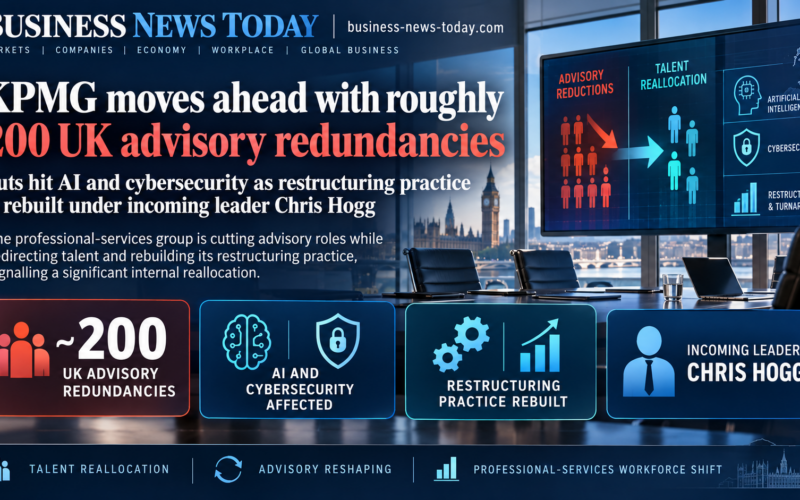
KPMG’s United Kingdom business is simultaneously shrinking parts of its advisory workforce and rebuilding a corporate restructuring capability it exited five years ago, providing an unusually clear picture of how professional-services firms are shifting people toward areas where demand is strongest. Approximately 200 UK advisory roles have been targeted for redundancy, while KPMG has now reportedly recruited Chris Hogg to lead its renewed turnaround and restructuring operation.
The workforce reductions affect parts of KPMG’s data and technology advisory organisation, with employees working in artificial intelligence, cybersecurity, SAP and testing among the teams reported to be exposed. The cuts represent around 4% of the advisory workforce and follow consultation that was due to culminate with affected employees receiving redundancy decisions on October 9.
Separately, The Times reported that KPMG has hired Hogg from Alvarez & Marsal to rebuild its restructuring and insolvency capability. Hogg is expected to join in November, five years after KPMG sold its former United Kingdom restructuring business to H.I.G. Capital in a deal reported at approximately £400 million.
Why is KPMG cutting technology consultants while hiring restructuring specialists?
The apparent contradiction is actually a useful illustration of how professional-services businesses manage capacity. They do not simply decide whether they need more or fewer people overall. They continually decide which skills clients are buying, where fees are strongest and where current staffing exceeds demand.
KPMG’s advisory business has been under pressure following the pandemic-era consulting boom. Advisory sales fell 3% in the financial year ended September 2025, while low employee attrition meant natural departures were not reducing headcount fast enough to match demand.
KPMG previously said evolving market conditions and low attrition had led it to propose reductions in some client-facing advisory teams so that its skills and capacity better matched customer requirements. The fact that artificial intelligence and cybersecurity employees are included is particularly notable because both fields are commonly described as major areas of corporate investment.
Demand for a broad category does not guarantee equal demand for every consulting service within that category. Clients may be bringing more technology expertise in-house, expecting smaller project teams, purchasing AI software instead of labour-intensive transformation programmes, or becoming more selective about discretionary consulting expenditure.
Restructuring advisory faces a different demand environment. Higher borrowing costs, weak corporate balance sheets in parts of the economy and continuing insolvency activity create work for advisers specialising in turnarounds, refinancing and distressed businesses. KPMG can therefore reduce one pool of employees while hiring specialised professionals elsewhere without the strategies necessarily conflicting.
What is the significance of KPMG returning to restructuring after selling the business?
KPMG was historically a major participant in United Kingdom insolvency and restructuring work before selling the business in 2021. The divested operation became Interpath Advisory under H.I.G. Capital ownership, allowing KPMG to reduce potential conflicts between restructuring engagements and its large audit practice.
The return suggests KPMG now sees sufficient commercial opportunity to rebuild a presence in the market. The Times reported that a non-compete restriction preventing an earlier return had expired, opening the way for renewed recruitment.
Bringing in Chris Hogg signals that the move is more substantial than adding a handful of restructuring consultants to an existing practice. Hogg has worked at Alvarez & Marsal and previously spent years at FTI Consulting, giving him experience inside firms already competing aggressively for complex turnaround and restructuring assignments.
For KPMG, success will depend on building a team large enough to win major mandates without recreating the conflict-management problems that contributed to the earlier strategic exit. Professional-services firms now operate under intense scrutiny around audit independence, so the structure of the rebuilt practice will matter almost as much as its revenue potential.
Why are the latest KPMG job cuts attracting unusual attention?
Part of the attention has resulted from the areas affected. Removing employees from AI and cyber teams challenges the simplistic assumption that every job attached to those labels is automatically protected by rising technology spending.
The Register also reported that employees facing redundancy were offered a £100 payment linked to post-termination obligations, with one source characterising the arrangement as requiring employees to waive rights to appeal or bring claims. KPMG did not answer the publication’s detailed questions about the payment, meaning the precise legal scope and practical effect of the arrangement should not be overstated.
KPMG’s public explanation has focused instead on matching skills with market demand and dealing with unusually low employee attrition. The firm has said it intends to support affected colleagues through the process.
The broader employment trend is clearer than any disputed detail around exit terms. KPMG’s United Kingdom workforce has declined from the higher staffing levels built during the pandemic-era professional-services boom, while earlier 2026 redundancy rounds have also affected audit and central corporate functions.
Is KPMG cutting employees because the firm is financially distressed?
No evidence suggests that the group is facing a conventional financial crisis. KPMG UK/Swiss Group reported £3.6 billion of revenue for the year ended September 2025, with overall sales up 2%.
Profit before tax climbed 14% to £576 million, while average distributable profit per partner increased 11% to approximately £880,000. KPMG explicitly attributed part of the profit improvement to careful cost management in response to the economic cycle.
Those numbers make the employment reductions more strategically interesting. Workforce actions are contributing to an effort to preserve profitability while consulting demand remains uneven, rather than serving as an emergency response to enterprise-wide losses.
They also illustrate a structural feature of partnership-based professional services. Employee headcount, partner economics and client demand are closely connected because people constitute one of the industry’s largest costs. If utilisation falls while employees remain because attrition is unusually low, management eventually faces pressure either to accept weaker margins or reduce capacity directly.
The improvement in partner profitability shows which side of that trade-off KPMG has been prioritising.
What does KPMG’s restructuring tell us about professional-services jobs in the AI era?
The biggest lesson may be that skills shortages and redundancies can coexist inside exactly the same company. KPMG can reduce positions associated with artificial intelligence while continuing to invest heavily in AI tools, train other employees to use them and recruit people with different technology expertise.
That is because AI is not merely creating a new consulting product. It is also changing the economics of delivering consulting work. Teams may be able to perform research, analysis, documentation and testing with fewer junior hours, allowing firms to grow certain services without reproducing the employee pyramids used historically.
At the same time, restructuring advisory remains highly relationship-driven and dependent on experienced professionals capable of navigating lenders, boards, investors and distressed businesses. Demand for those skills may therefore rise even as more repeatable professional-services tasks become automated.
KPMG’s current workforce moves provide a useful preview of what corporate restructuring may look like across knowledge-intensive sectors. Employment may not simply decline in a straight line. Instead, companies will continually remove roles from slower, automated or overstaffed areas while aggressively hiring into the capabilities producing the strongest revenue opportunities.
For employees, that makes occupational labels less useful predictors of job security. Being attached to artificial intelligence does not guarantee protection, just as working in an older field such as corporate restructuring does not imply declining demand. What matters increasingly is whether a particular skill sits directly inside a service clients are prepared to buy profitably.
Discover more from Business-News-Today.com
Subscribe to get the latest posts sent to your email.