

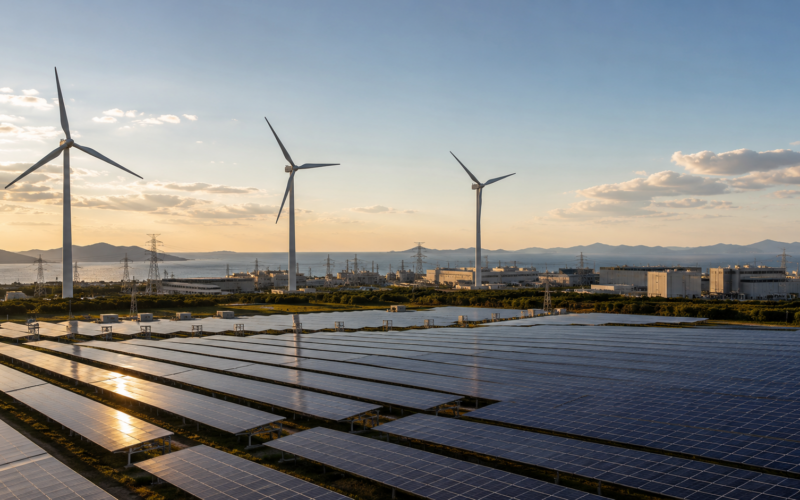
SK Inc. (KRX: 034730) and KKR & Co. Inc. (NYSE: KKR) have signed definitive agreements to create a KRW 2 trillion, approximately $1.3 billion, renewable energy platform by consolidating assets held across several SK Group businesses. The platform will begin with about 1.7 gigawatts of operating capacity across solar, onshore wind, offshore wind and fuel cells, alongside a development pipeline intended to lift total capacity to 10 gigawatts. KKR will hold initial management control, while SK Inc. will remain an equity investor and retain the possibility of negotiating control rights in the future. The transaction gives SK Inc. a way to reduce the capital burden of renewable expansion while giving KKR a scaled entry into South Korea’s growing industrial clean-power market.
The announcement is much more than a reshuffling of renewable assets between corporate entities. It brings together development, construction, operations and maintenance capabilities that were previously spread across SK Innovation, SK Ecoplant and SK Eternix. The commercial thesis rests on a simple but increasingly urgent assumption: South Korea’s artificial intelligence data centres, semiconductor plants and export-oriented manufacturers will require substantially more electricity, while major customers will face mounting pressure to secure lower-carbon power.
What does the SK Inc. and KKR platform change in South Korea’s renewable energy market?
The most immediate change is scale. South Korea’s renewable development market has historically been fragmented across utilities, conglomerate subsidiaries, specialist developers and project-specific investment vehicles. Combining 1.7 gigawatts of operating capacity with a pipeline reaching 10 gigawatts creates a platform large enough to compete for major corporate power contracts, financing packages and strategic development rights that may be difficult for smaller operators to secure independently.
Scale also improves portfolio diversification. Solar, onshore wind, offshore wind and fuel-cell projects have different construction schedules, generation profiles, permitting risks and cash-flow characteristics. A multi-technology portfolio can therefore reduce dependence on any single project category, although it cannot eliminate exposure to grid access, equipment costs or electricity-market regulation.
The integration may also strengthen negotiating power. A platform controlling development expertise, construction relationships and operating assets can approach lenders, equipment suppliers and corporate electricity buyers as a repeat customer rather than as a collection of isolated projects. That can improve financing terms and procurement discipline, particularly when projects are bundled or developed through long-term programmes.
However, calling the business South Korea’s largest renewable energy platform does not automatically make it the most profitable. The decisive variables will be the quality of the development pipeline, the proportion of capacity that already has permits and grid connections, the strength of power-purchase arrangements and the return thresholds imposed on new investment.
Why is KKR taking initial control while SK Inc. remains a strategic equity investor?
The control structure reflects the different priorities of the two partners. SK Inc. wants to preserve exposure to renewable energy growth while improving capital efficiency across a group that is simultaneously investing in semiconductors, artificial intelligence infrastructure, batteries, telecommunications and other capital-intensive businesses. KKR wants sufficient governance authority to allocate capital, consolidate operations and build the platform according to infrastructure-investment return targets.
Giving KKR initial management control can introduce sharper investment discipline. Renewable developers often accumulate large pipelines that appear impressive in headline capacity but contain projects at widely different stages of maturity. KKR will have an incentive to distinguish between projects that can generate risk-adjusted returns and projects that consume development capital without a credible path to construction.
For SK Inc., the structure converts a collection of dispersed assets into a financially visible platform without requiring SK Group to fund every expansion directly from affiliate balance sheets. The arrangement may free capital for other strategic priorities while retaining economic participation in renewable assets that could become more valuable as corporate clean-power demand increases.
SK Inc. has also preserved strategic optionality by retaining the flexibility to discuss future control rights. This suggests that the company does not view the transaction as a complete exit from renewable energy. Instead, SK Inc. appears to be using KKR’s capital and infrastructure expertise to build scale before deciding whether greater control would create sufficient value to justify additional investment.
The unresolved issue is how future control would be priced. If KKR successfully expands the platform and secures valuable contracts, any later increase in SK Inc.’s ownership or governance rights could be considerably more expensive. SK Inc. is therefore reducing near-term funding pressure but may eventually have to pay for the value created during KKR’s control period.
Can a 1.7 GW operating base realistically support the platform’s 10 GW ambition?
The gap between 1.7 gigawatts of operating capacity and a 10-gigawatt portfolio is the central execution challenge. The target implies adding or completing more than eight gigawatts of capacity, an expansion requiring substantial equity, project debt, permits, land, grid connections, construction resources and long-term electricity buyers.
Pipeline capacity should not be confused with commissioned capacity. Renewable projects can remain in development for years, particularly when offshore wind approvals, local opposition, environmental reviews or transmission constraints delay progress. A meaningful assessment of the 10-gigawatt target will require disclosure of how much capacity is operating, under construction, fully permitted, contracted, awaiting grid access or still at an early development stage.
The platform’s claim that 10 gigawatts could support 100 data centres rated at 100 megawatts each is arithmetically understandable, but nameplate capacity is not the same as continuous electricity supply. Solar and wind generation vary with weather conditions, meaning that reliable 24-hour supply will require storage, grid balancing, complementary generation technologies or contractual arrangements that combine renewable output with firm power.
Fuel cells could provide a more consistent generation profile, although their carbon intensity and eligibility within clean-energy procurement frameworks will depend on the fuel source and operating configuration. Energy storage will also become strategically important even though it was not highlighted as a core generation category in the main platform announcement.
The 10-gigawatt ambition is therefore credible as a portfolio-building objective, but it should not yet be treated as a guaranteed operating outcome. The platform must convert development rights into bankable projects and then convert construction capacity into contracted cash flow.
How could the integrated value chain improve renewable project economics for SK Inc. and KKR?
The platform combines development, construction, operations and maintenance capabilities within a single structure. This vertical integration can improve project economics by reducing coordination failures between developers, contractors and operators. Lessons from operating assets can also be fed back into engineering and procurement decisions for future projects.
Construction scale may support better equipment purchasing and contractor management. Large programmes can negotiate framework agreements for turbines, modules, electrical systems, foundations and maintenance services. These arrangements can reduce cost volatility, but they can also create concentration risk when a preferred supplier experiences delays or technical problems.
A larger operating portfolio can generate recurring cash flow that helps fund development expenditure. Operational projects typically offer more predictable revenue than early-stage developments, giving the platform a financial base from which to pursue growth. KKR may also recycle capital by selling minority stakes in mature projects while retaining management or operating exposure.
The integrated model could become particularly valuable when bidding for corporate power-purchase agreements. Large industrial buyers generally require credible delivery schedules, reliable generation data and confidence that the supplier can manage operational disruptions. A diversified platform may offer a more compelling proposition than a developer relying on a single solar or wind project.
There is nevertheless a risk that organisational integration becomes more complicated than expected. The assets originate from different SK Group businesses with separate management systems, project histories and commercial obligations. Standardising procurement, reporting, risk management and capital allocation will require careful execution, even when the businesses share a common corporate heritage.
Why are AI data centres and semiconductor plants reshaping Korea’s clean-power investment case?
Artificial intelligence is turning electricity availability into a strategic constraint rather than a routine operating expense. Data centres require large quantities of reliable power, while advanced semiconductor fabrication plants combine continuous production schedules with energy-intensive manufacturing processes. Both sectors also face pressure from customers and investors to reduce the carbon footprint of their supply chains.
South Korea is particularly exposed to this combination because semiconductors form a major part of its industrial base. Renewable power availability can therefore influence more than environmental targets. It can affect the competitiveness of manufacturing exports, the location of new computing infrastructure and the ability of Korean companies to satisfy international procurement requirements.
This creates an opportunity for the SK Inc. and KKR platform to move beyond selling electricity into offering structured energy solutions. Potential products could include long-term power contracts, renewable certificates, storage-backed supply arrangements and customised portfolios combining several generation technologies.
The demand story is attractive, but the quality of demand matters more than its headline size. Data-centre developers regularly announce projects before securing final customers, power connections or financing. Semiconductor expansion can also move in cycles, with capital expenditure rising and falling alongside memory prices, technology transitions and global trade conditions.
The platform must therefore avoid building speculative capacity solely around optimistic electricity-demand projections. The strongest projects will be those supported by creditworthy customers, enforceable contracts and realistic assumptions about connection timelines.
What regulatory, grid and financing risks could delay the SK and KKR expansion strategy?
Grid availability is likely to be one of the largest constraints. Renewable resources are often located far from the industrial facilities that consume the electricity, creating a need for new transmission infrastructure and regional network upgrades. A generation project with land and permits can still lose value if it cannot obtain a timely grid connection.
Permitting remains another major obstacle, particularly for offshore and onshore wind. Environmental reviews, fishing-industry concerns, local participation requirements and community opposition can extend development schedules. Consolidating assets into a larger platform does not make these issues disappear, although a well-capitalised operator may be better equipped to manage them.
Financing conditions will also influence the pace of construction. A KRW 2 trillion platform valuation does not indicate that sufficient capital has already been committed to build the full 10-gigawatt pipeline. Each project must still support acceptable returns after accounting for debt costs, equipment prices, construction risk and revenue assumptions.
Interest-rate volatility could narrow the difference between expected project returns and financing costs. Offshore wind is particularly vulnerable because it requires large upfront expenditure and long construction periods. Solar projects may be faster to build, but returns can be pressured by land costs, curtailment and competition for power contracts.
Policy stability will be equally important. Renewable investments depend on rules governing electricity sales, grid access, certificates and corporate procurement. Sudden changes to pricing mechanisms or development requirements could alter project economics after capital has already been deployed.
What does the stock-market response indicate for SK Inc., KKR and SK Eternix investors?
SK Inc. shares traded around KRW 752,000 during July 1, 2026, after closing at KRW 834,000 on June 30. Despite the sharp intraday pullback, the stock remained approximately 5.6% above its June 24 close and about 14.5% above its June 1 close. The shares were trading within a wide 52-week range of KRW 176,900 to KRW 883,000, indicating that broader SK Group catalysts and holding-company valuation expectations are producing considerably more volatility than the renewable transaction alone can explain.
For SK Inc. investors, the platform supports the company’s stated focus on capital efficiency and portfolio optimisation. The financial benefit will depend on the value of assets contributed, any cash proceeds, future capital commitments and whether the new platform can achieve higher valuations under KKR’s management. Those details remain more important than the headline capacity target.
KKR closed at $91.78 on June 30, up about 0.3% across five trading sessions but down approximately 4.3% from the end of May. The stock remained within a 52-week range of $82.67 to $153.87. The Korean platform is unlikely to change KKR’s near-term earnings outlook by itself, but it reinforces the company’s strategy of building infrastructure exposure around electrification, data-centre demand and industrial decarbonisation.
SK Eternix has shown the clearest transaction-linked market reaction. Its shares traded around KRW 57,100 on July 1, roughly 51% above the June 24 close and more than 42% above the end of May, although the stock remained below its KRW 69,300 52-week high. That performance shows that investors see potential value in consolidation, but it also raises the risk that significant execution success has already been anticipated in the valuation.
What happens next as SK Inc. and KKR move from consolidation to commercial scale?
The next phase must provide greater clarity on ownership, capital commitments and pipeline quality. Investors will need to know which assets are being transferred, how they are valued, what liabilities accompany them and how future development expenditure will be divided.
Commercial contracting will be the next major test. Announcing demand from artificial intelligence data centres and semiconductor plants is easier than securing long-term agreements with customers willing to support project financing. Contract duration, electricity pricing, credit quality and delivery obligations will determine whether the platform can generate infrastructure-style returns.
The partners must also establish measurable milestones for the 10-gigawatt pipeline. Capacity under construction and capacity backed by permits or power contracts will be more informative than a single aggregate development number. Regular disclosure could help investors distinguish genuine progress from changes in early-stage project inventories.
If the strategy succeeds, South Korea could gain a nationally significant independent renewable platform capable of serving industrial customers at scale. SK Inc. would demonstrate that portfolio rebalancing can preserve growth exposure without retaining full initial control, while KKR would deepen its position in Asian energy infrastructure.
If execution falls short, the structure could leave SK Inc. with a minority economic interest in a slow-moving development portfolio and KKR with capital tied up in projects facing permitting or grid delays. The transaction has created scale on paper. The harder work begins with turning that scale into dependable electricity and durable cash flow.
Key takeaways on what the SK Inc. and KKR renewable platform means for investors and Korea
- The KRW 2 trillion platform consolidates renewable assets that were previously dispersed across multiple SK Group businesses.
- KKR’s initial management control should strengthen capital discipline, but it reduces SK Inc.’s direct control during the platform’s early growth phase.
- SK Inc. retains renewable-energy exposure while reducing the pressure to finance the entire development pipeline through group balance sheets.
- The 1.7-gigawatt operating portfolio provides a meaningful base, but most of the proposed 10-gigawatt scale remains dependent on future execution.
- Ten gigawatts of nameplate renewable capacity cannot automatically provide ten gigawatts of continuous data-centre power without storage, firming and grid support.
- Artificial intelligence data centres and semiconductor manufacturing create a strong demand thesis, although actual value will depend on contracted and creditworthy buyers.
- Grid access, permits, financing costs and community acceptance could determine the pace of growth more than access to development capital.
- SK Inc.’s volatile share performance suggests investors are evaluating the transaction alongside wider holding-company and semiconductor-related catalysts.
- SK Eternix’s sharp rally indicates strong enthusiasm for consolidation, but it also raises the valuation risk if project conversions are delayed.
- The next valuation trigger will be disclosure of ownership economics, committed development capital, contracted customers and construction-ready capacity.
Discover more from Business-News-Today.com
Subscribe to get the latest posts sent to your email.