




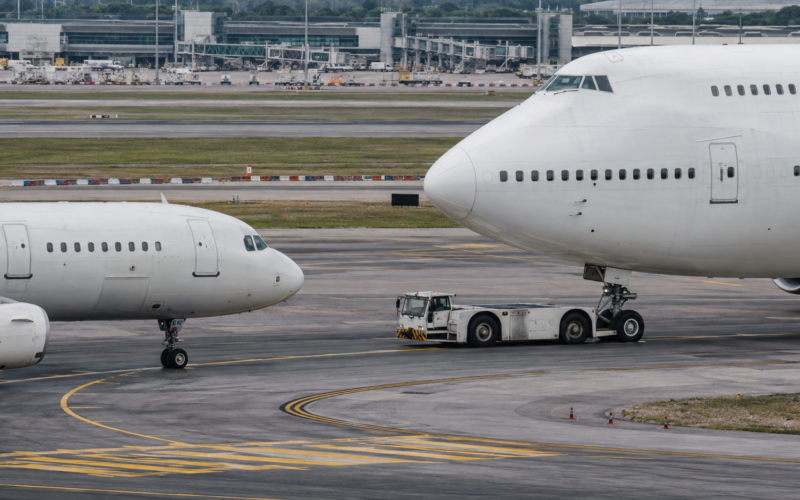
A Jetstar Airbus A320 and a Qatar Airways Boeing 777 narrowly avoided colliding on a taxiway at Sydney Airport on August 9, prompting a formal investigation into how two large passenger aircraft came into close proximity at Australia’s busiest aviation gateway. The Australian Transport Safety Bureau said the Jetstar aircraft was taxiing before a planned flight to Gold Coast Airport when its pilots observed the Qatar Airways Boeing 777 being towed across a nearby taxiway. Both aircraft stopped abruptly before contact occurred.
The sudden braking injured a cabin crew member aboard the Jetstar aircraft, while the connection between the Qatar Airways jet’s nose landing gear and its towing tug was damaged. No passenger injuries were reported, and there was no collision between the aircraft themselves. The Australian Transport Safety Bureau has begun collecting aircraft data, air traffic control information and airport surveillance footage while preparing to interview the flight crews, tug operators, controllers and other witnesses.
Jetstar said its aircraft had been following air traffic control instructions when its pilots were forced to brake firmly because another aircraft came into close proximity. Airservices Australia, which manages Australian air traffic, subsequently introduced departure-spacing measures at Sydney Airport to manage traffic safely while the incident was reviewed. The cause has not been established, and investigators have not attributed responsibility to either airline, the tug operator or air traffic control.
The timing has nevertheless increased scrutiny of Sydney Airport operations because widespread delays had occurred only a day earlier after Airservices Australia imposed similar traffic-flow restrictions while dealing with air traffic controller roster constraints. Those staffing issues provide important background but should not be treated as evidence explaining Sunday’s near collision unless the safety investigation establishes a connection.
What happened between the Jetstar Airbus A320 and Qatar Airways Boeing 777 at Sydney Airport?
The incident occurred on Sunday morning while the Jetstar Airbus A320 was taxiing towards departure for a domestic flight to the Gold Coast. At the same time, the Qatar Airways Boeing 777 was not taxiing under its own engine power but was being moved by an aircraft tug across a taxiway that intersected the Jetstar aircraft’s route.
According to the preliminary account provided to investigators, the Jetstar pilots observed the Qatar Airways aircraft extremely close on the crossing taxiway and stopped. The Qatar aircraft and tug also halted abruptly, preventing what could have become a ground collision between two large commercial jets.
The Australian Transport Safety Bureau has deliberately avoided making an early judgment about why the aircraft converged. Investigators will need to reconstruct the exact clearances and instructions issued to the aircraft and tug, establish their positions and speeds and determine what each crew understood at the time.
That distinction is important because airport-surface incidents can result from several interacting factors, including communications, misunderstood instructions, ground-vehicle movements, taxiway procedures and situational awareness. The investigation exists precisely to establish which of those factors, if any, contributed to the Sydney event rather than relying on assumptions formed from the initial reports.

Why is the damaged connection between the Boeing 777 and its tug relevant to the investigation?
The Qatar Airways Boeing 777 was being towed when the incident occurred, meaning ground-handling operations will form a central part of the investigation alongside conventional air traffic control procedures. The abrupt stop damaged the connection between the aircraft’s nose gear and the tug, demonstrating the force involved when the towing operation was halted.
Large passenger aircraft are routinely moved by specialised towing vehicles when repositioning between gates, maintenance areas and parking locations. Although the aircraft’s pilots may not be controlling the movement in the same way they would during powered taxiing, tug crews must still coordinate movements within an airport environment containing operating aircraft and other vehicles.
Investigators will therefore examine what instructions were issued for the tow, whether those instructions were correctly understood and how the Qatar Airways aircraft came to approach the Jetstar taxi route. The Australian Transport Safety Bureau has specifically said it will interview tug operators as well as air traffic controllers and flight crew, indicating that the investigation will encompass both airborne-operator and ground-handling procedures.
The damaged towing connection may also provide investigators with physical evidence about how abruptly the movement stopped. It does not, however, establish which party caused the aircraft to converge, and conclusions about responsibility would be premature until the regulator completes its evidence review.
Why was a Jetstar cabin crew member injured even though the aircraft did not collide?
The injury illustrates why aviation authorities treat near collisions seriously even when physical contact between aircraft is successfully avoided. A large passenger aircraft braking suddenly while taxiing can subject people inside the cabin to significant forces, particularly if crew members are standing, preparing the cabin or moving through an aisle.
The Australian Transport Safety Bureau has confirmed only that a cabin crew member was injured and has not publicly detailed the severity of the injury. Passengers were not reported injured, while the aircraft itself avoided collision damage associated with striking the Boeing 777.
That outcome demonstrates the value of the Jetstar flight crew detecting the hazard early enough to stop. Near-miss investigations are designed to understand why safety margins narrowed in the first place rather than treating the absence of a major accident as sufficient evidence that existing procedures worked perfectly.
Aviation safety systems depend heavily on examining precisely these events because they can reveal weak points before the same combination of circumstances results in a more serious outcome.
What will the Australian Transport Safety Bureau examine during its Sydney Airport investigation?
The Australian Transport Safety Bureau has outlined a broad evidence-gathering programme that should allow investigators to reconstruct the event in considerable detail. It plans to obtain available data from both aircraft and air traffic control systems while collecting relevant recorded information, including airport CCTV footage.
Investigators will interview the Jetstar flight crew, personnel associated with the Qatar Airways aircraft tow, air traffic controllers and other witnesses. The regulator has also publicly requested any available video showing the incident or its immediate aftermath, potentially adding passenger or airport-user footage to the official evidence.
The investigation will likely focus on the sequence of movement authorities and communications rather than simply the final physical proximity between the aircraft. Establishing when each party received clearance, how those instructions were interpreted and when the developing conflict became visible should help determine whether the event involved a procedural failure, a communication problem, a movement error or some combination of factors.
The bureau has said it will immediately inform relevant stakeholders if investigators identify a critical safety issue before the final report is completed. That means operational changes could be introduced before the entire investigation concludes if evidence reveals a risk requiring urgent action.
Are Sydney Airport’s air traffic controller staffing problems connected with the near collision?
There is currently no established causal connection, and that distinction needs to remain prominent until investigators provide evidence.
Sydney Airport experienced significant delays on the day before the near collision after Airservices Australia introduced departure-spacing measures because of air traffic controller roster constraints. Following Sunday’s incident, Airservices again used traffic-flow measures, this time to manage projected movements safely after the reported safety event.
The proximity of the two developments has understandably raised political and industry questions about staffing resilience at Australia’s busiest airport. New South Wales Premier Chris Minns expressed concern about both airport delays and the near-miss and argued that sufficient specialised personnel are essential because Sydney’s aviation system is economically important and will face additional demands as Western Sydney International Airport becomes part of the broader network.
However, a staffing shortage affecting traffic capacity is not automatically evidence that a controller error caused the Jetstar-Qatar incident. Airservices has declined to comment on the cause while the matter is under investigation, and the Australian Transport Safety Bureau has not identified controller staffing as a contributing factor.
The regulator’s eventual findings will therefore be important not only for determining what happened on the taxiway but also for separating legitimate systemic concerns from assumptions based on timing.
Why are taxiway near collisions taken so seriously at major international airports?
Airports operate through tightly coordinated movement systems in which aircraft can travel simultaneously on runways, taxiways, aprons and towing routes. A breakdown in separation on the ground can place very large aircraft within dangerous proximity even while their speeds are far lower than during flight.
The risks are amplified at complex international hubs because wide-body aircraft, domestic jets, ground vehicles and towing operations must move through intersecting areas according to precise clearances. A Boeing 777 is a substantially larger aircraft than an Airbus A320, and any ground collision involving major structural sections, engines, wings or fuel systems could generate significant damage and operational disruption.
Near collisions also provide information that cannot always be obtained through routine audits. Procedures may appear adequate on paper while real-world combinations of workload, communication, visibility and vehicle movement expose weaknesses that were not previously apparent.
That is why aviation regulators investigate serious incidents even when pilots or ground personnel successfully prevent an accident. The objective is to determine whether the final defensive action occurred because the system worked as intended or because an individual intervention compensated for an earlier failure.
Could the Sydney incident lead to changes in towing procedures or taxiway control?
Any procedural changes will depend on the Australian Transport Safety Bureau’s findings, but several areas could potentially come under examination if investigators identify weaknesses. These include towing clearances, communications between ground controllers and tug operators, visual monitoring of crossing taxiways and procedures governing the interaction of powered aircraft with aircraft under tow.
Airport operators and airlines can sometimes implement precautionary changes before a final report if emerging evidence indicates an obvious opportunity to increase safety. The Australian Transport Safety Bureau has explicitly said it will alert stakeholders immediately if it identifies a critical issue during the investigation.
The eventual outcome may also be narrower than sweeping airport reform. Investigations frequently determine that a specific sequence of misunderstandings or unusual circumstances created an event that can be addressed through targeted changes to procedures, training or communications.
What matters is that the near collision is investigated as a system event rather than reduced prematurely to the actions of one person. Aviation safety generally improves most effectively when investigators establish why a mistake or misunderstanding became possible and what barriers could prevent recurrence.
Why does the incident matter particularly at Sydney Airport as traffic demand continues rising?
Sydney Kingsford Smith Airport is Australia’s primary international gateway and one of the country’s most economically important pieces of transport infrastructure. Disruption there can propagate through domestic and international networks as aircraft, crews and passengers miss scheduled connections.
The latest incident occurred while the airport was already dealing with operational pressure from air traffic control roster constraints and associated departure spacing. Airservices said those measures were being used to safely manage projected airborne and departure demand, demonstrating how staffing and traffic-flow management can influence the amount of capacity available even without a safety incident.
Australia is also approaching a significant expansion of aviation capacity through Western Sydney International Airport. That increases the importance of recruiting, training and retaining enough specialised personnel across air traffic control and other safety-critical roles to support a larger metropolitan airport system.
The near collision therefore arrives during a wider debate about how Australian aviation infrastructure should prepare for future growth while maintaining safety margins. The investigation may ultimately conclude that Sunday’s event was unrelated to wider staffing pressures, but it has nevertheless intensified public attention on the resilience of the system.
What are the key takeaways from the Jetstar-Qatar Airways near collision at Sydney Airport?
- A Jetstar Airbus A320 taxiing for a flight to the Gold Coast came into close proximity with a Qatar Airways Boeing 777 being towed across a crossing taxiway at Sydney Airport on August 9. Both aircraft stopped abruptly before a collision occurred.
- A Jetstar cabin crew member was injured during the sudden stop, while the connection between the Qatar Airways Boeing 777’s nose gear and its towing tug was damaged.
- The Australian Transport Safety Bureau has opened a formal investigation and will collect aircraft data, air traffic control records and CCTV while interviewing flight crews, tug personnel, controllers and witnesses.
- Jetstar said its aircraft was following air traffic control instructions when its pilots were forced to brake firmly after the other aircraft came into close proximity.
- Airservices Australia introduced departure-spacing measures following the incident to safely manage traffic at Sydney Airport while the safety event was reviewed.
- Sydney Airport had experienced widespread delays the previous day because of air traffic controller roster constraints, but investigators have not established that staffing problems contributed to the near collision.
- The Australian Transport Safety Bureau has said it will notify relevant organisations immediately if the investigation uncovers a critical safety issue requiring action before the final report is published.
Why the Sydney Airport investigation matters more than determining who braked first
The most important question raised by the Sydney Airport incident is not simply which aircraft moved into the other’s path. The value of the investigation will come from reconstructing how the airport’s layered safety system allowed a taxiing Airbus A320 and a towed Boeing 777 to reach a point where abrupt stopping was required to prevent contact.
Sunday’s outcome shows that at least one important safety barrier remained intact: the Jetstar pilots saw the developing conflict and stopped their aircraft. Yet aviation systems are deliberately designed with multiple layers because pilots should not routinely have to depend on last-moment visual detection to prevent ground collisions between large commercial aircraft.
The investigation must therefore determine what happened earlier in the sequence, including the movement instructions issued to the aircraft and tug, how those instructions were understood and whether all parties had adequate information about the other traffic. The presence of air traffic controller staffing pressures elsewhere in the weekend operation deserves examination as context, but treating staffing as the cause before evidence emerges would risk obscuring whatever actually happened.
Sydney Airport avoided a far more serious event on August 9, but the injured crew member and damaged towing equipment demonstrate that the episode was not inconsequential. If investigators can identify why the safety margins narrowed and translate those findings into effective operational changes, the near collision can serve the purpose aviation investigations are designed for: learning from an incident before a similar chain of events produces an accident.
Discover more from Business-News-Today.com
Subscribe to get the latest posts sent to your email.