
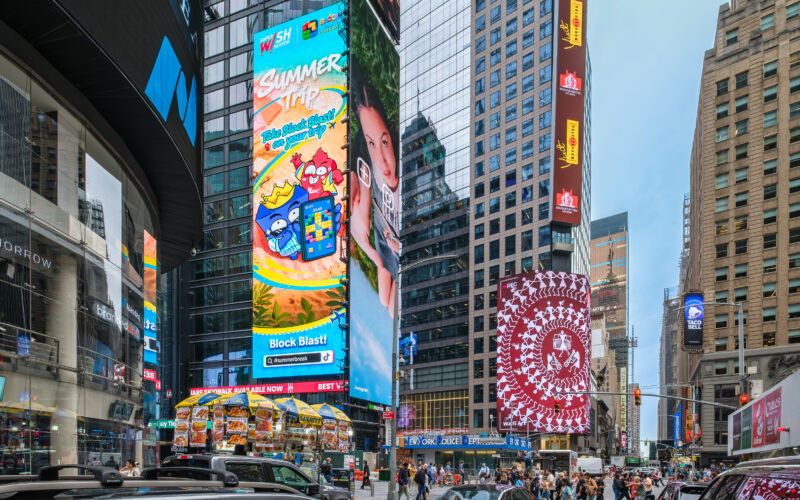
Hungry Studio has expanded Block Blast into U.S. summer travel and sports culture through a series of TikTok-linked visibility campaigns across major city locations. The mobile puzzle game has appeared around One Times Square, Broadway, Grand Central Terminal, New York subway placements and major Las Vegas areas, connecting digital gameplay with physical consumer moments. The move is strategically relevant because Hungry Studio is no longer relying only on app-store discovery or performance marketing to sustain Block Blast’s momentum. With Block Blast already operating at global scale, the bigger question is whether the company can convert casual download dominance into durable brand memory, repeat engagement and a stronger position in the U.S. mobile gaming market.
Why is Hungry Studio taking Block Blast into U.S. travel, sports and city-life moments?
Hungry Studio’s latest U.S. push shows a clear shift from pure user acquisition toward brand-led engagement. For a casual puzzle game, that matters because visibility in app stores can be powerful but fragile. Rankings change quickly, copycat titles crowd search results, and performance marketing costs can make growth expensive if retention does not keep pace. By placing Block Blast across high-footfall cultural locations and connecting the campaign with TikTok programs, Hungry Studio is trying to make the game feel familiar before a player even searches for it.
The choice of U.S. summer travel and sports moments is also commercially logical. Travel periods create fragmented downtime, and sports seasons create repeated social attention windows. Both settings fit the core use case of Block Blast, which is quick, low-pressure play that can be started and stopped easily. Hungry Studio is not trying to position Block Blast as a deep, console-like gaming experience. It is instead framing the title as a lightweight entertainment habit that fits waiting, commuting, watching, sharing and scrolling.
That is more important than it may look at first glance. Casual mobile games often win because they become default behaviours rather than planned entertainment choices. A player does not need to schedule Block Blast in the way they might schedule a console game or a multiplayer session. The strategic ambition is to own the five-minute gap. In mobile gaming, the five-minute gap can be a very large market if the product is sticky enough.
How does the TikTok connection strengthen Block Blast’s U.S. mobile gaming strategy?
The TikTok element gives Hungry Studio a bridge between offline visibility and social discovery. A Times Square or subway placement can create awareness, but TikTok can convert that awareness into repeatable online circulation. For a game such as Block Blast, where mechanics are visually simple and easy to understand, short-form video is a practical discovery channel. The gameplay does not require long explanation, which makes it easier to package into clips, challenges, casual demonstrations and creator-led posts.

This matters because casual gaming growth is increasingly shaped by attention loops rather than one-time app installs. A user may see the game in a public setting, encounter it again on TikTok, try it during a break and then re-enter through daily challenges or habit-based play. That loop is harder for competitors to copy than a single advertisement, although not impossible. The casual games market has never been shy about imitation. If there is a working format, a small army of clones usually arrives before anyone has finished saying “drag, match and clear.”
The risk is that broad visibility does not automatically translate into deeper monetization. U.S. players are valuable, but they are also overloaded with entertainment options. Hungry Studio will need to ensure that new awareness leads to sustained play frequency, not just curiosity downloads. In that sense, the U.S. activation is not merely a marketing campaign. It is a live test of whether Block Blast can move from viral utility to everyday entertainment identity.
What does Block Blast’s scale say about the changing economics of casual mobile games?
Block Blast’s reported scale gives Hungry Studio an unusual platform for a casual puzzle title. The game has been presented as having tens of millions of daily active users and hundreds of millions of monthly active users globally, while earlier industry coverage has linked its growth to heavy product experimentation and thousands of A/B tests. That suggests Hungry Studio’s advantage is not just the simplicity of the core mechanic. It is also the company’s ability to tune onboarding, progression, difficulty, rewards, ad exposure and session design at massive scale.
That distinction is critical in the current mobile market. Downloads are still important, but the stronger strategic battleground is now monetization, retention and lifetime value. Mobile gaming is maturing, and mature markets reward titles that can keep users active without making the experience feel exhausting. For Block Blast, the advantage is accessibility. The risk is fatigue. The same simplicity that helps the title reach a broad audience can become a weakness if players do not find enough variation or progression to keep returning.
Hungry Studio’s U.S. strategy appears to acknowledge that issue. Real-world activations and cultural positioning can help refresh perception around a simple game without changing the basic product too aggressively. That is useful because casual games must be careful with complexity. Add too much, and the title loses its low-friction charm. Add too little, and it becomes yesterday’s waiting-room distraction.
Why does the United States matter so much for Block Blast and Hungry Studio?
The United States is one of the most important markets for mobile entertainment because it combines high advertising value, strong consumer spending and dense cultural amplification. A game that becomes visible in the United States can benefit not only from direct player acquisition but also from global signaling. If a mobile title appears in New York, Las Vegas and TikTok-linked cultural moments, the message travels beyond those locations. For a company seeking to make Block Blast feel like a global casual gaming brand, that visibility carries symbolic weight.
The U.S. market is also difficult. User acquisition is expensive, competition is intense and consumer attention is split across games, streaming, sports, social media and creator platforms. A casual title cannot assume that download leadership will protect it forever. Hungry Studio therefore has to compete on habit, not just awareness. The company needs players to think of Block Blast when they have a few spare minutes, not only when an advertisement appears.
That makes the campaign more strategic than a standard outdoor-media burst. The goal is not simply to say that Block Blast exists. The goal is to associate Block Blast with everyday entertainment moments that already exist in the player’s routine. If Hungry Studio can make that association stick, the U.S. campaign could support higher retention, better brand recall and more efficient organic discovery over time.
What are the competitive risks for Block Blast as puzzle games fight for attention?
The most obvious competitive risk is replicability. Block puzzle mechanics are not hard for rivals to understand, and the mobile app ecosystem is full of titles that borrow, remix or closely resemble successful mechanics. Hungry Studio’s moat therefore cannot rely only on gameplay format. It has to come from scale, data, polish, player familiarity, brand recall and the speed at which the company improves the product.
Another risk is monetization pressure. Free mobile puzzle games often rely on advertising, in-app purchases or a blend of both. Push monetization too hard, and players complain or churn. Keep monetization too light, and scale may not translate into sufficient economic value. Hungry Studio’s challenge is to find a balance where Block Blast remains relaxing while still supporting a sustainable business model. That is a fine line, especially in casual games where users can leave with one tap and no guilt.
There is also platform dependency. TikTok, Apple App Store, Google Play and advertising networks can all influence reach, discovery and revenue performance. A campaign built around TikTok can be powerful, but it also sits inside a broader platform ecosystem that Hungry Studio does not control. That does not weaken the strategy, but it does mean the company needs multiple routes to audience attention rather than one dominant channel.
What happens next if Block Blast’s U.S. cultural strategy succeeds or fails?
If the U.S. strategy succeeds, Block Blast could gain a stronger position as one of the defining casual puzzle games of this cycle. The payoff would not simply be more downloads. The more valuable outcome would be improved retention, higher organic search volume, stronger creator-led visibility and a deeper association between the game and everyday mobile downtime. That would make future campaigns more efficient because brand familiarity reduces the burden on paid acquisition.
If the strategy underperforms, the lesson would be different but still useful. Hungry Studio would learn that physical visibility and TikTok-linked cultural placements may generate awareness without materially changing player behaviour. In that case, the company would need to lean harder into product-level retention, live operations, personalization and monetization testing. For a game at Block Blast’s scale, small changes in engagement can matter more than large bursts of visibility.
The broader industry implication is clear. Casual mobile games are no longer fighting only for installs. They are fighting to become habits, cultural cues and default boredom solutions. Hungry Studio’s U.S. campaign is a sign that the next phase of casual gaming competition may look less like traditional app marketing and more like consumer brand building. That is a bigger, tougher and potentially more rewarding game board.
Key takeaways on what Block Blast’s U.S. push means for Hungry Studio and mobile gaming
- Hungry Studio is using Block Blast’s U.S. summer and sports visibility to move beyond app-store discovery and build broader consumer familiarity around a casual mobile gaming habit.
- The TikTok collaboration matters because it connects physical city placements with online sharing loops, giving Block Blast a better chance of turning awareness into repeat discovery.
- The U.S. campaign fits Block Blast’s core use case because travel, commuting and sports-viewing moments all create short pockets of downtime suited to quick puzzle play.
- Block Blast’s reported global user scale gives Hungry Studio a major advantage, but the strategic challenge is now retention, monetization and brand durability rather than pure downloads.
- The casual puzzle category remains highly vulnerable to imitation, which means Hungry Studio must defend Block Blast through data-led product refinement and stronger brand recall.
- Monetization remains a delicate issue because casual players may tolerate ads or purchases only if the experience continues to feel low-pressure and rewarding.
- The U.S. market offers strong advertising and spending potential, but it also forces Hungry Studio to compete against a crowded entertainment landscape for tiny slices of attention.
- If the strategy works, Block Blast could become more than a download leader and strengthen its position as a default mobile downtime game for U.S. users.
- If the strategy fails, Hungry Studio may need to rely more heavily on product experimentation, live operations and personalization rather than broad cultural placements.
- The broader mobile gaming signal is that casual game publishers are increasingly behaving like consumer brands, not just app developers chasing install charts.
Discover more from Business-News-Today.com
Subscribe to get the latest posts sent to your email.