



Larsen & Toubro Limited, listed on the National Stock Exchange of India under the ticker LT, has strengthened its European renewable-energy pipeline through an offshore wind framework agreement with grid operator TenneT. However, the company has not officially described the latest agreement as a single ₹55,000 crore order, despite headlines circulating with that figure. Larsen & Toubro classified the framework as an “Ultra-Mega” order, which under its disclosure system means a value exceeding ₹15,000 crore. The strategic significance remains substantial because the arrangement covers multiple high-voltage transmission projects connecting North Sea wind generation with the Netherlands and Germany, but investors must distinguish the disclosed order range from an unsupported headline number.
Did Larsen & Toubro receive one ₹55,000 crore order under the latest TenneT agreement?
The available official disclosure does not support the conclusion that Larsen & Toubro has received a single order worth exactly ₹55,000 crore.
On July 28, 2026, Larsen & Toubro announced that it had concluded a Framework Cooperation Agreement with TenneT for the grid operator’s 2 gigawatt high-voltage direct current offshore wind programme. The agreement was secured through a consortium involving Larsen & Toubro and Hitachi Energy.
Larsen & Toubro classified the development as an “Ultra-Mega” order. According to the company’s own order-classification table, an ultra-mega order is valued at more than ₹15,000 crore. The disclosure did not provide a narrower value range, a fixed contract amount or a figure of ₹55,000 crore.
The distinction matters because a framework covering several projects is not necessarily equivalent to one fully executable contract with the entire value immediately secured, booked and available for revenue recognition. Individual projects may have separate notices to proceed, engineering milestones, delivery schedules, contractual conditions and revenue-recognition profiles.
The ₹55,000 crore figure has appeared previously in market coverage of Larsen & Toubro. In February 2024, one publication used the amount to describe the approximate cumulative value of multiple orders obtained across different businesses and geographies, rather than one individual contract. That older cumulative figure should not automatically be attached to the July 2026 TenneT announcement.
This does not make the new framework insignificant. An order category exceeding ₹15,000 crore is material even for a company of Larsen & Toubro’s size. The concern is editorial and financial precision. A ₹55,000 crore single order would imply a substantially larger immediate addition to the backlog than Larsen & Toubro has officially confirmed.

How does the TenneT offshore wind framework expand Larsen & Toubro’s European opportunity?
The framework places Larsen & Toubro within one of Europe’s largest coordinated offshore electricity-transmission programmes.
TenneT is developing standardised 2 gigawatt offshore grid connections to transport electricity generated in the Dutch and German sectors of the North Sea. These systems are designed to collect power from offshore wind farms, convert it for efficient long-distance transmission and deliver it to onshore electricity networks.
The Larsen & Toubro and Hitachi Energy consortium agreement covers, in principle, six projects as well as potential future opportunities under the wider TenneT programme. Four projects were specifically identified in the announcement.
The consortium will continue work on the IJmuiden Ver Alpha and Nederwiek 1 projects in the Netherlands. It will also commence work on Nederwiek 3 in the Netherlands and LanWin 5 in Germany. The four named projects represent an aggregate transmission capacity of 8 gigawatts operating at 525 kilovolts.
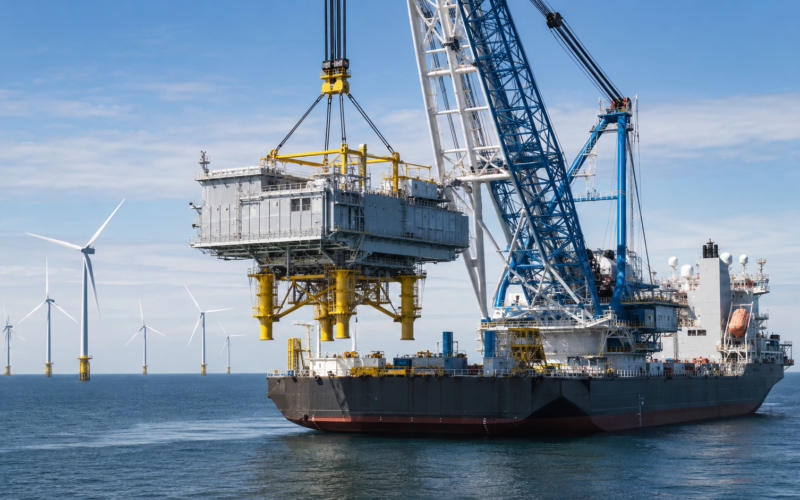
Larsen & Toubro will be responsible for offshore converter platforms and associated infrastructure under the engineering, procurement, construction and installation scope. Hitachi Energy will supply the high-voltage direct current conversion and transmission technology.
The division of responsibilities is strategically important. Larsen & Toubro is not merely supplying individual pieces of equipment. It is participating in the design, fabrication and delivery of enormous offshore platforms that serve as critical nodes between wind farms and national electricity systems.
That creates an opportunity to establish a reusable execution model. Once engineering standards, supply chains, fabrication processes and installation interfaces have been developed for the initial projects, the consortium may be able to apply those capabilities across later TenneT connections.
The framework can therefore offer more than one cycle of revenue. It may provide project visibility, engineering continuity and a reference base for competing in other European offshore transmission programmes.
Why does this ultra-mega order matter when Larsen & Toubro already has a ₹7.79 lakh crore backlog?
Larsen & Toubro entered the new financial year with substantial order visibility, but the composition of that backlog is as important as its size.
The company reported consolidated order inflow of approximately ₹1.08 lakh crore during the quarter ended June 30, 2026, representing year-on-year growth of 14%. International orders accounted for ₹60,702 crore, or 56% of quarterly intake.
The consolidated order book reached ₹7.79 lakh crore at the end of June, an increase of 5% from the preceding quarter. International projects represented 52% of the backlog. Revenue from operations increased by about 7% to ₹67,942 crore, while consolidated net profit rose by approximately 14% to ₹4,123 crore.
The TenneT framework reinforces several themes already visible in those numbers. Larsen & Toubro is becoming increasingly international, and its order pipeline is extending beyond the Middle East into Europe and other markets.
Geographical diversification is particularly relevant because the Middle East contributes nearly 29% of Larsen & Toubro’s revenue. Supply-chain disruption associated with geopolitical instability affected infrastructure execution during the June quarter, contributing to a 3% year-on-year decline in infrastructure revenue and pressure on profitability.
European offshore wind transmission provides a different demand driver. It is linked to grid investment, renewable-energy integration and long-term national infrastructure programmes rather than conventional oil and gas capital expenditure.
This does not eliminate geographical risk. European projects bring their own regulatory requirements, labour constraints, engineering standards, delivery risks and contractual liabilities. However, a broader geographic mix can reduce dependence on any one investment cycle.
There is also an important accounting question. The July 28 framework should not be mechanically added in full to the June 30 order book. Larsen & Toubro has not stated how much of the associated project value had already been recognised within first-quarter order inflow or how future framework opportunities will be booked.
Investors therefore need subsequent disclosures showing the value and timing of specific project conversions rather than treating the entire framework as newly secured incremental backlog.
What operational capabilities could help Larsen & Toubro execute the North Sea projects?
Offshore converter platforms are among the most complex structures in the energy-infrastructure market. They must support high-voltage electrical systems in harsh marine conditions while meeting demanding safety, reliability and maintenance requirements.
Larsen & Toubro plans to draw on engineering centres in India and Sharjah as well as its modular fabrication facilities at Kattupalli in Tamil Nadu. The company has presented this combination of engineering, procurement and fabrication capability as a foundation for executing large offshore structures.
Kattupalli can become strategically important if Larsen & Toubro uses the TenneT programme to develop a repeatable export-oriented production base for offshore wind infrastructure. Large converter platforms require extensive prefabrication, modular integration, testing and marine logistics before installation offshore.
Producing more of that value in India could give the company access to a competitive engineering and fabrication cost base. It could also deepen India’s participation in the global offshore wind supply chain, even while India’s domestic offshore wind market remains at an earlier stage.
However, the economic benefits will depend on execution discipline. Large engineering contracts can generate attractive revenue visibility, but they can also expose contractors to commodity-price fluctuations, supply-chain delays, design changes and liquidated damages.
Larsen & Toubro reported a consolidated earnings before interest, taxes, depreciation and amortisation margin of 9% for the June quarter, compared with 9.9% in the corresponding period a year earlier. Management attributed part of the pressure to volatile commodity prices and project-execution conditions.
The company has maintained its fiscal 2027 expectation of approximately 8.3% margins and growth of between 10% and 12% in both revenue and the order book. The TenneT projects can support that growth outlook, but their value to shareholders will depend on whether Larsen & Toubro can preserve margins while delivering technically demanding platforms on schedule.
Could the framework create opportunities beyond the four named offshore grid projects?
The most strategically interesting aspect of the announcement may be the framework structure rather than the minimum disclosed order category.
The agreement covers six projects in principle, while only four were named in the announcement. It also refers to potential future opportunities under TenneT’s programme. That language indicates the relationship could extend beyond the currently identified projects, although future awards should not be regarded as guaranteed.
TenneT’s standardised 2 gigawatt approach creates an industrial-scale procurement model for offshore transmission. Standardisation can lower design complexity, accelerate project development and allow contractors to apply lessons across multiple platforms.
For Larsen & Toubro, repeat awards could improve resource utilisation across engineering teams and fabrication facilities. They may also provide stronger purchasing leverage with suppliers and allow the company to spread development costs across several projects.
The reference value may be equally important. Successful delivery for TenneT and Hitachi Energy could help Larsen & Toubro qualify for additional offshore wind and high-voltage transmission opportunities in Europe.
Governments and grid operators are planning significant investment in electricity networks to integrate renewable generation, manage cross-border flows and replace ageing infrastructure. Competition will remain intense, especially from European, South Korean and Chinese engineering and fabrication groups. Nevertheless, proven execution on 2 gigawatt platforms would strengthen Larsen & Toubro’s credentials in a market with high technical barriers.
The framework also supports the company’s effort to balance conventional energy exposure with green-energy infrastructure. Conventional energy order inflow fell sharply during the June quarter because of project deferments and an unusually high comparison base, while Larsen & Toubro reported growth in green-energy ordering.
That shift does not mean conventional hydrocarbons are disappearing from the portfolio. It indicates that offshore engineering capabilities developed for oil and gas can increasingly be applied to wind-power and electricity-transmission infrastructure.
How did Larsen & Toubro shares respond to the order and first-quarter results?
Larsen & Toubro shares closed at ₹3,930.35 on the BSE on July 29, 2026, rising 2.55% during the session and outperforming the 1.16% gain in the BSE Sensex.
The closing price remained 11.48% below the stock’s 52-week high of ₹4,440, which was recorded on February 24, 2026. The rally followed Larsen & Toubro’s first-quarter results and the TenneT announcement, although the movement cannot be attributed exclusively to one development.
Before the post-results rally, Larsen & Toubro shares had declined more than 8% over the preceding month and approximately 7.5% during 2026. The weaker performance suggested that investors were balancing the company’s strong order pipeline against margin pressure, geopolitical disruption and uncertainty about the pace of infrastructure execution.
Broker reactions following the results were broadly constructive but not uniform. Goldman Sachs and Motilal Oswal retained positive recommendations, while Nuvama maintained a more cautious stance because of the possibility that Middle East-related disruption could keep first-half execution subdued.
Motilal Oswal raised its target price to ₹4,550, citing stronger-than-expected core engineering and construction order inflow. JM Financial retained a positive view with a ₹4,640 target, pointing to the backlog and the potential for execution to improve during the second half of fiscal 2027. These targets represent broker assessments rather than assured valuations.
The market reaction indicates renewed confidence in the earnings and order trajectory. However, a sustained rerating will probably require evidence that revenue growth is accelerating without another material decline in margins.
What will determine whether the TenneT framework creates lasting value for Larsen & Toubro?
The TenneT agreement improves Larsen & Toubro’s position in offshore wind transmission and strengthens the international composition of its order pipeline. It also creates an opportunity to convert Indian engineering and fabrication capabilities into export revenue from European energy infrastructure.
What remains unresolved is the precise contract value, the timing of project awards under the framework and the margin profile of the work. The official disclosure confirms only that the order falls above ₹15,000 crore under Larsen & Toubro’s classification system.
The next measurable proof points will be individual project orders, additions to the reported order book, progress at the Kattupalli fabrication facility and evidence of revenue conversion during fiscal 2027 and fiscal 2028.
The broader Larsen & Toubro investment case remains supported by a ₹7.79 lakh crore backlog and growing international exposure. The counterweight is that backlog size alone does not guarantee cash generation. Working-capital discipline, contractual risk management and margin protection will determine how much of the headline order momentum reaches earnings.
A ₹55,000 crore headline naturally attracts attention. The stronger analytical conclusion is less dramatic but more useful: Larsen & Toubro has obtained a material, multi-project European offshore wind framework worth more than ₹15,000 crore, and its ultimate value will be established through project conversion and profitable execution.
What are the key takeaways from Larsen & Toubro’s latest TenneT offshore wind agreement?
- Larsen & Toubro has not officially confirmed a single ₹55,000 crore order.
- The TenneT framework is classified as an ultra-mega order, meaning it exceeds ₹15,000 crore.
- The agreement covers six projects in principle and potential future opportunities.
- Four named projects represent a combined offshore transmission capacity of 8 gigawatts.
- Larsen & Toubro will execute converter platforms and related infrastructure.
- Hitachi Energy will supply the high-voltage direct current transmission technology.
- The framework expands Larsen & Toubro’s exposure to European renewable-energy infrastructure.
- Larsen & Toubro ended June 2026 with an order book of ₹7.79 lakh crore.
- Execution quality, margins and project conversion matter more than the unconfirmed headline figure.
- Specific project awards and profitable revenue recognition will be the next important evidence.
Discover more from Business-News-Today.com
Subscribe to get the latest posts sent to your email.