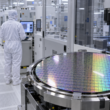





Intel Corporation (NASDAQ: INTC) and South Korea’s SK Hynix are exploring a manufacturing arrangement that could bring SK Hynix memory-chip production to the United States for the first time, potentially giving Intel a new route to improve utilization of its huge Ohio manufacturing investment. Reuters reported on September 16 that possible structures include SK Hynix leasing part of Intel’s planned Ohio semiconductor complex or participating in a venture involving Intel and major cloud companies seeking greater security of memory supply. SK Hynix stressed that no decision has been made, while Intel described the report as speculation and said it continues investing to prepare its Ohio site.
The discussions matter because they bring together two companies confronting different sides of the same artificial-intelligence infrastructure boom. SK Hynix is one of the most important suppliers of high-bandwidth memory used alongside advanced AI processors, while Intel has committed enormous capital to expanding US manufacturing but has repeatedly pushed back the timetable for its Ohio factories. A partnership could therefore combine scarce memory expertise with underutilized or delayed manufacturing infrastructure, although the technological, economic and political hurdles remain substantial.
Why would an Intel and SK Hynix manufacturing deal matter for US semiconductor capacity?
Intel announced in 2022 that it could ultimately invest as much as $100 billion in Ohio as part of an ambition to create one of the world’s largest semiconductor manufacturing complexes. Production was initially expected much earlier, but completion of the first two plants has since slipped to 2030 and 2031, increasing scrutiny of how quickly Intel can translate major capital commitments into commercially productive capacity. Bringing an external memory-chip producer into the site could therefore improve the economics of the Ohio build-out without requiring Intel itself to fill every fabrication line.
For SK Hynix, the logic runs in the opposite direction. The company already produces DRAM, NAND flash and high-bandwidth memory at scale in Asia, but customers and governments increasingly want critical semiconductor capacity located closer to major AI and cloud-computing markets. SK Group Chairman Chey Tae-won said in July that SK Hynix was facing substantial pressure from customers and governments to expand chip supply and had reason to consider a US factory.
The company already has a semiconductor packaging project under construction in Indiana, but wafer fabrication in the United States would represent a much larger industrial commitment. That distinction matters because advanced memory manufacturing requires expensive fabrication equipment, specialized materials, highly trained engineering teams and deep supplier networks that remain concentrated in Asia. A US production arrangement could strengthen geographic diversification, but it would also expose SK Hynix to structurally higher labor, construction and supply-chain costs.
Could artificial-intelligence demand make the higher US manufacturing cost worthwhile?
The commercial backdrop is unusually strong. Artificial-intelligence infrastructure spending has placed enormous pressure on supplies of advanced memory, especially high-bandwidth memory that sits close to GPUs and other accelerators inside AI systems. SK Hynix has emerged as a leading supplier in that market, giving the company leverage with hyperscale customers but also increasing expectations that it will expand capacity quickly enough to prevent memory from becoming a bottleneck in data-centre deployment.
Cloud companies have a direct interest in this equation because secure access to memory increasingly matters alongside access to Nvidia, Advanced Micro Devices and custom accelerator chips. Reuters reported that one possible structure under discussion could involve cloud companies participating alongside Intel and SK Hynix, which would effectively connect semiconductor manufacturing investment with long-term customer commitments. Such a structure could reduce some demand risk for a new US facility if customers were prepared to support capacity in return for assured supply.
That would also fit a broader change in semiconductor economics. The AI boom is encouraging customers to think beyond individual chips and toward complete computing systems in which networking, memory, processors, power and cooling all determine performance. Memory suppliers that can guarantee substantial capacity close to strategic customers could therefore gain a commercial advantage even when manufacturing costs are higher.
Why could South Korean approval become the biggest obstacle?
The principal complication is that advanced memory technology is considered strategically important in South Korea. Reuters reported that production involving high-bandwidth memory or even advanced DRAM could potentially trigger government scrutiny because those technologies may fall within South Korea’s framework for protecting national core technologies. The South Korean trade ministry said a company decision involving such technology would be subject to review under the Industrial Technology Protection Act.
That creates a delicate balancing act for SK Hynix. Washington has been pushing semiconductor manufacturers to expand domestic production, while Seoul wants to preserve South Korea’s technological leadership and encourage investment in its own semiconductor clusters. US Commerce Secretary Howard Lutnick has also threatened tariffs of as much as 100% on South Korean and Taiwanese semiconductor companies unless they increase US production, adding a trade-policy dimension to what would otherwise be a corporate investment decision.
The project could therefore become part of wider US-South Korean investment negotiations rather than a simple bilateral agreement between two chipmakers. South Korea previously committed hundreds of billions of dollars in investment linked to lower US tariffs, and the allocation of a substantial portion of that commitment remains unresolved. Semiconductor investment could become negotiating currency for both governments.
What does the share-price reaction say about investor expectations?
Intel shares rose 5.2% in US premarket trading after the talks were reported, while SK Hynix finished 4.1% higher in Seoul. The moves do not prove that investors expect a deal to happen, but they indicate that the possibility addresses identifiable concerns around both companies: utilization and financial pressure at Intel, and capacity expansion at SK Hynix.
For Intel, the reaction is particularly notable because bringing another major semiconductor manufacturer onto the Ohio site could alter perceptions of a project whose delays have become symbolic of the difficulty of rebuilding advanced chip manufacturing in the United States. A tenant, partner or joint venture could potentially share infrastructure costs and create a clearer path toward productive use of the site.
The most important next milestone is therefore not construction but structure. Investors need to see whether discussions progress from exploratory scenarios into a defined agreement covering technology, ownership, production type, customer commitments and regulatory approval. Until then, the talks are strategically significant but remain just that: talks.
Discover more from Business-News-Today.com
Subscribe to get the latest posts sent to your email.