

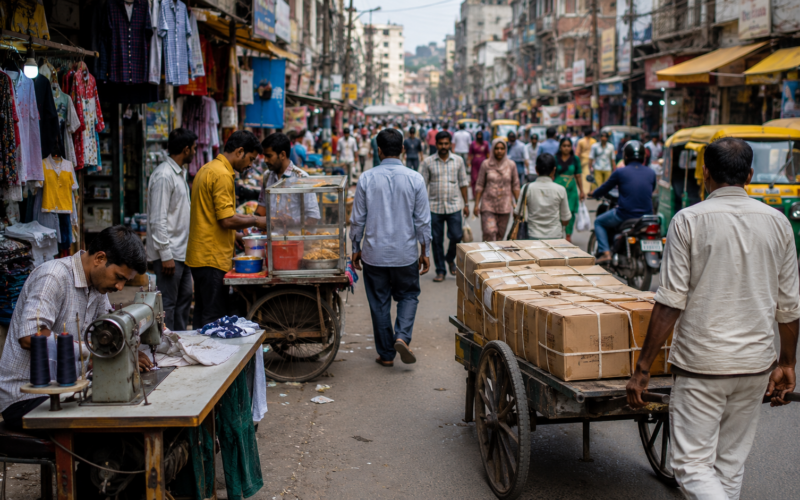
India’s vast unincorporated non-agricultural economy expanded significantly during April-June 2026, with the estimated number of establishments rising 9.2% year on year to 8.67 crore and employment increasing 6.55% to 13.70 crore, according to quarterly data released by the National Statistical Office on August 21.
The figures capture millions of small manufacturers, traders and service businesses operating outside the incorporated corporate sector and provide an important view of economic activity that conventional listed-company and organised-sector statistics cannot fully capture. Growth was notably stronger in urban India, where the number of establishments increased more than 15% and employment rose above 12% from a year earlier.
The data also reveal a more complicated labour-market picture beneath the headline expansion. Establishment numbers grew faster than employment, working owners increased their share of the workforce and the proportion represented by hired workers declined, suggesting much of the expansion continues to come from very small, owner-operated enterprises rather than businesses adding large payrolls.
How quickly did India’s unincorporated business sector grow in April-June 2026?
The estimated number of unincorporated non-agricultural establishments increased from 7.94 crore in April-June 2025 to 8.67 crore a year later, an increase of about 73 lakh establishments.
Employment rose from approximately 12.86 crore workers to 13.70 crore over the same period. Other services were a major contributor, with estimated employment in the segment increasing by more than 21% year on year.
These enterprises include unincorporated businesses engaged in manufacturing, trade and other services and cover proprietorships, partnerships other than limited liability partnerships, co-operatives, societies and trusts within the survey framework. The data do not represent the entire informal economy, nor should they be treated as a direct proxy for quarterly gross domestic product.
The distinction is relevant because the survey measures a particular segment of economic activity. Incorporated companies and several other activities sit outside its coverage, making the results valuable as a complementary indicator rather than an alternative national-output estimate.

Why is urban India accounting for so much of the latest growth?
Urban establishments expanded approximately 15.3% year on year, considerably faster than the roughly 3.9% growth recorded in rural areas. Urban employment increased just over 12%, while rural employment rose only around 0.7%.
The divergence suggests the strongest new-business formation and labour absorption during the quarter occurred in cities and towns. Services, retail activity, local logistics, digitally enabled businesses and small professional enterprises can all contribute to this pattern as urban consumption and commercial networks expand.
For policymakers, strong urban growth creates both an opportunity and an infrastructure requirement. A larger population of very small businesses increases demand for affordable commercial space, digital connectivity, payments infrastructure, working-capital credit, transport and reliable municipal services.
The weakness of rural employment growth requires a different interpretation. Rural establishment numbers still increased, but the comparatively small rise in workers indicates that business formation did not translate into equivalent employment expansion.
This urban-rural gap will be worth monitoring in subsequent quarters because a sustained divergence could reveal where India’s small-business economy is generating incremental employment and where enterprise growth remains predominantly self-employment.
Does a 9.2% increase in establishments mean India is creating more formal jobs?
Not necessarily. The workforce composition shows why the headline establishment figure requires qualification.
Working owners represented 62.38% of employment in April-June 2026, up from 60.18% a year earlier. The share of hired workers fell to 22.77% from 24.38%, while only 12.13% of establishments employed hired workers.
Those figures indicate that India’s unincorporated economy remains dominated by extremely small businesses in which owners themselves provide much of the labour. Creating hundreds of thousands or millions of additional owner-operated enterprises can strengthen livelihoods and entrepreneurship without producing the same labour-market effect as larger businesses recruiting multiple salaried employees.
This does not make the increase economically unimportant. Self-employment can represent genuine business creation, particularly in services and trade, but it means establishment growth and high-quality wage employment should not be treated as interchangeable indicators.
The April-June numbers consequently present a mixed but broadly constructive signal. More enterprises are operating and more people are working in the sector, yet the faster growth in establishments than employment suggests average enterprise size remains small.
How rapidly are India’s unincorporated businesses becoming digital?
Digital adoption is one of the more striking features of the latest survey. Around 82% of establishments reported using the internet for entrepreneurial purposes, while nearly 80% used cashless methods such as online banking, Unified Payments Interface, mobile wallets or point-of-sale systems.
The figures illustrate how India’s distinction between a digital business and a formally incorporated business is becoming increasingly blurred. A neighbourhood retailer, sole proprietor or home-based service provider may remain unincorporated while simultaneously using digital payments, online procurement, social media and internet-based customer acquisition.
Registration is also increasing. Approximately 42.5% of establishments reported registration under at least one Act or authority, more than seven percentage points higher than the comparable April-June 2025 level.
Digitalisation and formalisation should nevertheless be treated separately. Using Unified Payments Interface does not automatically mean a business has entered the corporate tax, labour or regulatory frameworks associated with larger organised enterprises.
What digital adoption does create is infrastructure through which businesses can build transaction histories. Over time, those records could improve access to formal credit, insurance and government schemes for enterprises that traditionally operated almost entirely in cash.
What does the rise in women’s participation reveal about India’s small-business economy?
Women accounted for more than 30% of total employment in the unincorporated sector during April-June, continuing an increase from the corresponding period of the previous year.
That is a meaningful labour-market indicator because the sector includes many forms of economic participation that may not appear prominently in corporate payroll statistics. Small manufacturing, local services, retail activities and household-linked enterprises can provide more flexible routes into paid or self-employed work.
However, the headline share does not on its own reveal the quality or remuneration of that employment. Some workers are owners, some are hired employees and others can include unpaid family workers, so participation should not automatically be equated with secure salaried employment.
The broader economic signal from the quarterly bulletin is therefore one of expansion accompanied by structural complexity. India’s unincorporated business universe is becoming larger, more urban and increasingly digital, but it remains overwhelmingly composed of small enterprises.
For the economy, the next test is whether this expanding business base can progress from owner-dependent microenterprises into firms capable of improving productivity, obtaining credit and hiring more workers. If that transition strengthens, the 8.67 crore establishment figure could represent not merely more businesses, but a deeper pipeline for future organised-sector growth.
Discover more from Business-News-Today.com
Subscribe to get the latest posts sent to your email.