


International Business Machines Corporation (NYSE: IBM) has expanded its IBM z17 and IBM LinuxONE 5 portfolios with new single-frame and rack-mounted configurations designed for enterprises facing rising data-center costs, limited physical capacity and increasingly complex artificial intelligence workloads. The systems provide up to 82 cores and 18 terabytes of memory while supporting on-chip artificial intelligence acceleration, confidential computing and post-quantum cryptography. The launch broadens IBM’s infrastructure strategy beyond the largest traditional mainframe installations by providing smaller and more flexible entry points for regulated businesses, research institutions and hybrid-cloud users. IBM shares traded near $311 during the July 7 session, approximately 10.6% above the June 30 close and less than 7% below their 52-week high.
Why is IBM introducing compact z17 and LinuxONE 5 systems at this point in the infrastructure cycle?
The product expansion addresses a practical constraint that has become increasingly important as enterprises add artificial intelligence, analytics and cybersecurity workloads to already crowded technology environments. Data-center capacity is becoming more expensive, while many organizations cannot easily build new facilities or secure additional power. International Business Machines Corporation is therefore attempting to make its highest-value infrastructure more compatible with the physical and economic realities facing customers.
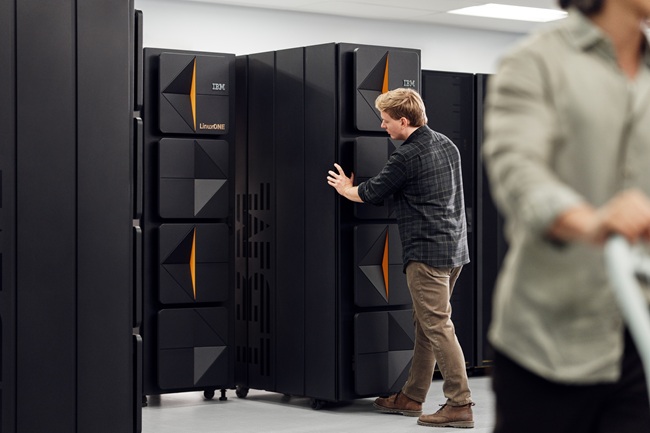
The rack-mounted format allows organizations to install IBM Z components inside industry-standard racks alongside non-IBM equipment. This can reduce the disruption associated with adopting a specialist infrastructure platform and make IBM systems easier to deploy inside colocation facilities or mixed-vendor data centers. Customers can add IBM computing capacity without redesigning an entire room around a proprietary frame.
The launch also signals that IBM sees an opportunity to expand the addressable market for mainframe-class infrastructure. The traditional perception of IBM Z is tied to extremely large banks, governments, insurers and transaction-processing environments. More compact configurations allow IBM to target organizations that need high levels of resilience and security but do not require the capacity or capital commitment of the largest multi-frame systems.
This is commercially important because hardware growth is often shaped by product cycles. International Business Machines Corporation needs new configurations, software tools and use cases that extend demand after the initial z17 launch wave. A broader product range can support additional orders between major refresh cycles while creating more opportunities to sell software, support and hybrid-cloud services.
How could rack-mounted IBM z17 systems change the economics of enterprise mainframe adoption?
The most significant commercial change is not simply that the system is smaller. It is that the infrastructure can fit more naturally into procurement, facilities and operating models built around standard racks. Enterprises that previously viewed a mainframe deployment as a specialized architectural decision may be more willing to consider IBM Z when it can be installed alongside storage, networking and distributed computing equipment.
The new IBM z17 configurations support up to 82 cores and 18 terabytes of memory across two processor drawers. IBM has reported approximately 20% more core capacity and 12% more memory than the comparable earlier configuration. The IBM z17 ME2 also provides greater throughput per core than the IBM z16 A02, which could allow customers to process more work without expanding the physical footprint proportionately.
These improvements may help IBM defend the economic case for consolidated computing. Many organizations have spent years distributing workloads across large numbers of servers and cloud instances, sometimes creating rising software licensing, networking and management costs. A high-density system can become attractive where workloads require constant availability, predictable latency and intensive transaction processing.
However, purchase price remains only one part of the decision. Customers must compare power consumption, software licensing, migration costs, specialist skills and long-term support against public cloud or distributed alternatives. IBM’s compact design improves the deployment argument, but the company must still prove that total cost of ownership is competitive for each workload rather than assuming that density alone will win the calculation.
Why are artificial intelligence inference and transaction processing central to IBM’s infrastructure strategy?
International Business Machines Corporation is positioning IBM z17 and IBM LinuxONE 5 as infrastructure for artificial intelligence that operates inside core business transactions. This is different from training enormous general-purpose models in graphics-processing-unit clusters. IBM is focusing on inference, where a trained model evaluates data and produces a prediction or decision while a business process is taking place.
The Telum II processor provides on-chip artificial intelligence acceleration, while IBM Spyre Accelerator cards can support generative artificial intelligence and multiple model architectures. This allows customers to evaluate risks, fraud indicators, customer behavior or operational conditions without continuously moving sensitive data to an external platform. Processing data close to the transaction can reduce latency and strengthen control over regulated information.
The strategy is particularly relevant to banking, insurance, healthcare, telecommunications and government workloads. These sectors need artificial intelligence, but they cannot always send confidential records to public model endpoints or accept unpredictable processing delays. IBM can argue that artificial intelligence should be embedded directly into the systems already processing the transaction rather than added as a separate external service.
The challenge is proving that customers need specialist infrastructure for these tasks. Graphics-processing-unit providers, public cloud companies and enterprise software vendors are all improving inference economics. IBM must demonstrate that integrated security, low latency, reliability and data locality justify the platform’s cost and operational complexity.
Can IBM LinuxONE 5 reach customers that would never have considered a traditional mainframe?
IBM LinuxONE provides IBM’s underlying mainframe architecture for Linux and open-source workloads. This positioning allows International Business Machines Corporation to pursue customers that want enterprise-grade security and resilience without operating traditional IBM z/OS applications. The Rockhopper 5 and LinuxONE 5 Express configurations could therefore become important tools for expanding the platform beyond IBM’s established mainframe customer base.
The compact 18U configuration is designed for organizations running a smaller set of workloads. This could include universities, healthcare providers, financial technology companies, regional banks, government departments and enterprises consolidating databases or containerized applications. Customers can begin with a smaller configuration and expand as processing requirements increase.
Red Hat OpenShift strengthens the hybrid-cloud proposition by allowing containerized applications to operate across IBM infrastructure and other environments. IBM can use LinuxONE to connect infrastructure sales with Red Hat subscriptions, automation software, consulting and application modernization. The value of each hardware deployment may therefore extend well beyond the initial system sale.
Market expansion will depend on channel reach and implementation simplicity. Organizations unfamiliar with IBM infrastructure may not have internal specialists or established procurement relationships. IBM must make acquisition, configuration and administration feel closer to mainstream Linux infrastructure while preserving the differentiation created by its architecture.
How could IBM’s new management and COBOL tools reduce the mainframe skills barrier?
One of the most persistent risks facing enterprise infrastructure is the availability of specialist employees. Many organizations depend on IBM Z and COBOL applications but struggle to recruit or retain professionals familiar with older operating practices. International Business Machines Corporation is responding by making the platform accessible through tools and workflows commonly used in modern infrastructure teams.
IBM Infrastructure Management for Z and LinuxONE introduces infrastructure-as-code capabilities and Terraform-based automation. Technology teams can use automated provisioning and configuration methods rather than relying entirely on platform-specific manual processes. A unified interface may also reduce operational complexity and allow a wider group of employees to manage routine infrastructure tasks.
IBM COBOL Elevate for z/OS is intended to optimize and modernize existing COBOL applications without forcing customers to rewrite entire systems. This is strategically important because full rewrites can be expensive, risky and disruptive. Many legacy applications contain decades of business rules that are poorly documented but remain essential to daily operations.
These tools protect IBM’s installed base by making existing workloads easier to maintain. They also create a bridge between older applications and newer artificial intelligence or hybrid-cloud services. The risk is that improved automation could reduce demand for some traditional services, although IBM may compensate by selling higher-value software, modernization work and platform expansion.
What do the new IBM systems mean for post-quantum security and regulated workloads?
Post-quantum cryptography is becoming a more immediate infrastructure consideration as governments, banks and critical-infrastructure operators prepare for future quantum computing risks. Information encrypted today could be collected and stored for later decryption, which means organizations with long-lived sensitive data cannot wait until a cryptographically relevant quantum computer arrives before beginning migration.
International Business Machines Corporation is making post-quantum cryptography standard across the new IBM z17 and LinuxONE Rockhopper 5 systems. The platform also includes confidential computing and enterprise secrets-management capabilities. This combination strengthens IBM’s proposition for organizations that need to secure data while it is stored, transmitted and processed.
IBM Crypto Discovery and Inventory is intended to give security teams a consolidated view of cryptographic assets across the enterprise. This matters because many organizations do not have a complete record of where older algorithms, certificates and encryption methods are embedded. Migration cannot be managed effectively until the exposure is identified.
Security could become a powerful reason to refresh infrastructure even when customers are not experiencing immediate capacity constraints. Regulatory expectations and internal risk policies may justify investment before older systems reach the end of their useful lives. IBM can therefore connect post-quantum readiness with hardware renewal, software sales and security consulting.
Could the compact z17 and LinuxONE launch extend IBM’s infrastructure revenue momentum?
International Business Machines Corporation reported first-quarter 2026 revenue of $15.9 billion, representing growth of 9% on a reported basis and 6% at constant currency. Infrastructure revenue increased 15% to $3.3 billion, while hybrid-infrastructure revenue rose 28%. IBM Z revenue grew 51%, reflecting strong demand following the z17 product cycle.
The new configurations could help extend this momentum by opening additional customer segments and supporting more deployment options. Rack-mounted and single-frame products can generate incremental orders from customers that do not require the largest configurations. They may also encourage existing customers to place IBM systems in additional locations, development environments or disaster-recovery sites.
Hardware revenue can create a broader economic multiplier. A system sale can generate operating-system, transaction-processing, security, automation, support and consulting revenue over several years. This makes the installed base strategically important even though software has become the larger and more closely watched part of IBM’s business.
Investors should nevertheless expect infrastructure results to remain cyclical. Strong IBM Z growth following a major launch creates difficult comparisons in future periods. The compact systems may smooth the cycle, but they are unlikely to remove it. The key question is whether International Business Machines Corporation can use each hardware refresh to expand recurring software revenue and improve customer retention.
How will IBM compete with cloud platforms and distributed server vendors for new workloads?
The competitive battle is broader than a traditional mainframe contest. Amazon Web Services, Microsoft Azure and Google Cloud provide flexible infrastructure with consumption-based pricing and extensive artificial intelligence services. Dell Technologies, Hewlett Packard Enterprise, Oracle Corporation and other vendors offer distributed systems that fit familiar enterprise architectures and procurement processes.
International Business Machines Corporation is unlikely to win by claiming every workload belongs on IBM Z or LinuxONE. Its stronger position is workload selection. High-volume transactions, regulated data, core databases, confidential computing and applications requiring exceptional availability may justify IBM infrastructure, while less-sensitive or highly variable workloads can remain in public or distributed environments.
The rack-mounted configuration supports this fit-for-purpose strategy because customers can colocate IBM and non-IBM technology. The physical design reflects the hybrid architecture IBM has promoted through Red Hat OpenShift. Rather than requiring customers to choose between a mainframe and the cloud, IBM is trying to make its systems one controlled component within a broader hybrid environment.
Execution will depend on integration and pricing transparency. Customers need clear evidence that applications can move data, invoke services and operate across environments without excessive complexity. IBM must also prevent software licensing from weakening the economic case created by greater density and automation.
What does IBM stock performance reveal about investor confidence in the infrastructure strategy?
IBM shares traded near $311 during the July 7 session, rising approximately 3.8% from the previous close. The stock was about 10.6% above the June 30 closing price of $281.21 and roughly 9.2% above the June 5 close of $284.84. The shares traded within a 52-week range of $212.34 to $332.46 and were approximately 6.5% below the record high.
The rally indicates stronger investor confidence in IBM’s combination of software, artificial intelligence, infrastructure and quantum-computing exposure. First-quarter revenue growth, strong IBM Z performance and expectations for improving software results have supported sentiment. The new infrastructure announcement adds another near-term product catalyst but is unlikely to be the primary reason for the broader valuation change.
Analyst sentiment is constructive but includes an important valuation warning. Recent bullish targets extend toward $330 and above, while broader consensus estimates cluster around the high $290s to low $300s. With IBM stock already near $311, investors are pricing in a meaningful degree of execution success.
The next major test will be whether earnings growth and free cash flow can keep pace with the higher valuation. Strong hardware demand must translate into durable software and support revenue rather than remain a temporary product-cycle benefit. Any slowdown in Red Hat, transaction-processing software or IBM Z orders could create volatility after the rapid share-price recovery.
What execution risks could limit the commercial impact of IBM’s compact infrastructure strategy?
The first risk is customer perception. Smaller configurations do not automatically make IBM Z a mainstream choice for organizations that associate mainframes with high costs and specialized operations. International Business Machines Corporation must simplify sales, pricing, deployment and administration enough to overcome that reputation.
The second risk is workload economics. Compact systems may save space, but customers will examine licensing, support and migration costs closely. IBM must provide credible total-cost comparisons and avoid complex commercial structures that make public cloud or standard servers appear easier to budget.
The third risk is talent availability. Automation and infrastructure-as-code can reduce the specialist burden, but organizations still require employees who understand mainframe architecture, LinuxONE, security and workload optimization. IBM and its partners will need to expand training and certification alongside the product rollout.
The fourth risk is product-cycle dependence. IBM Z revenue has already grown sharply, creating a demanding comparison base. New formats may extend demand, but a weaker refresh cycle could still affect Infrastructure segment growth.
The final risk is artificial intelligence positioning. IBM must show that on-chip inference and hybrid artificial intelligence deliver measurable business value. Customers will not purchase high-value infrastructure merely because artificial intelligence appears in the specification sheet. Transaction speed, fraud reduction, compliance, energy efficiency and operating-cost savings must support the investment case.
What are the key takeaways from IBM’s compact z17 and LinuxONE 5 expansion?
- IBM is expanding z17 and LinuxONE 5 beyond the largest traditional deployments through single-frame and rack-mounted configurations.
- Rack mounting allows IBM components to coexist with non-IBM equipment inside standard enterprise and colocation environments.
- The systems support up to 82 cores and 18 terabytes of memory while reducing the physical footprint required for high-value workloads.
- On-chip artificial intelligence inference strengthens IBM’s proposition for transaction processing, fraud detection and regulated data.
- LinuxONE 5 could attract organizations that need enterprise resilience but do not operate traditional z/OS applications.
- Terraform automation and simplified infrastructure management may reduce dependence on scarce mainframe specialists.
- COBOL modernization tools can protect IBM’s installed base while creating additional software and consulting opportunities.
- Post-quantum cryptography gives regulated customers another reason to consider an earlier infrastructure refresh.
- Strong IBM Z revenue growth supports the commercial timing, although hardware product cycles remain an investor risk.
- IBM stock’s proximity to its 52-week high means future gains will increasingly depend on earnings, recurring software revenue and execution.
Discover more from Business-News-Today.com
Subscribe to get the latest posts sent to your email.